
Obtaining Low Equity Loans
What if you could stop paying your landlord’s mortgage and move into your own place next month, even without a massive six-figure deposit tucked away? Many Kiwis feel stuck in the rent trap, fearing that a “no” from the big banks or confusing income caps will keep them from securing a 5 percent deposit home loan nz for years to come. It’s a common worry, but the path to your first home is often closer than it looks when you have a seasoned professional in your corner.
We know how frustrating it is to feel like you’re falling behind while trying to navigate complex banking criteria on your own. You’re about to discover exactly how to secure a home loan with just a 5% deposit and move into your first home sooner than you thought possible. We’ll break down the latest eligibility rules, explore how new builds can bypass traditional restrictions, and show you how professional advocacy can help you organise the paperwork to turn a complex process into a successful move.
Key Takeaways
- Learn why you don’t need a massive 20% deposit to get started and how a smaller entry point can get you into your home years earlier.
- Understand the specific income and eligibility criteria needed to qualify for a 5 percent deposit home loan nz through the First Home Loan scheme.
- Discover why choosing a new build property could be your fastest route to home ownership thanks to special exemptions on deposit requirements.
- Get practical tips on how to organise your bank statements and KiwiSaver details so the banks see you as a reliable, low-risk borrower.
- Find out how an expert negotiator with over 20 years of experience can help you find alternative paths when the big banks say no.
Breaking the 20% Rule: How a 5% Deposit Works in NZ
You’ve likely heard that 20% is the magic number for a house deposit. It’s often talked about as if it’s a law, but in reality, it’s just a standard guideline that banks prefer. For many first-time buyers, saving that much cash feels like trying to catch a moving train while you’re still standing on the platform. A 5 percent deposit home loan nz acts as a vital bridge, allowing you to cross over from renting to owning much sooner than you ever thought possible. By only requiring a small portion of the purchase price upfront, these loans help you bypass the years of extra saving that usually keep people stuck in the rent trap.
To understand why banks usually ask for more, we need to look at Loan-to-Value (LVR) restrictions. These are essentially rules that govern how much a bank can lend compared to the value of the property you’re buying. Usually, lenders want a 20% buffer to protect themselves if the market shifts. However, the government often steps in to help by underwriting these low-deposit loans. This means they provide a guarantee that reduces the risk for the bank. When the risk is lower, the bank feels much more comfortable saying “yes” to your application, even with a smaller deposit in your bank account.
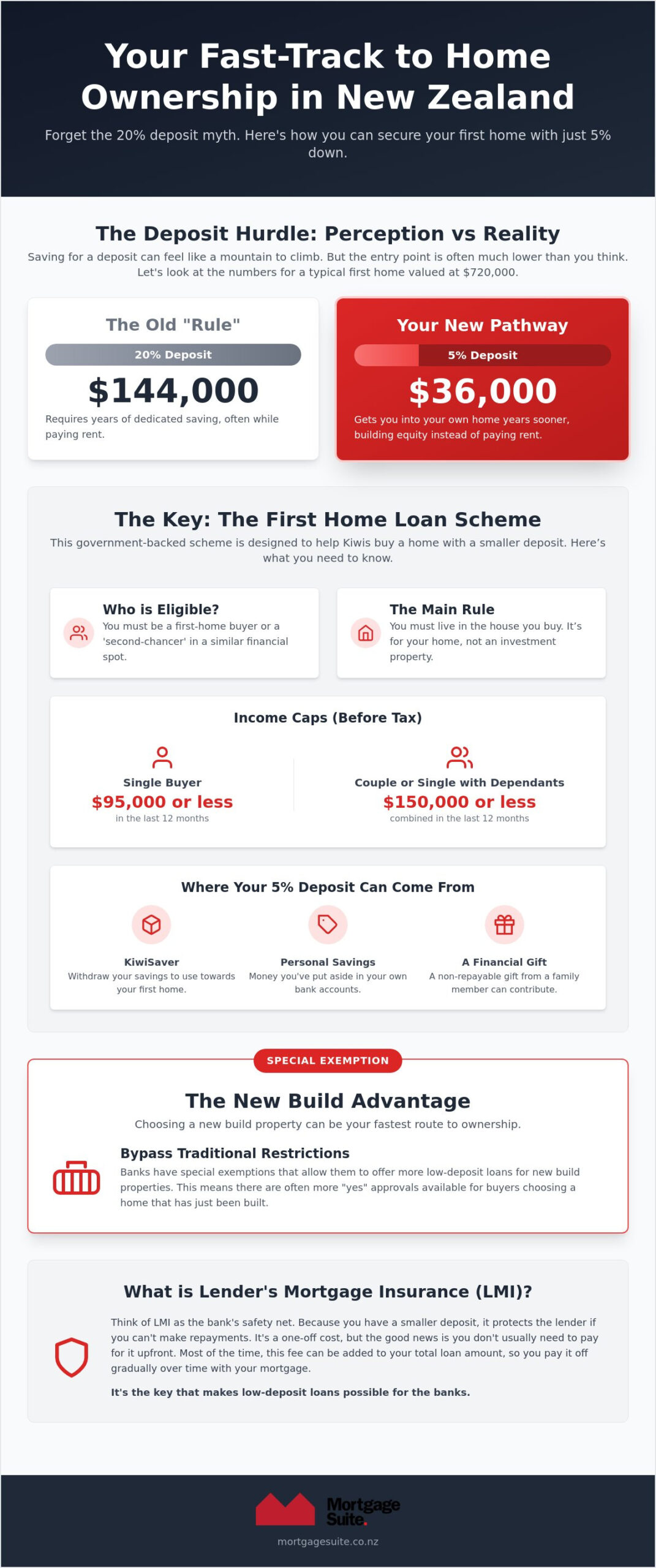
What is Lender’s Mortgage Insurance (LMI)?
LMI is essentially a bank safety fee. It’s a one-off cost that protects the lender in case you can’t keep up with your repayments; it doesn’t actually provide any cover for you as the borrower. While it might sound like an extra hurdle, it’s the price of admission for entering the market early. The best part is that you don’t usually need to find this cash on top of your deposit. Most lenders are happy to add this fee to your total loan amount, so it’s paid off gradually over the life of your mortgage rather than all at once.
Why the 2026 Market Favourably Views Low Deposits
In early 2026, the median price for properties bought by first-home buyers reached approximately $720,000. If you were strictly following the 20% rule, you’d need $144,000, which is a massive mountain to climb while living costs are high. Recent data shows that first-home buyers now make up about 27.5% of the market, and over half of them are using deposits of less than 20%. Banks have become more flexible, particularly for buyers who are ordinarily resident in New Zealand and have a stable work history. Getting into a home now with a 5% deposit allows you to start building your own equity through capital gains rather than spending another five years chasing a savings goal that keeps moving further away.
The First Home Loan Scheme: Are You Eligible?
The First Home Loan scheme is the heavy lifter for most low-deposit entries in New Zealand. It’s a partnership between Kāinga Ora and specific lenders designed to help people who can manage mortgage repayments but struggle to save a massive upfront sum. To qualify, you must be a first-home buyer or a “second-chance” buyer who is in a similar financial position to a first-time purchaser. A strict requirement is that you must intend to live in the property as your primary home. This scheme isn’t for people looking to flip houses for a quick profit or build a rental portfolio. If you happen to own Māori land, you might still be eligible, as this usually doesn’t count against you in the same way as owning a standard residential property would.
Income and Savings Requirements
The 2026 criteria for a 5 percent deposit home loan nz are quite specific about what you can earn. If you’re buying on your own with no dependants, your income for the last 12 months must be $95,000 or less before tax. For couples or solo parents with dependants, that combined limit is $150,000. When banks assess your application, they’ll look at your total income package. This includes your base salary, regular bonuses, and even consistent earnings from side hustles. Your 5% deposit can be pulled together from several sources, such as your KiwiSaver withdrawal, personal savings, or even a financial gift from family members. Having these different streams makes the entry point much more accessible for many Kiwi families.
Property Criteria and Regional Differences
There are also rules about the type of property you can buy. The land size is generally limited to one hectare, which fits most standard suburban sections. One significant advantage in the current market is that house price caps were removed back in 2022, meaning you have more freedom to choose a home that fits your needs without being restricted by a specific regional price ceiling. However, you still need to meet the bank’s own lending criteria for the specific property type. For a deeper look at how these rules apply to different regions, you can read The Ultimate First Home Buyer Guide for New Zealanders.
Navigating these various rules and requirements can feel like a lot to handle on your own. If you’re unsure how your specific income or deposit source fits into the scheme, speaking with a professional mortgage broker can help you organise your application with confidence. We can help you determine exactly where you stand before you start visiting open homes.
Comparing Your Options: 5% vs 10% vs New Build Deposits
While a 5 percent deposit home loan nz is a fantastic way to jump into the market, it’s not the only path available. Choosing between a 5% and a 10% deposit often comes down to a trade-off between time and cost. If you wait until you have a 10% deposit, you might secure a slightly better interest rate or reduce your bank safety fees. However, if house prices rise while you’re saving that extra 5%, you could end up needing a much larger loan anyway. It’s a bit of a balancing act. You’ll also find that mortgage rates NZ lenders offer can vary depending on exactly how much skin you have in the game. Generally, the more you can put down, the more “special” rates become available to you.
For those who can’t quite reach that 5% mark on their own, there’s the “Family Springboard” or guarantor model. This is where a family member uses the equity in their own home to help secure yours. It can sometimes allow you to buy with a very small cash deposit, or even none at all, though it requires a high level of trust and clear legal advice for everyone involved. If you don’t have that family support, the First Home Loan scheme remains your strongest bet for a low-deposit entry into an existing home.
The New Build Advantage
New builds are currently the “golden ticket” in the Kiwi property market. Because new homes are exempt from standard lending restrictions, banks are much more relaxed about deposit sizes. You can often secure a “turnkey” property with just a 10% deposit, where you pay a small amount upfront and the rest when the house is finished. The best part is that these 10% new build loans usually don’t have the same strict income caps as government-backed schemes. This makes them a great option for professional couples who earn too much for the 5% scheme but haven’t saved a full 20% yet.
10% Deposits with Mainstream Banks
Mainstream banks do offer 10% deposit loans on existing houses, but they have “speed limits” on how many of these they can approve each month. These are internal quotas set to keep their overall risk in check. This is why you might get a “no” from your own bank even if you have a perfect credit score. They might simply have run out of space for low-deposit borrowers that month. An expert broker knows exactly which bank has “room” in their quota, helping you find a path forward when your local branch can’t help.
Step-by-Step: How to Organise Your 5% Deposit Application
Moving from the research phase to an actual application is where the real work begins. Organising a 5 percent deposit home loan nz is about more than just having the cash; it’s about proving to a lender that you are a reliable partner for the next thirty years. Because you’re asking for a higher level of lending, the bank will look at your life through a magnifying glass. Following a clear, logical plan will help you avoid the common pitfalls that lead to a “no” from mainstream lenders.
- Step 1: Sort your KiwiSaver. Contact your provider early to get a letter confirming your withdrawal eligibility. This is often the biggest chunk of your deposit, so you need the exact figure before you start visiting open homes.
- Step 2: Clean up your bank statements. Banks really dislike seeing “buy now pay later” payments or frequent gambling on your recent records; these suggest a lack of financial discipline.
- Step 3: Gather your evidence. You’ll need your last six months of pay slips and a letter from your employer confirming your status. If family members are helping you, you’ll also need a formal gift letter stating the money does not need to be repaid.
- Step 4: Partner with a broker. Instead of guessing which bank might say yes, a broker can shop your application to the specific lenders most likely to approve a low-deposit loan based on your unique income.
- Step 5: Confirm your deposit makeup. Since the First Home Grant was discontinued in May 2024, you’ll need to ensure your full 5% is sourced entirely from your savings, KiwiSaver, or family gifts.
Polishing Your Financial Profile
The “three-month rule” is a standard you should live by before you even think about applying. Banks want to see that you can manage your money without relying on credit cards or overdrafts for at least ninety days. If you have car loans or other personal debts, try to pay them down as much as possible because these directly reduce your borrowing power. Uncommitted monthly income is simply the cash you have left over after all your bills and living costs are paid each month. This is the bank’s favourite metric because it shows them exactly how much “breathing room” you have to make mortgage repayments comfortably.
The Role of Pre-Approval
You should never walk into an auction or sign a sale and purchase agreement without a pre-approval in your pocket. For a 5% loan, this process is much more rigorous than a standard application because there is less room for error. Lenders will often put specific conditions on a pre-approval, such as requiring a registered valuation of the property you want to buy. Most approvals last for about sixty to ninety days. If you haven’t found a home by then, you’ll need to refresh the application with your latest pay slips and bank statements. To get your application ready for the bank’s scrutiny, contact Mortgage Suite Ltd today to start the process.
Why a Mortgage Broker is Your Secret Weapon for Low-Deposit Loans
Walking into your local bank branch only gives you one set of options. If that particular bank has already hit its monthly quota for low-deposit lending, they’ll likely tell you “no,” even if your finances are in great shape. A broker works differently by looking at the whole market rather than just one set of products. When you’re aiming for a 5 percent deposit home loan nz, you need an advocate who knows which lenders are currently hungry for new business and which ones have the most flexible criteria for first-time buyers.
At Mortgage Suite, we bring a level of expertise that goes beyond just filling out forms. Krish Krishna offers over 20 years of “insider” banking experience, which means he knows exactly how bank managers think and what they need to see to approve a loan. We do the heavy lifting for you, from organising the initial paperwork to negotiating the best possible terms. This professional advocacy is often the difference between staying in the rent trap and finally getting the keys to your own front door.
When the Mainstream Banks Say ‘No’
There are many reasons why a big bank might turn down an application. Perhaps you’re self-employed and don’t have two years of perfect tax returns yet, or maybe your income comes from several different “side hustles” that don’t fit a standard box. If the big four banks aren’t an option, a 2nd tier lender New Zealand can be a fantastic stepping stone. These lenders often look at the bigger picture and are more willing to help “outside the box” cases. We specialise in these alternative paths, helping you get into a home now so you can start building equity immediately rather than waiting years to fit a traditional bank’s rigid profile.
The Cost of a Broker (Hint: It’s Usually Free for You)
Many first-home buyers are surprised to learn that our services are usually at no cost to them. Brokers are typically paid by the banks, which means you get a professional negotiator and mentor in your corner for free. This is incredibly valuable when you’re dealing with the stress of auctions or making a fast offer on a property. We make sure your finance is robust and ready to go, giving you the confidence to bid when you find a place you love. To see how we can help you navigate the process and find a way forward, get your 5% deposit journey started with a quick chat today.
Move Into Your First Home Sooner Than You Planned
Owning your own home in New Zealand doesn’t have to be a distant dream that’s five or ten years away. By understanding how a 5 percent deposit home loan nz works, you can stop paying rent and start building your own future right now. Whether you’re looking at an existing property through the government’s scheme or exploring the flexibility of a new build, the path to home ownership is much wider than the big banks often lead you to believe.
The key is preparation and professional advocacy. From cleaning up your bank statements to finding the right lender for your specific income, every step you take today brings you closer to your first set of keys. At Mortgage Suite, our founder Krish Krishna uses over 20 years of banking experience to help you navigate the paperwork and negotiate with lenders. We specialise in finding alternative paths for those who have been declined by mainstream banks, providing a steady hand to ensure your application stands out.
You’ve got the drive to own your own place; now you just need the right team to cross the finish line. We’re here to help you move in sooner than you thought possible.
Frequently Asked Questions
Is a 5% deposit enough to buy a house in NZ in 2026?
Yes, a 5% deposit is absolutely enough to buy a home in 2026, especially through the government-backed First Home Loan scheme. With the median purchase price for first-home buyers sitting around $720,000, you would only need to have $36,000 saved to get started. This makes entering the market much more realistic than trying to save a massive 20% chunk while property prices continue to shift.
Can I use my KiwiSaver as part of my 5% deposit?
You can definitely use your KiwiSaver funds to make up part or even all of your 5% deposit. Most first-home buyers find that their KiwiSaver is their biggest asset when it comes to buying. Just make sure you get your withdrawal pre-approval sorted early so you know exactly how much cash you have to play with when you start house hunting. This ensures there are no surprises when it comes time to pay the deposit.
What are the income limits for the First Home Loan scheme?
The income limits for a 5 percent deposit home loan nz are currently set at $95,000 for a single buyer without dependants. If you’re buying as a couple or a solo parent with children, that combined limit is $150,000. These figures are based on your total before-tax income over the last 12 months; this includes any regular bonuses or extra earnings you’ve made from side jobs.
Do I have to pay a higher interest rate with a 5% deposit?
While you might not always get the “special” rates reserved for people with 20% equity, many lenders offer competitive rates for first-home buyers. You will usually need to pay a 1.2% bank safety fee, which is often called Lender’s Mortgage Insurance. This fee can often be added to your total loan amount so you don’t have to find extra cash upfront when you’re already stretching your savings.
Can my parents gift me the 5% deposit?
Yes, your parents or family members can gift you the money for your deposit. This is a very common way for Kiwis to get onto the property ladder sooner. The bank will just need a signed letter from them stating that the money is a genuine gift and doesn’t need to be paid back. This keeps your financial records clear and shows the bank that you don’t have extra debt to worry about.
What happens if I earn more than the Kāinga Ora income cap?
If your income is above the government caps, you still have several great options for buying with a low deposit. New build properties are often exempt from standard rules, which means you might only need a 10% deposit regardless of what you earn. We can also look at 2nd tier lenders who have more flexible criteria for people with higher incomes but smaller savings; they often provide the perfect stepping stone.
How long does it take to get a 5% deposit home loan approved?
You should generally allow about five to ten working days for a low-deposit loan to be approved. Because these applications are more detailed, the bank needs extra time to check your spending habits and income evidence. Working with a broker can speed this up because we make sure your application is perfect before it even hits the bank manager’s desk, which reduces the chance of delays.
Are there any hidden fees with low-deposit home loans?
There aren’t really any “hidden” fees, but there are standard costs you should plan for. These include the 1.2% bank safety fee, a professional valuation of the house, and a building inspection report. It’s also a good idea to have some cash set aside for your lawyer’s fees and moving costs. Having these costs organised early means you won’t be caught short when you’re ready to settle on your new home.