
Finance for Lifestyle Blocks and Lifestyle Purchases in NZ: Your 2026 Guide
You have finally found that perfect five-hectare slice of paradise in the Waikato, but your bank just sent a “no” because the land is apparently too big for a standard mortgage. It is a common hurdle in 2026, especially when nearly 2,000 lifestyle blocks are changing hands every three months across New Zealand. We know that securing Finance for Lifestyle Purchases / Refinancing can feel like a maze when mainstream lenders treat your dream home like a complex commercial farm just because you want a bit of extra space for the kids or a few sheep.
You shouldn’t have to settle for high interest rates on personal loans or feel stuck by strict debt-to-income caps. We are here to show you how to use your home equity to lower your borrowing costs and find a lender that actually understands the value of a rural-residential property. This guide covers everything from the July 2026 OCR changes to the specific ways we can package your application to get a “yes” from the right people. You’ll discover exactly what you need for a deposit and how to bridge the gap between the bank’s rigid rules and the life you want to lead.
Key Takeaways
- Understand why land size changes your deposit requirements and how to tell if your property counts as a lifestyle block or a farm in the eyes of a lender.
- See how Finance for Lifestyle Purchases / Refinancing allows you to use your home equity to buy things like boats or horse floats at home loan interest rates.
- Learn the essential standards for access and living conditions your property must meet to ensure your loan gets approved without any fuss.
- Discover how working with a specialist to package your application can open doors to lenders that are happy to look at deals the big banks find too hard.
What exactly is a lifestyle block and why is the finance different?
Many Kiwis dream of trading the city grind for a few acres where the kids can roam and there’s space for a massive vegetable garden. However, from a lender’s perspective, that dream can look quite different. A lifestyle block is essentially a residential property that has enough land for a hobby, not a primary income. While you might see it as just a bigger backyard, a bank sees a complex asset that doesn’t fit the standard suburban house box. Understanding what is a lifestyle block is the first step toward getting your loan approved, as the term describes a property where the value comes from the home rather than any commercial farming activity.
Finance for Lifestyle Purchases / Refinancing is trickier because of the “main source of value” rule. Most mainstream banks want to see that the house is the primary asset they are lending against. If the value of the dirt or the outbuildings starts to outweigh the value of the dwelling, the bank begins to worry. They prefer lending on assets that are easy to sell if things go wrong. A three-bedroom home in a quiet suburb has thousands of potential buyers; a specialised lifestyle block with specific farming infrastructure has a much smaller pool. This perceived risk is why the rules change the moment you move past the city limits.
The land size ‘tipping point’
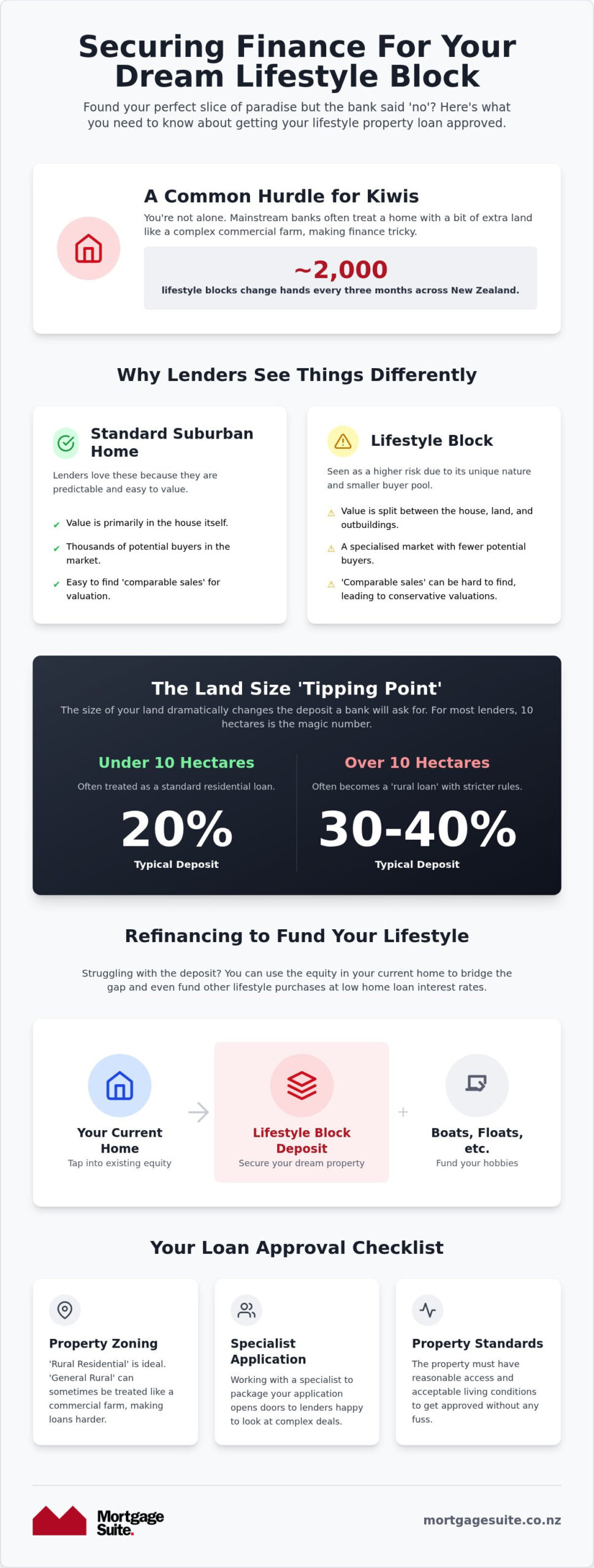
Banks usually have a specific cut-off point where a standard home loan suddenly becomes a rural loan. For many lenders, this “tipping point” is 10 hectares. If your slice of paradise exceeds this limit, don’t be surprised if the bank asks for a much larger deposit, often between 20% and 30%. They want to ensure you have enough skin in the game to cover the extra risk associated with larger parcels of land that might be harder to offload quickly. This is where we step in to help package your application so the lender sees the home, not just the hectares.
Zoning and ‘Highest and Best Use’
Council zoning can change your loan requirements overnight. If a property is zoned Rural Residential, lenders are generally more relaxed because they know the land is intended for living. However, if it’s General Rural, they might view it as a commercial farm. Ironically, having highly productive land can sometimes make a loan harder to get. If the property is capable of generating a significant income, the bank may insist on a commercial or rural loan structure. These often come with higher interest rates and stricter terms than a standard residential mortgage, which is why getting the zoning right in your application is vital.
Understanding the LVR and deposit rules for rural living
Getting the keys to your rural retreat usually starts with a conversation about the deposit. For most standard lifestyle blocks under 10 hectares, mainstream banks generally look for a 20% deposit. However, the moment that land size creeps higher, the rules tighten. If you’re eyeing up a property over 10 hectares, don’t be surprised if your lender asks for 30% or even 40% upfront. They do this because larger blocks are considered higher risk and can be harder to sell quickly if things go pear-shaped.
Lenders also look closely at the ‘curtilage’ of the property. This is just a simple way of describing the house and the immediate garden area. They’ll often put a higher value on this section while being quite conservative about the back paddocks or extra land. If you’re struggling to find the cash for a deposit, one of the smartest moves is using the equity in your current suburban home. By tapping into the value you’ve already built up, you can often secure Finance for Lifestyle Purchases / Refinancing without needing to clear out your savings account. This strategy is particularly effective for those looking to upgrade their lifestyle while keeping their existing property as an investment.
Why the ‘Big 4’ banks might say no
Mainstream banks love predictability. In a suburb, they can find ten similar houses sold in the last month to prove what a property is worth. In rural areas, ‘comparable sales’ are often thin on the ground. A bank might worry that a unique property will sit on the market for months if they ever need to sell it. This lack of data often leads to a very conservative registered valuation, which can leave you with a funding gap that you didn’t expect.
Alternative options when the bank isn’t playing ball
If your local branch says no because the land is too big or the house is too old, you aren’t out of luck. This is where a 2nd tier lender New Zealand wide can make all the difference. These lenders often focus on the person and the overall quality of the property rather than just ticking boxes on a rigid checklist. It’s an excellent way to secure Finance for Lifestyle Purchases / Refinancing when the big banks aren’t interested in the nuances of rural living. While the interest rate might be slightly higher, it’s often a small price to pay to get onto your dream patch of dirt. If you’re feeling stuck, you should have a chat with a specialist who can help you find a lender that actually sees the potential in your rural move.
Refinancing your home to fund lifestyle purchases
Living the dream in New Zealand often means more than just having a nice house. It’s about the boat for the weekend, the caravan for summer trips, or the horse float for the kids’ events. When you’re looking at Finance for Lifestyle Purchases / Refinancing, the most powerful tool you have is likely sitting right under your feet: your home equity. Equity is simply the difference between what your house is worth and what you still owe the bank. If your property value has grown, you can often “pull” that value out to fund the things that make life enjoyable.
The biggest advantage of this approach is the cost of borrowing. In mid-2026, major bank floating rates are sitting around 6.04% to 6.15%, while some special fixed rates are even lower. Compare that to a standard personal loan or vehicle finance, which can easily sting you with interest rates between 12% and 15%. By refinancing your mortgage to include these lifestyle “toys,” you could effectively halve your interest costs. However, you need to be smart about the term. While it’s tempting to put a boat on a 30-year mortgage, you don’t want to be paying for a vessel that hit the scrap heap two decades ago. We always suggest carving that portion of the loan into a separate, shorter repayment structure.
Using equity for renovations and ‘lifestyle’ upgrades
Sometimes the best lifestyle purchase is an upgrade to your current patch of dirt. Adding a swimming pool or a large multi-bay shed can significantly improve your quality of life and often adds tangible value to the property. When you structure a “top-up” for these projects, we look at the projected end value of the home to ensure the bank stays happy. If you’re planning these upgrades for a property you intend to rent out later, it’s worth checking out our guide on residential investment property loans NZ wide to see how the tax and equity rules might differ.
Consolidating debt to free up lifestyle cash
If you’re already juggling a couple of high-interest car loans or credit cards, your weekly cash flow is probably taking a hit. Rolling those debts into your mortgage can give you a lot more breathing room. The key here is disciplined repayments. Because the interest rate is lower, you have a golden opportunity to pay the principal off faster than the bank requires. This keeps your total interest bill down and ensures you’re actually building wealth while enjoying your lifestyle. It’s about making your debt work for you, rather than letting it dictate how you spend your weekends.
Checklist: What you need to get your lifestyle loan approved
Before a lender hands over the cash for your rural retreat, they need to be certain they aren’t buying into a headache. Unlike a standard city house, a lifestyle block comes with unique moving parts that can stall an application if you aren’t prepared. Banks primarily want to see that the property is both habitable and accessible. If the driveway is a legal mess or the house isn’t technically finished, your Finance for Lifestyle Purchases / Refinancing application will likely hit a brick wall.
You also need to factor in the “unseen” costs that banks look for. They’ll want to see that you’ve considered the price of boundary fencing, water tank maintenance, and even the cost of a ride-on mower. These aren’t just lifestyle choices; they are essential for keeping the property in a state that protects the bank’s investment. Having a clear plan for the land—whether you’re running a few head of cattle or just keeping the grass down—shows the lender that you’re a responsible borrower who understands the reality of rural life.
The ‘Rural Essentials’ document list
Your paperwork needs to be spotless. A LIM report is your best friend here, as it reveals any flood risks or missing building consents on those big outbuildings. Lenders also demand proof of a reliable water source and a functioning septic system. If the property relies on tank water, they might ask for a report on the tank’s condition. Finally, check your legal access. It’s surprisingly common for rural driveways to be “paper roads” or shared tracks without proper legal easements, which is a major red flag for any bank.
Proving your ‘serviceability’
When it comes to the money, banks are quite conservative. They will almost always ignore any potential income from your “hobby” farming when calculating your loan. You need to prove that your primary job or business can cover the mortgage, the rates, and the higher maintenance costs of a larger block. In 2026, Debt-to-Income (DTI) ratios are a major factor, with borrowing generally capped at six times your annual income for owner-occupiers. Presenting your finances clearly is the key to showing you’re a safe bet. If you’re feeling overwhelmed by the requirements, we can organise your application to ensure it meets every lender’s standard before we hit submit.
Why Mortgage Suite Ltd makes securing lifestyle finance easy
Securing Finance for Lifestyle Purchases / Refinancing shouldn’t feel like a second job. At Mortgage Suite Ltd, we don’t just fill out a standard form and hope for the best. We take the time to package your story so lenders see the true value of your property and your financial position. Most mainstream banks have a very narrow view of what a “good” loan looks like, but our background allows us to speak their language while advocating for your specific needs. We understand that your lifestyle dream is personal, and we treat your application with the same level of care.
If the big banks find your specific block size a bit too hard to handle, we have direct access to 2nd tier lenders who specialise in these exact scenarios. These alternative options are a lifesaver for Kiwis who have the income and the equity but don’t fit into a standard suburban box. With Krish Krishna’s 20-plus years of industry experience, he knows exactly what credit managers are looking for. He knows how to handle the heavy lifting during negotiations, ensuring you get a fair deal without the usual stress of dealing with a rigid institutional system.
A veteran hand in a shifting market
With the Reserve Bank raising the OCR to 2.50% in July 2026, the lending environment is moving quickly. Having a broker who has seen multiple market cycles is vital when things feel uncertain. We help you make sense of how these shifts affect mortgage rates nz wide, ensuring you aren’t caught out by sudden changes. Our commitment at Mortgage Suite Ltd is simple; we work to find a “yes” even when your local branch has already said “no.”
Taking the next step without the stress
Our conversational approach means we skip the scary jargon and focus on clear paths forward. We help coordinate the necessary valuations and legal checks mentioned earlier, making sure everything is spot on from the moment you find your dream block to the day you settle. We want you to focus on picking out your first set of gumboots while we manage the bank. If you’re ready to make your move, you can Chat with Mortgage Suite Ltd today about your lifestyle dream and let us handle the rest of the process for you.
Ready to make your rural dream a reality?
Your move to the country should be about fresh air and open spaces, not battling with bank paperwork. We have looked at how land size impacts your deposit and why using your home equity is often the smartest way to fund your lifestyle upgrades at lower interest rates. Securing the right Finance for Lifestyle Purchases / Refinancing comes down to how you package your application and which lender you choose to partner with.
With over 20 years of banking expertise, Krish Krishna understands how to manage the hurdles that typically trip up rural buyers. Mortgage Suite Ltd specialises in non-bank and 2nd tier lending, providing the personalised service needed to get your loan across the line even when mainstream banks say no. You don’t have to handle the shifting 2026 market alone; having a veteran hand to guide the process makes all the difference.
Book a friendly chat with Mortgage Suite Ltd to organise your lifestyle finance and let us take the stress out of the process. Your new life on the block is closer than you think.
Frequently Asked Questions
Can I buy a lifestyle block with a 10% deposit in NZ?
You generally cannot buy an existing lifestyle block with a 10% deposit. Most mainstream banks require a minimum 20% deposit for owner-occupiers, and this can rise to 30% or more if the land size exceeds 10 hectares. While some new build exemptions exist, lenders usually view rural land as a higher risk than a standard suburban home and stick to stricter deposit rules.
What is the difference between a lifestyle block and a farm for a mortgage?
The main difference lies in where the value of the property comes from. A lifestyle block is viewed as a residential home where the land is for pleasure, meaning the house is the primary asset. A farm is considered a business where the land is expected to produce a primary income. Lenders use different sets of rules and interest rates for each category.
Is it cheaper to refinance my home for a boat than taking a boat loan?
It is almost always cheaper to use your home equity. By choosing Finance for Lifestyle Purchases / Refinancing, you can access interest rates around 6.04% to 6.15%, which is significantly lower than the 12% to 15% often charged for personal or boat loans. This strategy can save you thousands in interest over the life of the loan as long as you pay it off quickly.
Will the bank count my income from selling sheep on my lifestyle block?
Banks will almost never include income from hobby farming when they calculate how much you can borrow. They want to see that your regular salary or business profit can cover the mortgage without relying on the land. Because hobby income is often unpredictable, lenders treat it as a bonus rather than a reliable source of funds for making your repayments.
What happens if the lifestyle block has a business running on it?
If the property has a significant business operating from it, the bank might classify your application as a commercial or rural loan. This can change your deposit requirements and the interest rates you are offered. Lenders look at the “highest and best use” of the land, so a property with a large commercial orchard or a trucking yard will be treated differently than a simple home.
Do I need a special valuation for a rural property in New Zealand?
You will definitely need a registered valuation from a professional who specialises in lifestyle or rural properties. A standard computer-generated estimate or a suburban valuer won’t suffice. The bank needs a detailed report that considers things like land quality, water rights, and outbuildings to ensure the property provides enough security for the amount of money you want to borrow.
Can I use my KiwiSaver to buy a lifestyle block if it’s my first home?
You can use your KiwiSaver for a lifestyle block provided you intend to live in the house as your primary residence. The standard first-home withdrawal rules apply, but you must still meet the bank’s specific deposit requirements for lifestyle land. It is a great way to boost your deposit, but you should check with your provider early to ensure the property type is eligible.
What are the common traps to avoid when financing a rural property?
The biggest traps are legal access issues and non-compliant septic or water systems. Many buyers also get caught out by Finance for Lifestyle Purchases / Refinancing when they realise the bank won’t lend on the full land size at standard rates. Always check the LIM report for unconsented sheds and ensure the driveway has proper legal easements before you commit to the purchase.