
Commission Income Mortgage NZ: How to Get Approved in 2026
What if your most successful sales year was the very thing stopping you from getting a house key? It sounds backwards, but many high earners find that when they apply for a commission income mortgage in NZ, the banks treat their hard-earned bonuses like a liability rather than an asset. You have likely felt that sting of frustration when a rigid online calculator ignores half your pay packet just because it is variable.
I understand how disheartening it is to have your financial success dismissed by a computer algorithm. This article is here to take the stress out of the process by showing you exactly how New Zealand banks calculate your borrowing power. You will learn how to navigate the “shading” rules that lenders use to discount your pay, what specific paperwork you need to gather to prove your consistency, and why a second-tier lender might be the perfect partner if the big banks won’t budge. By the end, you will have a clear, professional strategy to turn your commission into a home.
Key Takeaways
- Understand the “shading” rule where banks typically only count 80% of your commission to create a safety buffer against market changes.
- Learn how to organise your IRD income summaries and recent payslips to prove a consistent two-year history of success to your lender.
- Discover why non-bank lenders are often the best choice for a commission income mortgage nz if you have a shorter history of variable earnings.
- Find out how simple moves, like reducing credit card limits or timing your application after a big month, can rapidly increase your borrowing capacity.
What exactly is commission income for an NZ mortgage?
When you’re preparing to buy a home, the way you describe your earnings matters just as much as the amount you actually take home. What exactly is commission income? In the eyes of a lender, it’s the variable portion of your pay that’s tied to your performance, sales volume, or specific targets. It’s common across several Kiwi industries, particularly for real estate agents, car dealers, and IT sales representatives who often have a lower base salary but high earning potential through results.
The main reason banks look at this differently from a standard nine-to-five salary is risk. A fixed salary is predictable, but commission can fluctuate based on the market or even just a slow month. Lenders also distinguish between contractual commission, which is clearly outlined in your employment agreement, and discretionary bonuses, which an employer can choose to stop at any time. For a successful commission income mortgage nz application, showing that your income is stable and reliable is the first hurdle you’ll need to clear.
The types of variable pay banks look for
Not all extra pay is treated the same by a credit manager. Performance-based bonuses are usually larger sums paid out annually or quarterly when you hit specific company milestones. Sales commission is typically more frequent, often hitting your bank account monthly as you close deals. Lenders also tend to group overtime and shift allowances into this same variable bucket. While you might see these as a guaranteed part of your week, the bank views them as optional hours that could disappear if the business faces a downturn.
Why your total package might confuse the bank
It’s often a shock for high earners to see the gap between their IRD income summary and what the bank actually uses for their borrowing power. If you had a one-off massive win last year that doubled your usual monthly take-home, the bank might exclude that spike entirely to avoid over-lending. They’re looking for a sustainable average rather than your best-ever month. Commission income is the variable portion of your earnings that requires a track record to be validated by lenders. Understanding this distinction helps you set realistic expectations before you start house hunting.
The “Shading” Rule: Why banks don’t count every dollar
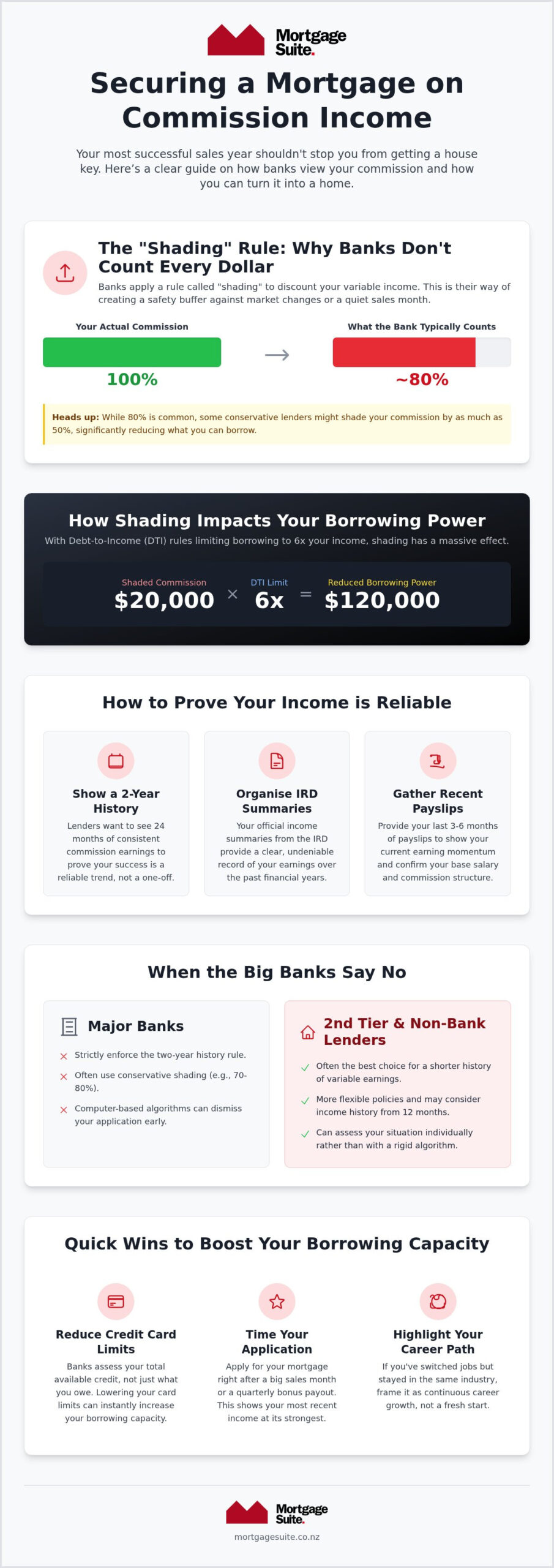
When you look at your annual earnings, you see a total figure that reflects your hard work and success. However, when you apply for a commission income mortgage nz, the bank often sees a different number entirely. This is due to a standard banking practice called shading. Essentially, lenders discount your variable income by at least 20% to create a safety buffer. They do this to protect themselves, and you, against a potential market downturn or a few quiet sales months where your income might dip unexpectedly.
In 2026, this rule is more relevant than ever. With the debt-to-income (DTI) restrictions now in full effect, owner-occupiers are generally limited to borrowing six times their gross annual income. If a bank shades $20,000 of your commission, that could potentially wipe $120,000 off your maximum loan amount. Most major banks also stick to a strict two-year rule. They want to see 24 months of consistent commission history to prove that your high-earning years aren’t just a lucky streak but a reliable trend.
Calculating your “Bank-Ready” income
You can estimate your borrowing power using a straightforward calculation. Take your base salary and add 80% of your average commission earnings from the last two years. While 80% is the standard for many big banks, some are far more conservative, shading variable pay by as much as 50%. Getting approved for a commission income mortgage nz requires knowing which shading percentage each bank uses before you apply. If you’re struggling to find a bank that sees your full value, it might be time to chat with an expert who knows which lenders are currently commission-friendly.
Exceptions to the two-year rule
What happens if you haven’t been in your current job for two years? You aren’t necessarily out of the race. If you’ve stayed in the same industry but simply switched to a competitor, many banks will view your career as a continuous path rather than a fresh start. A high base salary can also act as a safety net, giving the bank enough confidence to overlook a shorter commission history. This is a common strategy for those exploring Home Loans for First Home Buyers in New Zealand: The 2026 Comprehensive Guide. By focusing on your total career trajectory rather than just your latest payslip, you can often find a path forward that the rigid bank calculators miss.
Paperwork you’ll need to organise for a commission-based loan
If shading is the bank’s way of playing it safe, your documentation is your chance to prove you’re a reliable bet. To secure a commission income mortgage nz, you need to move beyond simple payslips. Lenders want to see the story behind the numbers, which means you’ll need to gather evidence that shows your income is both consistent and likely to continue. It’s about building a case that proves your success isn’t just a flash in the pan.
Start by downloading your IRD “Income Summary” reports for the last two years. This is the gold standard for banks because it shows a clear, multi-year trend of what you’ve actually earned and paid tax on. Alongside this, you’ll need your most recent payslips, usually covering the last three to six months. These must clearly show the breakdown between your base salary and your commission. Banks will also ask for your full employment agreement to confirm that your commission structure is a permanent part of your role, rather than a one-off bonus. Finally, ensure your bank statements for the last three months match the deposits shown on your payslips exactly. Any discrepancy here can cause unnecessary delays.
Proving the “Sustainability” of your pay
Lenders are naturally cautious, so they look for an upward trend in your earnings. If your commission has grown steadily over the last two years, you’re in a strong position. However, life happens. If you’ve had a dip in income due to parental leave or an industry-wide slump, don’t panic. You just need to explain it. A letter from your employer can be a real game-changer here. If your boss can confirm your commission structure, explain any temporary dips, and state that your earning potential remains high, it adds a layer of professional reassurance that a spreadsheet simply can’t provide.
The “Self-Employed” crossover
In industries like real estate, many people work on “commission-only” contracts. If this is you, banks will often treat you as self-employed rather than a standard employee. This changes the rules of the game. Instead of just payslips, you’ll likely need to provide GST returns and full financial accounts prepared by an accountant. This can feel like a lot of extra “hoop-jumping,” but it’s standard practice for non-salary earners. If the mainstream banks find your situation too complex, you might find more flexibility with a 2nd Tier Lender New Zealand: Your 2026 Guide to Alternative Home Loans. These lenders often take a more common-sense approach to variable income, especially for those who are technically self-employed.
When the big banks say no: 2nd tier and non-bank options
Getting a “no” from your local bank branch doesn’t have to be the end of your home buying journey. If your commission income mortgage nz application was declined because you lack a two-year history, 2nd tier lenders are often the secret weapon you need. These lenders aren’t registered banks, which means they aren’t always bound by the same rigid rules set by the Reserve Bank. While a mainstream bank might ignore 20% or even 50% of your variable pay, some non-bank lenders are comfortable shading your commission at just 10%. This small shift in calculation can suddenly add tens of thousands of dollars back into your borrowing pool.
The real advantage here is speed. Many non-bank lenders are happy to look at a six to twelve month history of consistent earnings rather than demanding a full two years. There is a trade-off, as these loans typically come with slightly higher interest rates. However, for many Kiwis, paying a little more in interest for a year or two is a small price to pay to get into the house they want today. It’s often better to buy now and watch your equity grow than to wait another year for a “perfect” bank history while house prices potentially move out of reach.
Is a non-bank loan right for you?
A 2nd tier loan is rarely a forever solution; it’s a stepping stone. It makes perfect sense if you’re buying your first home before your two-year work anniversary or if you’re looking at Residential Investment Property Loans NZ: The 2026 Investor’s Reference Guide and need more flexible income testing. The goal is simple: secure the property now, build a rock-solid track record of payments, and then refinance back to a mainstream bank once your commission history hits that magic 24-month mark. This strategy allows you to use the 2nd tier market as a bridge to long-term financial stability.
Navigating the 2nd tier landscape with an expert
You generally can’t just walk into a 2nd tier lender’s office off the street. Most of these alternative funding pools are only accessible through a professional broker. With over two decades of banking experience, Krish Krishna knows exactly how to package your application to highlight your earning potential rather than just your risks. We don’t just send off your payslips; we tell the story of your career success and negotiate directly with credit managers who understand the sales industry. If the big banks have turned you away, contact Mortgage Suite Ltd today to see how we can unlock a path forward through the 2nd tier market.
Strategies to boost your borrowing power with commission
Improving your chances of a “yes” is often about the small details you handle before you even fill out an application form. One of the smartest moves you can make is timing. If you’ve just had a record-breaking sales month, wait until that income is officially reflected on your IRD record before you apply. This provides fresh, high-value data for the bank’s average calculation, ensuring they see your most recent success. Additionally, look at your existing debt. Banks don’t just look at what you owe on a credit card; they look at the total limit. A $10,000 credit card limit can reduce your borrowing capacity by significantly more than a single low-commission month would.
If you’re buying with a partner who has a stable, salaried role, their income acts as an anchor for the loan. This joint application advantage often makes banks more comfortable with your variable pay because there’s a guaranteed base to cover the mortgage if sales slow down. Similarly, if you can bring a larger deposit to the table, usually 20% or more, lenders tend to be more forgiving. A bigger stake in the property reduces the bank’s risk, which can sometimes lead to more generous shading on your commission income mortgage nz application.
Five steps to a “Yes” from the lender
- Get a pre-assessment: Chat with a broker early to see exactly where you stand and what a bank might lend you today.
- Clean up your statements: Avoid “buy now, pay later” services in the months leading up to your application. Banks want to see clean, disciplined spending.
- Gather history early: Don’t wait for the bank to ask. Have your 24 months of IRD records ready to go.
- Be transparent: Explain your commission structure clearly from day one so there are no surprises during the credit check.
- Use a stepping stone: If the big banks aren’t ready for you yet, consider a 2nd tier lender to get into the market sooner.
How Mortgage Suite Ltd takes the stress out of the process
You don’t have to navigate these rigid bank rules alone. We do the heavy lifting by comparing different bank shading policies to find the one that treats your income most fairly. With Krish Krishna’s 20 plus years of industry experience, we know how to present your case to lenders so they see your potential rather than just a variable number on a screen. Whether you’re a first home buyer or an investor, our deep knowledge of 2nd tier loans ensures you always have a plan B. Organise a chat with Mortgage Suite Ltd today to review your commission income and let’s get you into your new home.
Secure your home loan with confidence
Navigating the world of home lending when your pay packet changes every month doesn’t have to be a source of anxiety. By understanding how banks apply shading and preparing your IRD records well in advance, you can position yourself as a strong, reliable borrower. Whether you are looking at mainstream banks or need the flexibility of a 2nd tier lender, the key is having a strategy that highlights your actual earning power rather than just your base salary.
You don’t need to do this alone. With over 20 years of banking and mortgage experience, we specialise in complex income scenarios and have access to both mainstream and 2nd tier lenders across New Zealand. We know how to package your commission income mortgage nz application to get the results you deserve. Talk to Krish and the team about your commission-based mortgage today and let’s turn your hard-won success into a front door key. Your high-earning potential should be your greatest asset, and we are here to make sure the banks see it that way too.
Frequently Asked Questions
Can I get a mortgage if my income is 100% commission?
Yes, you can certainly get a home loan with 100% commission income, though most mainstream banks will treat you as a self-employed borrower. This means you will typically need a solid two-year track record of earnings to prove your financial stability. If you haven’t reached that two-year milestone yet, we often look at alternative lenders who are more comfortable with shorter histories for a commission income mortgage nz.
How many months of commission do I need to show for a home loan in NZ?
Most major New Zealand banks require a 24-month history of commission to verify your average earnings. This allows them to see how your pay fluctuates through different seasons and market cycles. However, if you have been in the same industry for a long time but recently changed jobs, some lenders may accept a shorter period of six to twelve months if your earnings are consistent.
Do banks count bonuses the same way as commission?
Banks generally group bonuses and commission together as “variable income,” but they often view contractual commission more favourably. Because a bonus is often discretionary, a bank might shade it more heavily than commission that is clearly linked to your sales targets in an employment agreement. We can help you review your specific contract to see how a lender will likely categorise your extra earnings before you apply.
What happens if my commission has dropped recently?
If your earnings have dipped, banks will typically average your last two years of income, which will naturally lower your borrowing power. If the drop was due to a specific event, like parental leave or a temporary industry downturn, providing a written explanation or an employer’s letter can help. Lenders want to see that your future earning potential remains high despite a recent quiet patch in your industry.
Can I use commission income to buy an investment property?
You can definitely use your variable earnings to secure a residential investment property. Under the 2026 rules, property investors are subject to a debt-to-income ratio of seven times their gross annual income. Just remember that the bank will still apply shading to your commission before they calculate that seven-times limit, so your actual borrowing capacity might be lower than you expect based on your total gross pay.
Why did my bank decline me even though I earn a high total income?
A high total income doesn’t always guarantee a “yes” if a large portion of that pay is variable. Banks use conservative calculators that automatically discount your commission to ensure you can still afford repayments during a bad month. If your base salary is low and your commission is high, the “shaded” version of your income might not meet the bank’s strict affordability tests, even if you feel financially comfortable.
Are interest rates higher for people with commission income?
Interest rates are generally the same as standard market rates if you are approved by a mainstream bank. You won’t be charged more just because you earn commission. However, if the big banks decline your application and you choose to use a 2nd tier lender to secure a commission income mortgage nz, you should expect to pay a slightly higher interest rate in exchange for their increased flexibility.
What is the “shading” percentage for major NZ banks in 2026?
While every lender has its own internal policy, the standard shading percentage for major New Zealand banks in 2026 is typically 80%. This means they will only use 80 cents of every dollar you earn in commission when they work out how much you can borrow. Some conservative lenders may shade as low as 50%, which is why it is vital to apply with the right bank from the start.