
7 Common First Home Buyer Mistakes in NZ (and How to Dodge Them) in 2026
What if a “no” from your local bank manager isn’t actually the end of your home-buying dream? In 2026, many Kiwis feel like the goalposts have shifted, especially with the strict debt-to-income rules and the fear of making common first home buyer mistakes nz that could stall their plans for years. It’s completely normal to feel stressed when you’re trying to figure out if you’ll ever get a look-in from the big banks or how to manage hidden costs like building reports.
We know that the pressure to get everything right is huge, and the fear of missing out can lead to some expensive slips. This article is designed to help you spot and avoid those blunders so you can approach the 2026 property market with a sense of certainty. You’ll learn how to handle those tricky bank conversations, why a 20 per cent deposit isn’t always the only way, and how to protect yourself from buying a “lemon” property. We’re going to break down the specific traps that cost people thousands and show you how to secure a home loan even if you don’t fit into a standard box.
Key Takeaways
- Learn why house hunting without a formal pre-approval is a recipe for heartbreak and how to keep your credit score healthy for the big banks.
- Discover how to budget for the “big three” hidden costs beyond your deposit to avoid the most common first home buyer mistakes nz.
- Understand how to perform proper due diligence, including spotting red flags in a LIM report that could make a property uninsurable.
- Explore why a “no” from a mainstream bank isn’t the end of the road and how non-bank lenders can help you get across the line.
- Master the art of keeping your mortgage approval safe by avoiding new debt or credit changes in the critical weeks before settlement.
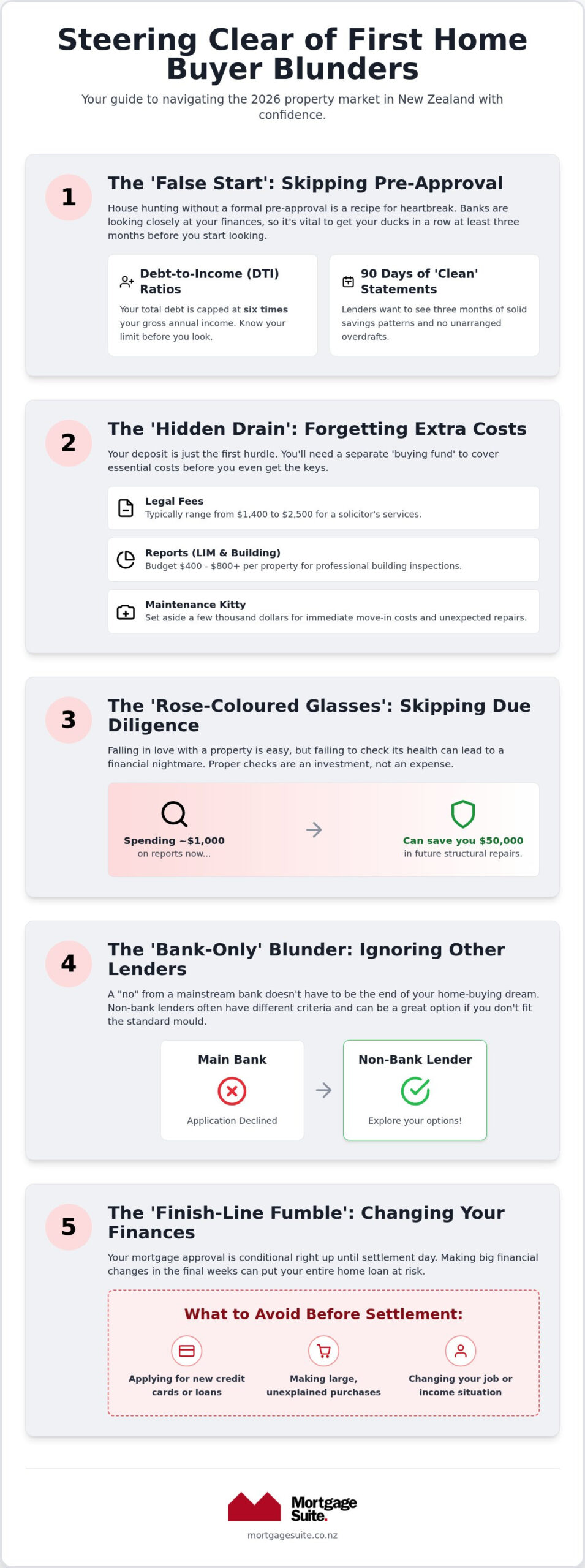
The ‘False Start’: Skipping Pre-approval and Credit Checks
Imagine finding a sun-drenched bungalow in a suburb you love, only to discover the bank won’t even look at your application because you didn’t do the groundwork. This is one of the most common first home buyer mistakes nz. In 2026, house hunting without a formal pre-approval isn’t just risky; it’s a recipe for heartbreak. With the Official Cash Rate sitting at 2.25 per cent, lenders are being incredibly thorough. They aren’t just looking at your deposit; they’re looking at your entire financial life through a magnifying glass.
The rules have changed significantly over the last couple of years. Since July 2024, the Reserve Bank has enforced strict debt-to-income (DTI) ratios. For most people buying a home to live in, your total debt is capped at six times your gross annual income. If you haven’t sat down to calculate how this affects your specific budget, you might be looking at properties that are mathematically out of reach. Getting your “ducks in a row” at least three months before you start visiting open homes is essential. Banks want to see ninety days of “clean” bank statements, meaning no unarranged overdrafts and a clear pattern of saving rather than spending on non-essentials.
Understanding Your Real Borrowing Limit
There is often a big gap between what a bank says they could lend you and what you can actually afford to pay back comfortably. Banks use “test rates” to see if you could still manage your mortgage if interest rates climbed significantly higher than the current 4.74 per cent average. We always suggest aiming for a bit of a buffer. Maxing out your borrowing limit leaves you vulnerable if your circumstances change. A seasoned adviser can help translate this bank jargon into a clear dollar figure, so you know exactly which houses are in your league.
The Credit Score Clean-up
Your credit score is a digital footprint of your financial reliability, and in 2026, it matters more than ever. Small things like a missed power bill from a flat you lived in three years ago or too many “Buy Now Pay Later” applications can ding your score without you even realising it. You can check your credit report for free through providers like Centrix or Equifax in New Zealand. If your score isn’t where it needs to be, don’t panic. Simple steps like closing unused credit cards and ensuring every bill is paid on time for a few months can see your score bounce back before the bank sees it. This proactive approach is a vital part of avoiding common first home buyer mistakes nz and securing that all-important pre-approval.
The ‘Hidden Drain’: Overlooking Extra Costs Beyond the Deposit
Reaching your deposit goal is a massive milestone, but thinking that’s the only cash you need is one of the most common first home buyer mistakes nz. Saving that five, ten, or twenty per cent is just the first step of your financial journey. You also need a “buying fund” to cover the essentials before you even get the keys. Budgeting for the “Big Three” is non-negotiable: legal fees, which typically range from $1,400 to $2,500; a Land Information Memorandum (LIM) report; and professional valuations if your bank requires them. If you’re looking at multiple properties, these costs can repeat, quickly eating into your savings.
Once you actually move in, the costs don’t stop. We always recommend setting aside a “maintenance kitty” of a few thousand dollars. Whether it’s a leaky tap, a fence that needs a quick fix, or just the cost of getting the internet connected, having a cash buffer prevents you from starting your homeownership journey under immediate financial stress. It’s about being prepared for the reality of owning a home, not just the dream of buying one.
The True Cost of Due Diligence
It might feel painful to spend $400 to $800 on a building report for a house you don’t even own yet. However, spending $1,000 on reports now can save you $50,000 in structural repairs later. A builder’s report looks at the physical health of the house, while a council LIM report checks the legal history, such as whether that back deck actually has a permit. You should expect to pay for these reports for every serious offer you make. Understanding the official property buying process helps you see these costs as an investment in your future security rather than just another bill.
Government Grants and KiwiSaver Nuances
A major trap for many in 2026 is relying on the First Home Grant, which actually closed to new applications in May 2024. Instead, focus on the Kāinga Ora First Home Loan, which still allows for a 5 per cent deposit if you meet the income caps. When it comes to your KiwiSaver, timing is everything. You must have been a member for at least three years, and you’ll need to leave $1,000 in your account. Don’t leave the paperwork until the last minute; your lawyer needs time to coordinate the withdrawal so the funds are ready for settlement day. If you’re feeling overwhelmed by these moving parts, we can help you find home loans for first home buyers that take your full financial picture into account.
The ‘Rose-Coloured Glasses’: Failing to Do Your Due Diligence
Walking into a beautifully staged home can make you lose your head. The smell of fresh coffee and the perfect velvet sofa are designed to make you feel at home, but they are also designed to hide the cracks. One of the biggest common first home buyer mistakes nz is letting your heart lead your wallet without checking what is actually under the floorboards. Staging is fluff; your job is to see the bones of the property.
You might find a vendor who offers a free building report to “save you money.” While it looks helpful, you should never rely on a report you didn’t pay for. The inspector was hired by the person trying to sell you the house, so their loyalty isn’t to you. Getting your own independent report is the only way to ensure you are getting the full, unvarnished truth. In 2026, insurance companies are becoming much stricter about what they will cover. If your Land Information Memorandum (LIM) report shows the property is in a high-risk flood zone or has unconsented works, you might find it impossible to get insurance. Without insurance, the bank will not settle your loan.
Builder’s Reports: What’s a Deal-breaker?
It is vital to distinguish between a house that needs a bit of love and one that is a money pit. Structural issues, like a sagging roof or a cracked foundation, are major deal-breakers that can cost tens of thousands to fix. On the other hand, peeling paint or old carpets are just cosmetic fixes that you can tackle over time. For homes built between the late 1980s and mid-2000s, moisture testing is non-negotiable. The “leaky home” legacy still haunts the New Zealand market, and a moisture probe can save you from a lifetime of debt. If the report finds issues that aren’t deal-breakers, use that information to negotiate a lower purchase price.
The Legal Fine Print
Your lawyer is your ultimate safety net during the contract stage. They will check the property title for things like easements, which might give the council the right to dig up your driveway, or covenants that restrict how you can use your land. We often see “fishy” clauses in Sale and Purchase agreements that favour the seller, so having a professional eye over the document is essential. Most importantly, ensure your “finance condition” is robust. In a market where bank criteria can shift quickly, you need a clause that protects you if your loan application hits a snag at the last minute. This keeps you in control and prevents you from being legally forced into a contract you can no longer afford.
The ‘Bank-Only’ Blunder: Ignoring 2nd Tier and Non-Bank Lenders
Many Kiwis walk away from their home-buying dreams after a single “no” from a branch manager. This is one of the most common first home buyer mistakes nz. In 2026, the lending market is much broader than just the household bank names you see on the high street. 2nd tier and non-bank lenders are not a “last resort”; they are a professional alternative for people who have great potential but don’t fit a standard computer-generated template. These lenders are strictly regulated and often provide the flexibility needed to get you into a home when others won’t.
A non-bank lender looks at the person behind the paperwork. While a major bank might decline you for having a slightly smaller deposit or a complex income, these alternative lenders are often more willing to listen to your story. They provide a vital path forward, ensuring that a “no” from a big bank isn’t the end of your journey. Avoiding these common first home buyer mistakes nz starts with knowing that you have options beyond the traditional banking box.
When to Consider a Non-Bank Loan
You might find yourself in a position where your career is taking off, but your bank statements don’t yet show the long-term stability a big bank demands. This is particularly common for those who are self-employed or working as contractors. In these cases, a non-bank loan can be a lifesaver. You should expect interest rates to be a bit higher, with some variable rates for “near prime” lending starting around 6.60 per cent. The strategy here is simple: use a non-bank lender to get into the property market now, build your equity for a year or two, and then we can help you move your loan to a mainstream bank once your financial history is more established.
Navigating Alternative Lending with an Expert
Pitching an application to a 2nd tier lender requires a different approach than a standard bank application. These lenders have very specific criteria, and knowing which one will be most receptive to your situation takes years of experience. We act as your advocate, using our 20 years of industry knowledge to present your case in the best possible light. We focus on your strengths and your ability to service the loan, rather than just ticking boxes. For a deeper look at how this works, check out our guide on 2nd tier lender New Zealand for more detail. If you’re ready to see what’s possible, we can help you explore home loans that fit your specific needs.
The ‘Finish Line’ Fumble: Messing with Your Credit Before Settlement
You’ve signed the contract, the deposit is paid, and you’re already measuring the windows for curtains. It feels like the hard part is over. However, one of the most heartbreaking common first home buyer mistakes nz happens in the quiet weeks between going unconditional and settlement day. Many buyers don’t realise that a mortgage approval is technically “conditional” until the very second the money changes hands. If your financial situation shifts during this period, the bank has the right to pull the offer entirely.
In 2026, with the Reserve Bank’s debt-to-income (DTI) limits being so tight, there is almost no room for error. If you were approved at a six-times income limit, even a small new debt can push you over the edge. Taking out a loan for a new car or putting a designer sofa on interest-free finance might seem harmless, but it changes your “borrowing power” in the eyes of the bank. We’ve seen cases where a $20,000 car loan meant the bank was no longer willing to lend the $600,000 needed for the house. The rule is simple: wait until you have the keys in your hand before you make any big purchases.
Protecting Your Approval Status
Banks often do a final “spot check” of your credit or ask for updated bank statements just before settlement. Anything that suggests a change in your ability to pay back the loan will trigger a re-evaluation. This includes more than just new debt. Changing jobs, even for a higher salary, can cause issues because banks prefer the stability of someone who has passed their 90-day trial period. If you’re thinking of moving into self-employment, definitely wait until after you’ve moved in. If an unavoidable life change happens, like a redundancy, tell your adviser immediately. We can often work through these challenges if we know about them early, rather than finding out from a bank’s last-minute decline.
Final Steps to a Smooth Settlement
The final 48 hours before you move in should be about ticking boxes, not frantic phone calls. You’ll need to do a final property inspection to ensure the house is in the same condition as when you signed the contract. Check that the oven works, the hot water is running, and no new damage has occurred. You also must ensure your house insurance is active and the bank is listed as an interested party; without this, the funds won’t be released. For a deeper dive into these final hurdles, read our Ultimate First Home Buyer Guide for New Zealanders. Avoiding these common first home buyer mistakes nz ensures that your first night in your new home is a celebration, not a stressful memory.
Take the Next Step Toward Your First Home with Confidence
Buying your first home in 2026 is a massive achievement, but it requires a disciplined and strategic approach. We have looked at how vital it is to get your pre-approval sorted early and why you should never skip the “big three” hidden costs like LIM reports and valuations. Most importantly, you now know that a “no” from a mainstream bank doesn’t have to be the end of the road. By staying disciplined with your credit right up until settlement, you can avoid the most common first home buyer mistakes nz and move into your new place with total peace of mind.
You don’t have to navigate this complex market on your own. At Mortgage Suite Ltd, we bring over 20 years of banking expertise to the table, acting as your seasoned mentor throughout the entire process. We are specialists in finding home loans for Kiwis who don’t fit the standard bank mould, and we provide a nationwide service to help you access 2nd tier lending options. Whether you are just starting to save or you’re ready to make an offer, we are here to advocate for your success. Book a no-obligation chat with the Mortgage Suite Ltd team today to explore your options. Your dream of home ownership is well within reach; you just need the right partner in your corner.
Frequently Asked Questions
Can I buy my first home if I have a small amount of debt?
Yes, you can, but it is all about how that debt impacts your borrowing power. Under the 2026 debt-to-income rules, every dollar you owe on a car loan or credit card reduces the total amount a bank will lend you. We often help clients consolidate these small debts or close unused accounts to make their application look much stronger to a lender.
What happens if the bank declines my pre-approval at the last minute?
If a bank pulls your approval, it is not necessarily the end of your home-buying journey. We first look at why the decline happened, whether it was a change in your spending habits or a new entry on your credit report. From there, we can often present your case to a 2nd tier lender who might be more flexible with their criteria than a mainstream bank.
How much should I really save for a deposit in NZ in 2026?
While a 20 per cent deposit is the gold standard to avoid extra fees, you can still buy with as little as 5 per cent through the First Home Loan scheme. For a median-priced home of $804,303, a 5 per cent deposit is roughly $40,215. Just remember that you will also need a bit of extra cash set aside for your legal fees and building reports.
Is a builder’s report really necessary for a brand-new home?
Absolutely, getting a professional inspection is a smart move even for a brand-new build. New homes can still have structural snags or installation errors that aren’t obvious during a quick walk-through. Getting a report ensures you aren’t walking into one of the most common first home buyer mistakes nz before you have even spent your first night in the property.
Can I use my KiwiSaver for the initial deposit or just at settlement?
Your KiwiSaver funds are typically paid out on settlement day, but they can be used for the initial deposit if your lawyer organises the paperwork correctly. You must have been a member for at least three years and you have to leave at least $1,000 in your account. It is best to start this process as soon as your offer is accepted to avoid any delays.
What is the First Home Grant and am I eligible?
The First Home Grant was officially closed to new applications on 22 May 2024 and is no longer available. If you are looking for government support now, you should focus on the First Home Loan, which allows for a 5 per cent deposit. There are still income caps to meet, such as $150,000 or less for a couple, so check your eligibility early.
Why should I use a mortgage broker instead of going straight to my bank?
A mortgage broker works for you rather than a specific bank, giving you access to a much wider range of lending options. While a bank can only offer you their own products, we can compare multiple lenders and find a solution that actually fits your unique life. We also handle the tough negotiations to get your loan across the line with less stress.
What are DTI ratios and how do they affect first home buyers?
Debt-to-income (DTI) ratios limit your total borrowing to six times your gross annual income. This is a key part of avoiding common first home buyer mistakes nz, as it sets a hard ceiling on your budget regardless of your deposit size. Knowing your specific DTI limit early on prevents you from wasting time on properties that the bank simply won’t finance for you.