
Company Share Apartment Financing NZ: The 2026 Guide to Getting Your Loan Sorted
Have you found the perfect character apartment in Wellington or Auckland, only to have your bank manager look at you like you’re speaking a foreign language? It’s a common story in 2026, where many buyers find that securing company share apartment financing nz feels like trying to solve a puzzle with missing pieces. Most mainstream lenders see the “licence to occupy” structure and immediately put it in the “too hard” basket.
It’s incredibly frustrating to be told your dream home isn’t a “standard” security, especially when you’re already facing high deposit requirements that can reach up to 50 per cent. We agree that these properties aren’t “bad” investments; they simply require a specialised lending map that most banks don’t carry. This guide will show you exactly how to secure a loan for a company share apartment, even when the big banks make it feel like an uphill battle. We’ll help you find lenders who understand these unique properties, clarify the path to approval, and break down the costs so you can move forward with confidence.
Key Takeaways
- Understand the fundamental difference between owning shares and owning land, and why this distinction is the key to unlocking your loan approval.
- Discover how to navigate the specific requirements for company share apartment financing nz, including why you’ll likely need a larger deposit than a standard home.
- Compare the long-term costs of company share levies against standard body corporate fees to see if these “hidden gems” truly fit your budget.
- Learn the exact steps to prepare your application, from sourcing company financial records to getting a specialist pre-approval that actually carries weight.
- See how 2nd tier lenders can provide a reliable way forward when mainstream banks say no, giving you a clear path to securing your new home.
What is a company share apartment and why is the bank being difficult?
Imagine finding a stunning apartment in a character building, only to realise the price tag is significantly lower than everything else on the street. It feels like a massive win, until you call your bank. Most company share properties in New Zealand are older, established buildings with plenty of soul. However, they operate on a different legal level than a modern townhouse. Instead of buying a piece of land or a unit title, you’re buying a stake in a company. This setup is much like a cooperative apartment building found in cities like New York or London. While this makes the entry price attractive, it creates a unique hurdle for standard bank loans.
The difference between owning a home and owning a share
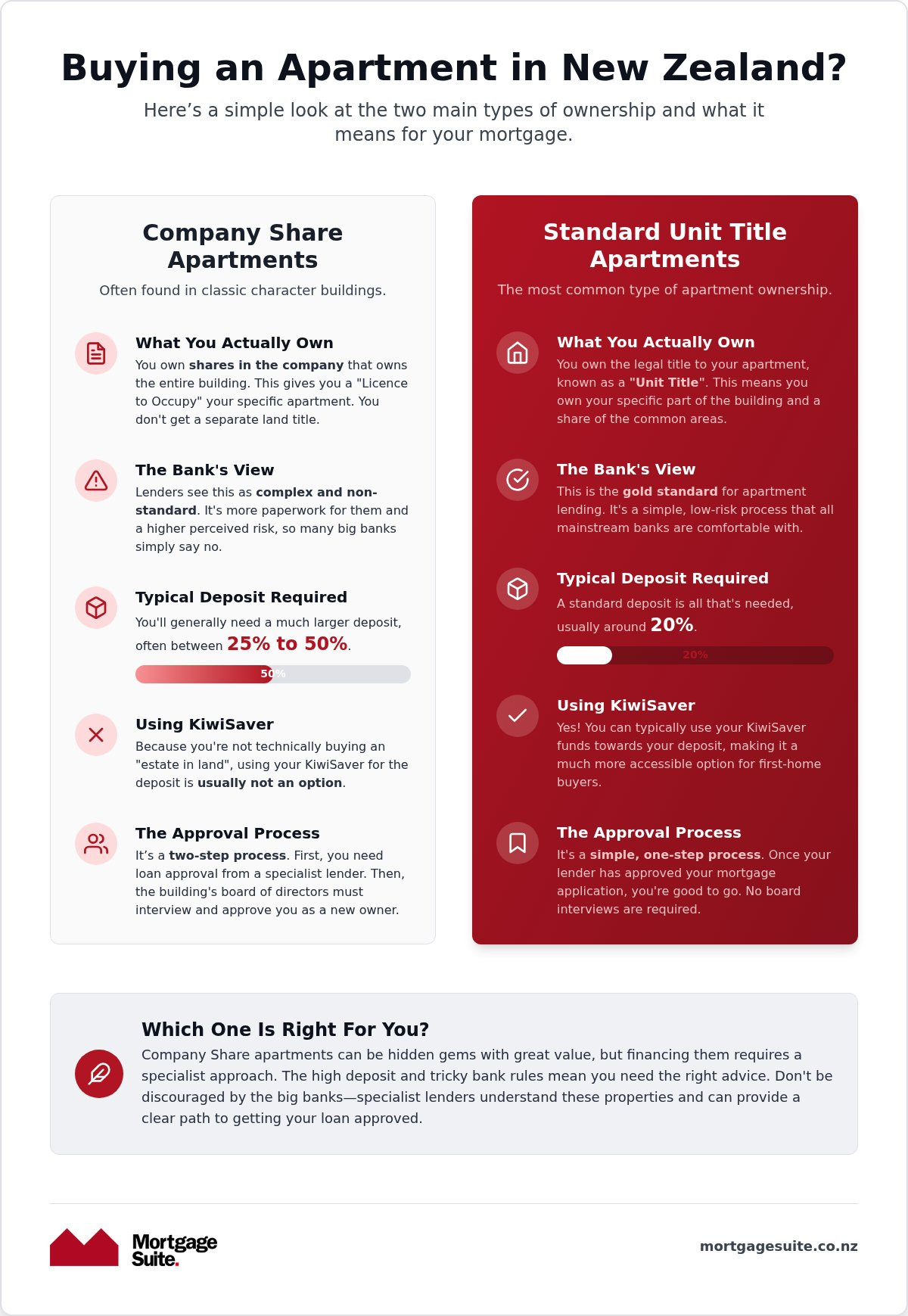
Visualise the building as a large pie. In a standard unit title, you own your specific slice of that pie outright. With a company share, you own a bundle of shares in the company that owns the entire pie. Your right to live in your specific unit comes from a “Licence to Occupy”. This isn’t just a legal technicality. It means there is no separate land title for the bank to register a mortgage against. Because you don’t technically own an “estate in land”, you usually can’t use KiwiSaver for the deposit either. You also have to deal with the company board. They often have the right to vet new owners, ensuring everyone fits the building’s community standards and rules before the sale is finalised.
Why the big banks often say ‘no thanks’
Mainstream banks thrive on simplicity and high volume. They have systems designed for standard houses and modern unit titles. When you apply for company share apartment financing nz, you’re asking them to step outside their comfort zone. Their legal teams have to review company constitutions and share certificates rather than just checking a standard land title. To a big bank, this represents higher risk and significantly more paperwork. If they ever needed to recover their money, the process of selling shares is more complex than selling a house. This is why they often set the deposit bar at 35 or 50 per cent, or simply decline the application. It isn’t that the property is a poor investment; it’s just that the bank’s rules are too rigid to see the value.
The nuts and bolts: How company share financing actually works
Getting your head around the numbers is the next step once you’ve found a place you love. While a standard home might only need a 20 per cent deposit, company share apartment financing nz operates on a different set of rules. Lenders see these as higher risk, so they want to see more of your own skin in the game. Equity for a 2026 buyer represents the market value of your shares in the building minus any money you still owe to your lender.
Interest rates can also look a bit different. While major banks have floating rates around 6.04 per cent in July 2026, a loan for a company share property might carry a slightly higher rate or different fees. This is because it sits in the “non-standard” category. You’re also bound by the company’s constitution. This document is the ultimate rulebook, dictating everything from whether you can renovate your kitchen to whether your cat is allowed to move in with you. Always read this before you sign anything.
Deposit requirements: Saving a bit extra
Most lenders will ask for a deposit between 25 per cent and 50 per cent. This can be a huge hurdle if you’re a first-time buyer. However, if you already own a home, you can often use the equity in that property to cover the gap. This is a common strategy for those looking into residential investment property loans NZ. By using the value in your current home, you can secure the new apartment without needing a massive pile of cash sitting in the bank. It’s a clever way to bypass the strict deposit rules that usually stop people in their tracks.
The approval process from the building’s side
The building’s board has a massive say in your purchase. They often require an in-person interview to ensure you’ll be a good neighbour. This can add weeks to your settlement timeline. If the board doesn’t feel you’re a good fit, they can actually decline the sale. It’s vital to have your finances ready so you look like the perfect candidate on paper. Providing clear proof of your ability to pay levies and follow building rules goes a long way. If you’re feeling unsure about how to present your case, you can talk to a specialist broker who knows how to navigate these unique hurdles and get your application over the line.
Comparing company share apartments with standard unit titles
Choosing between a company share property and a standard unit title often comes down to a trade-off between price and paperwork. While unit titles are the “standard” in the New Zealand market, company share buildings are frequently the hidden gems. These properties are often older, character-filled buildings in premium suburbs that offer a lifestyle you simply can’t find in a modern high-rise. Because they are harder to finance, they often sit on the market longer, giving savvy buyers a chance to negotiate a better deal.
Ongoing costs are another area where the two structures differ. Instead of body corporate fees, you’ll pay “levies”. At first glance, these levies might look more expensive than a standard body corporate fee. However, they usually bundle your council rates and building insurance into one single payment. This can actually make your personal admin much easier. You don’t have to worry about separate rates bills arriving in the post; the company handles it all on your behalf.
The ‘Affordability Gap’ in the 2026 market
In the current 2026 climate, the price difference can be quite startling. It isn’t uncommon to see a company share apartment priced 15 to 20 per cent lower than a freehold unit of the same size in the same street. This gap exists because the pool of buyers is smaller. Many people are put off by the high deposit requirements or the perceived complexity of company share apartment financing nz. For first-home buyers who have managed to save a solid deposit, this represents a massive opportunity to buy into a “blue chip” area. We cover these types of strategic entry points extensively in our first home buyer guide New Zealand, as they can be a shortcut to home ownership for those with the right financial backing.
Rules, regs, and renovations
Living in a company share building means being part of a community that values stability. The rules are often stricter than what you’d find in a standard apartment block. You might need board approval for everything from installing a heat pump to changing your floor coverings. Rules regarding pets and short-term rentals are also common. While this might feel like a limit on your freedom, it serves a vital purpose. It protects the value of your investment by ensuring the building is well-maintained and that the neighbours are respectful. When it’s time to sell, you’ll be offering a home in a building with a proven track record of care and quality. Just ensure your future buyer knows they’ll need their own company share apartment financing nz ready to go, as the board will want to see they are financially stable during the interview process.
Your checklist for a successful company share loan application
Finding the right property is only half the battle. To actually get the keys, you need a plan that accounts for the specific hurdles of company share apartment financing nz. Unlike a standard house, where a bank might give you a “yes” in 48 hours, these deals require a methodical approach. You aren’t just proving you can pay the mortgage; you’re proving the building itself is a solid bet for the lender. Be prepared for a slightly longer wait for approval, as the lender’s legal team will need to manually review the building’s structure.
Your first step is to ignore the generic online calculators. They are built for standard freehold titles and will give you a false sense of security regarding your deposit. Instead, get a pre-approval from a specialist who understands that your “title” is actually a bundle of shares. You also need to request the company’s financial records and meeting minutes as early as possible. Lenders will look at these to see if there are any upcoming special costs or maintenance issues that could affect your ability to keep up with payments.
Gathering the right paperwork
The Share Certificate and the Licence to Occupy are the two most important documents in your folder. Without these, the bank has no security to lend against. They will also want to see a clear long-term maintenance plan for the building. If you are running your own business, proving your income becomes even more critical. A self-employed home loan through a 2nd tier lender is often the most realistic path to a “yes” for non-salary earners.
Finding the right professional help
You need a lawyer who has managed company share transfers before, not just simple suburban sales. They must understand how to review a company’s constitution and protect your occupation rights. A specialist mortgage broker also acts as your advocate. We “sell” your case to lenders who are comfortable with non-standard properties but need to see a clean financial history. If you’re ready to get started, get in touch with our team to review your options today.
How Mortgage Suite helps you navigate non-standard property loans
Securing a loan for a unique property shouldn’t feel like you’re fighting a losing battle against a machine. At Mortgage Suite, we see the person and the property, not just a tick-box on a bank’s spreadsheet. Krish Krishna brings over 20 years of banking experience to the table, meaning he has sat on the other side of the desk and knows exactly how these institutions think. He has spent decades seeing the deals the big banks miss because they were too focused on “standard” titles. We understand that company share apartment financing nz is a niche field, but it’s one where our expertise truly shines.
We specialise in being the bridge between your unique property dreams and the funding needed to make them real. Because we’ve built a national reputation for handling non-standard property types, we have access to a deep network of lenders who don’t run away at the mention of a “licence to occupy”. We do all the heavy lifting, from initial negotiation to final approval, so you can focus on planning your move rather than arguing with loan officers.
When the bank says no, we look for a way to say yes
If your local branch has already turned you down, don’t lose heart. We often find success by accessing 2nd tier lender New Zealand options that are specifically designed for “non-conforming” loans. These lenders look at the big picture, including the strength of the building’s management and your overall financial health. We don’t just find you any loan; we structure it to ensure it remains sustainable for your long-term goals. Having a veteran negotiator in your corner gives you the peace of mind that every stone is being turned to find a path forward.
Ready to get your company share apartment sorted?
Getting started is as simple as having a quick, no-obligation chat. When you first reach out to us, you won’t be met with a clinical interview. Instead, we’ll have a straightforward conversation about your goals, the property you’ve found, and any hurdles you’ve faced while trying to organise company share apartment financing nz on your own. We treat every client as a partner, ensuring you understand every step of the process before we move forward. If you’re tired of the uphill battle and want a clear path to approval, Let’s have a yarn about your apartment financing today!
Take the next step toward your new home
Buying into a company share building doesn’t have to be a stressful ordeal. While the big banks might hesitate, these properties offer a unique lifestyle and price point that’s hard to beat in the 2026 market. The secret is simply having the right map. By understanding the “licence to occupy” structure and preparing your paperwork early, you can navigate the path to approval with ease. You’ve seen that company share apartment financing nz is entirely possible when you look beyond the rigid rules of mainstream lenders.
Mortgage Suite is here to be your advocate. Krish Krishna uses his 20 plus years of banking expertise to find the specialised 2nd tier and non-bank loans that actually fit your situation. We take pride in providing a personalised service that treats you as a partner. You don’t have to figure out these complex financial puzzles on your own. Book a friendly chat with Krish and the team at Mortgage Suite to get your loan sorted. Your dream apartment is closer than you think, and we’re ready to help you get the keys.
Frequently Asked Questions
Can I use KiwiSaver to buy a company share apartment in NZ?
No, you generally cannot use KiwiSaver for a company share apartment. This is because KiwiSaver rules require you to purchase an “estate in land”, but a company share purchase is technically buying shares in a private company. Since you’re not buying a registered land title, the withdrawal isn’t permitted. It’s a key detail to check before you start your search, as you’ll need to source your deposit from other savings or equity.
Is a company share apartment harder to sell later on?
It can be slightly more challenging to sell a company share apartment compared to a standard unit title. The main reason is that potential buyers face the same hurdles with company share apartment financing nz that you are currently navigating. Because many people can’t provide a 35 to 50 per cent deposit, the pool of buyers is smaller. However, these properties often attract a loyal following of people who love character buildings.
Why do I need a bigger deposit for a company share apartment?
You need a larger deposit because lenders cannot register a traditional mortgage over the property title. Instead, the loan is secured against your shares in the company. Banks view this as a higher risk because the process to recover funds is more complex than a standard house sale. In 2026, most lenders will ask for at least 35 per cent down, though some specialist providers can be more flexible depending on your position.
Can I rent out my company share apartment to tenants?
This depends entirely on the building’s constitution, but many company share buildings have strict rules against renting. These properties are often designed for owner-occupiers to maintain a quiet, stable community. Some boards might allow short-term rentals under specific circumstances, while others ban them entirely. It’s vital to have your lawyer review the company rules early in the process to ensure the building fits your long-term plans for the property and lifestyle.
What are the main differences between company share and unit title?
The main difference is what you actually own on paper. With a unit title, you own the specific apartment and a share of common areas on a registered land title. With a company share, you own shares in a company that owns the whole building, giving you a “licence to occupy” your unit. This distinction is the primary reason why company share apartment financing nz requires a different approach than a standard home loan.
How do I know if a 2nd tier lender is right for me?
A 2nd tier lender is often the best choice if you’ve been declined by a mainstream bank or if you’re self-employed with a non-standard income. These lenders are more comfortable with “non-conforming” properties like company share apartments. They look at the big picture rather than just following a rigid checklist. If you need flexibility and a lender who understands unique property structures, a 2nd tier option could be the perfect bridge to your home.
What happens if the company board doesn’t approve my application?
If the company board doesn’t approve your application, the sale cannot go ahead. The board usually interviews potential owners to ensure they’ll be a good fit for the building’s community. While it’s rare for a board to say no without a good reason, a rejection means the contract is cancelled. We help you prepare for this by ensuring your financial history and background are presented professionally, making you a standout candidate for the board’s approval.