
Mezzanine Finance for NZ Developers: 2026 Strategy Guide
In 2026, the most successful New Zealand developers aren’t necessarily the ones with the deepest pockets; they’re the ones who know how to protect their own cash while still moving projects forward. It’s a demanding environment right now, especially with banks tightening their criteria and the central bank’s interest rate expected to rise to 3.21 percent. You’ve likely felt the frustration of having too much personal equity tied up in one site, or having to pass on a prime opportunity because your cash is trapped by the bank’s lending limits. Utilizing mezzanine finance for property developers NZ is now a sophisticated tool to bridge that frustrating gap between your bank loan and your own capital.
We understand you want to maintain control without draining your personal reserves. This guide will show you how to secure the total funding needed for construction while minimising the amount of your own money you need to put in. We’ll explore how this funding works, how it compares to bringing in a partner, and how to make your project irresistible to lenders so you can keep your momentum regardless of market shifts. It is about finding a steady path so you can grow your business with confidence.
Key Takeaways
- Understand how to bridge the funding gap between your main bank loan and your own capital by using a “middle layer” of debt.
- Discover why choosing debt over an equity partner allows you to keep more of your hard-earned profit and maintain full control of your project.
- Learn exactly what lenders need to see in your feasibility study and track record to approve mezzanine finance for property developers NZ.
- Find out how expert negotiation and professional deal packaging can help you secure funding even when mainstream banks are tightening their belts.
- See how to scale your property portfolio in 2026 without draining your personal cash reserves or getting stuck by rigid bank criteria.
Understanding Mezzanine Finance: Filling the Gap in Your Project Funding
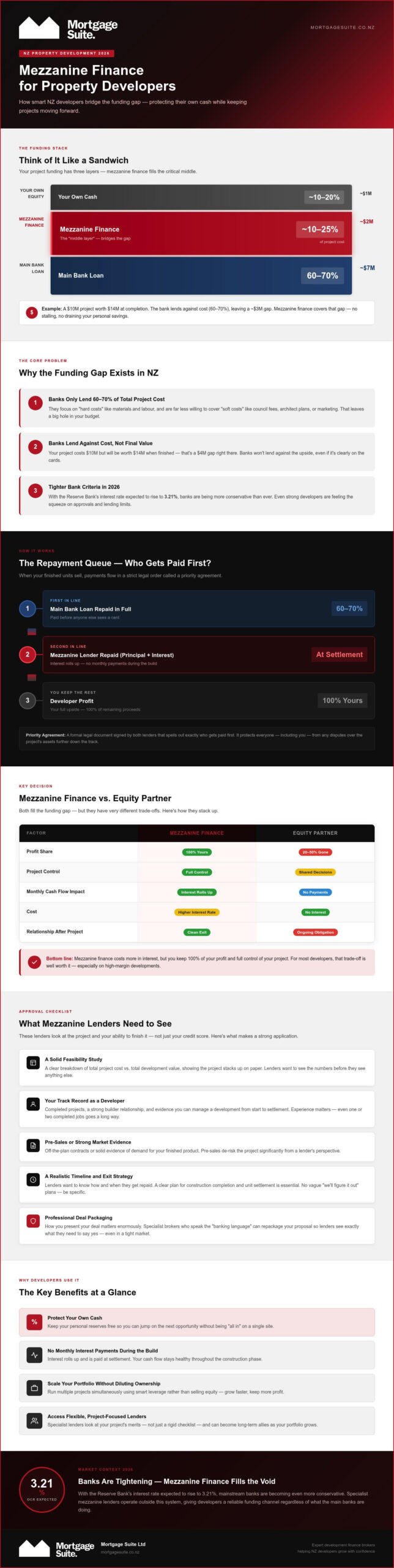
Imagine your project funding as a sandwich. At the bottom, you have the main bank loan. At the very top is your own hard-earned cash. In between, there is often a large, empty space because banks in New Zealand are being incredibly careful right now. This middle layer is where mezzanine capital sits. It acts as the bridge that connects what the bank is willing to give you and what you actually need to finish the job. For many, mezzanine finance for property developers NZ is the secret to moving a project from a plan to a reality without having to find millions of dollars in extra personal savings.
Some people worry that looking for extra funding is a sign that a project is struggling. In reality, it’s quite the opposite. Most high-level developers use this as a strategic tool. It allows them to keep their own cash free so they can jump on new opportunities when they appear. It’s about being smart with your money rather than being “all in” on a single site. Using this type of finance shows you’re focused on growth and scale.
Why the ‘Gap’ Exists in NZ Property Development
In 2026, bank criteria are tighter than ever. Banks are focusing heavily on lowering their own risk, often limiting their lending to 60 or 70 percent of the project’s total cost. They love “hard costs” like building materials and labour, but they’re often much less enthusiastic about “soft costs” like council fees, architecture plans, or marketing. This creates a hole in your budget that can be hard to fill with your own pocket money.
There’s also the difference between the “Total Development Value” (what the project is worth when finished) and the “Total Cost.” Banks usually lend against the cost, not the final value. If your project costs $10 million but will be worth $14 million, that $3 million gap is where you’d typically be stuck. Mezzanine funding steps in to cover that specific distance so you don’t have to stall your progress.
The Role of 2nd Tier Lenders in the Mezzanine Space
You won’t usually find this type of funding at your local high-street bank. It almost always comes from specialised lenders who sit outside the main banking system. These lenders are much more flexible because they don’t just look at a credit score or a rigid set of rules. They look at the project itself and your ability to finish it. They’re willing to stand behind the main bank because they understand the New Zealand property market and see the value in a well-planned development.
Working with these lenders requires a slightly different approach. They want to see a partnership rather than just a transaction. That’s where having an expert negotiator who understands the “banking language” makes all the difference. Packaging your deal so these lenders see the same potential in the project that you do is essential. When you present a solid case, these lenders can become your most valuable allies in scaling your business.
How Mezzanine Finance Works: The Mechanics of the ‘Middle Layer’
When you use mezzanine finance for property developers NZ, you are essentially entering into an arrangement where the lender agrees to stand second in line behind your main bank. If we look at the project as a queue for payment, the main bank is at the very front. The mezzanine lender is right behind them. They only get their money back once the main bank has been paid in full from the sale of your finished units. This position is why they are often more interested in the final success of your project than just your current bank balance.
To make this work, both lenders sign a legal priority agreement. This is a formal document that spells out exactly who gets paid first and how much they are entitled to before the next person in line gets a cent. It might sound like a lot of paperwork, but it is a standard part of the process that we handle regularly to ensure everyone is on the same page. Having this clear agreement in place protects you from lenders arguing over the project’s assets later on. It creates a stable foundation for the entire project’s funding.
One of the biggest advantages of this setup is how it treats your cash flow. Unlike a standard mortgage where you have to find money for monthly interest payments, this type of funding is usually added to the loan balance. This means the interest grows with the loan and is paid at the very end when the project is sold. You don’t have to worry about monthly bills while you are still in the middle of construction. It keeps your day-to-day money focused exactly where it needs to be: on the building site. If you want to see how this might look for your specific project, it’s worth having a quick chat with Mortgage Suite Ltd to map out the numbers.
The Ranking of Debt
Ranking of debt is simply the order in which lenders get paid. For you as a developer, this means the mezzanine lender sits behind the main bank. Because they are taking a bigger risk by standing second in line, they will want to see a very strong project plan. If things don’t go according to schedule, the bank gets paid first. This higher risk is why they charge more than a traditional bank, but the trade-off is the flexibility they provide to get your project moving when the bank stops lending.
Interest Rates and Fees: What to Expect
Since these lenders are taking on more risk, you can expect the costs to be higher than your main bank loan. You’ll typically see a fee to set up the loan at the start and sometimes a fee for the duration of the funding. However, because the interest is added to the loan balance, these costs don’t drain your project’s working capital during the build. It’s a strategic choice; you’re paying a bit more for the money, but you’re gaining the ability to keep your own cash for other projects or unexpected costs. It’s a powerful way to use mezzanine finance for property developers NZ to build more than you could with bank funding alone.
Mezzanine Finance vs Equity: Balancing Cost Against Control
When you find yourself staring at a funding gap, you generally have two ways to fill it. You can either take on more debt through a mezzanine loan or bring in an equity partner. While an equity partner might seem like an easy fix because there’s no interest to pay during the build, it’s often the most expensive money you’ll ever use. Most equity partners will want anywhere from 25 to 50 percent of your final project profit. Think about that for a second. You do all the work, manage the builders, and handle the council, yet you give away half the reward just to get the project across the line.
In contrast, mezzanine finance for property developers NZ is what we call non-dilutive capital. You pay a higher interest rate for the privilege of the loan, but you don’t give away any of your company or your project. Once the lender is paid back, every remaining dollar of profit stays in your pocket. It’s the best way to keep yourself in the driver’s seat while ensuring your project actually gets built. You aren’t just saving money; you’re protecting your future growth by keeping your profits for your next big move.
When Equity Makes More Sense
Debt isn’t always the right answer for every scenario. If a project is particularly risky or you’re entering a very volatile market, sharing that risk with a partner can be a smart move. If the project doesn’t perform as expected, the equity partner shares the loss with you. A lender, however, expects to be repaid regardless of the final outcome. We often sit down with developers to weigh up these structured finance options and find the balance that protects their interests while managing the overall risk of the development.
The ‘Return on Equity’ (ROE) Multiplier
The real magic happens when you look at how debt multiplies your personal returns. Let’s say your project makes a $1 million profit. If you had to tie up $2 million of your own cash to finish it, you’ve made a 50 percent return. But if you use mezzanine debt to cover the gap and only use $500,000 of your own money, that same $1 million profit represents a 200 percent return on your capital. You can use our mortgage calculator to see how debt levels affect your numbers and see the impact of different funding structures. It’s about making your cash work as hard as possible so you can scale your business faster and take on more projects at once.
Getting Your Funding Sorted: What Lenders Look for in a Developer
Securing approval for mezzanine finance for property developers NZ requires more than just a good plot of land and a set of drawings. You need to think like the lender. They aren’t just looking at the potential profit; they’re looking at the person behind the project. They want to see that you’ve thought through every possible hurdle and have a solid plan to clear them. It’s about building a case that proves the project is going to reach the finish line, no matter what the 2026 market throws at you.
Risk reduction is the name of the game. If you have pre-sales or pre-leases already lined up, you’re in a much stronger position. In a cautious market, these contracts prove that there’s real demand for your finished product. Most importantly, you need a crystal-clear exit strategy. Whether you plan to sell every unit or refinance the whole development into a long-term commercial loan, the lender needs to see exactly how and when they get their capital back. Success breeds trust, so showing your track record of previous completions is vital.
The Professional Feasibility Report
A lender will spend the most time looking at your feasibility report. This document needs to be airtight, covering everything from land costs and construction budgets to GST and a healthy contingency fund. Don’t be tempted to present a “best-case scenario” only. A slightly pessimistic scenario that still shows a profit is often more convincing to a seasoned lender than a perfect one. It shows you’re realistic and helps to minimise any concerns the lender might have about cost overruns. Having a professional Quantity Surveyor report ready to go is also essential, as it provides that crucial independent verification of your numbers.
Your Development Team and Pedigree
The people you choose to work with say a lot about your project’s risk level. Lenders want to know who is managing the build and who designed the plans. Choosing a builder with a strong reputation in New Zealand can actually make your application for mezzanine finance for property developers NZ much more attractive. We suggest presenting a professional CV that highlights your previous successes, including photos, budgets, and timelines of finished projects. You can read about our team’s 20 years of experience in NZ finance to see how we use our own history to help package your deal for the best possible outcome.
If you’re ready to get your project moving and want to see how to present your deal to the right people, let’s talk about your funding options today.
Why Partner with Mortgage Suite Ltd for Your Next Property Development
Finding the right funding is often the hardest part of the job. That is why having Krish Krishna in your corner is such a massive advantage. With over two decades of banking experience, he understands exactly how the system works from the inside. He isn’t just a broker; he’s a seasoned veteran who knows how to navigate the hurdles that often stop projects in their tracks. When you are looking for mezzanine finance for property developers NZ, you need someone who can speak the language of the big banks while also maintaining deep relationships with private funders.
We don’t just pass on your paperwork. We package your deal so it tells a compelling story. We highlight your strengths and address potential risks before the lender even asks. This approach makes your application irresistible to 2nd tier lenders who want to see a professional, well-organised project. Plus, we manage both your senior debt and your mezzanine layer. Having one point of contact for the entire funding sandwich saves you time and ensures both lenders are working in harmony rather than against each other. It’s about making the process as smooth as possible for you.
Whether you are building townhouses in Auckland or a commercial space in Christchurch, we have you covered. Mortgage Suite Ltd provides national coverage across all of New Zealand. We understand the local nuances of different regions and how they affect development costs and timelines. We are here to be your steady hand in a fluctuating market, ensuring you have the support you need to succeed.
We Speak the Language of Both Banks and Private Lenders
We bridge the gap between rigid institutional requirements and the flexible funding you actually need. Our reputation as dedicated negotiators means we don’t take “no” for an answer easily. We push back on banks and fight for the best terms on your behalf. We also believe in the “Mortgage School” approach. We take the time to educate you on your options so you can make the best decision for your business. You’ll never feel like just another file in a system; you’ll feel like a priority partner.
Ready to Scale Your Development Business?
If you want to grow your portfolio without draining your own cash, it’s time to look at smarter ways to fund your projects. Using mezzanine finance for property developers NZ can be the key to unlocking your next big opportunity. We handle the heavy lifting with the financiers and the mountain of paperwork, leaving you free to focus on the build. It’s a much easier way to operate. We invite you to reach out for a no-obligation chat about your next project. You can also see what other NZ developers say about working with us to get a feel for how we operate. Let’s get your next development moving.
Secure Your Funding and Scale Faster
Building a successful property portfolio in 2026 requires more than just construction skills; it demands a clever approach to capital. We’ve explored how bridging the gap between your bank loan and your own cash allows you to keep moving without draining your reserves. By choosing debt over equity partners, you protect your profits and stay in total control of your vision. It’s about working smarter with your available liquidity to ensure your projects never stall.
With over 20 years of banking and mortgage experience, we specialise in navigating the complex world of 2nd tier and development finance. We provide national service for developers across New Zealand, ensuring your deal is packaged perfectly for success. If you’re ready to see how mezzanine finance for property developers NZ can transform your next project, we’re here to help. Book a chat with Krish and the team to get your project funding sorted today. Your next big opportunity is waiting, and we have the steady hand you need to reach it.
Frequently Asked Questions
What is the main difference between mezzanine finance and a standard bank loan?
Mezzanine finance for property developers NZ sits behind the main bank loan and covers the funding gap that banks won’t touch. While a bank loan is secured by a first charge and covers 60 to 70 percent of costs, mezzanine debt is a second charge. It allows you to borrow more against the project’s value without needing as much of your own cash up front. It’s about getting higher leverage for your capital.
How much can I typically borrow through mezzanine finance in NZ?
You can typically borrow enough to bring your total funding up to 80 or even 90 percent of the project’s total cost. The exact amount depends on the project’s strength and your own track record. Instead of being capped by rigid bank limits, this funding looks at the final value of the development. It’s designed to fill that specific hole between your main loan and your personal equity.
Do I need to have a bank loan approved before I apply for mezzanine finance?
It isn’t strictly necessary to have the bank loan finalised, but it certainly helps the process move faster. Most mezzanine lenders want to see that a main lender is already on board or at least very interested in the project. We often work with developers to secure both layers of funding at the same time. This ensures the two lenders agree on the legal priority of payments before you start.
Is mezzanine finance more expensive than other types of property development loans?
Yes, the interest rate is higher because the lender is taking a bigger risk by standing second in line behind the bank. However, it’s often much cheaper than giving away half your profit to an equity partner. You’re paying for the privilege of keeping 100 percent ownership of your project. When you factor in the ability to start sooner and scale faster, the extra cost is often a smart strategic investment.
What happens if my project takes longer than expected to complete?
If your project runs over time, you can usually negotiate an extension with the lender to cover the extra months. Because the interest is added to the loan balance, you won’t have to find monthly cash to cover the delay, but the total amount you owe will increase. This is why having a healthy contingency in your initial study is so important. We help manage these conversations to keep your project moving.
Can I use mezzanine finance for land acquisition or just for construction?
While it’s most common for construction, you can use mezzanine finance for property developers NZ for land acquisition in specific cases. This usually happens when you’ve already secured resource consent or have a very clear plan for the site. Lenders prefer projects that are closer to the starting blocks of building, as this reduces their risk. It’s a great way to secure a site while keeping your cash for the actual build.
What are the common fees associated with mezzanine debt in New Zealand?
You’ll typically see an establishment fee at the start, along with legal costs for setting up the priority agreements. There might also be a management fee charged over the life of the project. Legal fees for both you and the lender are also standard, especially for setting up the Deed of Priority. We make sure all these costs are clearly outlined so there are no surprises when the project is finished.
How long does it take to get mezzanine funding approved and settled?
Approval can happen relatively quickly, often within a week or two if your feasibility study is ready to go. Settlement usually takes a bit longer as it requires coordination between your lawyer, the main bank, and the mezzanine lender. You should generally allow four to six weeks from your first chat with us to having the funds ready to draw. Being organised and having your reports ready is the key to a fast turnaround.