
Contractor Home Loan NZ: Getting Your Mortgage Sorted in 2026
What if your bank saw your contracting career as a sign of professional success rather than a massive risk factor? For many Kiwis, the dream of home ownership feels like it’s on hold because their income doesn’t arrive in a tidy, fortnightly payslip. If you’ve been told you need years of perfect books or a “standard” job to qualify for a contractor home loan nz, you’re likely feeling the frustration of trying to fit a square peg into a round hole.
It’s exhausting to deal with lenders who don’t seem to understand that your fluctuating monthly income is just part of a thriving, modern career. We know the paperwork mountain feels high, but securing a mortgage shouldn’t mean sacrificing your independence. This guide will show you exactly how to navigate the 2026 market, from organising the right documents to finding a lender who looks at the big picture of your finances. You’ll discover a clear path to getting your mortgage sorted without the typical big-bank stress and discover how to make your career choice work for your home ownership goals.
Key Takeaways
- Understand why big banks often struggle with non-standard income and how to bypass their rigid “computer says no” systems.
- Learn how to present your true earning power to lenders using simple methods that show your actual take-home pay, not just what’s on your tax return.
- Compare the benefits of the “Big Four” banks against flexible 2nd tier lenders to find the best contractor home loan nz for your unique situation.
- Follow our five-step checklist to organise your paperwork and clean up your spending before a lender even sees your application.
- Discover how a steady hand with decades of experience can turn a complex application into a successful home purchase.
Why Big Banks Often Give Contractors the Cold Shoulder
Banks are creatures of habit. They’ve spent decades building systems that love one thing above all else: a predictable, fortnightly payslip. If you don’t have one, you’re suddenly an outlier. A contractor home loan nz isn’t actually a different financial product; it’s just a mortgage application that requires a human being to look at your bank statements instead of a computer algorithm. While the core concept of what is a mortgage remains the same, the path to getting one is much steeper when you’re your own boss.
When you apply at a big bank, you’re often met with a “computer says no” response. This happens because their software is designed to flag anything “different” as a “risk”. In reality, being a contractor often means you’re more resilient and higher-earning than a salaried employee, but the bank’s rigid rules don’t see it that way. They see your business expenses, which your accountant uses to lower your tax bill, as a lack of income. It’s a frustrating paradox; the more efficient you are with your taxes, the less the bank thinks you can afford to borrow.
The Salary-Only Mindset vs. Your Reality
Traditional lenders struggle with invoices because they represent a “maybe”. They worry that if your current contract ends, your income disappears entirely. This “fluctuating income” myth is one of the biggest hurdles we help clients clear. At Mortgage Suite, we don’t just look at the bottom line on your tax return. We look at your industry experience, your contract history, and the true value of your business. We treat you like a partner, not a set of data points. If you’re feeling overwhelmed by these concepts, our Mortgage School is a great place to start getting educated before you apply.
Common Contractor Scenarios We See
Every contractor’s story is unique, but we see a few common patterns that big banks usually reject. We regularly work with people in these situations to find a way forward:
- IT Professionals: You might be on a high daily rate but only have a six-month contract. Banks see the end date; we see your high demand and niche skills.
- Tradies and Sole Traders: Your income might peak in summer and dip in winter. We help show the bank your annual average rather than a single quiet month.
- Creative Freelancers: Managing five different income streams can confuse a standard bank manager. We help pull those threads together into a coherent financial picture.
Cracking the Code: How Lenders Look at Your Income
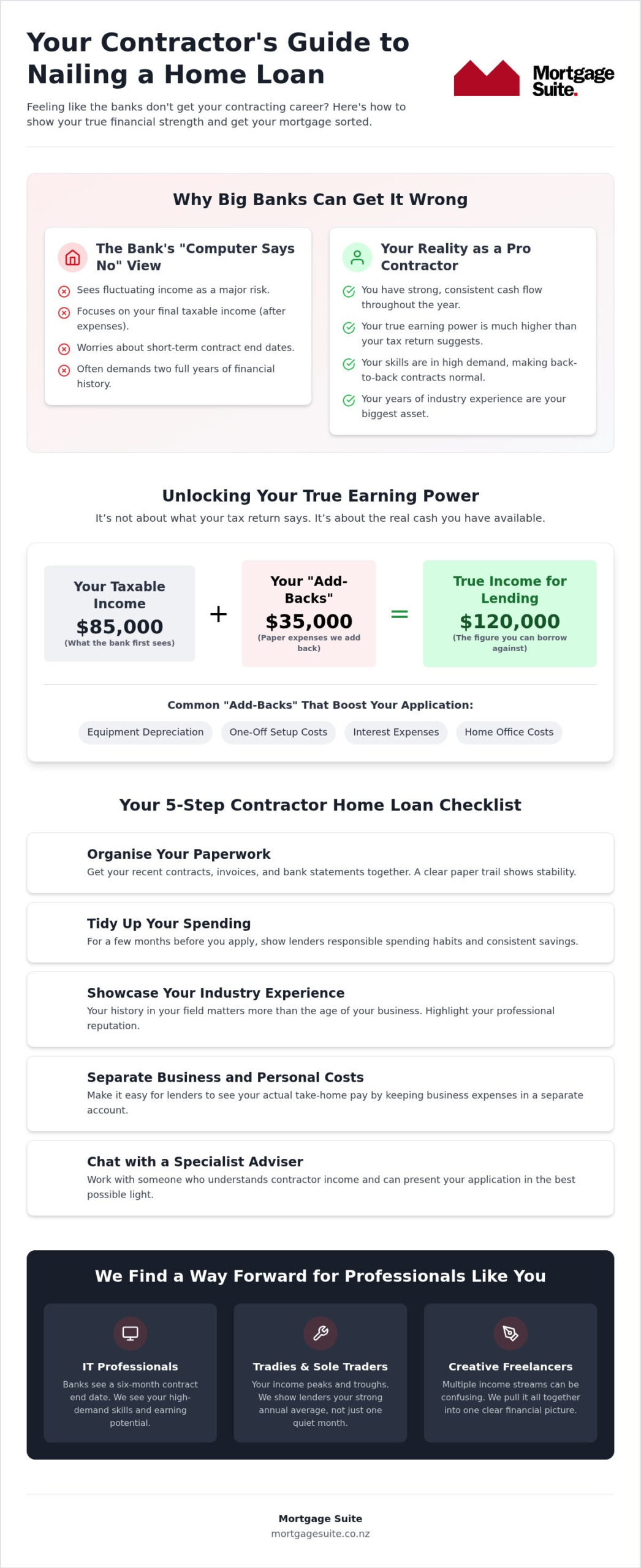
Understanding how a bank calculates your earnings is the absolute secret to a successful application. When you’re chasing a contractor home loan nz, the number your accountant gives you at the end of the financial year isn’t always the number the bank uses to decide if you’re a “yes”. Your accountant’s main goal is to keep your tax bill as low as possible, which is great for your wallet but can look like low income to a bank manager. This is where we show your true financial strength by looking at your “add-backs”. We take expenses that don’t actually cost you cash every month, like the drop in value of your equipment or a one-off office fit-out, and add them back to your profit. It’s a simple way of showing the lender that this money is actually available to cover your mortgage.
A seasoned expert knows that your history in your industry is your biggest asset. Lenders often care more about how long you’ve worked in your specific field than the length of your current contract. If you’ve spent fifteen years as a project manager but only started your own business last year, we can often present you as a very safe bet. We focus on building a file that highlights your professional reputation and your consistent ability to secure high-value work. Organising your application this way makes it much harder for a bank to say no just because your business is relatively new.
Taxable Income vs. Actual Cash Flow
Banks have a specific way of asking how much you can afford to pay back each week. They want to see your cash flow, which is the real money moving through your accounts. We help you identify one-off costs that shouldn’t hurt your chances, like a new work ute or a major marketing campaign. By separating these unique expenses from your regular living costs, we give you a fair go at proving what you can really afford to borrow. If you’re curious about how your income might translate into a loan, check out our mortgage calculator to see what’s possible today.
The Two-Year Rule: Is it Still Relevant?
You don’t always need two full years of accounts to buy a home in New Zealand. While the big banks are quite rigid about this, we frequently help people who only have one year of financial history. In many cases, we use alternative lenders as a helpful bridge. These companies are often much more flexible with newer businesses. This allows you to get the keys to your home today and then move your loan to a major bank once you’ve got a longer track record under your belt. Learn more about 2nd tier lending and how it can help you get around the strict two-year requirement.
Mainstream vs. 2nd Tier: Finding the Right Fit
Most Kiwis grow up thinking the major banks are the only places to get a mortgage. While these big institutions offer competitive rates for standard borrowers, they aren’t always the best choice for your first contractor home loan nz. These massive organisations operate like financial factories; they need every application to look exactly the same. If your income comes from multiple sources or your business expenses are high, you might find their systems aren’t built to handle your complexity. This is where alternative, or 2nd tier, lenders become a vital part of your strategy.
Specialist lenders don’t just look at a score on a screen. They employ real people who take the time to understand your industry and your earning potential. They often offer loans that require less paperwork, which means they might accept GST returns or bank statements instead of two years of full financial accounts. You’ll likely pay a slightly higher interest rate with these lenders, but it’s often a price worth paying to get into your home now rather than waiting years to satisfy a traditional bank’s strict criteria.
When to Choose a 2nd Tier Lender
Choosing an alternative lender is often a smart “stepping stone” strategy. If you’re a first home buyer who has recently started contracting, you might not fit the standard bank boxes yet. We often help clients secure a 2nd tier loan to get them into the property market today. Once you’ve built up a year or two of solid accounts, we can then help you move that loan back to a mainstream bank at a lower rate. It’s about getting the keys in your hand now so you can start building equity. Check out our Mortgage School for more tips on how to prepare for this transition.
The Pros and Cons of Non-Bank Loans
The biggest advantage of a non-bank lender is speed and a personalised approach. You aren’t just another number in a call centre queue. These lenders are often much faster at giving you an answer, which is crucial when you’re trying to buy in a competitive market. While the interest rate might be higher, the flexibility they offer can be the difference between buying a home and missing out entirely. We weigh these options with you to ensure the choice makes sense for your long-term goals.
| Feature | Mainstream Banks | 2nd Tier Lenders |
|---|---|---|
| Approval Speed | Often slow (7 to 10 days) | Fast (2 to 3 days) |
| Flexibility | Rigid, computer-led rules | Human-led, common sense |
| Income Proof | Full financials required | Accepts GST or bank statements |
Your Contractor Home Loan Checklist: Getting Sorted
Preparing for a contractor home loan nz is about more than just having a deposit. It’s about telling a financial story where you’re a reliable professional, not a risky outlier. To get bank-ready, you need to look at your finances through a lender’s eyes. This starts with your accountant. They aren’t just there to file your GST; they’re your primary witness. An accountant can provide a letter confirming your projected income or explaining that a large expense was a one-off business investment that won’t happen again next year.
One secret weapon many people overlook is an updated CV. While it sounds odd to bring a resume to a mortgage meeting, a professional profile showing a long history of successful projects proves to the bank that you’re in high demand. If your current contract ends, your CV shows you have the skills to land the next one immediately. This simple document turns you from a “temporary worker” into a “highly sought-after specialist” in the eyes of the credit team.
Before a broker even sees your file, take a few months to clean up your personal spending. Banks look closely at your uncommitted monthly income. Frequent small debts like buy-now-pay-later schemes or high-interest credit cards can significantly lower your borrowing power. We recommend following these five essential steps to get sorted:
- Collaborate with your accountant to frame your income correctly.
- Audit your bank statements and pause non-essential subscriptions.
- Refresh your professional CV to show career longevity.
- Clear small debts and close unused credit cards or personal loans.
- Organise your tax documents so everything is ready to go.
The Paperwork You Actually Need
Lenders want to see proof that your business is healthy. This means gathering your IRD income summaries and GST returns for the last year. While big banks might ask for more, having six months of clean business bank statements is often the most important factor. These statements prove the cash flow we discussed earlier. You’ll also need to show exactly where your deposit is coming from, whether it’s genuine savings, equity in another property, or a gifted sum from family.
Improving Your Chances of a “Yes”
Reducing your personal debt is the fastest way to boost your application. Even a credit card you don’t use with a $10,000 limit is seen as a potential debt by the bank. It’s also helpful to keep a buffer of cash in your business account to show you can handle a quiet month without stress. To get a better idea of your position, try using our mortgage calculator to see how your current debts might affect your borrowing. If you want a hand getting your documents in order, contact our team at Mortgage Suite for a personalised review.
How Mortgage Suite Navigates the Maze for You
Applying for a mortgage when you work for yourself can feel like walking through a maze where the walls keep moving. At Mortgage Suite, we see our role as the steady hand that guides you through every turn. Krish Krishna leads our team with over two decades of experience inside the banking industry. This isn’t just a number on a page; it means we know exactly how the people on the other side of the desk think. We don’t just fill out forms. We act as your dedicated negotiator, presenting your financial story in a way that makes sense to a lender’s credit department.
The big banks often have a rigid view of what a “safe” borrower looks like. We challenge that view by highlighting your professional potential and your industry reputation. Whether you’re looking for a standard bank mortgage or a 2nd tier loan that fits your current lifestyle, we handle the complex heavy lifting. This allows you to stay focused on your business while we manage the endless follow-ups and paperwork required for a successful contractor home loan nz application. We’ve seen every possible scenario and know exactly how to bridge the gap between your personal needs and the rigid world of institutional banking.
A Personalised Path to Home Ownership
We believe in straight talk. You won’t get any corporate lectures or confusing financial jargon from us. Instead, we offer a non-corporate experience that puts your goals first. Our process is designed to be as stress-free as possible, moving at your pace while ensuring every detail is perfect before it reaches a lender. We take pride in the relationships we build, and our client reviews show that we care about the person behind the loan, not just the numbers on the screen. We’re here to be your advocate, ensuring you get a fair go from the very start.
Ready to Get Started?
If you’re ready to see what’s possible, the first step is a simple, no-obligation chat. You don’t need to have all your paperwork perfectly organised yet. In a quick 15-minute consultation, we can look at your current situation and give you a clear idea of your options. We’ll explain how we can help you navigate the 2026 market and what the next steps look like for your specific career path. You can learn more about Mortgage Suite and our mission to help Kiwis who don’t fit the standard bank box. Let’s get your mortgage sorted together.
Take the Next Step Toward Your New Home
Contracting gives you freedom and flexibility, and your mortgage should reflect that success. By understanding how lenders view your income and preparing your file with a professional eye, you can bypass the “computer says no” culture of the big banks. Whether you need a mainstream bank or a flexible 2nd tier solution, the right strategy turns a complex application into a successful result. We’ve shown you that the paperwork mountain is manageable when you have the right guide by your side.
With over 20 years of banking and brokerage expertise, we know how to present your case to get a fair go. We specialise in alternative and 2nd tier lending solutions for those who don’t fit the standard box, acting as a dedicated advocate who knows exactly how to talk to the banks on your behalf. Securing a contractor home loan nz doesn’t have to be a mountain of stress. You’ve worked hard to build your career; now it’s time to make that career work for your home ownership goals.
Get your contractor home loan sorted with Mortgage Suite and take the first step toward the keys to your new home. We’re here to make the process simple, clear, and successful.
Frequently Asked Questions
Can I get a home loan with only 6 months of contracting history?
Yes, you can certainly secure a loan with six months of history, though you’ll likely need to look beyond the big banks. Most mainstream lenders prefer two years of accounts, but 2nd tier specialists often accept six months if you have a solid background in the same industry. We focus on showing the lender that your career is stable despite the recent change in how you’re paid.
Do contractors pay higher interest rates in New Zealand?
Contractors don’t automatically pay higher rates, but it depends on which lender approves your application. If your file is strong enough for a mainstream bank, you’ll get the same market rates as anyone else. If you require the flexibility of a 2nd tier lender to get your contractor home loan nz approved, you might pay a slightly higher rate. This is often a temporary step until you have more history.
Can I use my business income to buy a house if I am a sole trader?
You can absolutely use your sole trader income to buy a house. Lenders treat your business profit as your personal income. We work with you to identify “add-backs” like depreciation or one-off equipment costs that shouldn’t count against your borrowing power. This ensures the bank sees your actual cash flow rather than just the lower figure your accountant uses to reduce your tax bill.
How much deposit does a contractor need for a home loan in NZ?
Deposit requirements for contractors usually follow the same standard rules as salaried employees. For most first home buyers, a 20% deposit is the gold standard, though some schemes allow for as little as 5% or 10% depending on the property. If you’re looking at an investment property, you’ll generally need closer to 30% or 35% to satisfy current New Zealand lending restrictions and bank policies.
What happens if my contract is about to end?
Having a contract near its end date isn’t an automatic “no” if we can prove your future earning potential. We use your professional CV and industry history to show the bank that you’re in high demand and likely to secure a new contract quickly. Providing a letter of intent from your current client or showing a history of back-to-back contracts helps alleviate the bank’s concerns about potential income gaps.
Can I get a “low-doc” loan as a contractor in 2026?
Low-doc loans are a very real option in 2026, especially through alternative lenders. These loans allow you to prove your income using GST returns or business bank statements instead of full, accountant-prepared financial statements. This is a popular choice for contractors who haven’t completed their first full year of trading but have a clear and consistent stream of income hitting their business accounts every month.
Does being a contractor affect my ability to get a first home grant?
Your employment status doesn’t stop you from getting a first home grant, but your total income must stay under the government caps. The key challenge for contractors is proving their taxable income for the previous 12 months. As long as you can provide the correct IRD summaries and meet the standard criteria, you’re just as eligible as a salaried worker to access these government support schemes.
Is it better to apply as an individual or through my company?
Most lenders will look at your total household or global income regardless of whether you’re a sole trader or a company director. Even if you trade through a company, the bank will usually require you to be a personal guarantor for the loan. We help you structure the application to show your income in the most favourable light, ensuring the bank understands the full picture of your finances.