
Technical Guide: How Much Can I Borrow for a Mortgage NZ
Your final home loan cap in New Zealand rests on bank serviceability tests and debt-to-income caps, not on a headline rate alone. Before you chase a listing, you need clear answers to three linked questions: how much a lender will fund against your income, how large a deposit you must show, and whether stretching to the edge of that limit still leaves you room to live. Work through those decision points in order and you avoid months of mismatched applications.
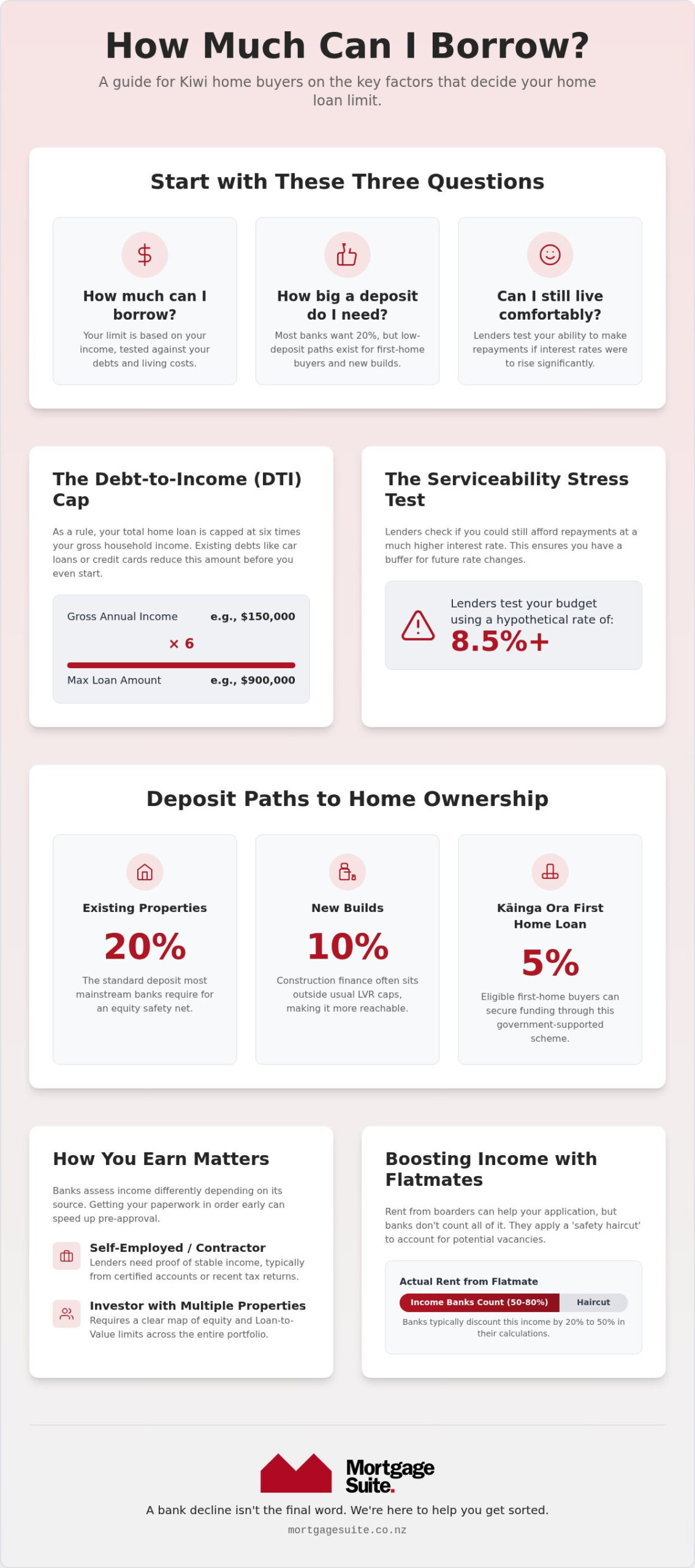
Key Takeaways: Your maximum mortgage borrowing in NZ is generally capped at six times your gross income under 2024 debt-to-income (DTI) limits and bank serviceability tests.
- Lenders apply a serviceability stress rate of 8.5% or higher to test your repayment capacity.
- Except when buying new builds, most mainstream banks require a 20% deposit for existing properties.
- Therefore, first-home buyers should target the Kāinga Ora 5% deposit scheme if savings are modest.
- Boarder income can boost eligibility but banks typically apply a 20% to 50% safety haircut.
Match your NZ borrower category before you apply
Banks do not treat every earner the same way, so the first useful step is naming the file type you will present.
- Self-employed contractor: put certified accounts or tax returns in order early; lenders want proof of stable income before they discuss a figure.
- Investor balancing several properties: map equity and Loan-to-Value limits across the portfolio so one highly geared title does not drag the whole application down.
Your home loan capacity depends mostly on that borrowing group. A contractor home loan is assessed very differently from a standard wage earner’s file, and criteria shift with how you earn. Naming your real category early helps you avoid mainstream declines that simply mean the file sat in the wrong queue. If you want local guidance, the team at Mortgage Suite negotiates directly with lenders as your supportive advocate. Book a short chat when you are ready to place your file in the right path.
How lenders set the figure you can actually borrow
Lenders build your borrowing power by subtracting living costs and debt commitments from total gross household income, then testing the remainder at a higher serviceability rate. They are not only looking at today’s fixed rate; they want proof you can still meet repayments if rates rise. Existing personal loans tighten debt-to-income scaling and shrink the final limit, and each bank treats board income, overtime, and living costs differently.
Tailored packaging is what secures approval. A decline from your main bank usually means your setup did not match that bank’s formula, not that you are locked out of the market. We act as your personal negotiator so the right lender sees your true financial strength. You can browse notes on borrowing power for more on how assessments differ, then book a friendly review of your own numbers when you want a concrete figure.
Deposit size that unlocks mainstream and low-deposit paths
Most New Zealand banks prefer a 20% equity safety net on existing property. Saving that sum is hard work, and standard Loan-to-Value settings limit how much high-ratio lending mainstream lenders will book. Low-deposit routes still exist. You may need only a 10% cash cushion if you meet targeted criteria, and eligible first-home buyers can secure funding with a 5% deposit through the Kāinga Ora 2026 First Home Loan programme.
Building a new home often sits outside the usual equity caps, which is why some buyers find construction finance more reachable than a second-hand purchase at the same price point. A decline from one bank manager is not the end of a homeownership plan; clear alternative pathways still reach lenders when the file is presented well. The Mortgage Suite team can walk through your deposit options in a no-obligation chat.
Tip: Check whether your prospective flat triggers the small-unit rule, as lenders may demand a higher deposit percentage.
2024 DTI limits cap your max borrowing capacity
New Reserve Bank settings restrict a home loan to six times your gross income. High earners who already carry personal debts feel the pinch first, because every store card or car loan consumes servicing space before the mortgage is even typed in. Picture your borrowing limit as a bucket: existing debt fills it before mortgage funding gets a turn.
These caps are designed to keep household debt manageable, even when they frustrate a purchase timeline. A bank decline on DTI grounds is still not the end of the path. As dedicated negotiators, we review alternative funding structures when the first formula falls short. Client stories on our testimonials page show how tightly packaged applications move through complex criteria.
Among Mortgage Suite Ltd’s Google reviews, Baycom (5★) wrote:
"We have dealt with Krish for over 20 years and in that time we have purchased 5 properties. Krish is knowledgeable, professional, and responsive. We would highly recommend Krish and Mortgage Suite to anyone looking to invest in property, Steve & Rosie Bower"
Situation: a household already holding several properties needed fresh funding of $200,000 under tighter income caps. Solution: long-running advice and responsive packaging across purchases. Result: five properties settled over two decades with the same adviser relationship intact. An experienced adviser helps you read strict lending caps without giving up a sound long-term plan.
How flatmate rent can lift your borrowing capacity
Boarder income can raise overall borrowing capacity, yet mainstream banks usually count only a portion of it. Lenders apply a safety haircut so vacancy does not break the file; current market practice is a 20% to 50% discount when that cashflow enters the debt-to-income maths. Banks also run boarder payments through the higher serviceability stress rate, so the boost is real but smaller than the raw rent total.
Taking in flatmates remains a practical move for a single buyer who needs extra servicing room on a first purchase. If assessors will not accept your full boarder figure, negotiation with other lenders is the next step rather than abandoning the income line altogether. We put that case directly to the credit desk when the first pass looks too thin.
Serviceability stress tests cut what you can bid
Banks set your maximum borrowing limit with a serviceability stress test: a hypothetical repayment check at a higher interest rate to probe future affordability. Real fixed rates matter less inside the calculator than those test rates. When actual fixed rates sit well below the test rate, the bank still judges your income against the steeper threshold, and that gap trims the price you can bid.
| Assessment Type | Typical Interest Rate | Impact on Affordability |
|---|---|---|
| Actual Fixed Rate | Current market level | Sets actual monthly repayments |
| Bank Stress Rate | 8.5%+ | Reduces calculated borrowing cap |
Test rates can penalise higher incomes harder than you expect, because the same loading is applied across the board. If the stress figure leaves your shortlist out of reach, flexible non-bank or second-tier structures are worth comparing before you rewrite your property brief. Mortgage Suite acts as your personal advocate when you need that comparison done without sales pressure.
Paperwork that speeds your pre-approval
Organised files move lender assessments faster, and gathering paperwork early removes a common source of delay. Treat the pack like a road-trip checklist: one missing item stalls the whole trip.
- Verify income: recent payslips, or certified accounts if you are self-employed.
- Show savings: bank statements that prove deposit funds and a genuine savings history.
- List debts: a clear debt-to-income summary, including credit cards.
- Detail living costs: an accurate monthly household expense breakdown for the lender.
A contractor home loan usually needs two years of trading history or current contracts on the desk. Mainstream hurdles do not have to stop the process when the file is complete and directed to a lender that accepts your income type. Reach out for a confidential chat when you want a second pair of eyes on the pack before you submit.
When stretching your borrowing limit is a bad move
Maxing out mortgage potential leaves little shield against rate rises or sudden lifestyle bills. Squeezing every last dollar from an assessment often backfires once the unexpected lands. A buffer is what keeps the household steady when life shifts.
Treat the limit like a rubber band: pull it to the edge and any extra tension snaps the budget. Passing a serviceability stress test shows you can pay on today’s assumptions; it does not price future cost spikes. Borrowing below your theoretical maximum is often the steadier choice if you want sleep at night as well as keys in the door. If the numbers feel tight, ask us to model a safer cap before you sign a sale and purchase.
Secure your pre-approval with non-bank options
A bank decline is rarely the end of a property plan. Alternative lenders supply a useful safety margin when mainstream credit policy says no. Non-bank institutions often apply more flexible criteria for complex income or smaller deposits, and they look past a single computer scoreboard.
Use that path as a springboard when you need short-term flexibility, then refinance later if your profile fits a bank book. At Mortgage Suite we act as your dedicated advocate through pre-approval and drawdown, so the credit story stays consistent from first call to settlement. Contact the team for a confidential chat when you want those options laid out side by side.
Frequently asked questions
How much can you afford to repay?
Your affordable repayment depends on total household income, living expenses, and current personal debts. Lenders review day-to-day spending to confirm enough remains for ordinary life after the mortgage leaves the account. We help you line those figures up so the repayment you offer is one you can sustain.
How much will a bank lend on a property?
Banks set a maximum by running a serviceability stress test across income and expenses, using a higher test interest rate to guard against future increases. They also apply debt-to-income caps to the overall funding total. If one bank declines, our team compares alternative lenders that read the same numbers under different policy settings.
How much of my income can go to mortgage repayments?
Most lenders prefer home loan repayments at no more than 30–35% of gross income. Staying inside that band leaves room for bills you cannot defer. Each bank weights household size slightly differently, so a short adviser conversation clarifies where your file sits.
What percentage of a property’s value can banks lend?
Banks usually lend up to 80% of value on owner-occupied homes under standard Loan-to-Value settings. First-home buyers with smaller deposits can sometimes borrow a higher share when they meet low-deposit criteria. A smaller flat may attract a higher deposit demand under small-unit policy. We can test your case across more than one lender credit desk.
What is a minimum surplus or UMI and how much is needed?
Uncommitted Monthly Income is the cash left after bills, living costs, and loan repayments. Lenders want a positive surplus buffer, often $1,000 each month, as evidence you can absorb a surprise expense. Mortgage Suite works with lenders to present that surplus clearly so the buffer you actually run is the one on the page.
Getting sorted with your home loan
Working out how much you can borrow for a mortgage across NZ starts with the same three decision points you met at the top: servicing capacity, deposit path, and whether the limit you are offered still leaves a liveable buffer under debt-to-income and stress-test rules.
Mainstream criteria can feel opaque, and a decline is rarely the end of your options in 2026. Mortgage Suite Ltd advisers act as your personal advocate, comparing non-bank alternatives and negotiating structure when the first formula does not fit. If you want clarity on your borrowing capacity, contact the team for expert mortgage advice.