
NZ Property Development Loan Requirements 2026
A lender’s decision on a development project depends on more than the land or your borrowing history. Lenders may also assess whether the plan can be delivered, whether the numbers make sense and how the loan will be repaid. That can make property development loan requirements nz feel unclear, especially if you’re unsure which documents to prepare or how your experience and project structure will be assessed.
It’s reasonable to want a clear picture before you apply. This guide explains the main areas lenders may assess and the project information that can support an application, including plans, budgets, building contracts and funding stages. You’ll also learn how project progress can affect the drawdown process and what options may be available if a mainstream bank’s criteria don’t fit. Mortgage Suite provides property development finance and helps organise project information and negotiate with lenders. Founder Krish Krishna brings more than two decades of banking experience to these discussions. A bank decline isn’t always the end of the conversation. Understanding what may suit your project is a practical next step.
Key Takeaways
- Property development loan requirements nz can vary according to the lender, project type, stage and funding structure.
- Lenders may consider your experience, finances, project feasibility, security and plan for repaying the loan.
- Grouping supporting documents into clear categories can help you prepare a more organised application.
- Review your project assumptions, timeline and repayment plan so you’re ready to discuss delays or changes.
- A finance adviser can help present your project to lenders and explore suitable funding pathways if a mainstream bank isn’t the right fit.
Property development loan requirements in NZ: what lenders look at first
In brief: Lenders usually consider the borrower, project, available security and proposed repayment plan together. The property development loan requirements nz applicants face can vary with the lender, project type, development stage and funding structure. There isn’t one document or criterion that applies to every application.
A lender is assessing the project’s risks as a whole: who will deliver it, whether the plan appears workable, what property supports the borrowing and how you intend to repay the loan. A clear application connects these elements and explains how the project is expected to progress.
What does a property development lender assess?
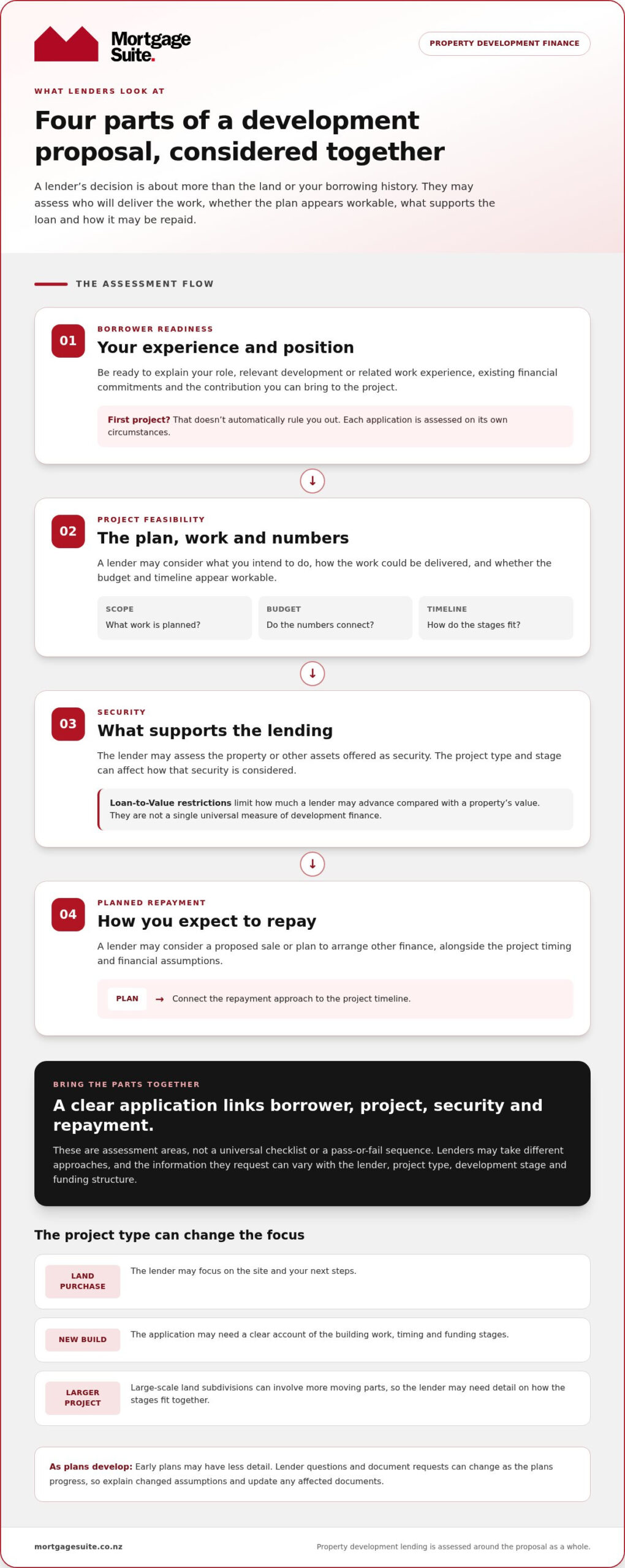
Four broad areas help a lender build a picture of your proposal:
- Your experience and position: Your background may help explain your ability to manage the work. A lender may also consider your financial position and existing commitments.
- The project plan: The lender needs to understand what you intend to do, how the work may be delivered and whether the project appears financially workable. Development can involve connected stages, from acquiring land through to construction, as outlined in this real estate development process.
- Security: The property or other assets offered as security help the lender assess what supports the loan. The project type and stage may affect how that security is considered.
- Repayment plan: The lender will want to understand how you propose to repay the borrowing, such as through planned sales or by arranging other finance. The plan should fit the project timeline.
These are assessment areas, not a universal checklist. The evidence a lender requests depends on the application. Organising your information around these points can help you explain the proposal clearly.
Why development loan requirements differ between projects
A request to fund a land purchase may focus on the site and your next steps. A new build may need a clear account of the building work, timing and funding stages. A larger project, such as large-scale land subdivisions, can involve more moving parts, so a lender may need detail on how the stages fit together.
Project stage matters too. Early plans may have less detail than a project that’s further along. Lender questions and document requests can change as the plans develop, and lenders may take different approaches. The phrase property development loans in NZ covers a range of funding situations rather than one standard application. Start by organising information around your specific project and what is known at its current stage.
How lenders assess your experience, finances and project plan
A lender looks at how your background and finances fit the project, not just whether the land appears suitable. Property development loan requirements nz can differ between lenders, so use these assessment areas as guideposts rather than a pass-or-fail checklist.
Borrower readiness: What experience, financial commitments and contribution do you bring? Relevant development experience can show how you’ve handled similar work and help a lender understand your role in delivering the project. If this is your first project, that doesn’t automatically rule you out. Each application is assessed on its own circumstances.
Project feasibility: Does the plan appear workable? A clear description of the work, budget and timeline helps explain what you intend to do, how the stages connect and what could affect delivery.
Security: What property or other assets are being offered to support the lending? Owning suitable land may form part of the picture, but it doesn’t guarantee finance. The lender also considers the borrower, proposed work and repayment plan.
Planned repayment: How do you expect to repay the loan? A lender may consider your proposed sale or refinancing plan alongside the project timing and financial assumptions.
How your background and financial position may be considered
Be ready to explain your role in the project and any relevant experience, whether from previous developments or related work. Lenders may also consider your existing commitments and the contribution you can bring to the project. Together, these details give a fuller picture of your borrowing position.
How a lender may review project feasibility and security
A joined-up plan makes it easier to see how the budget, timeline and intended work relate to each other. If an assumption changes, explain why and update any documents it affects. For general property-sector context, Property Council New Zealand shares information about the industry, while lender decisions depend on the individual proposal.
Loan-to-Value restrictions are limits on how much a lender may advance compared with a property’s value. They aren’t a single universal measure of development finance. The lender, project and funding structure can all affect how security is assessed. Mortgage Suite helps organise these parts into a clear application and discuss how to present your circumstances. You can also learn about Mortgage Suite’s approach to supporting borrowers through lending decisions.
Which documents can support a property development loan application?
A well-organised application connects your circumstances with the project plan. For property development loan requirements nz, requested documents vary by lender, project type and stage. Use this preparation checklist as a starting point, then tailor it to the information available for your project. Some items may not apply, and a lender may request other evidence.
Borrower and project information to organise
- Borrower: Identification, details of your financial position and existing commitments, and information about the project’s ownership structure.
- Experience: A summary of relevant project history, including your role and examples of completed work, if applicable. This helps explain who will manage delivery.
- Land or property: Information about the site, its ownership and any existing lending secured against it. A valuation or other property report may also be requested.
- Project: A short project summary, development plans, timeline, budget and proposed funding schedule. Make clear what work is planned and when funding may be needed.
- Repayment plan: An outline of how you expect to repay the borrowing, supported by relevant sale plans or proposed arrangements for refinancing, where applicable.
Planning, building and technical documents
Depending on the project, supporting material may include council information, consent documents, architectural or engineering plans, building reports, contractor details and building contracts. For construction, show the costs and timing for siteworks separately from base construction where that distinction helps explain the budget. A staged funding schedule can also show how these items relate to the drawdown process, the release of funds as agreed milestones are completed.
Council requirements and available evidence can differ by project and current council processes. The NZ Government Building Process guide offers information about building a home, including consents and building stages. Documents relevant to a subdivision may differ from those for a single new build.
Check that figures and dates match across your plans, contractor quotes, reports and funding schedule. If a quote changes, update the budget and timeline, or clearly explain the difference. Consistent information gives the lender a clearer view of the proposal and makes questions easier to answer. For more plain-English guidance, explore Mortgage Suite’s Mortgage School lending guides.
How to prepare for lender questions about risk and repayment
Lenders may ask what could change during the project and how you’d respond. Clear answers won’t guarantee approval, but they can show how your budget, timeline and repayment plan fit together.
- 1. Review your assumptions. Check that your budget reflects the planned work, including expected changes in scope. Note what each estimate is based on and which figures are still provisional.
- 2. Test the timeline. Set out the main project stages and consider what a delay at each point could mean for later work, funding needs or a planned sale. Record key dates and dependencies rather than relying only on a best-case schedule.
- 3. Organise your evidence. Keep plans, quotes, reports and funding schedules together, and make sure the figures and dates agree. If an assumption changes, update related documents or explain the difference.
- 4. Explain repayment. Describe how you expect to repay or restructure the lending and how that plan connects with project progress. Be ready to explain what could affect the timing.
How to present a clear project budget and timeline
Show how the budget lines up with project milestones and when funds may be needed. For example, if site preparation comes before building work, show those stages separately where that helps explain the funding schedule. Flag important assumptions, such as the timing of work, and explain how a change could affect the budget or completion date.
A quantity surveyor report may be useful for some projects, particularly where a lender needs more detail to understand building costs. It isn’t a universal requirement. The aim is to give a consistent, realistic picture of the work, not to suggest that every uncertainty has been removed.
How to explain the repayment or exit plan
An exit plan is how you expect to repay the development loan or restructure the lending. Depending on the project, this could involve selling completed property or arranging a Refinance. Explain the steps behind your proposal, the timing you’re working towards and the evidence that supports it. A lender may consider whether the plan fits the project’s progress, rather than treating a proposed sale or refinance as certain.
If your assumptions or timeline change, update your repayment plan too. Mortgage Suite helps organise project information and present your proposal to lenders. For general borrowing context, you can use the mortgage calculator, but remember that a calculator can’t assess a development project or predict a lender’s decision.
Getting development finance sorted with a clear application plan
Development finance can feel like a lot to pull together, especially when the project is still taking shape. A clear application plan helps you explain what you’re building, what’s already in place and how you expect to repay the borrowing. Property development loan requirements nz vary, so focus on presenting your project accurately rather than trying to fit a one-size-fits-all checklist.
What to prepare before discussing your project
Start with a short summary that gives a lender the essentials. Include:
- Project type and stage: Explain whether you’re buying land, starting a build or progressing a subdivision, and what has happened so far.
- Ownership structure: Set out who owns or will own the property and who is involved in the borrowing.
- Objectives: Describe what you plan to complete and your intended repayment approach.
- Supporting information: Bring together available financial details, property records, council or planning information, project plans, budgets, quotes and timelines.
Some details may still be developing. Mark estimates clearly and note what could change, so the application doesn’t present an assumption as a confirmed figure. You can read about Mortgage Suite and its approach to helping borrowers with lending decisions.
How Mortgage Suite can help you consider lender options
Mortgage Suite helps organise your information, identify gaps and present your project so its stages and funding needs are easy to follow. We act as your personal advocate, working with you to explain the proposal and negotiate with lenders. This can include mainstream and alternative lending channels, depending on the project and lender fit. Each lender makes its own decision, so finance can’t be guaranteed.
A mainstream-bank decline can be disappointing, but it isn’t necessarily a final judgement on your project or the end of your funding options. Another lender may assess the proposal differently, while still looking closely at its risks and repayment plan. You can read client reviews to learn about other borrowers’ experiences.
Mortgage Suite founder Krish Krishna brings more than two decades of banking experience to development finance discussions. If you’re preparing an application or reconsidering your options after a decline, Mortgage Suite can help you understand your project-specific funding needs and work out a sensible next step.
Take the next step with a clearer funding plan
Understanding property development loan requirements nz starts with seeing the whole picture. Lenders may assess your experience and financial position alongside the project plan, security and intended repayment. Clear supporting documents, consistent figures and a realistic timeline can help explain how the project fits together. Requirements vary between lenders and projects.
If a mainstream bank has declined your application, that doesn’t automatically mean the project has no funding options. Mortgage Suite helps organise development finance applications and consider mainstream and alternative lending pathways. Founder Krish Krishna brings more than two decades of banking experience to those discussions, with a focus on understanding your circumstances and presenting your project clearly. Approval can’t be guaranteed, but a thoughtful funding conversation can help you identify a practical next step.
Talk through your development finance options with Mortgage Suite. A clear plan can help you approach your next steps with greater confidence.
Frequently Asked Questions
What do lenders look for in a property development loan application in NZ?
Lenders usually assess your experience and financial position alongside the project plan, security and proposed repayment. They’ll want to understand who is managing the work, whether the budget and timeline make sense, what supports the lending and how you expect to repay it. The property development loan requirements nz applicants face vary by lender and project, so prepare clear information rather than relying on a universal checklist.
How much equity do I need for a property development loan?
There’s no single equity amount that applies to every development loan. The contribution a lender expects can depend on the project, its stage, the security available and the funding structure. A lender may consider how your contribution fits with the overall budget and project risks. Before committing to a plan, get guidance on which lender criteria may suit your circumstances.
Can I get a development loan if I have not completed a project before?
Possibly. Being new to development doesn’t automatically exclude you, but a lender may want to understand how the project will be delivered. Explain your role, the experience of others involved and how the work will be managed. A clear project plan, realistic timeline and well-organised supporting information can help a lender assess the application, though they can’t guarantee approval.
What documents do I need for a property development loan?
Documents may include identification and financial details, property and ownership information, project plans, a budget, timeline, contractor quotes and relevant council or planning information. You may also need to explain how you intend to repay the loan. The exact evidence varies by lender and project stage. Keep figures and dates consistent across your plans, reports, quotes and funding schedule.
Do I need council consent before applying for development finance?
Not necessarily in every case. The information a lender requests can depend on the project, its current stage and the relevant council process. You may be asked for council information, consent documents or an update on planning progress, but don’t assume every application follows the same sequence. Set out which approvals or information you have and what remains underway, so the project status is clear.
Can I get a property development loan after a bank declines my application?
Possibly. A decline from one bank doesn’t automatically mean your project has no funding options. The decision may reflect that lender’s criteria or how the application was presented. Reviewing the reasons, project details and available evidence can help clarify next steps. Mortgage Suite assists with development finance and alternative lending options, but each lender makes its own decision and approval isn’t guaranteed.
How are development loan funds released during a project?
Some development or construction finance uses a drawdown process, meaning funds are released in stages as agreed project milestones are completed. The lender’s terms explain how releases work and what evidence may be needed at each stage. The process can vary, so align your funding schedule with the work timeline and allow for the lender’s requirements when planning cash flow.