
Getting a mortgage in your 50s in NZ: balancing repayments and retirement
Getting a mortgage in your 50s in NZ calls for a clear plan for when the loan will be paid off and whether repayments will stay manageable if your income changes. The key isn’t simply your age; it’s whether the loan fits your expected income, retirement plans and day-to-day budget.
It’s understandable to feel cautious about taking on a long-term commitment while also thinking about retirement. New Zealand retirements may last 25 or 30 years, so balancing mortgage payments with the life you want later deserves careful thought. This guide explains how to test repayments against possible income changes, weigh mortgage payments alongside retirement savings and consider ways to keep your options flexible. You’ll also find practical steps for working out what a comfortable loan could look like for your circumstances.
Key Takeaways
- Assess when the mortgage could be paid off and whether repayments would remain manageable if your income changes.
- Set a budget that balances mortgage payments with your retirement plans and everyday needs.
- Consider how options such as downsizing or part-time work could affect your repayment plan.
- Build flexibility into your approach so you can adapt as your circumstances and priorities change.
- Plan for a retirement that may last 25 or 30 years, rather than focusing only on the first years after work.
1. Assessing mortgage repayment affordability as income changes
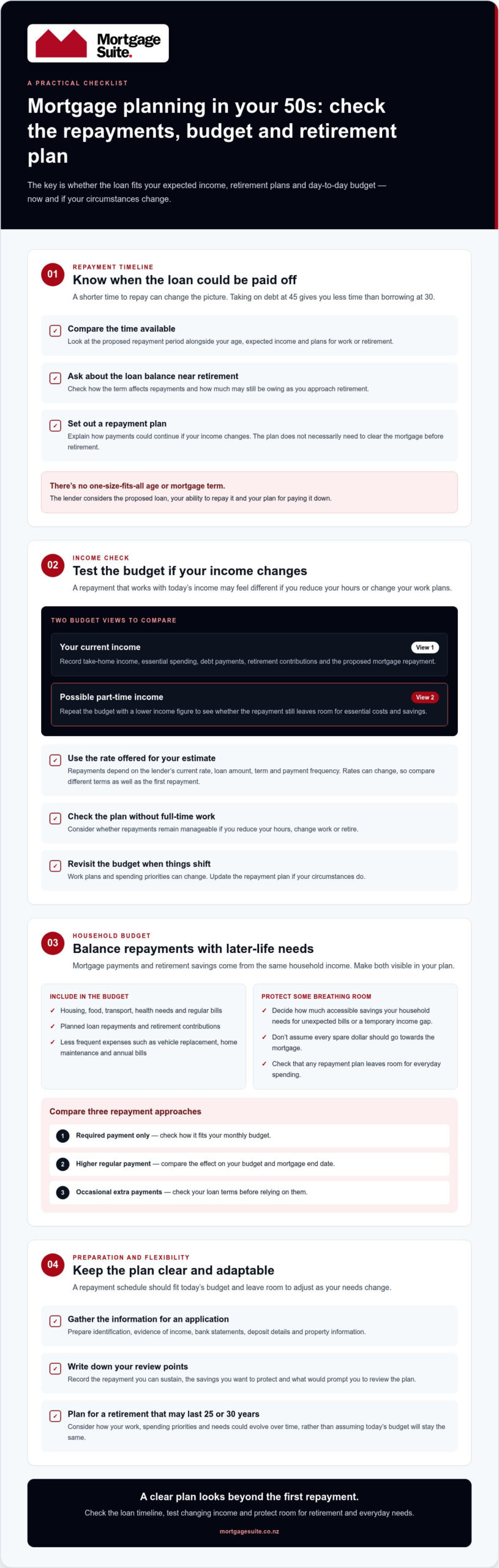
Taking on debt at 45 gives you a shorter available timeframe than borrowing at 30. For Kiwis getting a mortgage in their 50s in NZ, the key question is how repayments fit now and if income changes before the loan is cleared.
Compare borrowing in your 50s with borrowing in your 30s or 40s by looking at the time available to repay and your expected income. A borrower taking on more debt at 45 has a shorter timeframe than someone borrowing at 30. In your 50s, consider how a change in hours, work or retirement plans could affect each repayment.
New Zealand banks assess the proposed loan, repayment ability and plans for paying it down. There is no single mortgage term or maximum age figure that applies to every borrower; the lender considers the loan alongside your income and repayment plan. Ask how the term would affect repayments and the balance remaining as you approach retirement.
Banks may expect a plan for repaying the mortgage, but that plan doesn’t necessarily mean clearing it before retirement. Set out how repayments could continue if your income changes, and whether you expect to keep working, reduce hours or use another source of funds. People in their 50s and early 60s should assess when the mortgage is likely to be paid off and whether payments remain manageable if income shifts.
There is no single deposit amount for every New Zealand borrower in their 50s. The deposit needed depends on the property price, the amount borrowed, your available funds and the lender’s assessment. Work out how much you can contribute, then check the proposed loan against your budget and other commitments.
Mortgage rates and repayments depend on the lender’s current rate, loan amount, term and repayment frequency. Rates can change, so use the actual rate offered to estimate payments; Mortgage Suite’s mortgage calculator can help you explore repayment scenarios. Compare the effect of different terms, not just the first repayment amount.
Taking out a mortgage close to retirement can leave less room in your budget if income falls or costs rise. A longer repayment period may also mean carrying debt later in life. Test whether the payments would remain manageable without relying on full-time work.
To prepare an application, set a repayment budget and list your income, regular expenses and debts. Gather identification, evidence of income, bank statements, deposit details and property information. These records help show how the loan could fit your circumstances and support a clear discussion with the lender.
Many people in New Zealand do not stop working at age 65 and then spend the following 25-30 years simply living without further changes in priorities or needs. When testing affordability, consider how your work plans and spending priorities could evolve, rather than assuming today’s budget will stay unchanged. Check whether repayments would still fit if you reduced your hours or changed how you use your income, and revisit the plan if your circumstances shift. A repayment schedule that works now should also leave room to adapt as your needs change.
2. Balancing mortgage repayment with retirement savings
A mortgage and retirement savings both draw on the same household income. Start by listing essential costs, planned loan repayments and the amount you can set aside for later life. This gives you a clearer view of what remains for everyday spending. For someone in their 50s, the balance should reflect their expected retirement date and the mortgage’s likely finish date.
Build a retirement budget covering housing, food, transport, health needs and regular bills. Compare it with your expected income and any mortgage payments still due. If your budget relies on clearing the home loan, check that the repayment schedule supports that plan.
Try a simple monthly comparison. In one column, record your take-home income, essential spending, debt payments and retirement contributions. In a second version, reduce the income figure to reflect a possible move to part-time work. If the mortgage fits only the first version, consider a smaller loan, a different term or a repayment plan that leaves more room.
Don’t treat every spare dollar as mortgage money. Extra repayments can reduce the balance faster, but accessible savings can help cover an unexpected bill or temporary income gap. Decide how much readily available money your household needs before committing surplus cash to repayments. Review that decision when your work, health or family responsibilities change.
Compare three repayment approaches: the required payment only, a higher regular payment, and occasional extra payments when income allows. Record how each affects your monthly budget and the mortgage end date. Check how extra payments work under your loan terms before relying on them. Your plan should remain manageable in ordinary months, not just when income is higher.
Include less frequent expenses in your retirement budget, such as vehicle replacement, home maintenance and annual bills. Note when each is likely to fall, then set aside money regularly so it doesn’t unexpectedly compete with mortgage payments. A calendar of these expenses can reveal months when your usual repayment plan leaves too little room for other commitments.
Write down the decisions that shape your plan: the repayment amount you can sustain, the savings you want to protect and what would trigger a review. For example, a change in work hours could prompt you to update the household budget before increasing repayments. This turns a broad goal into practical steps and helps you adjust your mortgage plan as your priorities shift.
Considering downsizing, part-time work, or investment income
Alternatives to a standard mortgage for older homeowners can include borrowing less, selling and buying a smaller home, or continuing to earn work income for longer. Each changes the repayment picture differently. Downsizing may reduce the loan required, while part-time work may help cover payments without moving. Compare these options with your budget and plans.
Start with your home. Estimate what selling your current property could leave after paying off its mortgage and allowing for moving and purchase costs. Then compare the price and ongoing costs of a smaller property with those of your current home. A lower loan may mean lower repayments, but a new location could affect transport, support networks and access to services.
Part-time work can help support repayments if your retirement plans include paid work. Build a budget using the income you expect from those hours, then test it against a period when that work is unavailable. Don’t rely on the most optimistic version of your work plans to make the mortgage affordable.
Rental income may also contribute to household cash flow. If you own a property you could rent out, list the expected rent alongside ongoing expenses, including maintenance and regular bills. A vacancy or repair can reduce what remains for mortgage payments, so don’t count every dollar of rent as available to repay debt.
NZ Super, if applicable, and reliable rental income can form part of your repayment plan. Consider when each income source would begin, how regular it is and whether it is likely to continue. Lenders assess income and supporting evidence as part of the application, so keep records showing where the money comes from.
Before relying on an option, write down the steps and their timing. For downsizing, include the sale, purchase and move. For part-time work, set out the expected hours and income. For rental income, allow for periods without a tenant and property expenses. Comparing the options side by side can show whether one is enough or you need a combination.
A residential investment property loan may be relevant if you’re considering buying a property to rent out. Treat rent as one part of the plan, not a guaranteed source of repayments. Compare expected income with ownership costs and the mortgage payment, then consider whether your budget could cope if rent stopped temporarily.
Choose a fallback before committing to a repayment plan. You might reduce spending, increase work hours if possible, or reconsider the property if your income changes. Write down what would prompt a review, such as a change in employment or rental income. A clear trigger can help you respond early, before payments become difficult.
4. Maintaining flexibility in later retirement
A flexible mortgage plan gives you room to respond as your needs change later in life. Start by identifying what could affect repayments, such as reduced work, a move or new household responsibilities. Decide which changes would prompt a review. For example, a change in regular income could be a reason to revisit your repayment amount and household budget.
Review the loan structure as well as the payment. A fixed interest rate stays unchanged for an agreed period, which can make repayments predictable during that time. Check what happens when the period ends and whether your budget could manage a different payment. Don’t build a plan around one rate staying in place indefinitely.
Keep a clear record of your mortgage balance, repayment amount and remaining term. Review these details alongside your current income and spending. If you’re paying extra, check the loan terms first. Some arrangements may limit when or how extra repayments can be made, so don’t assume surplus funds are always freely accessible.
Plan for changes to your housing needs. If stairs become difficult, for instance, you might consider moving to a more suitable property. Think through how a sale, a new purchase and any remaining mortgage would affect your monthly commitments. A home that works now may not suit your needs throughout retirement.
Keep flexibility in your wider budget, too. Separate essential bills from spending you could adjust if income changed. This makes it easier to see which costs could be reduced before missing a mortgage payment. Set aside time to review the figures after a change in work, housing or family circumstances.
At age 75, retirement drawdown strategies may need review. Use that milestone to reassess the mortgage alongside your income, housing needs and expected spending. Ask whether the existing repayment plan still fits, or whether a change in the loan or home should be considered. Treat the review as a practical checkpoint, not an assumption that your circumstances will follow a set path.
Write a simple action plan covering what you’ll monitor, what change would trigger a review and which options you could consider. For example, a fall in income might lead you to reassess spending before deciding whether to adjust repayments or housing plans. Writing down these steps makes them easier to revisit as your priorities evolve.
5. Preparing for retirement while paying a mortgage
Before retirement, make sure you understand how your mortgage works day to day. Keep the loan agreement and recent statements together, and note the repayment amount, payment dates and any conditions that affect changes. This gives you a clear reference when reviewing your plans with a partner or adviser.
Build a cash-flow plan around when income arrives and bills are due. Record regular income dates, mortgage payment dates and when larger household expenses fall. If a payment is due before income arrives, ask about adjusting the timing to make your budget easier to manage.
Check how your plan would work if an income source stopped or arrived later than expected. List essential payments first, then identify discretionary costs you could temporarily reduce. This helps you see what practical changes are available before a short-term disruption affects your ability to make mortgage payments.
Include the property itself in your retirement planning. Note upcoming maintenance, accessibility changes or repairs that could affect your household budget. For example, consider a planned bathroom upgrade alongside mortgage payments, rather than treating it as an unrelated future expense.
Keep a record of conversations and decisions about the loan. Note the date, who you spoke with, what you discussed and any agreed next steps. If your circumstances change, this record can help you explain the background clearly without relying on memory alone.
If you share the mortgage, agree how you’ll make decisions about repayments, spending and changes to the home. Write down who will manage routine payments and how you’ll discuss changes in income or household needs. A shared plan can reduce confusion during a stressful transition.
Revisit the plan after a major change, such as finishing work, moving home or taking on caring responsibilities. Update the figures and decide what action makes sense before changing repayments or making a large purchase. Keeping the plan practical and current can help you make considered choices as retirement approaches.
Consider how much your retirement plan depends on staying in the home, and whether that assumption still fits your expected income and needs. The 2025 Massey University Retirement Expenditure Guidelines note that future generations of New Zealand retirees are expected to have lower home-ownership levels. Treat this as a reason to examine your own housing arrangements rather than as a prediction of what will happen to you. Set out the likely costs of keeping the property, including mortgage payments and planned work, and compare them with the income you expect to have available. If the figures feel uncertain, identify what information you need before making a decision.
Discuss what you would do if staying in the home became difficult to afford or manage. Consider possible changes to your living arrangements, when you might make a decision and how each option could affect your budget. Don’t make a major commitment based only on an optimistic estimate of future income. Revisit your assumptions when your retirement plans or household circumstances change. If you share the home or mortgage, make sure everyone understands the options and has a chance to raise concerns. Including these questions alongside repayments and maintenance can help you weigh housing decisions against your wider retirement needs.
Mortgage Suite: Home Loans to First Home Buyers
Mortgage Suite Ltd can help you assess home loan options when you are weighing a property purchase against retirement plans. The conversation can focus on your expected income, repayment comfort and the loan structure that fits your goals, rather than treating age as the only factor. If a mainstream bank has declined your application, that does not have to end the discussion; 2nd Tier Loans may suit borrowers who do not fit mainstream bank criteria.
Bring a clear picture of your income, regular commitments, deposit and plans for work or retirement. Mortgage Suite Ltd can help you consider these details and discuss suitable lending options, keeping the long-term repayment plan in view. Our advice is free of charge with no obligation. To talk through your circumstances, visit mortgagesuite.co.nz.
Make your next mortgage decision with confidence
A plan for getting a mortgage in your 50s in NZ should leave room for the life you want beyond the next repayment. Before taking your next step, write down the questions that matter most, such as how borrowing fits your priorities or what would prompt you to review your plans. A focused list can help you have a clearer conversation about your options.
Use the conversation to explore the options that fit your circumstances and the trade-offs involved. Take time to consider the information and decide what feels workable for you.
Discuss your borrowing plans and take the next step with a clearer sense of what matters to you.
Frequently Asked Questions
Can you get a mortgage in your 50s in New Zealand?
Yes, getting a mortgage in your 50s in New Zealand is possible; age alone doesn’t automatically rule you out. Lenders consider your income, debts, deposit and ability to manage repayments over the loan term. They may also look at how you plan to meet payments if your employment income changes. Presenting a clear picture of your finances helps show how the proposed borrowing fits your circumstances.
How do NZ lenders assess retirement income and mortgage affordability?
In NZ, lenders assess whether your expected income can cover repayments alongside regular household commitments. They may consider ongoing work income, NZ Super or rental income, and review evidence such as income records and bank statements. If you expect to reduce your working hours, for example, show how the resulting income fits your budget. Regular expenses and existing debts also affect how much room remains for mortgage payments.