
Mortgage for a New Build in NZ: Compare Your Options and Plan Your Next Steps
What if the right mortgage for new build NZ buyers depends as much on how they buy as on the home itself? Buying a completed new home, choosing a house-and-land package and building from scratch can each involve different finance steps. Staged payments and changing build timelines can add to the uncertainty.
This guide explains the main purchase pathways, how finance may work for each and what to organise before discussing your plans. Mortgage Suite Ltd works with banks, private lenders and non-bank lenders, and negotiates on your behalf to find a lending option suited to your circumstances. Its advice is free of charge with no obligation.
Key Takeaways
- Identify whether you’re buying a completed new home, a house-and-land package or building from scratch. Each pathway can shape your finance options.
- Understand the drawdown process and how build milestones, payment timing and loan arrangements fit together before you commit.
- Prepare a clear picture of your income, existing commitments, deposit position and preferred purchase pathway before discussing finance.
- Compare mortgage for new build nz options against your plans and circumstances, rather than assuming one loan structure suits every buyer.
- Mortgage Suite works across banks, private lenders and non-bank lenders, negotiating on your behalf as you consider a suitable way forward.
Mortgage for a New Build in NZ: Start by Identifying Your Buying Path
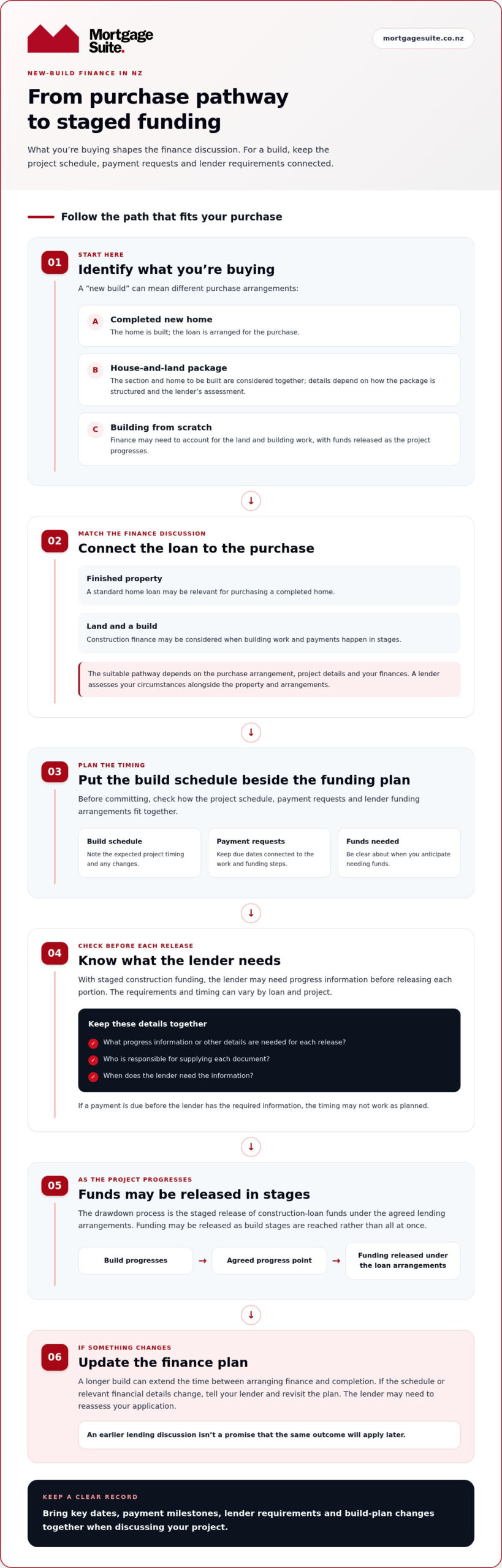
A “new build” might be a completed home ready to buy or a property that’s still under construction. That difference matters when arranging finance. If construction is complete, you’re generally seeking a loan to purchase the home. If you’re buying land and funding a build, the finance may also need to account for construction. Start by clarifying which pathway applies to you.
Buying a completed new home versus building from scratch
With a completed new home, the property is built and your loan is arranged for the purchase. If you’re building from scratch, you may need finance for the land and the building work, with funds released as the project progresses. The payment schedule and timing can affect how you plan your borrowing.
A house-and-land package combines the section and the home to be built. The land purchase and construction arrangements need to be considered together, but the details depend on how the package is structured and the lender’s assessment.
For example, one buyer might purchase a finished new home and arrange a home loan for settlement. Another might buy a section with a build contract, where construction finance could be relevant because the home is not yet complete. Both homes are new, but the finance discussion differs.
What a mortgage for a new build is designed to do
A home loan provides finance towards buying a property, with the property used as security for the lending. A home loan is commonly arranged to fund a purchase, while construction finance may be considered when building work and payments happen in stages. The right option depends on the purchase arrangement, project details and your finances.
Construction finance may involve a drawdown process, where loan funds are released in stages under agreed arrangements as the build progresses. Check how the funding schedule relates to the work and payments before settling on a loan structure. This overview of mortgage loan structures explains how security, interest and repayments can fit together. Your own lending terms depend on the lender’s assessment.
As you compare options, focus on what you’re buying, whether construction is part of the purchase and when funds may be needed. Mortgage Suite can help you consider these details across banks, private lenders and non-bank lenders, and negotiate on your behalf. A clear picture of your plans gives the lending discussion a practical starting point.
How New-Build Mortgages Work: Understand Stages, Drawdowns and Timing
When you’re building, finance may need to keep pace with the work rather than arrive in one lump sum. Before committing, understand how the project schedule, payment requests and lender’s funding arrangements fit together. This can help you plan ahead and spot potential timing issues.
The drawdown process is the staged release of construction-loan funds under the agreed lending arrangements. The process depends on the loan and project, including what progress information the lender needs before releasing each portion. Ask for the funding steps to be explained in plain English, including what needs to happen before each release.
How staged construction-loan funding works
In a staged build, work begins, reaches agreed points and continues towards completion. Funding may be released as those stages are reached rather than all at once. The loan arrangements set out how this works and what supporting information is needed for each release. Stage names, documents and timing can vary, so use the requirements for your own project rather than relying on another buyer’s experience.
Keep the build schedule and funding requirements side by side. If a payment is due before the lender has received the required progress update or other information, the timing may not work as planned. Check who is responsible for supplying each document and when it’s needed. This can help you plan cash flow and connect the finance steps to the build.
Why build timelines matter to your mortgage plans
A longer build can extend the time between arranging finance and reaching completion. Your income, commitments or other financial circumstances may change during that period, and a lender may need to reassess your application if relevant details change. An earlier lending discussion isn’t a promise that the same outcome will apply later.
Discuss timing early. Share the expected project schedule, when you anticipate needing funds and what you know about the build. If the schedule changes, update your finance plan rather than waiting until a payment is due. This won’t prevent every delay, but it can help you identify where a change in progress may affect the funding arrangements.
Keep a simple record of key dates, payment milestones, lender requirements and changes to the build plan. This gives you a useful reference when discussing the project and helps you see what needs attention next. When weighing up a mortgage for new build nz, consider how funding stages fit with your circumstances, not just the loan structure.
Mortgage Suite can help you compare construction lending pathways and negotiate with banks, private lenders and non-bank lenders on your behalf. The Mortgage School guides offer more plain-English information as you plan.
Compare New-Build Mortgage Options for Your Purchase Scenario
The finance pathway depends on what you’re buying and when the property or build will be ready. Use this comparison as a starting point, not a promise of eligibility. A lender will assess your circumstances alongside the property and the purchase or construction arrangements.
| Purchase scenario | Finance pathway to discuss | What to consider |
|---|---|---|
| Completed new home | A standard home loan may be relevant for purchasing a finished property. | Consider the purchase and settlement details, your deposit position and the lender’s assessment of your application. |
| House-and-land package | A standard home loan or construction finance may be relevant, depending on how the land and build are arranged. | Clarify how the land purchase connects to the building agreement, when funding is needed and how progress payments are handled. |
| Build from scratch | Construction finance may be relevant if funding is required as building work progresses. | Consider the project plan, payment arrangements and information the lender needs as the build advances. |
Standard home loan or construction finance?
A standard home loan generally funds the purchase of a completed property. Construction finance may be considered when the project is unfinished and funds are needed in stages. This distinction can shape how you plan payments and coordinate lending with the build. Neither option is automatically cheaper, quicker or easier to obtain. The fit depends on your application and project details.
If you’re building as an owner-builder, discuss your role, project plan and how the work will be managed with a mortgage adviser. The lender’s assessment may depend on those details, your financial position and the property being used as security.
Compare more than the headline rate
A lower advertised rate may catch your eye, but it doesn’t show whether the loan suits your plans. Compare the overall structure, when funds are available, how repayments are arranged and what flexibility you may need if the build schedule changes. Ask how the lending works during construction and what happens when the home is complete.
A fixed interest rate stays unchanged for an agreed period. Consider whether that arrangement suits your plans and how it fits with the timing and structure of the lending. Compare the full arrangement, not just the initial rate.
Read the Mortgage Rates NZ guide alongside this comparison for more on rates. If you’re considering a mortgage for new build nz, Mortgage Suite can compare pathways across banks, private lenders and non-bank lenders, then negotiate on your behalf. The aim is to find an option that suits your circumstances, while recognising that lenders may assess the project differently.
Prepare for a New-Build Mortgage: A Practical Buyer Checklist
Preparing a few key details can make a lending conversation more manageable. You don’t need every project detail finalised, but bringing together what you know helps an adviser understand your plans and discuss possible pathways. For a mortgage for new build nz buyers, explain the type of purchase and how far the project has progressed, as well as your financial position.
Information to organise before discussing your application
Pull together a snapshot of your household finances and the build. Include your income and regular income sources, existing loan or credit commitments, and your deposit position. Note your borrowing goal too: are you buying a completed home, purchasing land with a build, or constructing from scratch?
Gather any project information already available. Depending on your pathway, this may include a building contract, plans, project timeline, land purchase details and updates on the construction stage. Start with what you have. The aim is to give your adviser a practical picture, not to create a perfect file before asking questions.
- Income: Record your income sources and any details that explain how you’re paid.
- Commitments: List existing debts and regular financial obligations.
- Deposit: Set out your current deposit position and where the funds are coming from.
- Purchase pathway: Describe whether you’re buying a finished home, choosing a house-and-land package or building from scratch.
- Project details: Collect available plans, contracts, timelines and updates on the build stage.
Questions to resolve before committing to the build
Map the expected payment stages against your household budget. Consider when funds may be needed, what other payments you’ll need to manage and how much room you have if the schedule changes. Drawdown arrangements and supporting information can vary, so discuss them alongside the construction plan rather than treating finance and building as separate issues.
Talk through what a timeline change could mean for your application. If the project takes longer or your circumstances change, a lender may reassess the application. An adviser can help you understand how the timing and your finances fit together, without assuming an earlier discussion guarantees a later lending decision.
For an initial view of repayments, Mortgage Suite’s mortgage calculator can help you explore affordability. Treat the result as a guide for planning, not a lending decision.
Bring your questions, even if some details are still taking shape. Mortgage Suite’s advice is free of charge with no obligation, and the team can help you compare options and negotiate with lenders. Explore your new-build finance options with Mortgage Suite.
Find a New-Build Mortgage Pathway That Fits Your Situation
Choosing finance for a new build involves more than the property or interest rate. Your purchase pathway, the timing of staged funding, the project details and your finances all help shape which options are worth considering. A mortgage for new build nz buyers can look different from one person to the next, so compare the choices against your own plans.
When a lender comparison may help
Lenders may assess the same borrower or project differently. Comparing banks, private lenders and non-bank lenders can show which lending channels may better fit your circumstances. Mortgage Suite can help with that comparison and negotiate on your behalf. You can also read Mortgage Suite client reviews to hear about other people’s experiences, while keeping in mind that every application is assessed on its own details.
Look beyond whether a lender is willing to consider the application. Think about how the proposed finance fits the property, build arrangements and your plans over time. If a mainstream bank has declined your application, it can feel disheartening, but it isn’t necessarily the end of your options. Other lending channels may be worth discussing, though no lender can be assumed to approve an application.
What happens when you ask Mortgage Suite for help
The first conversation is a chance to explain what you hope to buy or build, where the project stands and what matters to you financially. Talk through the documents you’ve gathered and any uncertainties about the finance or build timeline. This helps Mortgage Suite understand your goals and circumstances before comparing possible pathways.
Mortgage Suite works across banks, private lenders and non-bank lenders, acting as your advocate as lending options are considered. The team works to negotiate a suitable deal based on your situation and the project. This is support through the decision-making process, not a promise of approval. Your application remains subject to the lender’s assessment.
The advice is free of charge with no obligation, so you can discuss your plans and understand possible next steps without pressure. Bring your questions, even if the project details are still developing. A clear conversation can help you weigh the purchase pathway, funding arrangements and timing together before deciding how to proceed.
To compare a pathway that may suit your circumstances, discuss your new-build mortgage options with Mortgage Suite.
Take the Next Step With a Clear Plan
You don’t need every detail settled before exploring your options. Start with the question that feels most pressing, whether it’s how to structure your borrowing or how the project timing fits your plans. A focused conversation can help you decide what to clarify next as you consider a mortgage for new build nz.
Mortgage Suite was founded by Krish Krishna in 2000. The team can help you work through your new-build plans and consider a way forward that reflects your circumstances, without pressure to decide before you’re ready.
Talk with Mortgage Suite about your build plans and take the next step when you’re ready.
Frequently Asked Questions
Do I need pre-approval before choosing a new-build property?
Pre-approval can help you understand your borrowing position before committing, but it isn’t final loan approval. If you’re weighing up a completed home against a section with a build planned, discuss both possibilities early so the finance conversation reflects the purchase you’re considering. If the property, project or your circumstances change, the lender may reassess the application. Keep your adviser informed as your plans take shape.
Can I get a mortgage for a house-and-land package in New Zealand?
A house-and-land package may be financed, but the right pathway depends on how the land purchase and build are arranged. If you’re considering a mortgage for new build NZ, clarify whether the home is finished or still to be built, and how the agreement handles each part of the purchase. This gives your adviser useful context for the lending discussion. The lender will assess your circumstances and the project details.
How do lenders assess a mortgage application for a new build?
Lenders assess your financial position alongside the property and construction details. The information they consider can depend on the loan structure and how far the build has progressed. For example, someone discussing a home still at the planning stage may need to provide different project details from a buyer purchasing a completed home. Prepare an overview of your income, regular commitments and project information, then discuss what’s relevant to your situation.
What happens to a new-build mortgage if construction is delayed?
A construction delay may affect when you need funds and whether the finance plan still fits the project. The impact depends on your lending arrangements, the reason for the change and your circumstances. If the expected completion date moves, tell your lending adviser and lender promptly rather than assuming the original plan remains unchanged. They can explain whether the new timing affects your application or funding arrangements.
Can self-employed buyers apply for a mortgage for a new build?
Self-employed buyers can discuss a new-build mortgage, and each application is considered on its own information. Be ready to explain how you earn your income and how it supports your borrowing plans. If your income varies through the year, describing that pattern gives your adviser useful context alongside the project details. Lender requirements differ, so an adviser can help you explore options without promising approval.
Can I explore other lending options if a bank declines my new-build mortgage?
Yes. A bank’s decision doesn’t automatically mean there are no other pathways to discuss. Mortgage Suite works across banks, private lenders and non-bank lenders, whose assessments may differ depending on the lender and your application. Share the reason for the decline, any feedback you received and what has changed since you applied. An adviser can help you consider possible next steps, although each lender makes its own decision and approval isn’t guaranteed.