
Home loan application in NZ: evidence for income and deposit
A practical home loan application checklist NZ borrowers can start with includes income records, proof of deposit, property details and identification showing residency status. For a First Home Loan, you must be a New Zealand citizen, permanent resident or resident visa holder ordinarily resident in New Zealand, and a first-home buyer or previous homeowner in a similar financial position. Lenders also assess whether repayments are affordable.
Gathering paperwork can feel like a hurdle, especially when your income is irregular or your circumstances do not fit a straightforward first-home-buyer profile. Organising your documents can help you explain your position and show lenders what they need to assess your application.
This guide covers the income and deposit evidence to gather, the property and residency details that matter, and the additional criteria for First Home Loan applicants. It also explains how pre-approval fits into the process and how a mortgage broker can help you prepare your application.
Key Takeaways
- Gather recent bank statements and employment records so a lender can understand your income and regular spending.
- Keep a clear record of where your deposit comes from, including any gifted funds.
- Pre-approval can help you understand your borrowing position before house hunting, with final approval considered once you have a property in mind.
- Collect property and building documents early, especially if you’re buying a home that needs work or planning a build.
- Check residency and first-home-buyer eligibility alongside your income and deposit, as these details can affect which application pathway fits.
Income evidence for employees and casual workers
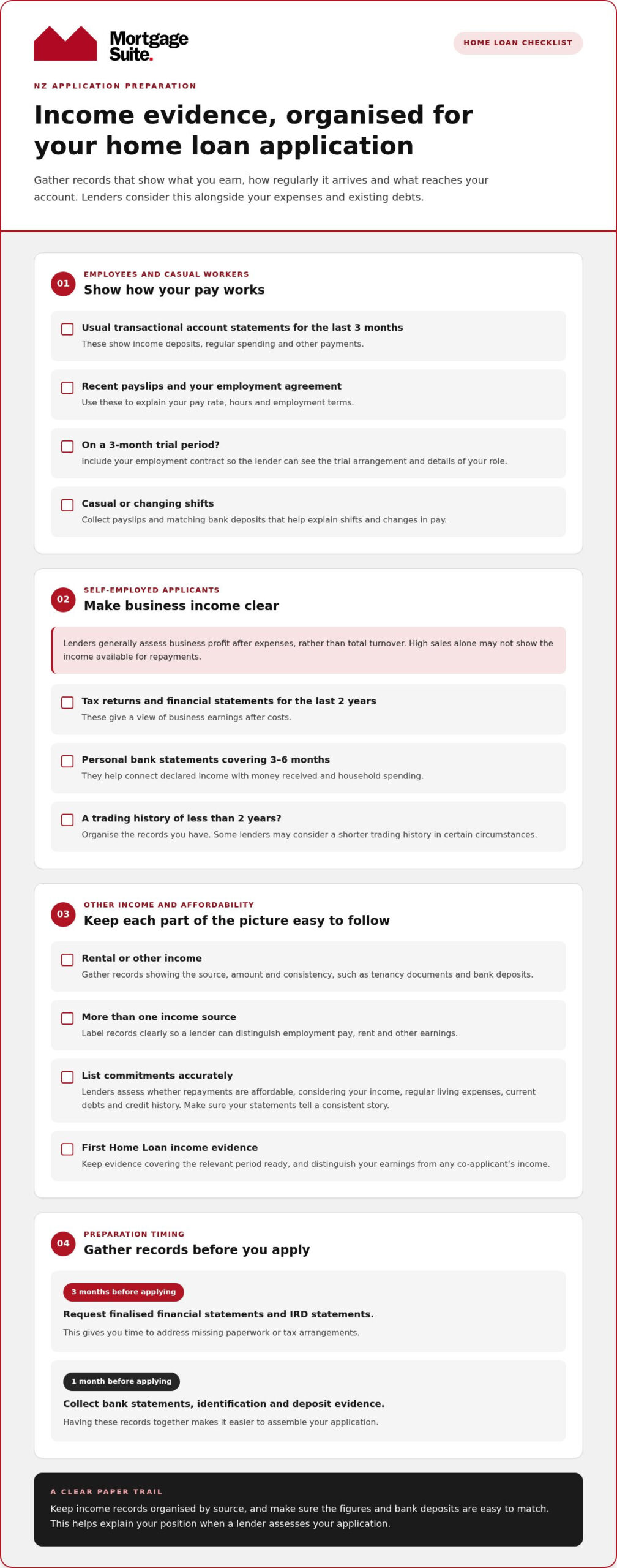
Start with records showing what you earn, how regularly you receive it and what reaches your account. Lenders consider this evidence alongside your expenses and existing debts when assessing affordability. A home loan application checklist NZ borrowers can use should make every income source easy to identify.
- Gather your usual transactional account statements for the last three months. They help show income deposits, regular spending and other payments.
- Collect recent payslips and your employment agreement. These help explain your pay rate, hours and employment terms.
- If you’re on a three month trial period, include your employment contract. It gives the lender information about the trial arrangement and your role.
- For casual work, organise records that show your shifts and changing pay. A clear run of payslips and matching bank deposits can help explain fluctuations.
How do NZ banks assess living expenses, debts, credit history, and affordability? Lenders consider your ability to repay, current debts and credit history, as well as your income and regular living expenses. They must assess affordability and suitability, so list your commitments accurately and ensure your statements tell a consistent story.
Self-employed income needs a different paper trail. Self-employed applicants may be asked to provide tax returns, financial statements and personal bank statements. They generally assess business profit after expenses, not total turnover, so high sales alone may not show the income available for repayments.
- Prepare tax returns and financial statements for the last two years. These give a view of business earnings after costs.
- Gather personal bank statements covering three to six months. They help connect declared income with money received and household spending.
- If your trading history is under two years, organise the records you do have. Some lenders may consider a shorter trading history in certain circumstances.
- Request finalised financial statements and IRD statements three months before applying. This gives you time to address missing paperwork or tax arrangements.
- Collect bank statements, identification and deposit evidence one month before applying. Having these records together makes it easier to assemble your application.
For rental or other income, gather records showing the source, amount and consistency, such as tenancy documents and bank deposits. If you have multiple income sources, label each record clearly so the lender can distinguish employment pay, rent and other earnings.
First Home Loan income thresholds also matter. Keep evidence covering the relevant period ready for your application. A home loan application checklist NZ first-home buyers prepare should distinguish personal earnings from any co-applicant’s income.
Deposit sources and gifted funds
Loan-to-Value restrictions compare the loan amount with the property’s value, while deposit requirements depend on the lending pathway. A First Home Loan requires a minimum deposit of 5% of the purchase price; other applications are assessed against the lender’s criteria.
Your deposit evidence should show both how much you have and where it came from. Gather account statements and records for savings, transfers or a relative’s gift. A clear paper trail links the amount you declare to the money available for settlement.
- List each deposit source. Separate personal savings, eligible withdrawals and gifted funds so each amount has a clear origin.
- Save statements showing your savings balance. Keep the relevant account records together, including entries that show regular deposits or a transfer into your deposit account.
- Keep evidence of large transfers. Match the incoming payment to a transfer record or written explanation, so it is clear whether the funds are your savings or a gift.
- Record the gift’s source and amount. First Home Loan applicants may use a relative’s gift as their deposit, so keep a clear record of the relative and the gifted funds.
- Check that your available deposit matches your purchase plans. Compare the funds you can access with the purchase price and the minimum deposit required for your chosen pathway.
For example, if a relative transfers gifted funds into your everyday account, keep the statement showing the deposit and a record explaining the transfer. If you move savings between accounts, keep statements for both. This makes the movement of funds easier to follow and helps prevent unexplained gaps in your deposit history.
A First Home Loan has a specific minimum deposit: 5% of the purchase price. That figure is the programme’s deposit requirement, not a universal deposit rule for every home loan. Loan-to-Value restrictions relate the borrowing to the property’s value, so the required deposit and lending assessment depend on the loan type and lender criteria.
Before applying, organise your evidence in one place. Make a simple record of each deposit source, its amount, the account holding it and the supporting document. For gifted funds, include the transfer record and gift details. For savings, include statements showing the balance and transfers between accounts.
A tidy deposit record helps you explain your position clearly, whether your funds come from long-term savings, a relative’s gift or a mix of sources. Keep original statements and transfer records together so you can give a consistent account of your deposit during the application process.
Mortgage pre-approval and broker assistance
Pre-approval can help you understand your borrowing position before house hunting. A New Zealand First Home Loan applicant may seek pre-approval before finding a property, then return to the lender for final approval after choosing one. Treat pre-approval as an early step, not confirmation that every property or offer will be accepted. Have your income, deposit and purchase details ready for assessment.
Use pre-approval to set a practical search range and identify any information the lender still needs. If your income varies between pay periods, for example, explain the pattern rather than relying on one unusually strong week. Keep your evidence consistent with your application. A clear account of your income, commitments and deposit helps the lender understand your circumstances.
- Gather your financial details before applying. Include income, debts, regular expenses and deposit information, so the assessment reflects your whole position.
- State your likely purchase plans. Share the type of property you’re considering and your expected price range, because the chosen property is reviewed later.
- Keep a record of pre-approval conditions. Note any documents or changes the lender needs before final approval.
- Update the lender if your circumstances change. A new debt, job change or altered deposit can affect the application between pre-approval and purchase.
Once you find a home, provide the lender with its details for final approval. The lender then assesses the specific property alongside your application. A pre-approved amount should guide your search, not replace the final review. Keep purchase information and any new financial details organised for this step.
A mortgage broker can help you present your application clearly and understand how lender criteria may differ. They can review your circumstances, identify relevant questions and help organise information for a lender. If you have casual work, self-employed income or several income sources, a broker can help explain how the details fit together. The lender makes the final decision.
Lenders in New Zealand may apply different credit criteria, so a decline from one lender does not necessarily mean another will decline your application. A broker can help identify whether another lender’s criteria may better fit your circumstances and support a clear application. This can be useful if a standard application does not capture the full picture of your income or deposit.
If you’re self-employed, consider seeking pre-approval before house hunting. It gives you an early opportunity to discuss how your trading history and income records will be assessed. Use the time to fill gaps in your paperwork and understand the next steps before making an offer. Keep your financial information current as you move from pre-approval to a chosen property.
Property purchase and construction documents
Property documents connect your borrowing request with the home or project you plan to fund. Start a separate folder for each property, then add purchase records, property details and, where relevant, construction paperwork. Clear files make it easier to explain what you’re buying and how the proposed loan relates to it.
- Keep a copy of the sale and purchase agreement. It records the agreed transaction details, including the property and purchase terms.
- Note the property address and type. Record whether it’s a house, apartment, section or another property type, so your application identifies the security clearly.
- Save any property information supplied during your purchase. For example, keep the listing details and documents describing the land, dwelling or included fixtures.
- Organise any valuation or building report you receive. These documents provide information about the property’s value or condition.
- Keep relevant council records together. Plans, consents and correspondence can help explain the property’s status or planned work.
For a First Home Loan, the property must be less than 1 hectare, and you must use it as your primary place of residence. Keep property records that show what you’re buying and where you intend to live. If the purchase involves a section or a home with substantial work planned, separate existing property documents from proposed building documents.
Planning a build or renovation? Gather documents describing the work, expected stages and how the project will be funded. The lender needs to understand the property and proposed project together, so make that connection clear in your folder.
- File the building plans and specifications. These describe the intended layout, materials and scope of the work.
- Keep the builder’s contract and project schedule. These explain who is completing the work and how the project is organised.
- Save the project budget and payment schedule. They show how the expected spending relates to the work stages.
- Include relevant council documents. For example, keep consent records or correspondence alongside the plans they relate to.
- Record any siteworks separately. Note ground preparation or access work as distinct project items, so the costs and tasks are easy to identify.
Use a simple document list showing the file name, date and purpose of each item. If a plan changes, keep the updated version and label it clearly instead of mixing several drafts together. For example, label a revised building plan with its issue date and match it to the relevant project schedule. This creates a tidy record for the move from purchase details to final property assessment.
Residency and first-home-buyer criteria
For a First Home Loan, check residency and buyer eligibility before preparing your application. These criteria are separate from proof of income or deposit and can determine which application pathway suits your circumstances.
How do home loan application requirements differ between banks and non-bank lenders in NZ? Lenders may apply different credit criteria, so their documents and assessment approaches can vary. A decline from one bank does not necessarily mean another lender will decline your application.
- Confirm your residency category. First Home Loan applicants must be New Zealand citizens, permanent residents, or resident visa holders ordinarily resident in New Zealand.
- Gather documents that show your status. Put the relevant citizenship, permanent residency or resident visa records with your application, so your residency details are clear.
- Check whether you meet the first-home-buyer test. You must be a first-home buyer or a previous homeowner in a similar financial position to a first-home buyer.
- Explain previous home ownership accurately. If you’ve owned a home before, prepare a clear account of your present financial position and circumstances for the eligibility assessment.
- Confirm your intended use of the home. A First Home Loan property must be your primary place of residence, not a home you plan to use solely as a rental.
- Check the age requirement. Check whether any age requirements apply to your application, and include accurate identification details.
What bank statements and expense records should NZ home loan applicants provide? Keep statements from your usual transactional account for the last three months, alongside a clear record of regular household spending and debt repayments. These help present your living costs and financial commitments consistently.
If you’re buying with others, explain every buyer’s residency and ownership history. One buyer may be purchasing for the first time while another has previously owned a home, for example. Set out each person’s circumstances separately, then show how you are applying together. This helps clarify the relevant eligibility pathway.
What common mistakes or delays should NZ home loan applicants avoid? Avoid gaps in residency or ownership details, inconsistencies across forms and overlooking the primary-residence requirement. Match names and dates across identification and application records, and explain any previous ownership clearly.
Before applying, use a simple eligibility checklist: confirm your residency category, buyer status, intended home use and identification details. Then organise the supporting records under those headings. If you’re unsure how the criteria fit your circumstances, explore practical mortgage guidance before lodging your application.
Mortgage Suite: Home Loans to First Home Buyers
Mortgage Suite Ltd provides Home Loans to First Home Buyers, helping you consider how your income, deposit and eligibility fit together in an application. If your circumstances are complex, or a mainstream bank has declined your application, a different lender’s criteria may offer another pathway to explore.
Bring your organised documents and questions about pre-approval, the property you’re considering and your next steps. Mortgage Suite Ltd can help you understand the options and prepare a lending application that reflects your circumstances, without promising an approval outcome.
If you’re ready to discuss buying your first home, visit mortgagesuite.co.nz to get in touch with Mortgage Suite Ltd.
Take your next step with a clear plan
Turn your home loan application checklist for New Zealand into a working plan: organise your documents, note any outstanding details and prepare to explain your circumstances clearly. Then match that information to a lending approach suited to your goals, rather than focusing only on whether one application pathway fits.
Mortgage Suite Ltd offers Home Loans to First Home Buyers, residential investment property loans and Business Loans. If you’re buying your first home, growing a property portfolio or financing a business, a conversation can help clarify which lending questions to tackle first. The lender makes the final decision based on its assessment of your application.
Contact Mortgage Suite Ltd to discuss your lending plans. A considered next step can help you move forward with greater clarity and confidence.
Frequently Asked Questions
What documents do NZ banks require for a home loan application?
Prepare identification, income and deposit records, along with documents for the property you intend to buy. Keep files current and easy to match to your application. Use clear filenames and group documents by applicant and type, for example. If a transfer or change in your circumstances needs explaining, keep a note with the relevant record rather than relying on memory later.
What proof of income is needed for PAYE employees and self-employed applicants in New Zealand?
PAYE employees can use payslips and employment records to show their pay and work arrangements. Self-employed applicants can organise business accounts and tax records so lenders can distinguish business turnover from personal income. If your own company pays you a regular wage, show how it is paid and recorded. Make sure the amounts in your application match the supporting documents.
What deposit and proof of funds do New Zealand lenders require?
For a First Home Loan, the minimum deposit is 5% of the purchase price. Keep evidence that makes the source of each part clear. If a relative contributes a gift, retain the transfer record and a written explanation of the funds. If you have moved savings between accounts, keep records that show the movement, rather than presenting only the final balance.
What extra home loan application requirements apply to first-home buyers?
First Home Loan applicants must be over 18 and meet the programme’s residency and buyer criteria. The home must be intended as your primary residence, and two or more applicants complete a participating lender’s application form. If you previously owned a home, explain how your current financial position is similar to that of a first-home buyer. These details help the lender assess the correct application pathway.
What are New Zealand’s current LVR rules and deposit requirements for home loans?
Loan-to-Value restrictions compare the loan amount with the property’s value. A First Home Loan requires a minimum deposit of 5% of the purchase price; other applications are assessed against the lender’s criteria.