
Assessing business loan repayments with bad credit in New Zealand
A bad credit history doesn’t automatically rule out a business loan in New Zealand. If you’re asking how to get a business loan with bad credit in NZ, lenders will look at whether your business is viable and can repay the loan and interest. Your credit history matters, but it is only part of the picture.
It’s understandable to feel uncertain, especially after a lender has declined your application. A decline isn’t a judgement on you or your business, and it doesn’t necessarily close off every option. The next step is to understand what a lender needs to see and whether repayments fit your business’s cash flow.
This guide explains what can affect eligibility, how to assess repayments and which financial documents can support an application. It also covers what to do after a decline, so you can address gaps and decide on a clearer next step.
Key Takeaways
- Prepare tax returns for the past two to three years, alongside clear financial records, bank statements and a business plan.
- Build a cash flow forecast using cautious income estimates and realistic costs to see whether repayments fit your business finances.
- Lenders assess whether your business is viable and can repay the loan and interest; accelerated lending generally calls for at least 12 months of consistent profitability.
- If an application is declined, use the lender’s reasons to strengthen your business plan and address gaps in the financial evidence.
- A low credit score doesn’t tell the whole story. Your trading record, repayment capacity and the purpose of the borrowing can all help show your business’s position.
Preparing financial statements, tax returns and bank statements
Organised records help show how your New Zealand business earns, spends and manages money. Before applying, gather financial statements, tax returns and business bank statements. Lenders assess whether a business is viable and can repay the loan and interest. Clear, consistent records make it easier to explain your trading position, especially when your credit history may raise questions.
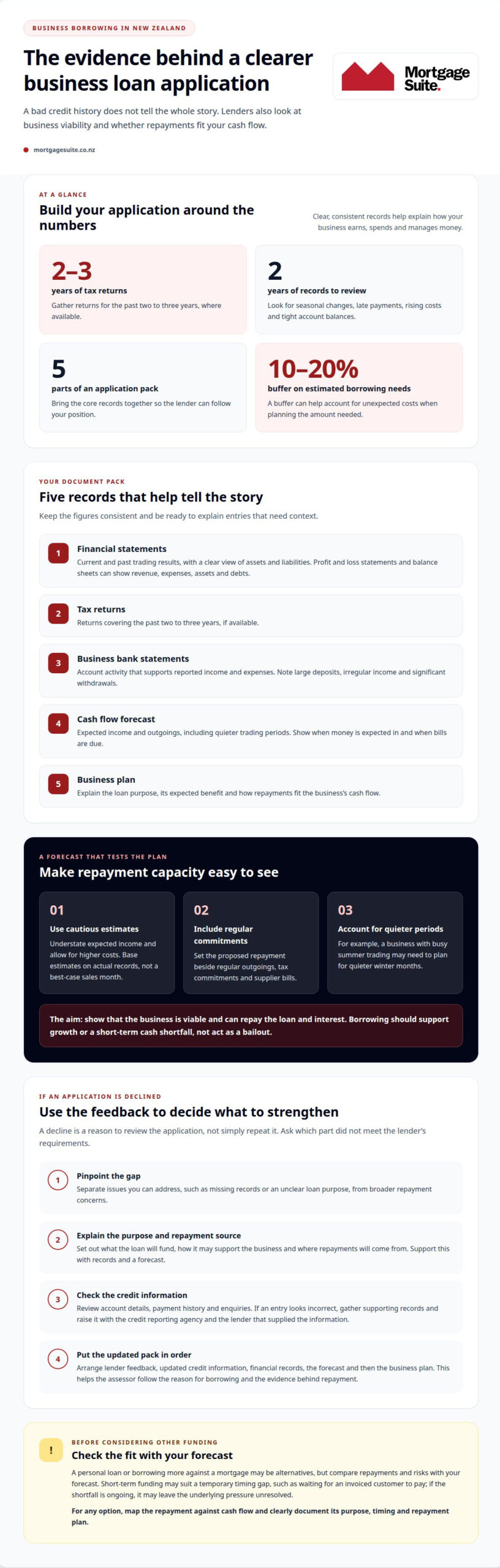
Start with tax returns for the past two to three years, where available, and financial statements for the same period, such as profit and loss statements and balance sheets. These show revenue, expenses, assets and debts. Compare the figures with your bank statements, noting large deposits, irregular income and significant withdrawals. Prepare a short explanation and supporting records for any entries that need context.
Review the past two years of financial records to understand repayment capacity. Look for seasonal changes, late customer payments, rising expenses and periods when the account balance was tight. For example, a business with busy summer trading may need to plan for quieter winter months. Use the records to prepare a cash flow forecast showing when money is expected in and when bills are due.
Prepare these documents as a practical application pack:
- Financial statements: current and past trading results, plus a clear view of assets and liabilities.
- Tax returns: returns covering the past two to three years, if available.
- Bank statements: business account activity that supports the reported income and expenses.
- Cash flow forecast: expected income and outgoings, including quieter trading periods.
- Business plan: the loan purpose, expected benefit and how repayments fit the business’s cash flow.
Build the forecast cautiously: understate expected income and allow for higher costs. Base estimates on actual records rather than a best-case sales month. Set the proposed repayment beside regular outgoings, tax commitments and supplier bills. A 10-20% buffer on estimated borrowing needs can help account for unexpected costs. Borrowing should support growth or a short-term cash shortfall, not act as a bailout.
What alternatives to business loans are available for New Zealand businesses with bad credit? If your business has limited financial data to support an application, options may be narrower. A personal loan or borrowing more against a mortgage may be alternatives, but compare the repayments and risks with your forecast before deciding.
Bridging finance or other short-term funding may suit a temporary timing gap, such as waiting for an invoiced customer to pay. Identify the incoming funds expected to cover the gap, then map the repayment against your cash flow forecast. If the shortfall is ongoing, short-term funding may leave the underlying pressure unresolved. Clearly document the purpose, timing and repayment plan.
What if my business loan application is declined?
A decline is a reason to review the application, not simply repeat it. Use the lender’s feedback to address gaps in your business plan, repayment evidence or credit information before applying again.
Strengthening an application
Make your business plan answer three practical questions: what will the loan fund, how will it support the business, and where will repayments come from? For example, explain how new equipment could increase production or meet confirmed customer demand. Support the explanation with financial records and a cash flow forecast showing how repayments fit alongside wages, supplier bills and tax obligations.
Applying with poor credit
A low credit score does not tell a lender everything about your business. Explain the circumstances behind missed payments and provide evidence of current trading and repayment capacity. For example, distinguish a one-off late payment during a temporary cash-flow squeeze from ongoing difficulty meeting business commitments. The application still needs to show that the business is viable and can repay the loan and interest.
High-cost loans and director guarantees
High-cost borrowing can add pressure to cash flow, especially if frequent repayments fall due before customers pay. Before accepting an offer, compare its repayment schedule with your forecast and consider what could happen during a quieter trading period. A director guarantee is a personal commitment connected to the company’s debt. Read the agreement carefully and understand the personal responsibility it creates before signing.
Checking and correcting a credit report
Request your credit report from a credit reporting agency, then review the account details, payment history and enquiries. If an entry appears incorrect, gather supporting records, such as payment receipts or lender correspondence, and raise the error with the agency. Contact the lender that supplied the information too. Keep copies of your request and evidence so you can track the correction process.
For your next application, organise documents in a simple sequence: lender feedback, updated credit information, financial records, forecast, then business plan. This helps the assessor follow your reason for borrowing and the evidence behind repayment. A complete application also makes it easier to identify unanswered questions before assessment begins.
During assessment, the lender considers business viability and whether repayments are affordable. If your application is declined, ask which part did not meet the lender’s requirements. Separate issues you can address, such as missing records or an unclear loan purpose, from broader repayment concerns. Revise the relevant documents rather than resubmitting the same case unchanged.
If the feedback points to weak repayment capacity, review the borrowing amount and timing against your business’s actual cash flow. If it points to credit information, resolve any disputed entry first and include the outcome in your updated application. These steps give the next assessment a clearer, more complete picture of your business.
Assessing repayment capacity with cash flow forecasts
A profit on paper doesn’t show exactly when cash will be available for repayments. Use a cash flow forecast to map expected receipts against payment dates, then test whether the business can meet each instalment without missing essential bills.
Build the forecast around actual cash movements. Record when customers are expected to pay, not simply when you issue invoices. Include regular outgoings such as wages, rent, supplier invoices, tax and existing debt repayments. A late customer payment, for example, may leave the business short when a loan instalment is due, even if the sale was profitable.
Compare the forecast balance before and after each proposed repayment. Ask whether enough cash will remain for ordinary operating needs. If an instalment coincides with payroll or a large supplier payment, test a different repayment date or loan structure. Your forecast should make timing pressure clear, rather than relying on a monthly total that hides low-balance days.
Test more than the expected trading pattern. Model a quieter sales period, delayed customer receipts or an unexpected business expense. Reduce expected income and increase costs in a cautious scenario, then check whether repayments remain manageable. If the forecast only works when every customer pays on time, the borrowing plan may leave too little room for normal disruption.
Include existing commitments in the same calculation. Add current loan repayments, credit facilities and regular business expenses before assessing room for another instalment. Separate one-off costs from recurring bills, but don’t omit costs just because they vary. A realistic forecast helps show whether the proposed borrowing adds a manageable commitment or strains available cash.
The loan term and repayment size also affect affordability. A shorter term or higher repayments may reduce interest charges, provided the business can afford the schedule. Compare the cash left under each option, especially during slower trading periods. Choose a structure your forecast can support, rather than one that only looks attractive because of its headline rate.
Plan for repayment dates and make payments on time. New Zealand banks and other lenders usually charge extra for late or missed loan payments, so add due dates to your business calendar and monitor account balances before each instalment. If cash flow changes, update the forecast promptly and identify pressure before a payment is missed.
Calculate the impact of early repayment too. Compare the interest saved with any early repayment fee before using spare cash to reduce the debt. That cash may be needed for wages, stock or supplier bills before the next customer payment arrives. A forecast helps you weigh potential savings against upcoming business commitments.
Use the final forecast as a decision tool, not just an application attachment. Check available cash across the full repayment schedule, note the periods with the least room, and decide whether the borrowing amount or timing needs to change. The forecast should show how repayments fit your business’s actual trading cycle.
Applying with a low credit score
A low credit score can make an application harder, but it doesn’t explain the whole business position. Lenders also assess viability and whether the business can repay the loan and interest. Your application should connect your credit history with current trading evidence, the borrowing purpose and a workable repayment plan.
Start by identifying what the credit issue represents. A missed payment during a temporary disruption differs from ongoing difficulty meeting commitments. Explain the circumstances plainly, then show what has changed, such as overdue accounts being settled or payments becoming regular again. Keep the explanation factual and support it with relevant records.
Next, make the loan purpose specific. “Working capital” alone may not explain how the borrowing will help. Describe the need, such as paying a supplier while waiting for an agreed customer payment, and show how the funds fit your business plan. Link the purpose to expected income or a defined short-term gap, not an assumed turnaround.
Present the application as a clear case, not a pile of documents. Put the business plan, financial records and cash flow forecast in a logical order. Highlight recent changes that affect the figures, such as a new contract or the loss of a major customer. This helps the assessor understand your current position instead of drawing conclusions from one credit entry.
- Explain: Give the date, cause and outcome of the credit problem.
- Support: Include records showing current account conduct and business activity.
- Connect: Link the loan purpose to a realistic business need.
- Test: Show how the repayment fits around existing commitments.
Choose an application route that suits the evidence you can provide. Some New Zealand online lenders can make business lending decisions within 24 to 72 hours using cloud accounting data. Traditional bank business loan applications can take two to six weeks from application to approval. Speed alone doesn’t show whether the repayment structure suits your business.
Ask what information the lender needs and provide a complete response. If the application relies on cloud accounting data, make sure the records reflect current trading and explain unusual entries. When applying through a bank, allow time for questions about credit history, loan purpose or cash flow. A complete file can clarify the assessment, but it cannot replace evidence of repayment capacity.
Keep new borrowing enquiries focused. Before submitting another application, address the reason a previous lender declined and update the relevant information. If the concern was unclear income, for example, explain trading receipts more clearly. If it was the loan purpose, revise the plan so the use of funds and repayment source are easy to follow.
Eligibility requirements for New Zealand businesses
Eligibility depends on more than a credit score. New Zealand lenders assess whether a business is viable and can repay the loan and interest.
Lender credit score requirements
What credit score do New Zealand business lenders require? No single score determines eligibility on its own. Lenders weigh credit history alongside business viability, repayment capacity and the evidence in the application. A low score may prompt questions about missed payments, so explain their cause and show what has changed.
A consistent record of profitability may help support an application for accelerated business lending in New Zealand. That track record can help show how the business performs, but it does not replace an assessment of its ability to meet repayments. Use current trading information to explain changes since the period covered by older accounts.
Security for a business loan
Can a business loan in New Zealand be secured with property, equipment or a personal guarantee? A lender may consider property or equipment as security, or request a director’s personal guarantee. The loan agreement sets out the security and what the borrower or guarantor agrees to. Read those terms closely before signing.
For property or equipment, identify the asset and any existing finance attached to it. For a guarantee, understand who becomes responsible if the business cannot meet its obligations. Ask how the terms relate to the loan amount, repayment schedule and default conditions. Security can affect the lender’s assessment, but it does not replace evidence that repayments are affordable.
What New Zealand rules apply to business lending, responsible lending and loan agreements? Review the written agreement for the amount borrowed, interest, fees, repayment dates, security and consequences of missed payments. Make sure the application and agreement reflect the business’s actual repayment capacity, not an optimistic sales forecast.
Beyond credit and security, lenders look at the business’s financial position and borrowing purpose. Your business plan should explain what the funds will support, while financial records show trading performance and existing commitments. A forecast then connects expected cash flow with the proposed repayments.
Check that the amount requested matches the business need. If borrowing will fund equipment, for example, explain how it supports operations and how repayments fit alongside supplier bills and wages. A clear purpose helps an assessor understand your case. A vague request can make the benefit and repayment source harder to assess.
Before applying, organise evidence around three points: consistent trading, a clear use for the funds and repayment capacity. If profitability has been uneven, explain the pattern using actual business records. Eligibility rests on the whole application, not a credit score alone.
Mortgage Suite: Business Loans
Mortgage Suite offers Business Loans, including 2nd tier lending for borrowers who don’t fit mainstream bank criteria. If a bank has declined your application or your credit history complicates the process, Mortgage Suite can help you consider how your business purpose, financial records and repayment capacity fit together.
Bring your loan purpose, current financial information and any lender feedback to a conversation with Mortgage Suite. This helps clarify your circumstances and the questions an application may need to address. A suitable path depends on your business and its ability to manage repayments, so approval cannot be promised.
If you’d like to discuss your business borrowing needs, contact Mortgage Suite.
Take your next step with a clear plan
Your next move can be a focused conversation about what your business needs and what repayments it can realistically manage. If you’re considering how to get a business loan with bad credit in NZ, bring your borrowing purpose and current financial position to that discussion. A mainstream bank’s decision doesn’t have to be the final word on your plans.
Mortgage Suite offers Business Loans, as well as Home Loans for First Home Buyers and Residential Investment Property Loans. If your business and personal borrowing needs overlap, a conversation can help clarify which lending direction fits your goals.
Contact Mortgage Suite to discuss your options and work through a practical next step. You can move forward with a clearer plan and the support to get sorted.
Frequently Asked Questions
Want a Bad Credit Business Loan Today?
Start by confirming when the money is needed and what payment it must cover. If a supplier invoice is due, ask whether its payment date can be adjusted while you consider funding. Don’t promise a payment date based on a loan that hasn’t been approved. A clear deadline helps you decide whether borrowing is suitable or whether changing the timing could ease immediate pressure.
How much interest will I pay?
The interest rate depends on the lender and loan structure. Ask whether the rate is fixed or can change, and what conditions affect it. A fixed rate stays unchanged for an agreed period, while a variable rate can move. Compare how each structure fits your plans, including whether you value predictable repayments or more flexibility if circumstances change.
What loans am I eligible for?
Business lending can cover needs such as start-up funding, working capital and equipment finance. A business buying a delivery vehicle, for example, may need a different loan structure from one managing a gap between invoices and customer payments. Describe what the funds will support, then consider whether the borrowing period matches how long the business expects to benefit.
Can you get a business loan in New Zealand with bad credit?
Yes, a New Zealand business can apply for a loan with bad credit. Be clear about the business structure and who would borrow, such as a sole trader or a company with directors. This helps frame the application correctly. If personal and business finances have been managed separately, explain the arrangement so the lender can identify which records relate to the business.
Which New Zealand lenders offer business loans to borrowers with bad credit?
Business loan options may come from mainstream banks, non-bank lenders or private lenders. The right category depends on the type of borrowing and the lender’s criteria, rather than a single nationwide list for bad-credit applicants. Mortgage Suite Ltd can consider lending options beyond mainstream banks, including 2nd tier lending. Focus on whether the product suits the business purpose and its plans for the funds.
What interest rates and fees do bad-credit business loans in NZ charge?
There isn’t one interest rate for every borrower or loan. Ask how the rate is set, whether it can change and what might trigger a review. Request the proposed terms in writing so you can understand how the rate applies throughout the loan. Compare the structure and flexibility of each option, not just its opening rate.
What documents and financial information are needed to apply for an NZ business loan?
Alongside financial records, an application may benefit from documents showing who owns or runs the business. Depending on the purpose, relevant records could include an equipment supplier quote, a customer contract or details of the business structure. These connect the application to a real business activity. Keep names, ownership details and the proposed use of funds consistent across the paperwork.
How can you improve your chances of getting approved for a business loan in New Zealand?
Make sure everyone involved in the application agrees on its key details before it goes to a lender. Directors or business owners should align on the borrowing purpose, who will sign and how the funds will be used. If one director expects equipment finance while another describes working capital, resolve that difference first. A consistent account makes the application easier to follow.