
Property valuation for a mortgage in NZ: who values your home
A council rating valuation and a property valuation for a mortgage in NZ serve different purposes. Registered valuers carry out property valuations, and a lender may require one when it needs a full market valuation.
It’s understandable to want a clear answer before moving ahead with a home loan. The type of valuation depends on what the lender needs to assess, so knowing who carries it out can help you understand the process.
This article explains who completes valuations in New Zealand, how council rating valuations fit in, and when a lender may require a full market valuation. You’ll also learn how Mortgage Suite Ltd can support your home loan application and help you find a lending option suited to your circumstances.
Key Takeaways
- Property valuations in New Zealand are carried out by registered valuers. Find out why an independent valuation may be useful before buying.
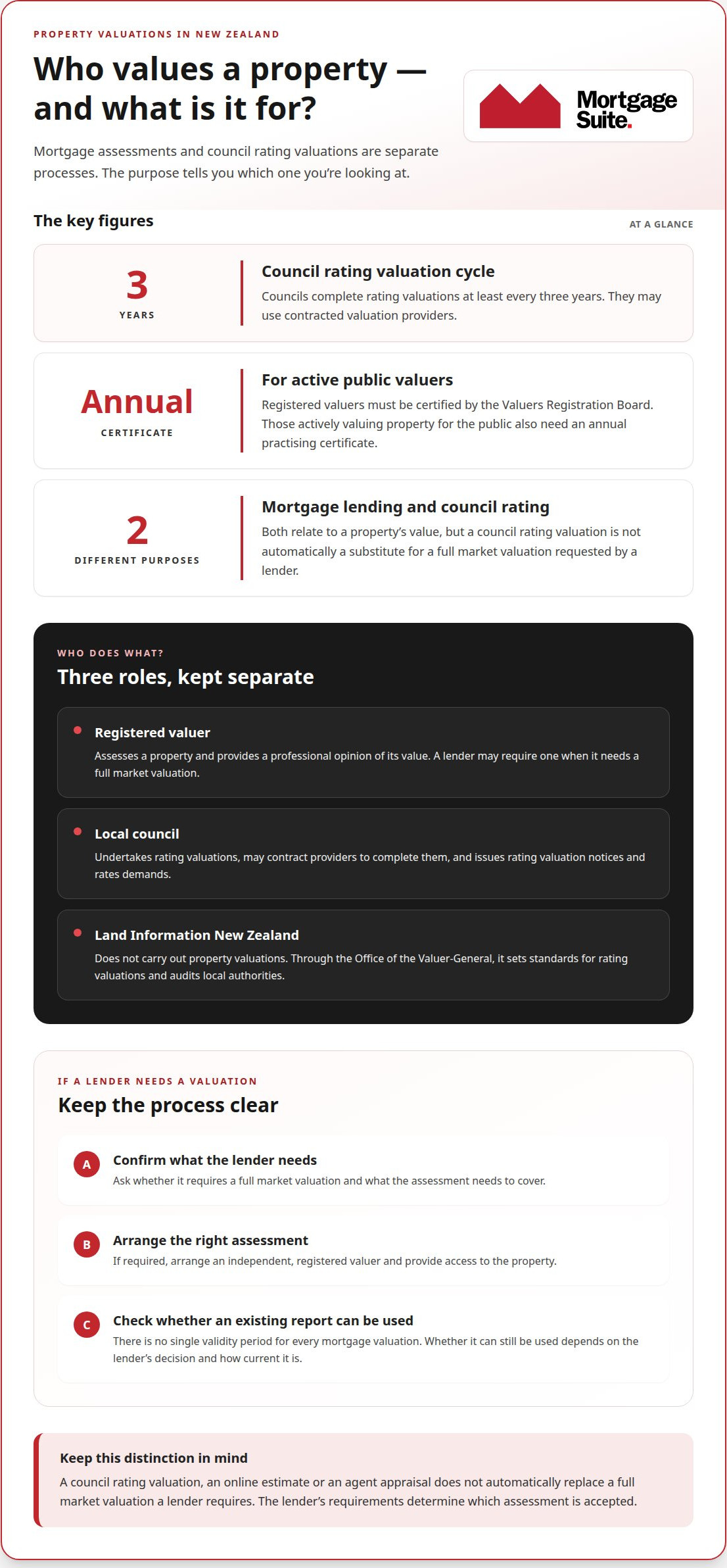
- Councils carry out rating valuations at least every three years, and may use contracted valuation providers.
- A council rating valuation and a full market valuation serve different purposes. Learn when a lender may require a full valuation for a home loan.
- The valuation a lender accepts can depend on the requirements of the lending application.
- Mortgage support may help you consider lending options that fit your circumstances.
Who does property valuations in New Zealand?
Registered valuers carry out property valuations in New Zealand. A registered valuer may be needed when a lender requires a full market valuation.
Registered valuers for mortgage assessments
A registered valuer assesses a property and provides a professional opinion of its value. If your lender requires a full market valuation, clarify the required assessment before arranging one. Registered valuers must be certified by the Valuers Registration Board. Those actively valuing property for the public also need an annual practising certificate. These requirements help identify the professional role involved.
A valuer considers the property’s features and relevant market evidence to reach an opinion of its value. Timing depends on the property, access arrangements and report requirements. There is no single validity period for every mortgage valuation. Whether an assessment can still be used depends on the lender’s decision and how current it is.
Local councils undertake rating valuations and may contract valuation providers to complete them. Councils issue rating valuation notices and rates demands, and complete rating valuations at least every three years. These assessments serve a different purpose from a full market valuation for mortgage lending.
Land Information New Zealand does not carry out property valuations. Through the Office of the Valuer-General, it sets standards for rating valuations and audits local authorities. This distinction helps clarify who produced a council valuation, as opposed to one prepared for a lending decision.
Independent valuations before buying
An independent valuation gives a buyer a professional view of a property’s value before purchase. People buying property in New Zealand are advised to obtain one from an independent, registered valuer. It can help you compare the proposed purchase price with the valuer’s findings. It is a separate assessment, not a guarantee that a lender will accept it for mortgage purposes.
A free online estimate, council rating valuation or real estate agent appraisal does not automatically replace a full market valuation required by a lender. Apartments, rural properties, new builds and investment properties may raise different questions about what is being assessed. The lender’s requirements, not the property type alone, determine whether a full market valuation is needed.
To arrange a mortgage valuation, first ask your lender whether it requires a full market valuation and what the assessment needs to cover. Then arrange an independent, registered valuer and provide access to the property. Clarifying the lender’s requirements first can help you avoid relying on an assessment that does not meet them.
If the valuation is below the agreed purchase price, the lender may assess its proposed lending against the lower figure. This can leave a gap between the loan and the purchase price. A lower assessed value can also increase the loan-to-value ratio, meaning the loan is larger relative to the property’s value. The deposit required and approval outcome depend on the lender’s assessment.
If you disagree with a valuation, raise specific concerns about the report’s evidence or property details with the valuer. You can formally complain to the Valuation Board about a registered valuer’s conduct. Keep the concern precise, such as identifying an incorrect property detail.
Who carries out property valuations
In New Zealand, registered valuers carry out property valuations. Who is responsible depends on the purpose: mortgage lending and council rating valuations are separate processes. Knowing which applies helps you understand who prepared an assessment and what it is intended to do.
A registered valuer must be certified by the Valuers Registration Board. Registered valuers who actively value property for the public also need an annual practising certificate. These requirements distinguish registered valuers from people who may offer a different kind of property assessment, such as an agent appraisal.
For a mortgage, a registered valuer may be involved when a full market valuation is needed. The lender’s request sets the purpose of the assessment. It is useful to distinguish the person who assesses the property from the lender, which considers the assessment as part of its lending decision.
Local councils have a separate role. They undertake rating valuations and may contract valuation providers to complete them. Councils also issue rating valuation notices and rates demands. A council rating valuation relates to local authority rating and is not automatically a substitute for a valuation required for mortgage lending.
Land Information New Zealand does not carry out property valuations. Through the Office of the Valuer-General, it sets standards for rating valuations and audits local authorities. This role concerns the framework and oversight for council rating valuations, not valuing an individual home for a mortgage.
These roles can be easy to confuse because each involves a property’s value. If your paperwork is a council rating valuation notice, the council is responsible for the rating process. If a lender needs a full market valuation, a registered valuer may be required. The assessment’s name and stated purpose help clarify which process applies.
When arranging a mortgage assessment, start by identifying what the lender has requested. A request for a full market valuation points to a registered valuer; a council rates demand relates to a local authority rating valuation. Keeping these purposes separate helps you follow the right process without assuming one document meets every lending need.
Registered valuers, councils, contracted valuation providers and Land Information New Zealand each have distinct roles. The key difference is whether the assessment is prepared for mortgage lending or council rating.
When do New Zealand banks require a property valuation for a home loan?
A New Zealand lender may require a registered valuer when it needs a full market valuation. The valuation helps the lender assess the property as security for the proposed home loan. It is one part of the lending decision, not an assessment of your income or ability to make repayments.
The request depends on what the lender needs to assess. A lender may seek a full market valuation rather than rely on another estimate when it needs a professional opinion of the property’s market value. The exact requirement depends on the application and the lender’s assessment. No single property type or purchase situation automatically triggers the need for one.
That distinction matters when you’re buying a home and preparing your loan application. The purchase price is the amount agreed with the seller; the valuation is the valuer’s opinion of the property’s value. The figures may differ. A lender may use the valuation to assess the property’s worth as security, alongside other information relevant to lending.
For example, if a full market valuation is requested, an online estimate or council rating valuation may not meet that requirement. The lender needs the type of assessment it specified. Before arranging a report, establish whether a full market valuation is required and what the lender’s request says. This helps ensure the assessment relates to the lending decision.
The requirement may also arise during an application, rather than being clear from the first conversation. A lender may need a fuller view of the property before assessing it as security. If a request arrives after you have provided other property information, treat it as a specific step in the lender’s assessment, not a replacement for the rest of your application.
A valuation does not determine the entire mortgage application. The lender still considers the loan request and the information supporting it. A value below the agreed purchase price may affect how the lender views the property as security, but it does not, by itself, explain every part of the lending decision.
For a property valuation for a mortgage in NZ, read the lender’s request closely. Confirm that it calls for a full market valuation, then follow the stated requirements. If you’re unsure what the request means, ask the lender to explain the type of valuation it needs before proceeding. This keeps the valuation step aligned with your home loan application.
What types of property valuations do NZ mortgage lenders accept?
For a home loan, the valuation type needs to match the lender’s request. A registered valuer may be required when a full market valuation is needed. Other figures, such as a council rating valuation or online estimate, describe the property differently. Don’t assume one assessment can replace another for a mortgage application.
Full market valuation: This is the relevant assessment when a lender requests a full market valuation. A registered valuer prepares the report, and the lender considers it as part of the application. Before arranging one, read the lender’s request and confirm the assessment type it requires. This helps align the valuation with the mortgage decision.
Council rating valuation: A local council undertakes rating valuations, sometimes using a contracted valuation provider. Councils use these valuations in their rating process, including issuing rating valuation notices and rates demands. For example, a figure on a council notice is a rating valuation, not automatically the full market valuation a lender requests.
Online estimates and agent appraisals: These can provide a general indication, but they are not the same as a full market valuation by a registered valuer. An online estimate is not prepared following a registered valuer’s assessment. An agent appraisal serves a different purpose. Treat either as background information, not proof that the lender’s requirement has been met.
The property itself can shape what the valuation needs to cover. An apartment, rural home, new build or investment property may involve different details. These examples do not determine which valuation a lender will accept. The lender’s stated requirement remains the practical guide, and a full market valuation may be needed when requested.
Acceptance depends on more than the report’s label. The assessment needs to match the purpose and type specified by the lender. For instance, supplying a council rating valuation when the request calls for a full market valuation could leave the lender without the assessment it needs. Clarify the request before arranging a report.
Keep the lender’s instructions with your property documents. If the wording is unclear, ask the lender what type of valuation it requires and whether the proposed assessment meets that request. A registered valuer is relevant when a full market valuation is needed; the lender’s instructions help distinguish this from rating information or an informal estimate.
In short, a registered valuer’s full market valuation is the relevant assessment when a lender requires one. Council rating valuations, online estimates and agent appraisals serve different purposes. Match the report to the lender’s request, rather than relying on the purchase price or another property figure to determine whether it will be accepted.
Preparing for a mortgage valuation in New Zealand
To help the valuation process suit your mortgage application, start with the lender’s instructions. They identify the type of assessment needed and its purpose. A report prepared for another reason may not address the property questions the lender needs answered.
Before the valuation, gather the property information available to you. Details such as the address, property type, layout and any known changes can help the valuer understand what is being assessed. For a new build, relevant plans or building documents may explain the proposed property. For an apartment, information about the unit and its place within the building can clarify what is being valued.
Access also affects how the assessment can be completed. Arrange a suitable time for the valuer to view the property and ensure the relevant areas are accessible. If parts of the home or site are unavailable, tell the person arranging the visit. Clear access helps the valuer understand the property rather than rely on incomplete observations.
Keep the lender’s instructions and valuation request together. If property details change, such as through agreed work before settlement, make sure the information provided reflects the current situation. The valuer needs to assess the property described in the request. Clear, consistent details help connect the report to your home loan application.
Once the assessment is complete, check the report’s basic property details and stated purpose. If you notice a factual error, such as an incorrect address or inaccurately described feature, raise that specific point with the relevant person. A clear correction request is more useful than a general disagreement with the assessed value.
For a purchase, keep the valuation with your property and lending documents. This makes it easier to refer to the report if the lender asks about a property detail or the assessment’s scope. If the lender’s original request and the completed report appear to describe different requirements, ask the lender what further information it needs.
Good preparation centres on clarity: the assessment requested by the lender, accurate property details, access for the valuer and a report that matches its purpose. These steps help connect the valuation to the mortgage application, whether the property is an established home, an apartment, a rural property or a new build.
Mortgage Suite
Mortgage Suite Ltd can help you understand how a property valuation fits into your borrowing plans. A registered valuer carries out the valuation; Mortgage Suite Ltd can personally advocate for you with lenders, explaining how the assessed value may affect your application and negotiating on your behalf. Approval isn’t guaranteed, but you won’t have to work through the lending questions alone.
Whether you’re buying your first home, considering a residential investment property loan, or seeking business or property development finance, the right lending approach depends on your circumstances and goals. Mortgage Suite Ltd can help you consider suitable options, prepare your case and negotiate with a lender, without treating a valuation as a guarantee of approval.
If you’d like support with your lending plans, contact Mortgage Suite Ltd to discuss your situation.
Plan your next lending move
As you plan a property valuation for a mortgage in NZ, consider how the purchase fits your wider financial priorities. A home loan can affect more than the immediate purchase, so think about your future plans and the lending structure that could support them. A clear view of your priorities can make the next conversation more focused.
If the process feels like a lot to manage, you don’t have to work through the lending questions alone. Mortgage Suite Ltd can act as your personal advocate, discuss your circumstances and negotiate with lenders on your behalf. They can help you consider suitable lending options and understand what to raise with a lender as you weigh up a purchase or plan your next move.
Discuss your lending next steps with Mortgage Suite Ltd and take the next step at a pace that feels right. With a clearer plan and a dedicated negotiator on your side, you can move forward with greater confidence.
Frequently Asked Questions
What is a property valuation for a mortgage in New Zealand?
It’s a professional assessment of a property’s value for a home loan application. The lender uses it to understand the property offered as security, rather than treating the agreed purchase price as the only measure. For example, if the valuation differs from the contract price, the lender can consider that difference when assessing the application. A valuation supports the lending decision but does not assess your income or ability to repay.
How is a New Zealand mortgage property valuation calculated?
A registered valuer considers the property’s features and relevant market evidence to provide a professional opinion of its value.