
Home loan with irregular income NZ: compare fixed and variable rates
Choosing a fixed rate isn’t automatically the safest move when your income changes from month to month. With a home loan with irregular income in NZ, the right fit depends on balancing repayment certainty with the flexibility to manage stronger and quieter earning periods.
It’s understandable to focus on the interest rate first, but the way your loan is structured matters too. A fixed interest rate stays unchanged for an agreed period, while a variable rate can move over time. Some borrowers may also consider splitting their mortgage between the two, depending on their cash flow and plans.
This guide compares fixed and variable rates, explains how loan structures and repayment terms can affect your budget, and covers options for freelancers, self-employed people and seasonal workers. You’ll get a clearer sense of what to weigh up when comparing lenders, including how your income records and repayment flexibility may shape the options available.
Key Takeaways
- Weigh the certainty of a fixed interest rate against the flexibility of a variable rate, and consider whether a mix better suits your income pattern.
- Explore mortgage structures and repayment options that can help you manage busy earning periods as well as quieter ones.
- See how lenders may assess self-employed, freelance and seasonal income, and which parts of your financial picture can shape their decision.
- Learn which income records can help present your application clearly and give lenders a fuller view of your earnings.
- Understand how a mortgage broker can compare suitable loan options and negotiate with lenders around your circumstances and goals.
What’s the best mortgage structure if I have an irregular income?
There isn’t one best structure for every borrower. A home loan with irregular income in NZ should balance repayment certainty with room to manage changing cash flow.
The main risks are that a lender may assess your income cautiously, or repayments may become harder during a quieter earning period. A structure with too little flexibility can add pressure when invoices, contracts or seasonal work slow down.
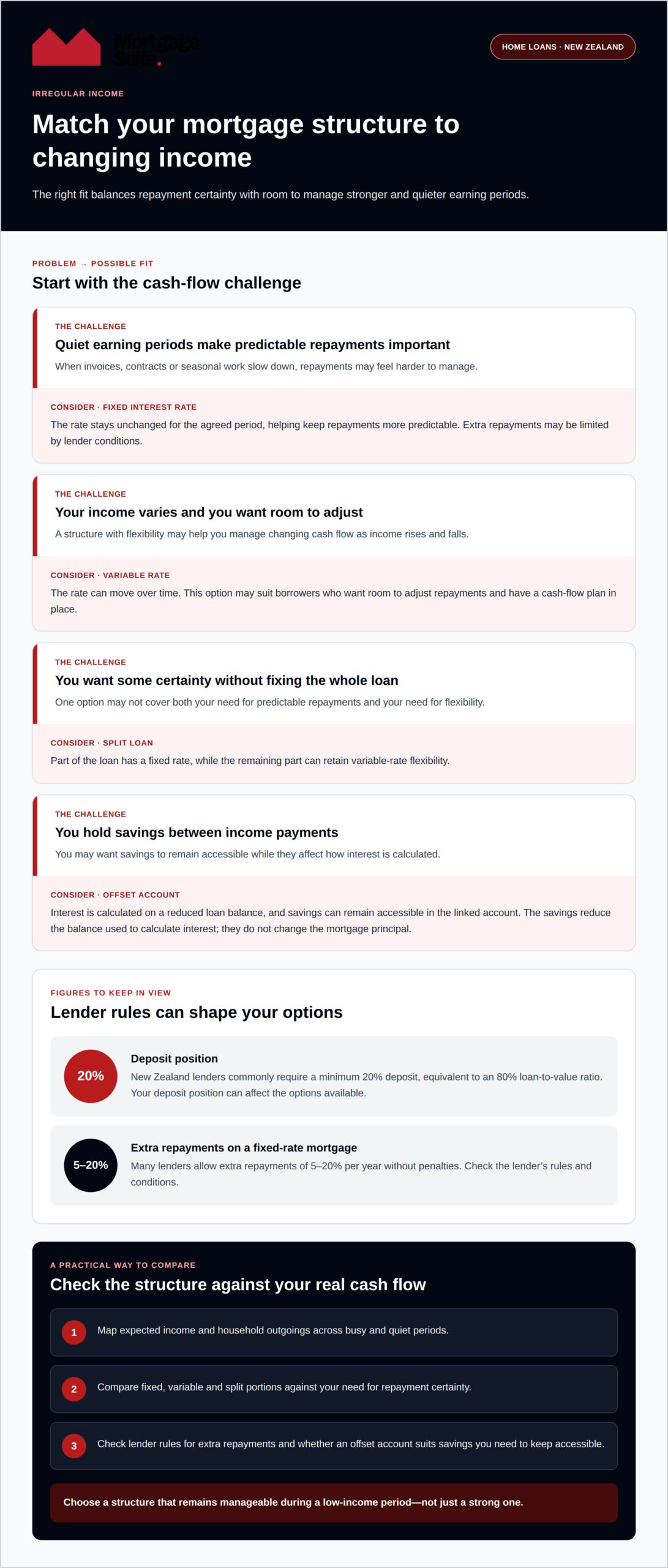
Start by matching each loan option to a clear need. A fixed interest rate keeps repayments more predictable during its agreed period, while a variable rate can change. Splitting a mortgage between the two can provide some repayment certainty while keeping part of the loan flexible.
New Zealand lenders commonly require a minimum 20% deposit, equivalent to an 80% loan-to-value ratio. That deposit position can affect the loan options available, alongside your income pattern and the property. An overview of mortgage structures can also help explain the terms before you compare them.
| Option | Repayment certainty | Flexibility | May suit |
|---|---|---|---|
| Fixed interest rate | Rate stays unchanged for the agreed period | Extra repayments may be limited by lender conditions | Borrowers prioritising predictable repayments |
| Variable rate | Repayments may change when the rate changes | Can suit borrowers wanting room to adjust repayments | Income that varies, with cash-flow planning in place |
| Split loan | Part of the loan has a fixed rate | The remaining part can retain variable-rate flexibility | Borrowers balancing certainty and access to flexibility |
| Offset account | Interest is calculated on a reduced loan balance | Savings can remain accessible in the linked account | Borrowers holding savings between income payments |
For example, with a NZ$400,000 mortgage and NZ$20,000 in savings linked to an offset mortgage, interest is charged on NZ$380,000. The savings reduce the balance used to calculate interest, rather than changing the mortgage principal.
A broker can help shape these options around your actual cash flow. They review when income arrives, how dependable each income source is, your regular commitments, deposit and property plans. They can then compare lender criteria and discuss how different repayment settings fit your circumstances.
- Map expected income and household outgoings across busy and quiet periods.
- Compare fixed, variable and split portions against your need for repayment certainty.
- Review lender rules for extra repayments; many lenders allow 5-20% per year on a fixed-rate mortgage without penalties.
- Check whether an offset account suits savings you need to keep accessible.
Choose a structure that remains manageable during a low-income period, not just a strong one. A broker can explain the trade-offs and help you compare suitable options before you commit.
Mortgage options for freelancers, self-employed people and seasonal workers
Loan options depend on how clearly you can demonstrate your income and repayment capacity. Lenders assess freelancers, business owners and seasonal workers using different evidence and criteria.
Lender and broker options
New Zealand lenders can consider applications from people with irregular income, but their assessment criteria differ. No single list of lenders accepts every freelancer, contractor or seasonal worker. Your income pattern and supporting records matter.
A mortgage broker compares lender criteria with your circumstances and can explain which options may fit. The broker doesn’t make the lending decision, but can help present your income clearly and discuss which lenders may suit your application.
Income records and tax returns
There isn’t one universal requirement for years of accounts or tax returns across New Zealand banks. Each lender sets its own evidence requirements, which may depend on how long you’ve been self-employed and whether your earnings have been steady.
Relevant records may include business accounts, financial statements, tax returns and bank statements. Freelancers may also use invoices or client contracts to show how they earn, while seasonal workers can use records to explain recurring busy and quiet periods.
Assessing variable and business income
Lenders look at income reliability, not just the highest amount earned. For bonuses and commissions, they may consider whether payments recur and how they compare across the records supplied. Sharply changing income may be treated differently from regular base pay.
For business income, lenders assess financial records and earning patterns. They may consider whether income is rising, steady or falling, alongside business commitments and personal expenses. For example, a strong recent season may be considered in the context of quieter periods.
How a broker can improve approval chances for self-employed borrowers
A broker can organise the application to show how business income supports the requested repayments. They can identify gaps in the records, clarify unusual changes and match the application with lender criteria before submission.
This is different from simply sending the same application to several lenders. A broker can explain the context behind a freelancer’s changing invoices or a seasonal worker’s annual pattern, then discuss suitable options. Clear presentation can support an assessment, but it cannot guarantee approval.
Before applying, gather your personal and business income records, details of regular commitments, and explanations for any significant changes. This gives the broker a clearer basis for comparing lender requirements and preparing your application.
Mortgage terms and repayments
Most New Zealand mortgages have a repayment term of 25-30 years. A longer term spreads scheduled repayments across more time, while a shorter term generally requires larger regular payments. The right fit depends on what your budget can manage through quieter earning periods, not just your strongest months.
For a practical illustration, a NZ$400,000 table mortgage at 6% over 30 years has monthly repayments of NZ$2,399. This example shows how the loan amount, interest rate and term work together to shape a regular payment. Your own repayment depends on the details of your loan.
Term length also affects how long interest is paid. Raising the example repayment to NZ$2,500 would pay it off three years earlier and save NZ$56,623 in interest.
Those figures are examples, not a recommendation to choose the shortest term. Higher repayments may be difficult to maintain when invoices are delayed or seasonal work slows. Consider how a payment fits both a busy month and a leaner stretch before settling on a term.
New Zealand mortgage borrowers often choose fixed rates, with two-year fixed terms accounting for nearly half of new mortgages. These market patterns help explain common choices, but don’t determine which term suits your income. Match the length of a fixed period to your plans and comfort with changing repayments.
A Reserve Bank of New Zealand debt-to-income limit relates borrowing to income and total debt. For irregular earners, the income figure used in that calculation can affect how much borrowing fits within the limit. It is one consideration alongside the lender’s wider assessment of repayments and existing commitments.
Compare repayment schedules with the shape of your yearly income. A seasonal worker could map expected payments against quieter months, while a freelancer could allow for gaps between finishing work and receiving payment. This can help show whether the proposed term leaves enough room in the household budget.
- Longer term: spreads scheduled repayments across more time.
- Shorter term: may reduce the time spent repaying, but requires larger payments.
- Fixed period: consider how its end date fits your plans and income changes.
Choose a schedule that remains manageable across the full earning cycle, not only during peak-income periods.
Around 86% of New Zealand mortgage borrowers choose fixed-rate mortgages, but that does not make a fixed rate the right fit for every income pattern. Consider the payment structure alongside setup costs, and check what fees apply before settling on a loan.
Include that cost in your comparison if you’re considering this option. Keep upfront fees in view alongside scheduled repayments, so your choice reflects affordability now and the budget during quieter periods.
How do NZ banks assess home loan applications with irregular or self-employed income?
New Zealand banks assess whether your documented income can support the proposed repayments. For self-employed applicants, the figures need context: business turnover alone doesn’t show what’s available for personal costs and mortgage payments.
Start with income consistency. A lender reviews the pattern across your records, looking at whether earnings are steady, rising, falling or seasonal. For example, a seasonal worker’s quieter months make more sense when the application shows the full yearly earning cycle.
For a business owner, the distinction between sales and personal income matters. A business can have strong sales while operating costs, tax obligations and other commitments reduce what the owner can draw. Financial statements help explain that difference and show how business performance connects to household income.
Next, lenders consider regular outgoings and existing debts alongside income. Rent, personal loans, credit card limits and household spending all affect the money available for mortgage repayments. A clear breakdown shows what remains after those commitments, rather than presenting earnings in isolation.
A serviceability stress test checks whether repayments remain affordable at a higher hypothetical interest rate. It helps a lender assess how changed borrowing conditions could affect your budget. With uneven income, the assessment also needs to account for quieter earning periods, not just a strong month.
Property and deposit details complete the wider picture. The lender considers the proposed security, the amount borrowed against its value, and the supporting information in your application. A deposit can affect the loan-to-value ratio, while the property must meet the lender’s security requirements.
For example, imagine a contractor with several strong invoices followed by a gap between projects. The lender needs to understand whether the gap is a normal part of the work cycle or a sign that earnings have changed. Contracts, invoices and account records can help explain the pattern.
Applications are easier to assess when the documents tell a consistent story. If a tax return shows lower income than recent business statements, explain the difference clearly. This lets the lender assess the figures in context instead of treating an unexplained change as reliable ongoing income.
- Income: show the source, pattern and reliability of earnings.
- Outgoings: account for debts and regular household commitments.
- Repayments: consider affordability under a serviceability stress test.
- Application: connect financial records with the deposit and property details.
This assessment looks beyond a single income figure. A well-organised application connects the records, explains seasonal or business changes, and shows how repayments fit your financial picture.
What income documents do NZ lenders require from self-employed borrowers?
There isn’t one standard document list for every self-employed borrower in New Zealand. A lender may ask for records showing how your income is earned, how consistent it is, and what remains after business commitments.
For a sole trader, recent financial statements and tax returns can help show business performance and taxable income. Lenders may also request bank statements to compare reported earnings with money moving through your accounts. Keep business and personal transactions clear so deposits and withdrawals are easier to understand.
If you operate through a company, financial statements can show the company’s position, while records of salary or drawings help explain the income available to you personally. Company revenue isn’t automatically the same as personal income. For example, money retained for business expenses may not be available for mortgage repayments.
Freelancers and contractors can add invoices, client agreements or records of completed work when these help explain their earnings. An invoice shows the amount billed, while a bank statement can show whether and when payment arrived. A current contract may clarify expected work, but it doesn’t replace evidence of income already received.
Seasonal workers can use records showing a full earning cycle. For example, a worker with busy summer months and quieter winter months can provide income records from both periods. This gives the lender more context than a single strong month or recent payment.
Other documents can help complete the picture. A lender may ask for details of existing debts, regular business commitments or the source of a large deposit. If a financial statement shows a sharp change, an accountant’s explanation or supporting records may clarify what happened.
To prepare a clear application, group records by purpose rather than sending an unexplained bundle:
- Income: financial statements, tax returns and relevant bank statements.
- Work pattern: contracts, invoices or seasonal earning records, where relevant.
- Business structure: company accounts and records showing salary or drawings.
- Changes: supporting information that explains a drop, increase or unusual payment.
Check that dates and figures line up across your statements, tax returns and accounts. If an invoice is unpaid, distinguish it from income already received. If business income has changed, explain why with a relevant record, such as a new contract or documented pause in work.
A mortgage adviser can help organise records around your work structure and the lender’s assessment needs. This can make it easier to explain how your income supports repayments without presenting turnover as personal earnings.
This is a property-related requirement, separate from the financial records used to explain self-employed earnings. Ensure your income documents show how earnings are received and what remains after business commitments. A valuation doesn’t replace financial statements, tax returns or bank statements as evidence of income.
Mortgage Suite
Mortgage Suite Ltd can help you compare home loan options against your income pattern and property goals. If your earnings vary, a broker can help present the pattern clearly to lenders and discuss loan structures that may fit your cash flow. A mainstream-bank decline doesn’t necessarily close off every option; Mortgage Suite Ltd also specialises in 2nd tier loans for borrowers who don’t fit mainstream bank criteria.
You can talk through how you earn, the quieter periods you plan for, and the repayments you’re considering. Mortgage Suite Ltd can help you understand possible next steps without promising approval. If you’re ready to discuss your circumstances, contact Mortgage Suite Ltd.
Take the next step towards a loan that fits
Your next move is to turn your borrowing plans into a clear conversation about what fits your income, property goals and comfort with repayments. For a home loan with irregular income in NZ, look beyond your latest earning period and consider how your work and plans fit together.
Mortgage Suite Ltd can discuss borrowing options for first-home buyers, residential property investors and people seeking business loans. Talk through what you’re aiming to do and how you earn your income, then consider a suitable way forward. No two applications are identical, and a conversation can help clarify the path ahead without treating a bank’s decision as a judgement on you.
Discuss your options with Mortgage Suite Ltd when you’re ready to talk through your plans. A thoughtful next step can help you move forward with greater confidence.
Frequently Asked Questions
Interest rate: fixed, variable or both?
Before choosing, compare how each option fits your plans for the loan, not just your current budget. For example, if you may sell or restructure the mortgage during a fixed period, ask how that timing could affect your choices. Also consider whether you’d prefer loan portions to reach their review dates together or at different times. The right fit depends on the trade-offs you’re comfortable managing.
Can contractors, freelancers, seasonal workers, or gig workers get a home loan in New Zealand?
Yes, work arranged through contracts, clients, seasons or online platforms doesn’t automatically rule out a home loan. A useful starting point is showing how these income sources fit together over time. For example, someone combining freelance projects with seasonal work can explain which work is ongoing and which is occasional. This broader picture helps distinguish varied work arrangements from an income source that has ended.