
How Much Deposit Do You Need for a Second Home in NZ?
Could the deposit for your second home come from your current home, rather than years of extra saving? The question of how much deposit for second home nz has no one-size-fits-all answer. The amount a lender may expect depends partly on whether you’ll live in the property, use it as a bach or rent it out.
It’s understandable to want a clear figure before you start planning. But equity in your home isn’t automatically cash in hand, and having a deposit ready doesn’t necessarily mean the repayments will fit comfortably alongside your other commitments. This guide explains how the purpose of your purchase, your savings and usable equity can shape the deposit discussion, as well as how lenders look at your wider borrowing position. You’ll also find practical steps to prepare before discussing your options, so you can make a plan with a clearer picture of your finances.
Key Takeaways
- For how much deposit for second home nz, start with the property’s purpose and the lender’s criteria rather than assuming one figure applies to everyone.
- Work out the difference between your home’s estimated value and mortgage balance, then discuss how much of that equity may be usable towards a deposit.
- Map your income, regular expenses and existing debt to see how a second loan could fit your household budget.
- Treat potential rent as information for a lender to assess, not as guaranteed income or approval.
- Before discussing your options with Mortgage Suite, gather your savings and mortgage balances and form a realistic view of your property’s value. Mortgage broking and financial advice are free of charge, with no obligation.
How much deposit might you need for a second home in NZ?
There isn’t one deposit figure for every second-home purchase. The amount a lender may require depends on what you plan to do with the property, the lender’s criteria, the funds you can contribute and whether your household can manage the proposed repayments alongside existing commitments.
A headline deposit figure can be a starting point, but it can’t determine what you may be able to borrow. Two buyers considering similar properties could receive different assessments because their income, debts, savings and existing home loans differ. The deposit is only one part of the application.
Why the purpose of your second home matters
A rental property, holiday home and second home for personal use may be assessed differently. If you plan to rent the property, a lender may consider it as a residential investment purchase and assess expected rent as part of the wider application. If it’s for your own use, the lender may assess its purpose and whether you can meet repayments without relying on rental income.
Be clear about how you plan to use the property, including whether you expect to rent it regularly or stay there yourself. Its intended use helps frame the lending discussion, but doesn’t guarantee a particular deposit requirement. The lender will consider it alongside your financial position and the property itself.
Is there one minimum deposit for every second home?
No single minimum applies to every borrower and purchase. Lenders consider their own criteria, the property and where your deposit is coming from. Current lending settings may also affect how much a lender can advance in a particular situation. General guidance can help you prepare, but it can’t promise what a lender will accept.
A useful concept is the loan-to-value ratio, which compares the amount borrowed with the value of the property used as security. It helps explain why lenders consider the deposit and property value together, but it doesn’t tell you by itself whether a loan will be approved.
For example, a buyer may have savings ready but still need to show that repayments are manageable after accounting for their current mortgage and regular expenses. Another buyer may have less cash available but own a home with equity that could contribute towards a deposit, subject to the lender’s assessment. Neither situation guarantees approval.
If you’re buying to rent, the residential investment property loan guide explores lending considerations for that purpose. For any second home, explain how you’ll use it and discuss your available funds, equity and overall ability to manage repayments. That gives you a more useful starting point than relying on a headline figure.
Can home equity count towards a second-home deposit?
It may. Equity is the difference between your property’s value and the mortgage balance still owing on it. If you’re weighing up how much deposit for second home nz, equity could be one part of the picture, alongside savings or money from selling another asset. But calculated equity isn’t cash in your account, and it doesn’t automatically mean a lender will approve further borrowing against your home.
Each source affects your plans differently. Savings can provide funds without adding debt secured against your current home. Sale proceeds depend on selling a property and having the funds available. Borrowing against your existing home may let you keep it, but increases the debt secured against it. There’s no single best option for everyone; your plans and ability to manage the total borrowing matter.
How to estimate the equity in your current home
Start with a simple calculation: estimated property value minus outstanding mortgage balance equals estimated total equity. For example, if your home’s estimated value is higher than its remaining mortgage, the difference is your estimated equity. This is not a property valuation or a borrowing decision.
An online estimate can give you a rough sense of value, but a lender may assess the property differently. The value the lender accepts, your current lending and its assessment all affect what, if anything, may be available to borrow. For official guidance on using equity to borrow against your home, the New Zealand Government explains how further borrowing secured against a property works.
What usable equity does, and doesn’t, tell you
Total equity is the gap between your property’s estimated value and its mortgage balance. Usable equity is the amount a lender may consider available for further borrowing after its own assessment. The two aren’t the same. A calculation can help you prepare, but it can’t account for every lending condition or show whether extra repayments will fit your budget.
Borrowing against your current home also means more debt is secured against that property. Consider how repayments could fit alongside your existing mortgage and the proposed second-home loan, including if your circumstances change. A lender will assess the wider picture, not just the amount of equity on paper.
If lending terms feel unfamiliar, talk through your deposit sources and borrowing position with Mortgage Suite. Mortgage broking and financial advice are free of charge, with no obligation.
What else can affect second-home borrowing beyond the deposit?
A deposit can help meet a lender’s requirements, but it doesn’t answer a separate question: can you manage the repayments? A lender may consider your income, regular household spending, existing debt and proposed loan together. That wider assessment can affect your borrowing options even if your deposit looks substantial.
Think of it as a household budget check. Your current mortgage and regular commitments don’t disappear when you buy another property. A lender may also consider how repayments could change over time, rather than looking only at what seems manageable today. The deposit is one part of the application, not a substitute for showing that the full commitment is affordable.
How existing commitments fit into the assessment
Before discussing a second home, make a clear record of your current home-loan repayments, other debt repayments and regular household expenses. Lenders may consider these alongside your income to understand what could be available for another loan. Some lending settings also look at total debt in relation to income, but no single calculation captures every part of an individual assessment.
A lender may use a serviceability stress test, which checks whether repayments could remain manageable under a hypothetical higher interest rate. The approach and assessment depend on the lender. For your own planning, consider whether you could keep up with both home loans while meeting everyday expenses, including if an unexpected bill arose.
How the second property’s intended use can affect the discussion
Be ready to explain whether the property will be rented or used personally. If you plan to rent it, a lender may consider expected rental income as part of its assessment. The lender decides how that information fits the application, so don’t assume rent will cover repayments or allow you to borrow more.
For example, you might rent a property for part of the year and use it yourself at other times. That plan may raise different questions from a property intended for a long-term tenant or a home used only by your household. Explain your plans, including any periods when you don’t expect rental income. Potential rent is a factor to discuss, not a guaranteed source of funds or approval.
To prepare for a lender conversation, write down:
- your household income and regular spending
- current mortgage repayments and other debt commitments
- how you intend to use the second property
- any rental income you expect, and when the property may be vacant or used personally
This information can make the discussion more practical and highlight questions to work through before you commit to a purchase. If you’re still asking how much deposit for second home nz, keep the wider borrowing picture in view too. A deposit that meets one part of the assessment may not resolve concerns about managing repayments over the long term.
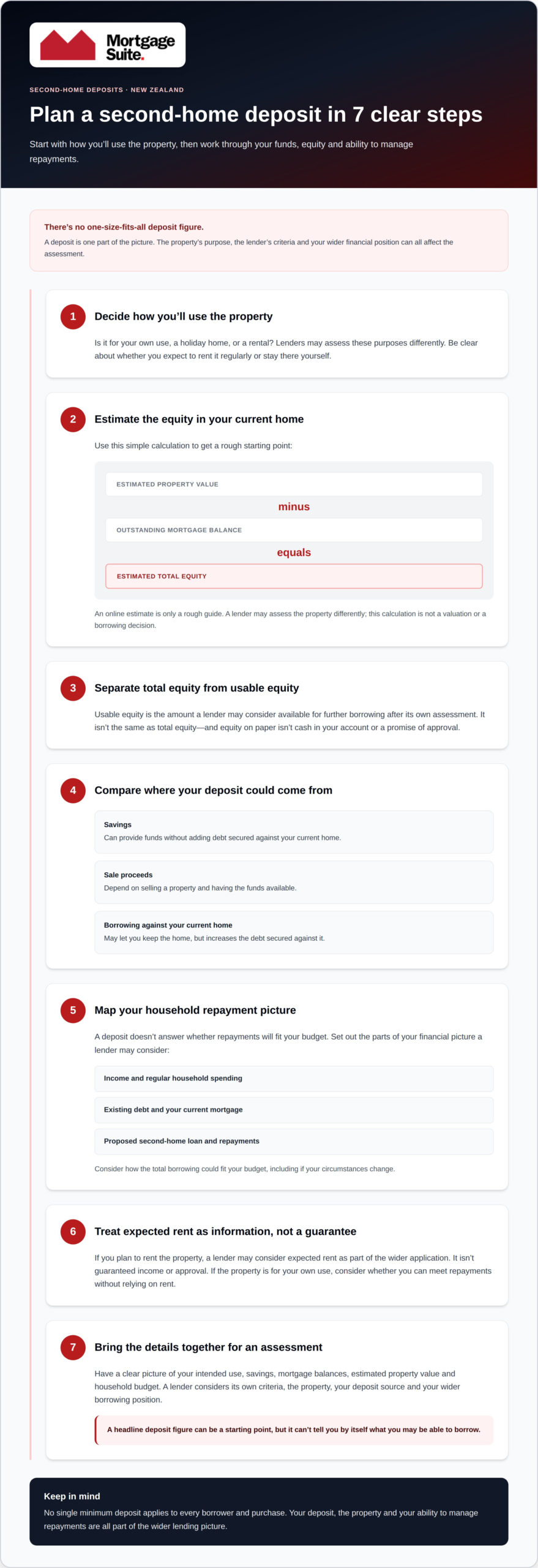
How to prepare your second-home deposit plan
A clear plan starts with why you want another property, then looks at the funds and borrowing position that could support it. Are you buying a rental, a holiday home or somewhere for personal use? Your answer helps frame the lending discussion. Next, compare your savings with any equity you may want to use, and consider how each option could affect your repayments and household budget.
Rather than rely on one estimate, map out a couple of possibilities. For instance, compare a plan based mainly on savings with one that also involves borrowing against your current home. You don’t need to choose between them straight away. The aim is to understand what information a lender needs and which questions to work through.
- Write down how you intend to use the second property.
- Record your available savings and any other funds you may contribute.
- Note your existing mortgage balances and get a realistic view of your property’s value.
- Set out your income, regular expenses and other debts so the deposit can be considered alongside affordability.
- Discuss more than one borrowing scenario before making firm assumptions about what you can spend.
What to gather before discussing your deposit
Bring together the details that explain both your deposit and your wider financial position. This includes current home-loan balances, savings, an estimate of your existing property’s value, household income, regular expenses and other debt commitments. Note whether you plan to rent the second property or use it personally, and whether you expect that use to change. Complete information makes the conversation more useful, although it doesn’t replace the lender’s own assessment.
If your property-value estimate comes from an online tool, treat it as a guide rather than a confirmed value. A lender may assess it differently. Having the estimate and mortgage balance side by side can still help you explain your starting point clearly.
When to seek a lending view
Discuss your position before assuming that savings or equity will be accepted as a deposit, or that a particular loan will be affordable. Pre-approval can offer an early indication of a lender’s view, but it isn’t a guarantee of final approval. The property and your circumstances still matter, so leave room in your plans for the lender’s full assessment.
A mortgage calculator can help you explore how different repayment scenarios might fit your budget. Treat the result as a planning aid, not a lending decision. The answer to how much deposit for second home nz is most useful when considered alongside your income, commitments and chosen property. For a personal discussion of how those pieces may fit together, talk with Mortgage Suite about your second-home deposit plan.
How Mortgage Suite can help you explore second-home lending
Working out how a deposit, existing home loan and future repayments fit together can feel like a lot to manage. A mortgage conversation can help you organise those moving parts and understand what questions to raise with a lender. Mortgage Suite provides mortgage broking and financial advice free of charge, with no obligation.
The discussion can start with your plans for the property. Is it somewhere you’ll use personally, a holiday home or a rental? From there, you can talk through possible deposit sources, such as savings or equity, and how a new loan might sit alongside your existing commitments. The aim is to consider the whole picture, not just focus on a deposit figure in isolation.
Mortgage Suite can discuss lending options across a range of bank, private and non-bank lenders. Each lender has its own requirements, and what may suit you depends on your circumstances, the property and your ability to manage repayments. Having more than one lender option to discuss doesn’t mean approval is assured, but it can help you understand possible next steps.
What a mortgage conversation can help clarify
Bring your goals and a clear summary of your finances to the discussion. A broker can help you consider how your purchase purpose, savings, equity, income and existing commitments may fit together, then discuss lender options relevant to your situation. Requirements vary, so a conversation can replace broad assumptions with a more individual view.
If a mainstream bank has declined your application, that can be disappointing, but it doesn’t necessarily end every lending conversation. Different lenders may assess circumstances differently. There’s no guaranteed outcome, but understanding the reasons for a decision can help shape what to explore next.
A straightforward next step for second-home buyers
Krish Krishna founded Mortgage Suite in 2000 after an 18-year banking career. That background informs a practical, personal approach to discussing home-loan options. You can talk through what you’re hoping to buy, how you might fund the deposit and what repayments could mean for your household.
You don’t need every detail settled before starting a conversation. If you’re asking how much deposit for second home nz, bring what you know so far, including your current loan balance, savings, income and intended use for the property. These details can help frame a useful discussion without pressure to commit or any promise of approval.
Discuss your home-loan options with Mortgage Suite.
Take your next step with a clearer plan
You don’t need every detail settled before taking a practical next step. Start by deciding what you want the second property to make possible, then consider what level of commitment would still feel manageable for your household. If you’re asking how much deposit for second home nz, focus on a plan that gives you room to make informed choices as your circumstances and goals become clearer.
A considered conversation can help turn your notes and questions into a useful way forward, without pressure to commit or any promise of approval.
Talk with Mortgage Suite about your home-loan options. Mortgage broking and financial advice are free of charge, with no obligation.
Frequently Asked Questions
Is a holiday home assessed differently from a rental property?
It can be, depending on how you plan to use the property and the lender’s criteria. A bach you’ll use yourself may be considered differently from a property intended to earn rent. If you’ll rent it for part of the year, explain when it’ll be available to tenants and when you’ll use it. The lender decides how that use affects its assessment, so don’t assume either purpose comes with a set deposit requirement.
Can I buy a second home before selling my current home?
You may be able to, but the lender will need to assess whether your finances can support the commitments involved. Until your current home sells, you could be responsible for its mortgage as well as repayments on the new property. A lender may also discuss whether bridging finance fits your circumstances. Before committing to a purchase, get a lending view based on your current debt and plans for the sale.
Can expected rent help with a second-home loan application?
Potentially, but a lender decides how to treat expected rent and may ask for evidence, such as a rental appraisal or tenancy details. Don’t build your plan on the assumption that all expected rent will count towards repayments. A property may be vacant between tenants or need repairs, and short-stay income can vary. Be ready to explain your rental plans and how you’d manage repayments if rent was lower than expected.
Do I need pre-approval before making an offer on a second home?
Pre-approval can give you an early indication of a lender’s view, but it isn’t a guarantee that the final loan will be approved. The lender may still need to assess the specific property and updated details about your finances. Before making an offer, understand any conditions attached to your lending position and avoid treating an initial indication as final sign-off. The right timing depends on your purchase plans and circumstances.
Can I use a personal loan for a second-home deposit?
A personal loan may provide funds, but it also adds a repayment commitment that the lender may include in its affordability assessment. Be upfront about where your deposit is coming from and any repayments you’ll need to make. A lender decides whether borrowed funds are acceptable for your application and how they affect the overall borrowing picture. Compare this option carefully with savings or other available funds before taking on extra debt.
What happens if my bank declines my second-home loan application?
A decline can be disappointing, but it doesn’t necessarily end every lending conversation. Ask what factors affected the decision, then consider whether updated information or a change in your plans could address them. A mortgage adviser can help you understand the feedback and discuss whether another lender’s assessment may suit your circumstances. Each application is assessed on its own merits, so no alternative route can guarantee approval.