
Commercial Property Finance NZ: Your 2026 Guide to Getting the Best Deal
Getting the right commercial property finance nz shouldn’t feel like you’re trying to crack a secret code just to grow your own business. It’s incredibly frustrating when you’re faced with mountains of paperwork, confusing talk about debt coverage, and deposit requirements that seem to shift every time you ask. You likely feel that the big banks are more interested in ticking boxes than understanding how your lease income actually supports your long-term vision.
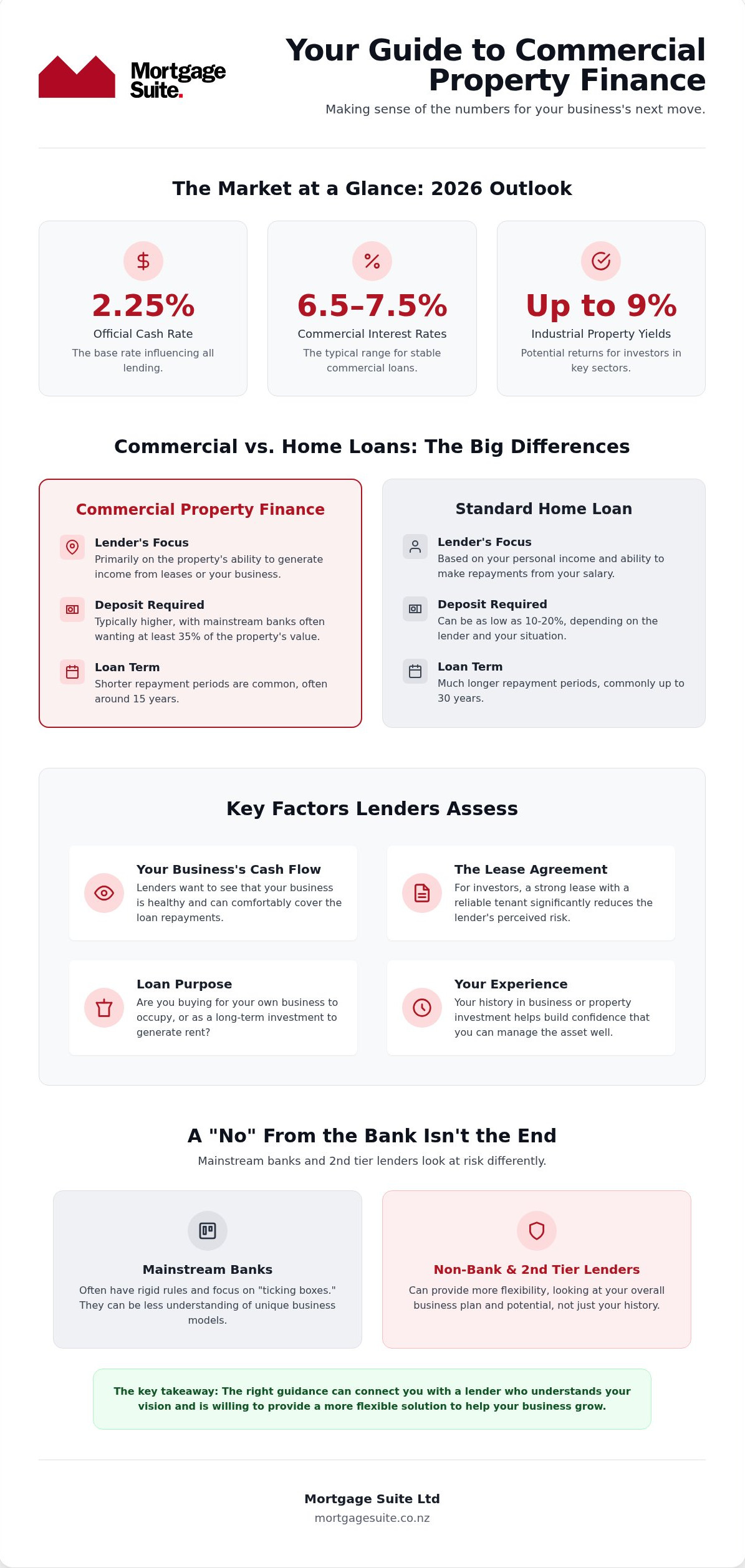
I understand that stress because I’ve seen it from both sides of the desk. This guide is here to simplify the process and show you how to find a flexible lender who sees the value in your plans. With the Official Cash Rate sitting at 2.25% and commercial interest rates stabilising between 6.5% and 7.5% in 2026, there are fantastic opportunities for those who know where to look. We’ll explore how to maximise your borrowing capacity based on your lease income and why a “no” from a mainstream bank is often just the start of a much better conversation. You’ll learn exactly how to position your business to get a deal that supports your growth rather than holding you back.
Key Takeaways
- Understand why lenders look at your business cash flow differently than a standard home mortgage when you’re looking for commercial property finance nz.
- Learn how to choose between fixed and floating interest rates to keep your business’s day-to-day cash flow steady and predictable.
- Discover the simple factors lenders use to judge your application and how to prioritise the right information to show your business in the best light.
- Find out why a “no” from a big bank doesn’t mean your deal is dead, and how non-bank lenders can provide the flexibility you need.
- See how expert guidance can help you organise your application to save time and secure a deal that supports your long-term growth.
What is Commercial Property Finance in NZ?
Think of commercial property finance nz as the financial foundation for your business’s physical home. Whether you are eyeing up a local retail shop, a professional office suite, or a massive industrial warehouse, these loans are specifically designed to help you own the space where the work happens. It is a significant shift from residential lending. While a home loan is personal, a commercial loan is a business decision. It is about turning a monthly expense into a long-term asset that you actually control.
The most exciting part for many business owners is the chance to stop the “rent trap.” Every dollar you send to a landlord is gone forever. By securing your own premises, you start building equity in a property that can grow in value alongside your company. Lenders look at these applications through a different lens than a standard mortgage. They are deeply interested in the building’s ability to make money. They want to see that the property can generate enough cash to cover its own costs, which is vital for the stability of New Zealand’s economy and your own financial health. In 2026, with interest rates stabilised between 6.5% and 7.5%, many businesses are finding it’s the right time to make this move.
Commercial vs Residential: The Big Differences
One of the first things you’ll notice is that the rules of the game change when you move into the commercial space. Deposit requirements are usually higher. While you might get a home with a small deposit, mainstream banks typically want you to provide at least 35% of the value for a commercial site. This is because banks see more risk in a warehouse or shop than a three-bedroom house. The lease agreement is your secret weapon here. A strong lease with a reliable tenant makes you look much safer to a lender. You should also prepare for shorter loan terms. Instead of the 30-year stretch you get with a house, commercial loans often wrap up in 15 years, so your repayment plan needs to be sharp.
Common Uses for Commercial Loans
Most of my clients use these loans for one of three reasons. First, they want to be an owner-occupier. This means your business lives in the building you own, giving you total control over your renovations and future. Second, you might be an investor looking to collect rent from other businesses. With yields for secondary industrial properties reaching up to 9% in 2026, it can be a very rewarding path. Finally, you might already have a mortgage but want to refinance. If your current bank is being too rigid or difficult, moving your loan to a more flexible lender can free up the cash you need to support your next stage of growth.
Types of Commercial Property Loans Available
Choosing the right structure for your commercial property finance nz is just as important as the building itself. You want a setup that works with your business’s unique rhythm, not against it. Most Kiwis start by choosing between fixed and floating interest rates. A fixed rate gives you the peace of mind of knowing exactly what your repayments will be for a set time, which is great for long-term budgeting. On the other hand, floating rates offer more flexibility. If your business has a bumper month, you can often pay off a bit more of the loan without getting hit by extra fees. It’s a simple way to stay in control.
For investors, interest-only options are a popular way to keep monthly costs low while waiting for the property to grow in value. This can be a smart move if you want to keep your cash free for other business expenses or if you’re planning a major upgrade to the building soon. Another clever strategy involves using the equity you’ve built up in your family home. Instead of coming up with a massive cash deposit, you might be able to use your home as security to get the deal across the line. It’s a powerful way to use what you already own to build a more secure future for your company.
Standard Commercial Mortgages
This is the most common path for businesses that want a permanent home. If your company is the one paying the rent to yourself, your repayment schedule is often tied to your business’s cash flow. It’s important to remember that these loans aren’t “set and forget.” As your business evolves, you might find that your original commercial property finance nz no longer fits your needs. This is when you might choose to refinance your commercial property to unlock better terms or release equity for a new project.
Development and Construction Funding
If you’re building from scratch or doing a major fit-out, a standard mortgage won’t work. You’ll need specific funding where the lender releases money in stages, known as progress payments, as the work gets done. This keeps your interest costs lower because you’re only paying for the money you’ve actually spent so far. You can read more about how this works in our guide on property development loans NZ. If you’re unsure which path is right for your specific goals, you can always talk to a specialist who can help you weigh up the pros and cons.
What Do Lenders Look for in an Application?
When you’re ready to apply for commercial property finance nz, it helps to understand that lenders aren’t just looking at a piece of real estate. They’re looking at a story. They want to be sure that the person behind the deal is reliable and that the numbers make sense for the long haul. Most lenders use a simple framework often called the “Three Cs” to judge your application: Cash flow, Collateral, and Character.
Cash flow is the most vital part. In 2026, most New Zealand banks want to see a debt service coverage ratio between 1.20 and 1.35. In plain English, they want to see that you have at least $1.20 in income for every $1 you owe in loan repayments. Collateral is the building itself, and Character is your personal track record as a business owner. If you’ve managed your finances well in the past, you’re already halfway there.
Lenders also look at how long your tenants are staying. They often use a term called WALE, but you can just think of it as “lease security.” If your building has a tenant with five years left on their contract, the bank feels much safer than if the tenant could leave next month. Finally, you need a clear exit strategy. Whether you plan to sell the property in ten years or refinance it once your business grows, the lender needs to see that you have a plan to eventually finish the loan.
The Deposit and LVR Explained
In the world of commercial property, you’ll need a bigger deposit than you would for a house. Mainstream banks typically lend up to 65% of the property’s value, meaning you’ll need a 35% deposit. However, the type of building matters. A modern industrial warehouse is often seen as a safer bet than a small retail shop in a quiet suburb, so the deposit requirements might shift. If you don’t have the full cash deposit, you can often bridge the gap by using equity from other properties or talking to a 2nd tier lender who might offer up to 70% of the value.
Documentation You Need to Organise
Being organised is the best way to show a lender you’re a serious professional. To get the ball rolling, you’ll generally need to provide:
- Two years of certified financial accounts for your business.
- A clear record of your current tax position with the IRD.
- The full lease agreement, including the history of the tenant’s payments.
- A personal statement of your assets and liabilities to show your overall financial strength.
Having these documents ready from the start makes the process much smoother and shows the lender that you’re a steady hand they can trust.
Mainstream Banks vs 2nd Tier Lenders
Big banks often operate with a rigid set of rules that can make getting commercial property finance nz feel like trying to fit a square peg into a round hole. If your business financials don’t look exactly like a textbook example, you might find yourself facing a quick rejection. This isn’t necessarily because your business is a bad risk. It’s usually because the bank’s automated systems aren’t designed to handle anything out of the ordinary. They prefer simple, predictable cases that require very little manual investigation.
Because of this rigidity, we’ve seen a massive rise in non-bank lenders across the New Zealand market. These 2nd tier lenders are becoming a vital part of the financial landscape in 2026. They don’t just look at a computer-generated score. Instead, they take the time to understand the person behind the business and the specific potential of the property. While the interest rates might be slightly higher than a mainstream bank, the trade-off is a much higher chance of approval and a significantly faster process. Getting the deal done today is often worth far more to your business’s growth than waiting months for a bank that might still say no.
When to Consider a 2nd Tier Lender
You should think about alternative options if your financial records aren’t perfectly “standard.” This is common for self-employed Kiwis or business owners who have had a fluctuating income over the last two years. Speed is another huge factor. If a prime industrial site hits the market and you need to move within days, a mainstream bank’s slow approval process could cost you the opportunity. You might also need a 2nd tier lender if the building itself is “non-conforming.” This could mean it has a lower seismic rating or a unique layout that traditional banks find too risky to touch.
The Advantage of Alternative Finance
The real beauty of alternative finance is the focus on the overall quality of the deal rather than just a checklist of boxes. These 2nd tier lenders in New Zealand fill a massive gap for business owners who are ready to expand but don’t fit the narrow bank criteria. I’ve spent over two decades in this industry, and I’ve seen countless “no” responses from banks turned into successful property purchases through the right alternative lender. It’s about finding a partner who sees your vision and wants to help you get there. If you’re tired of the bank’s red tape, it might be time to reach out for a chat about your options.
How to Get Your Commercial Finance Sorted
Securing the right commercial property finance nz shouldn’t be a lonely journey. While it’s tempting to walk straight into your local bank branch, that often limits your options before you’ve even started. A broker acts as your advocate, looking at the entire market to find the best fit for your specific business goals. We don’t just pass on your paperwork; we use over 20 years of banking experience to package your application so it speaks the language that credit managers want to hear. This preparation is often the difference between a quick approval and a long, drawn-out rejection.
Having a dedicated negotiator on your side means you don’t have to worry about the back-and-forth with lenders. We know which lenders are currently active in specific sectors and which ones are more open to unique property types in 2026. By choosing a partner who understands the inner workings of the banking system, you save yourself hours of stress and potentially thousands of dollars in better terms. It all begins with a simple, honest chat about where you want your business to go. We take the time to listen first, ensuring the funding we find actually supports your long-term vision.
The Application Process Step-by-Step
We’ve refined our process to be as straightforward as possible. It starts with an initial consultation where we dive into your objectives. Once we know what you’re trying to achieve, we move into the following stages:
- Initial Consultation: We discuss your business goals to understand exactly what you need from a lender and what you want to achieve.
- Information Gathering: We help you organise the documentation we discussed earlier, identifying the best lenders for your specific situation.
- Proposal and Negotiation: We submit a polished proposal and negotiate the best possible terms and structures on your behalf.
This structured approach removes the guesswork and keeps the momentum moving forward so you can focus on running your business.
Why Partner with Mortgage Suite Ltd?
When you work with us, you’re getting more than just a middleman. You’re getting the expertise of Krish Krishna at Mortgage Suite Ltd, a seasoned veteran who spent decades inside the banking system. This means we know exactly how to frame your story to overcome the hurdles that often stop other applications in their tracks. We’re committed to finding a path forward, even when mainstream banks have already said no. Our national service across New Zealand ensures that no matter where your business is located, you have access to top-tier financial advice. We pride ourselves on a personal, conversational approach that keeps you in the loop. You’ll never feel like just another file on a desk; you’ll feel like a priority.
Ready to Own Your Business’s Future?
Owning your own premises is a massive milestone that changes the trajectory of your company. You’ve seen that securing the right commercial property finance nz is about much more than just interest rates; it’s about finding a structure that gives you the breathing room to grow. Whether you’re finally moving away from the rent trap or expanding into a new industrial site, the right funding is out there if you know how to tell your story to the right lender.
You don’t have to tackle this complex process alone. With over 20 years of banking and mortgage experience, I specialise in finding solutions where others see obstacles. As a trusted Kiwi expert in 2nd tier and alternative lending, I provide the personalised service you need to navigate the market with confidence and clarity. We’ll work together to package your application so it gets the attention it deserves.
Book a friendly chat with Krish to discuss your commercial finance needs
Let’s turn your business goals into a reality and get your next property deal across the line.
Frequently Asked Questions
How much deposit do I need for a commercial property in NZ?
Typically, you’ll need at least a 35% deposit if you’re dealing with a mainstream bank. This is because most big banks limit their lending to 65% of the property’s value. If you work with a 2nd tier lender, you might be able to secure a deal with a 30% deposit, especially for high-quality industrial or retail sites that show strong potential.
Can I use my house as security for a commercial property loan?
Yes, you can absolutely use the equity in your family home to help fund your purchase. This is a popular way to bridge the gap if you don’t have enough cash sitting in the bank. By using your home as additional security, you can often reach the required deposit level without needing to sell other assets or wait years to save up the funds.
What is the average interest rate for commercial property finance?
As of 2026, commercial interest rates have stabilised between 6.5% and 7.5%. These rates are generally a bit higher than what you’d see for a standard house mortgage. Your specific rate will depend on factors like the type of building, the strength of your lease, and your business’s overall financial health. It’s a good idea to compare options to ensure you’re getting a fair deal.
How long does it take to get a commercial loan approved?
The timeline varies depending on who you’re talking to. A mainstream bank can often take four to six weeks to process everything because of their rigid internal checks. If you’re in a hurry to secure a site, a 2nd tier lender can sometimes provide an approval in just a few days. Having your certified accounts and lease details ready from the start will speed things up significantly.
What is a 2nd tier lender and are they safe to use?
A 2nd tier lender is a non-bank financial institution that offers more flexible terms than traditional banks. They are a perfectly safe and well-regulated part of the New Zealand market. Many business owners choose them for commercial property finance nz because they look at the big picture. They focus on the quality of the deal rather than just ticking boxes on a standard bank form.
Do I need a business plan to get a commercial mortgage?
Yes, having a clear plan is essential, especially if you’re an owner-occupier. Lenders want to see that you have a solid strategy for how your business will grow and how it will cover the loan repayments. It doesn’t need to be a massive document. A simple summary that shows your goals and financial forecasts will give the lender confidence in your ability to manage the debt.
What happens if my business has a bad year — will the bank cancel my loan?
Banks generally won’t cancel a loan just because of one tough year, as long as you keep making your repayments on time. However, they do perform regular reviews of your financials. If your income drops significantly, they might ask for a meeting to discuss your situation. Staying in touch with your lender and being honest about your cash flow is always the best way to maintain a good relationship.
Can I get a commercial loan if I am self-employed with only one year of accounts?
It’s very difficult with a big bank, as they usually demand two full years of certified records. However, this is where alternative lenders really shine. They are often happy to look at one year of accounts alongside other evidence of your business’s success and future potential. It’s all about how we package your story to show the lender that you’re a reliable and professional borrower.