
Commercial Property Loan Requirements NZ: Your 2026 Guide to Getting Approved
If you think your credit score is the only thing standing between you and a new warehouse or office space, you’re only looking at half the picture. In 2026, meeting the commercial property loan requirements nz is just as much about the strength of your lease and the quality of your tenants as it is about your own financial history. It’s a common hurdle for many Kiwis; you have a thriving business but feel stuck when mainstream banks demand a massive 35% deposit or start throwing around confusing terms like LVR and interest cover ratios.
We understand that being declined by a big bank doesn’t mean your business isn’t a great investment. This guide is here to help you organise a commercial loan that actually aligns with your long-term goals. We’ll walk you through a clear checklist of what lenders are looking for, explain why a non-bank option might be your best move, and show you how to find a lender that looks at the whole picture. By the time you’re finished reading, you’ll know exactly how to navigate the 2026 market with confidence.
Key Takeaways
- Learn why the strength of your lease and the quality of your tenants are just as important as your personal income when applying for a commercial mortgage.
- Understand the current commercial property loan requirements nz for 2026, including the typical deposit levels needed to secure a deal.
- Discover the pros and cons of mainstream banks versus 2nd tier lenders to help you choose the right path for your specific situation.
- Get a practical checklist of the essential paperwork you’ll need to organise before you start your application.
- See how professional negotiation can help you bypass the rigid boxes of traditional banking and find a financial solution that actually fits your business goals.
Understanding the Basics: What Makes a Commercial Loan Different?
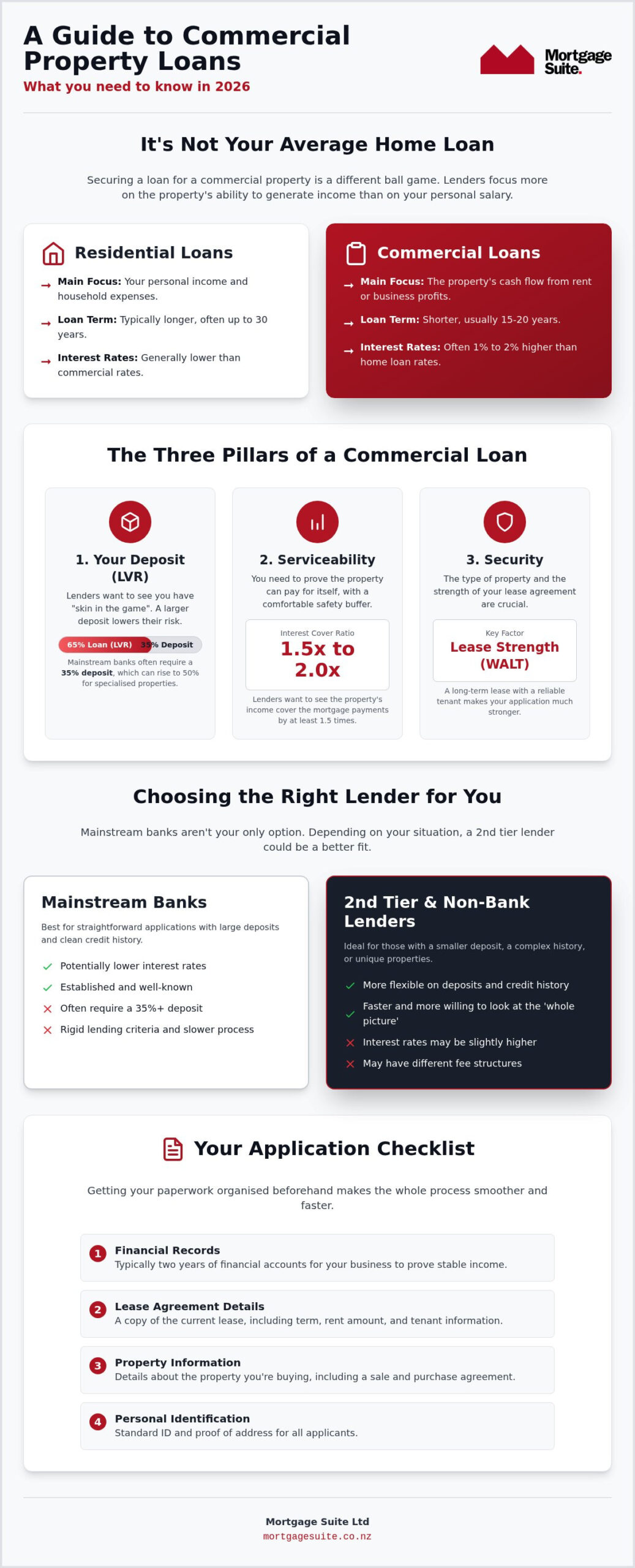
Most Kiwis start their property journey with a home loan, so the shift to commercial can feel like a bit of a shock. While residential lending focuses on your personal income and household expenses, understanding what is a commercial mortgage really comes down to the property’s ability to pay for itself. Instead of looking primarily at your salary, banks prioritise the cash flow the building generates through rent or business profits.
Lenders look closely at the “weighted average lease term”, often called WALT. This is just a simple way of asking how long your tenants are legally committed to staying. If you have a solid tenant on a ten-year lease, the bank feels much safer than if you have a month-to-month arrangement. Because businesses can be more volatile than residential households, you’ll find that loan terms are shorter, often 15 to 20 years, and interest rates are usually 1% to 2% higher than standard home loan rates. These factors are fundamental to the commercial property loan requirements nz that you’ll need to navigate.
The Property Type Matters
Lenders aren’t just looking at the numbers; they’re looking at the bricks and mortar. A standard warehouse is often seen as a safer bet because it’s versatile. If one tenant leaves, another can move in without much renovation. Compare that to a specialised hospitality fit-out, like a commercial kitchen or a boutique cinema, which is much harder to fill. The “use” of the building is a massive part of the commercial property loan requirements nz because it dictates how easily the bank could sell the asset if they ever needed to recover their funds.
Owner-Occupied vs Investment
Whether you’re buying a site for your own business or as an investment to lease out changes the bank’s perspective. If you’re an owner-occupier, the lender will dive deep into your business’s track record and profitability. They want to see that your company is stable enough to meet the repayments comfortably. For investors, the focus shifts to the lease agreement and the tenant’s reliability. Each path has different tax implications and deposit needs, but banks generally have a soft spot for owner-occupiers with a proven history because they have a direct interest in the property’s success and are less likely to walk away during a market dip.
The Big Three: Security, Serviceability, and Your Deposit
When you sit down to talk about your goals, lenders generally look at three main pillars to decide if they’ll say yes. These are the security you’re offering, your ability to pay back the debt, and the size of your deposit. While residential loans are often quite flexible, the commercial property loan requirements nz are a bit more rigid. You’ll usually need a larger “skin in the game” to get a deal across the line. Most mainstream banks in 2026 are looking for a deposit of at least 35%, though this can climb to 50% for certain types of retail or specialised buildings.
Your credit history also plays a massive role here. A clean record makes everything smoother, but don’t panic if you’ve had a few bumps in the past. We often work with clients who have a solid business but a complicated history. In these cases, we look at the whole picture rather than just a computer-generated score. If you’re short on cash but own your own home, you might be able to use the equity in your house to bridge the gap. This is a common way to get started without needing hundreds of thousands of dollars sitting in a savings account.
Calculating Your Deposit (LVR)
LVR stands for Loan-to-Value Ratio. It’s just a fancy way of describing the gap between what you owe and what the property is worth. If a warehouse is worth $1 million and the bank lends you $650,000, your LVR is 65%. In 2026, lenders have become more cautious, especially with retail spaces. If you’re struggling to find the full 35% deposit, we can often look at a “second charge” on your residential property. This allows the lender to take security over your home as well as the commercial building, which can significantly reduce the amount of actual cash you need to tip in. If you’re unsure where your equity stands, you can reach out to our team for a quick chat about your options.
Proving You Can Afford the Repayments
Serviceability is all about proving the property won’t sink your business. Lenders typically want to see two years of solid financial accounts to prove your income is stable. They use something called an interest cover ratio to see if there’s a safety buffer. Ideally, they want the property’s rent or your business profit to cover the mortgage payments at least 1.5 to 2 times over. If your business is in a fast growth phase and your last set of accounts doesn’t quite show your current potential, we can help you present a case that focuses on your future forecasts and current lease agreements to give the bank the confidence they need.
Mainstream Banks vs 2nd Tier Lenders: Finding the Right Fit
Choosing where to get your funding is just as critical as finding the right property. If you have a long trading history and a massive deposit, mainstream banks are usually the best starting point because they provide the lowest commercial property loan interest rates nz. The catch is that their commercial property loan requirements nz are incredibly strict. They want everything to fit into a very specific box; if your business or property has even one unique feature, you might find the door closed.
This is where a 2nd tier lender New Zealand becomes a valuable partner. These lenders are often more interested in the “why” behind your business and the actual value of the asset. They are a fantastic bridge for businesses that are growing fast but don’t yet have the three years of perfect tax returns a big bank demands. You’ll pay a bit more in interest, but you gain speed and a lender who is willing to look at the whole picture rather than just a credit score.
When the Big Banks Say No
Mainstream lenders often decline applications for reasons that have nothing to do with your business’s health. It could be that your lease term is too short, your industry is currently on their “risky” list, or your ownership structure is a bit more complex than they’d like. Private lending has grown significantly in the 2026 market to fill this gap. Mortgage Suite Ltd specialises in taking your story to these lenders and advocating for you. We know how to present your case so that a “no” from a computer becomes a “yes” from a person who understands your vision.
Comparing the Costs
It’s easy to get fixated on the interest rate, but you need to look at the total cost of the loan. 2nd tier options often come with establishment fees and ongoing “line fees” that don’t exist in the residential world. However, a slightly higher rate is often worth it if it means you can secure the property and start growing your business today. Our strategy at Mortgage Suite Ltd is often to use these flexible lenders as a short-term solution. Once your business has matured and you’ve built up more equity, we can help you move back to a mainstream bank to lock in those lower long-term rates.
Getting Your Paperwork Sorted: A Stress-Free Checklist
Gathering the right documents is often the part of the process that makes people want to pull their hair out. If you look at it as telling the story of your success, it becomes a lot less daunting. To meet the commercial property loan requirements nz, you need to be organised from day one. Lenders aren’t just looking for proof that you have the money; they’re looking for evidence that the deal makes sense for everyone involved.
Before you even approach a lender, you should have these core items ready:
- Financial statements: You will need your Profit & Loss and Balance Sheets for at least the last two years.
- Legal documents: A signed copy of the “Agreement for Sale and Purchase” and the current lease agreement for the property.
- Registered valuation: This must be from a lender-approved valuer. Please don’t book this yourself first, as most banks have a specific panel of valuers they trust, and you don’t want to pay for a report they won’t accept.
- Statement of Position: A clear summary of your personal assets and liabilities so the bank can see what you own and what you owe elsewhere.
The Importance of the Lease
The bank will want to see the “deeds of lease” for every tenant in the building. They are looking for stability. They’ll check for “break clauses” which allow a tenant to leave earlier than expected, as these can be a red flag for a lender’s risk department. Having a long-term, blue-chip tenant like a government department or a major bank can significantly lower your interest rate by reducing the lender’s perceived risk. If your leases are a bit messy, we can help you figure out the best way to present them to satisfy the commercial property loan requirements nz.
Business Plans and Projections
If you are an owner-occupier buying a premises for your own company, the bank needs to see where your business is heading. A solid cash flow forecast helps build confidence that you can handle the repayments even if things get a bit tight. This is where having a professional mortgage broker pays off. We package your application so it speaks the bank’s language, highlighting your strengths and proactively addressing any potential concerns. If you’re feeling overwhelmed by the list, our team can help you get your application ready for the bank so you can focus on running your business.
How Mortgage Suite Ltd Makes the Commercial Process Easy
Meeting the commercial property loan requirements nz is much simpler when you have an expert who knows the system inside out. Mortgage Suite Ltd, led by Krish Krishna, uses over 20 years of deep banking experience to advocate for you. We don’t just fill out forms; we tell the story of your business in a way that credit managers understand and respect. This professional representation is often the difference between a quick approval and a frustrating decline. Our goal is to secure a financial solution that supports your long-term growth, not just a one-off deal.
Beyond standard purchases, we manage the complexities of property development loans NZ and commercial builds. These projects often have moving parts that can overwhelm even seasoned business owners. Because we have access to a vast network of lenders, from the big household names to niche private providers, we can find the right home for your project. If your current bank arrangement is no longer serving your needs, we can also look into a commercial property refinance NZ to unlock equity or lower your ongoing costs.
A Personal Approach to Finance
We pride ourselves on clear communication without the drama. You won’t have to deal with cold, corporate jargon when you work with Mortgage Suite Ltd. We offer a straightforward chat about your options and a commitment to getting you a fair go. Because we are independent, we work for you rather than the bank, ensuring your best interests always come first. This partnership approach helps alleviate the stress often associated with high-stakes financial decisions.
Next Steps to Secure Your Property
The best way to start is with a quick, no-obligation chat to see if your project is bankable in the current 2026 market. We help you organise your information so it’s ready for lender review, which significantly reduces the risk of delays. Starting this process early is the most effective way to avoid stress as you approach your settlement date. We act as your dedicated negotiator, bridging the gap between rigid institutional rules and your personal business goals.
Taking the Next Step Toward Your Property Goals
Getting your head around the commercial property loan requirements nz is the first major hurdle in growing your business or investment portfolio. We’ve seen that success in 2026 relies on more than just a deposit; it’s about the quality of your tenants, the length of your leases, and choosing a lender that actually understands your vision. Whether you’re dealing with a mainstream bank or exploring more flexible non-bank options, having the right paperwork and a clear strategy is what gets the deal over the line.
You don’t have to navigate these complex financial decisions on your own. With over 20 years of industry experience, we specialise in finding 2nd tier and alternative lending solutions for clients right across New Zealand. We take pride in being the bridge between rigid bank rules and your specific business goals, handling the tough negotiations so you don’t have to. It’s time to stop worrying about the jargon and start moving forward with confidence.
Chat with Krish about your commercial loan today and let’s get your project off the ground. Your next property milestone is closer than you think, and we’re ready to help you reach it.
Frequently Asked Questions
How much deposit do I need for a commercial property loan in NZ?
You generally need a deposit of at least 35% when dealing with mainstream banks in New Zealand. If you’re working with a 2nd tier lender, you might be able to secure a loan with a 30% deposit for high-quality properties. This higher requirement compared to residential loans reflects the bank’s perception of business risk and the more volatile nature of the commercial market.
Can I use my house as security for a commercial loan?
Yes, you can certainly use the equity in your residential home to help meet the commercial property loan requirements nz. Lenders can take a “second charge” over your house, which reduces the amount of actual cash you need to provide upfront. It’s a common strategy for business owners looking to step into their first commercial premises without draining their cash reserves.
What are the current commercial property loan interest rates in NZ for 2026?
As of August 2026, interest rates for commercial properties typically range between 6.5% and 7.5%. These rates usually sit about 1% to 2% higher than standard residential mortgage rates. Because the Official Cash Rate (OCR) has stabilised at 2.25%, the market is currently offering more certainty for borrowers than we saw in previous years.
How long does it take to get a commercial loan approved?
Approval times vary depending on the lender, but you should generally allow two to four weeks for a mainstream bank. If you’re in a hurry, 2nd tier lenders are often much faster and can sometimes provide an answer within three to seven days. Getting your paperwork organised early is the best way to speed up the process and avoid settlement delays.
Do I need a business plan to buy a commercial building?
While not always a strict rule, having a clear business plan is highly recommended if you’re an owner-occupier. Lenders want to see that your business is stable and has a clear path for growth to ensure you can handle the repayments. For investors, the focus is more on the strength of the existing lease and the quality of the tenants rather than a formal business plan.
What happens if a bank declines my commercial loan application?
If a mainstream bank says no, it doesn’t mean your project is dead; it just means you need to look at alternative options. Many borrowers find success with 2nd tier lenders who have more flexible commercial property loan requirements nz and are willing to look at the “whole picture”. We specialise in taking these declined applications and finding a lender that sees the value in your specific situation.
Is GST included in a commercial property loan?
No, lenders typically lend against the GST-exclusive price of the property. This means you’ll need to account for the GST component separately, usually through your business’s GST registration and subsequent refund from the IRD. It’s vital to talk to your accountant early on to ensure your cash flow can handle the timing of these payments during the settlement process.
What is the difference between a commercial mortgage and a business loan?
A commercial mortgage is a loan secured specifically by a property asset, whereas a business loan is often used for operational costs or equipment. Mortgages generally offer lower interest rates and longer repayment terms because the bank has the building as security. Business loans are often shorter and might be unsecured, making them more expensive but useful for quick working capital needs.