
Cost to Build a House in NZ 2026: Your Full Financial Breakdown
What if the most dangerous number in your building project isn’t the total price, but the one you haven’t accounted for yet? It’s a question many Kiwis are asking as they look at the cost to build a house nz 2026, only to find themselves buried under conflicting advice and shifting estimates. You’ve probably noticed that one person quotes you a bargain rate while another warns of a budget blowout, leaving you worried about being left short by the bank halfway through the build.
We understand that the dream of a new home shouldn’t feel like a financial gamble. That’s why we’ve put together this clear, jargon-free guide to help you plan with confidence. You’ll get a realistic look at today’s true construction costs and learn the crucial difference between an initial quote and your final bill. We’ll also show you exactly how to secure the right finance for your project, even if mainstream banks have already said no. From square metre averages to the essential safety net funds you’ll need, we’ve got you covered.
Key Takeaways
- Understand why the initial builder’s quote is only one part of the story and how to plan for your total project budget from day one.
- Learn the real cost to build a house nz 2026 by looking past standard square metre rates to include often-overlooked site and design expenses.
- Discover how to spot “hidden” costs like council consents and groundworks before they surprise your bank account or stall your progress.
- Explore how to keep your build moving with 2nd tier loans if mainstream banks aren’t a good fit for your unique financial profile.
- Get a clear roadmap for assembling a professional team that aligns your dream home design with your actual borrowing limits.
The Real Deal on Building Costs in NZ for 2026
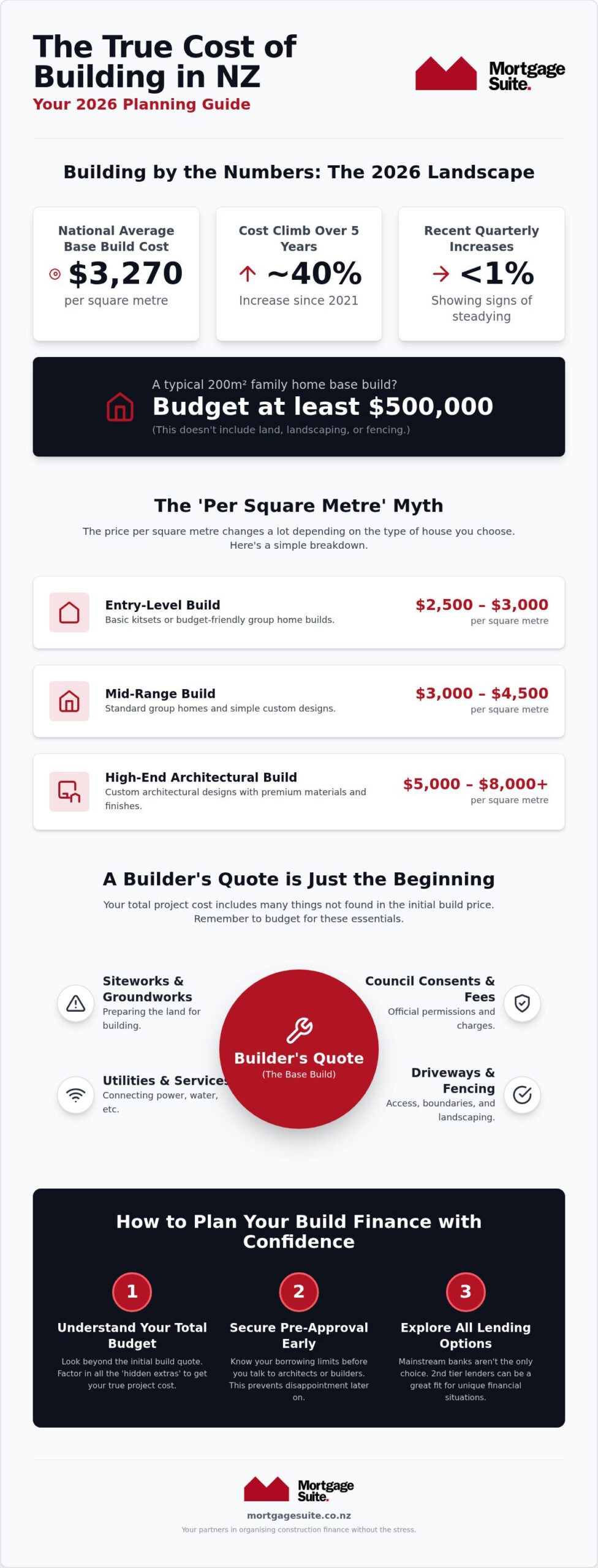
Building a house is a massive financial undertaking, and in 2026, the gap between a builder’s initial quote and the final “move-in” cost is wider than ever. Most people start by looking at the headline figures for the cost to build a house nz 2026, but these numbers often skip over the essentials like driveways, fencing, and council fees. Understanding Housing in New Zealand means recognising that your budget needs to cover the entire project, not just the timber and nails. While the national average sits around $3,270 per square metre, this is strictly for base construction. The industry has seen costs climb nearly 40% over the last five years, though the pace of these increases has finally started to steady to under 1% per quarter.
For a standard 200sqm four-bedroom family home in 2026, you should budget at least $500,000 for the base construction, keeping in mind this excludes land, fencing, and landscaping.
Why the “Square Metre Rate” is Just a Starting Point
Think of a square metre rate like the price of a car’s base model. It covers the engine and the wheels, but it doesn’t include the tow bar, the tinted windows, or the upgraded stereo. In the same way, a standard rate often assumes a simple, rectangular floor plan on a flat section. If your design includes complex corners, high ceilings, or expensive cladding, that rate will climb quickly. Every extra corner in a foundation requires more labour and materials. Additionally, 2026 compliance requirements and healthy homes standards mean that even a “basic” build now includes higher-quality insulation and ventilation than houses built just a few years ago, which adds to that baseline cost.
The 2026 Economic Landscape for Kiwis
The current market shows a mix of slowing inflation and lingering instability in material prices. While we aren’t seeing the double-digit spikes of previous years, builders are still cautious about offering fixed-price contracts because the price of timber or steel can still fluctuate. Waiting for prices to “drop” is rarely a winning strategy; historically, building costs in New Zealand tend to plateau rather than fall. Instead of waiting, the smartest move is to get your finance sorted early. Using a mortgage calculator can give you a rough idea of your limits, but getting a professional pre-approval is what allows you to talk to builders with real confidence. Having your funding strategy ready before you fall in love with a set of architectural plans prevents the heartbreak of a project that’s simply too expensive to finish.
Breaking Down the ‘Per Square Metre’ Myth
Many people get caught up in the “headline” rate, but the cost to build a house nz 2026 varies wildly based on your chosen construction style. A kitset home might start at the lower end around $2,500 per square metre, while a standard group home usually sits between $3,000 and $4,500. If you’re looking at a premium architectural project, you could easily see figures between $5,000 and $8,000 per square metre. According to official building activity data, the actual value of work being put in place reflects this complexity. It’s not just about the size of the floor plan; it’s about the level of finish and the structural requirements of the design.
Your choice of materials acts like a volume knob for your budget. Switching from basic brick to high-end cedar cladding or opting for a complex steel roof instead of standard tiles will push your costs up quickly. Then there’s the “two-storey tax”. While building up saves on land, it adds significant costs for scaffolding, floor joists, and structural engineering. Often, a larger single-storey home is actually cheaper to build than a smaller two-storey one because the construction process is much simpler.
- Entry-Level: $2,500 – $3,000 per sqm (Basic kitsets or budget group builds)
- Mid-Range: $3,000 – $4,500 per sqm (Standard group builders and simple custom designs)
- High-End: $5,000 – $8,000+ per sqm (Architectural designs with premium finishes)
Group Builders: The Entry-Level Pathway
Group builders are a popular choice because they buy materials in bulk, passing those “economies of scale” savings on to you. They use standardised plans, which makes the process more predictable and faster. In 2026, the key is looking for a fixed-price contract that clearly defines what’s included. These contracts offer peace of mind for your bank, but remember that any customisation or change to the plan will likely trigger an extra cost that can quickly eat into your contingency fund.
Architectural and Custom Builds
Architectural builds are for those who want something truly unique, but they come with a higher price tag. You’re paying for specialised design work and often more complex site requirements. These projects usually require a much larger mortgage, so it’s vital to align your “dream” with your actual borrowing power before the first sketch is drawn. If you’re unsure where your limit sits, it’s a good idea to talk with a specialist who can help you understand your financial boundaries before you fall in love with a plan that’s out of reach.
The ‘Hidden’ Extras: Siteworks, Consents, and Consumables
When you’re calculating the cost to build a house nz 2026, the builder’s quote is often just the visible part of the iceberg. Beneath the surface lie the “hidden” extras that can derail a budget if they aren’t factored in from the start. These aren’t just minor details; they are fundamental requirements like getting power to your front door or ensuring the ground can actually support your home. According to the latest building cost statistics from Stats NZ, these non-construction expenses are becoming a larger portion of the total project investment.
Utility connections are a prime example. Bringing power, water, and fibre from the street to your house can cost thousands, especially on rural or large sections where the house is set back from the road. Then there’s the finish. Many people leave landscaping and driveways out of their initial loan, only to find they’ve run out of cash when it’s time to move in. Including these in your total project budget ensures you aren’t living in a sea of mud for the first year or struggling to get your final code compliance certificate because the driveway isn’t finished.
The Ground Under Your Feet
Earthworks and retaining walls are the real budget killers of 2026. A “cheap” section on a steep slope might look like a bargain, but the price of cutting, filling, and securing that land can easily wipe out any savings. Soil tests are non-negotiable now. If the ground is soft or unstable, you’ll need deeper foundations or specialised engineered slabs. Banks are notoriously cautious about tricky sections because the risk of a budget blowout is much higher. It’s always a smart move to get a geotechnical report before you commit to buying the land, as this gives your lender the confidence they need to approve your finance.
Council and Professional Fees
You’ll need to budget for architects, engineers, and building consents before the first nail is driven. Development contributions are another factor; they’re a fee charged by councils to fund local infrastructure like pipes and roads. These costs can be substantial and are often due early in the process. If you haven’t planned your cash flow, these upfront bills can be a major hurdle. You can use our mortgage calculator to see how including these professional fees and council charges in your loan might change your monthly repayments and overall borrowing strategy.
Funding Your Build: From Mainstream Banks to 2nd Tier Options
Securing the money for your project is often more complex than choosing the floor plan. When you look at the total cost to build a house nz 2026, you need a lender who understands that construction isn’t a one-off payment. Most construction loans work through a “drawdown” process. Instead of giving you all the money at once, the bank releases funds in stages as your builder reaches specific milestones, like finishing the foundation or getting the roof on. This keeps your interest costs lower at the start and ensures the builder is only paid for work they’ve actually done.
While the big household-name banks are the first stop for many, they aren’t always the best fit. A 2nd tier loan is a tactical tool that can bridge the gap when mainstream criteria are too rigid, allowing you to start your build now rather than waiting years for a perfect bank profile. This is where a broker becomes your biggest asset. We have access to rates and terms you won’t find on a standard website, and we know exactly how to pitch your story to the right lender to get a “yes”.
What if the Bank Says No?
Mainstream banks love a simple salary, but many Kiwis today are self-employed or have income from several different places. If a big bank declines your application, it’s usually because your financial profile doesn’t fit their narrow box. 2nd tier lenders look at the bigger picture, focusing on your ability to handle the repayments rather than just a tick-box exercise. You can learn more about how these different lending paths work at our Mortgage School.
The Contingency Buffer
In 2026, a 10-15% contingency buffer is a non-negotiable part of your budget. This “just in case” fund protects you if material prices shift or if those hidden siteworks mentioned earlier cost more than expected. The beauty of a well-structured construction loan is that you only pay interest on the money you’ve actually drawn down. If you don’t need the full buffer, you don’t pay for it. If you already own a home, you might even be able to use the equity in that property to fund your new project, which can be a much smoother path than trying to save a massive cash deposit from scratch.
If you’re ready to see which funding option fits your build, get in touch with our team to discuss your project today.
How to Organise Your Construction Finance Without the Stress
Planning your dream home is exciting, but the financial side can quickly feel overwhelming if you don’t have a clear roadmap. The first and most vital step is to get an honest appraisal of your borrowing power before you even look at a floor plan. Knowing exactly how much you can afford for the cost to build a house nz 2026 prevents the heartbreak of designing a home that the bank simply won’t fund. Once you have your budget, it’s time to assemble your “A-Team”. This should include an experienced mortgage broker, a solicitor who understands construction contracts, and a designer who respects your financial boundaries.
When you finally have a contract in front of you, read it with a fine-tooth comb. Pay close attention to the “variations” clause. In 2026, these clauses often allow builders to pass on unexpected material price hikes to you. You need to know exactly what happens to your loan if the price shifts mid-build. Throughout the construction process, keep the communication lines open with your broker. We handle the paperwork for each stage of the drawdown, so letting us know when a milestone is approaching ensures your builder gets paid on time and your project stays on track.
Getting Your Paperwork Sorted
Lenders need more than just a handshake to approve a construction loan. They’ll want to see detailed plans, full specifications, and a signed build contract. It’s important to realise that “fixed-price” doesn’t always mean the final bill is set in stone. Many 2026 contracts include allowances for things like siteworks that might change once the digging starts. If you’re looking at a larger-scale project rather than a single family home, you might find our Property Development Loans NZ guide helpful for navigating those more complex funding requirements.
Partnering with an Expert
Krish Krishna and the team at Mortgage Suite are the steady hands you need during this process. We’ve spent over 20 years helping Kiwis navigate the banking world, and we’re passionate about finding solutions when the big banks make things difficult. We take the stress out of the paperwork and the negotiation so you can focus on the fun parts, like choosing your kitchen colours and floor plans. Our reputation is built on being dedicated advocates for our clients, ensuring you get the best possible terms for your situation. You can read our client reviews to see how we’ve helped others turn their building dreams into reality. If you’re ready for a straight-talk chat about your project, get in touch with Mortgage Suite today and let’s get your build moving.
Ready to Turn Your Building Plans into Reality?
Building a home is about more than just the floor plan; it’s about having a rock-solid financial strategy from day one. By now, you know that the true cost to build a house nz 2026 includes those often-forgotten siteworks and council fees that can catch people out. You also understand that the right team can help you bridge the gap between a builder’s initial quote and your final move-in budget. Having a clear picture of your total project costs allows you to make decisions with certainty rather than guesswork.
With over 20 years of banking experience, our team has helped countless Kiwis secure the funding they need, even when mainstream banks say no. We specialise in finding flexible solutions through 2nd tier loans that work for your unique financial profile. We take the stress out of the paperwork so you can focus on the excitement of your build. Book a free, no-obligation chat with our experts to get your project moving with confidence. Your new home is closer than you think when you have a steady, expert hand guiding you through the process.
Frequently Asked Questions
Is it actually cheaper to build or buy an existing house in NZ in 2026?
Building a new home often has a higher upfront price tag in 2026 compared to buying an existing property, but it offers better long-term value. New builds are more energy-efficient and come with modern warranties, which saves you thousands on maintenance and heating. While an older house might look cheaper initially, you’ll often face hidden costs for renovations or repairs that a new construction project simply won’t have.
How much of a deposit do I really need for a construction loan?
Mainstream banks usually look for a 20% deposit for a construction loan, but there are pathways for first-home buyers to start with as little as 10%. If you already own the section, the equity in that land can often serve as your deposit. We’ll help you look at your total assets to see if we can secure a loan without you needing to find a massive pile of cash upfront.
What is a 2nd tier lender and why would I use one instead of a big bank?
2nd tier lenders are non-bank institutions that offer more flexibility than mainstream banks. They’re a fantastic choice for self-employed Kiwis or those with non-standard income who don’t fit the big banks’ rigid criteria. At Mortgage Suite, we specialise in these solutions to ensure you can still build your home even if the household-name banks have turned you away. It’s about finding a lender that sees your potential.
Can I use my KiwiSaver to help pay for the cost to build a house?
Yes, you can usually withdraw your KiwiSaver savings to help cover the cost to build a house nz 2026 if it’s your first home. These funds are typically used for the land deposit or the initial construction stages. You’ll need to check with your provider for specific eligibility rules, as the money usually needs to be in your account for at least three years before you can access it for a build.
What happens if the building costs go over the original quote?
If your project goes over the original quote, you’ll rely on your contingency fund, which should be 10-15% of the total budget. This is why we stress the importance of a realistic budget from the start. If the increase is significant, you’ll need to talk to your broker immediately to see if your loan facility can be extended before the builder continues with the extra work.
How long does it usually take to get a construction loan approved?
Getting a construction loan approved usually takes between 10 and 15 working days. This timeframe is longer than a standard mortgage because the lender needs to review your build contract, detailed plans, and a valuation as if complete. Being organised with your paperwork from the start is the best way to speed up the process and get your project moving without unnecessary delays.
Are there any grants available for first-home builders in 2026?
First-home builders in 2026 should look into the First Home Grant and other government support schemes. These grants can provide a helpful boost to your deposit, provided you meet the income and house price caps. We recommend checking the latest criteria early in your planning phase, as these rules can change and may impact how much you’re able to borrow for your new home project.
What is the “builder’s margin” and is it negotiable?
The builder’s margin is a percentage, usually between 10% and 20%, added to the cost of materials and labour to cover the builder’s overheads and profit. While it might seem like a lot, it’s what keeps the building company running and ensures they can manage your project professionally. It’s generally not negotiable, as trying to cut this margin often leads to lower-quality work or a builder who can’t finish the job.