
Cross-collateralisation and property loans in NZ: risks, options and next steps
A loan structure that looks simpler today can leave you with less control over your properties tomorrow. If you’re researching cross collateralization property loans nz, you may be weighing the convenience of linking properties against the risk that selling or refinancing one could affect another.
That uncertainty is understandable. When a lender uses more than one property as security, it may have a say in what happens to the linked properties, including how sale proceeds are used. The arrangement can sometimes help a loan proceed, but it may also limit your choices later.
This guide explains how linked property security works in New Zealand, what flexibility you could give up, and how it compares with keeping loans separate. You’ll also find practical questions to ask your lender before accepting a structure or changing an existing one, such as which properties secure each loan and what would happen if you sold or refinanced. With more than two decades of banking experience behind Mortgage Suite Ltd, the team understands how complex lending structures can feel. The aim is to help you make a considered choice that suits your wider property and borrowing plans.
Key Takeaways
- With cross collateralization property loans nz, more than one property may secure lending, so check exactly which properties are linked to each loan.
- Before selling or refinancing, ask your lender whether it needs to approve changes to the linked security and what conditions may apply.
- Compare linked and separate loan arrangements against your plans, including how much flexibility you may want and how you prefer to manage your lending.
- Use the article’s questions to prepare for a conversation with your lender or mortgage adviser, especially about releasing a property from linked security.
- Mortgage Suite Ltd can help you assess how a proposed structure fits your wider property plans and negotiate with lenders, without promising a particular outcome.
What does cross-collateralisation mean for property loans in NZ?
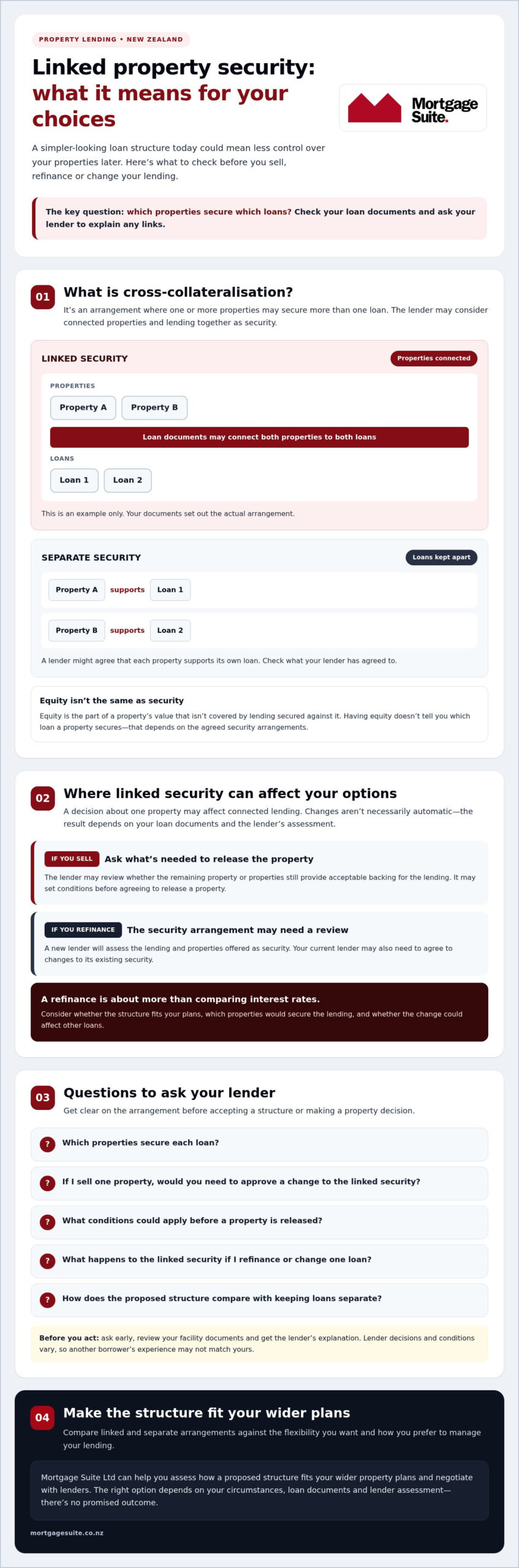
Cross-collateralisation is an arrangement where one or more properties may secure more than one loan. In everyday terms, a property gives the lender backing for the money it lends. If you’re looking up cross collateralization property loans nz, the key point is that the properties and loans may be connected, rather than each loan relying on just one property.
For a neutral overview of the underlying idea, see Cross-collateralization. The exact arrangement for your lending depends on your loan documents and what the lender has agreed to. Don’t assume that a property secures only the loan you associate it with; check the paperwork or ask your lender to explain it.
How can one property secure more than one loan?
Think of a borrower with two properties and two loans. The lender might agree that each property supports its own loan. Or the lending documents may connect both properties to both loans, so the lender considers them together as security. These are simple examples, not a guide to what your own documents say.
Linked security can involve more than one property, more than one lending facility, or both. Your loan documents set out the actual arrangement, so review them and ask the lender which properties support each loan if anything is unclear.
Is cross-collateralisation the same as using equity?
No. Equity is the part of a property’s value that isn’t covered by lending secured against it. A lender may consider available equity when assessing a borrowing request, but equity alone doesn’t tell you which property secures which loan. That depends on the agreed security arrangements.
For example, you may have equity in a property, but that doesn’t confirm whether it supports one loan or is linked to other lending as well. If you’re considering a residential property purchase or already have a rental property, the article Residential Investment Property Loans NZ offers wider context on borrowing for this purpose. For your own position, check the loan documents and ask the lender to clarify any links before making plans around a property.
How cross-collateralised property loans can affect your options
A property decision can affect connected lending because the lender may have agreed to rely on more than one property as security. If you want to sell, Refinance or change one loan, the lender may need to review the arrangement and approve a change to the linked security. The result depends on your facility documents and the lender’s assessment, so don’t assume a change will happen automatically.
What could happen if you sell one linked property?
Before you commit to a sale, ask the lender what must happen for the property to be released from the security arrangement. It may assess whether the remaining property or properties still provide acceptable backing for the lending. Depending on your loan terms and circumstances, the lender may set conditions before agreeing to release a property.
Ask for the requirements early, and check your facility documents alongside the lender’s explanation. Lender decisions and conditions vary, so another borrower’s experience may not match yours. Consumer Affairs also outlines How cross-collateralization works, including why connected security can affect a borrower’s choices.
Could linked security affect a refinance?
It can. If you’re considering moving your lending to another lender, the existing security arrangement may need to be reviewed as part of the process. The new lender will assess the lending it’s being asked to take on and the properties offered as security. Your current lender may also need to agree to changes to its existing security.
That means a Refinance involves more than comparing interest rates. Consider whether the proposed structure fits your plans, what properties would secure the lending, and whether you could manage the change without affecting other loans. If commercial lending is involved, Commercial Property Refinance NZ is a relevant topic to explore alongside advice from your lender or mortgage adviser.
In short, a decision about one property can affect connected loans, so confirm the conditions before you act. If you’re unsure how your current or proposed structure fits your plans, you can talk through your property lending options with Mortgage Suite Ltd. That conversation can help you identify what to ask your lender, without assuming a particular outcome.
Cross-collateralisation vs separate property loans: what should you compare?
There’s no single structure that suits every borrower. Linked security may make it simpler to manage several loans with one lender, while separate security can make each property’s role clearer. Your choice should reflect your plans and the lender’s assessment, not just how the arrangement looks on paper.
Use this table as a starting point. The practical details, including whether a property can be released or a loan changed, depend on the lender and your loan documents. Confirm each point for your own situation.
| What to compare | Linked security | Separate security |
|---|---|---|
| Flexibility | A change involving one property may require the lender to review the connected lending. | Each property may have a clearer link to its own loan, but changes still depend on lender approval and loan terms. |
| Administration | Coordinating lending with one lender may feel more straightforward, though the security links can be harder to keep track of. | It may be easier to see which property supports which loan, but separate arrangements can mean dealing with more than one facility or lender. |
| Future plans | Consider whether linked security fits your plans to sell, refinance or change a loan. | Consider whether a more distinct arrangement fits plans to sell, refinance or change ownership of a property. |
| What to confirm | Ask which properties secure each loan and what conditions apply to changing that arrangement. | Ask whether separate security is available and what each loan would require. |
Linked security can simplify how lending is arranged, but separate security may offer more clarity and control over each property. That’s the central trade-off to weigh up when comparing cross collateralization property loans nz.
When might linked security suit a borrower?
It may suit someone who values coordinating lending across several properties with one lender and expects to keep that structure in place. But convenience doesn’t guarantee approval or better terms. Suitability depends on your plans, the loan documents and the lender’s assessment. Ask what flexibility you would retain if your circumstances change.
When might separate security be worth discussing?
If you may sell, Refinance or change ownership of a property, ask whether separate arrangements could make each property’s role easier to understand. Separation may not be available or accepted in every case, so confirm the lender’s position before deciding. For questions about how lending documents relate to property matters, you can consult a property solicitor or find information through the New Zealand Law Society Property Law Section.
Questions to ask before accepting or changing linked property security
Before you agree to link properties or change an existing arrangement, get a clear picture of what the lender is asking you to accept. If you’re comparing cross collateralization property loans nz, take these questions to your lender or mortgage adviser and ask for answers in plain English:
- Which properties secure each loan? Ask for a clear list of the properties and loans involved, including any lending facility you may have overlooked.
- What needs to happen to release a property? Ask what conditions apply, whether the lender must approve the release, and how it would assess the remaining security.
- What if I sell or Refinance? Find out how either step could affect the other loans and what you need to arrange before proceeding.
- How would future borrowing fit? Ask whether taking on another loan could change the security arrangement or affect your current lending.
- Can the security be changed later? Check the process and conditions for separating properties or changing which property supports a loan.
- Are there alternatives? Ask whether separate security is possible for your circumstances, and what trade-offs the lender sees.
What to check in your loan documents
Find the documents that describe your loans and the properties connected to them. Look for the sections covering security, changes, releases and lender consent. If a clause is unclear, ask the lender to explain what it means for your situation. Don’t rely on a verbal summary alone; make sure you understand what the documents say before agreeing to a change.
Who can help you assess the structure?
A mortgage adviser can help compare possible loan structures against your borrowing goals and future property plans. A solicitor can explain the legal obligations and property-security documents. These roles are different: an adviser can discuss lending options, while a solicitor can provide independent legal advice. This guidance isn’t a substitute for having a solicitor review documents that affect your property.
For straightforward mortgage learning, visit Mortgage Suite’s Mortgage School. If you’d like support weighing a proposed structure against your plans, explore your property loan options with Mortgage Suite. Getting clear answers first can help you make a considered decision and feel more confident about your next step.
How Mortgage Suite can help you assess property loan options in NZ
Linked security can feel hard to untangle, especially if you have several properties, existing loans and plans that may change. Mortgage Suite can help you look at the full picture: how your current lending is arranged, what you want to do with your properties, and whether you may need to borrow again later.
Mortgage Suite acts as your advocate and negotiator with lenders. It isn’t the lender or a guarantor, and no particular lending outcome can be promised. Depending on your circumstances, the team can consider options through mainstream and alternative lending channels, then help you understand what questions to put to the lender about the proposed structure. If you’re researching cross collateralization property loans nz, the aim is to make the options clearer before you decide what fits your plans.
What to prepare for a lending conversation
A few notes and documents can help make the discussion more useful. Gather what you have, and don’t worry if you’re still trying to find out how a particular loan is secured.
- Loan documents and any recent lender correspondence that describe your current lending or security.
- Basic details of each property involved, and which loans you think may be connected to it.
- Your upcoming plans, such as buying another property, selling, refinancing or changing how a property is owned.
- Questions about what the lender may require to change or release security, and what conditions need to be confirmed.
Being clear about both your current position and what you hope to do next gives an adviser a better starting point. Your lender’s requirements still need to be confirmed directly, and a solicitor can explain legal documents and obligations.
Explore your options with a mortgage adviser
A conversation can help you compare possible structures against your goals, identify trade-offs and work out which details still need an answer from your lender or solicitor. If your plans include a rental property, you may also want to read Residential Investment Property Loans NZ for related borrowing context.
Mortgage Suite was founded by Krish Krishna, who brings more than two decades of banking experience. If you’d like a calm discussion about how your existing lending and future property plans fit together, talk through your property lending options. There’s no need to have every detail sorted before you start.
Make your next property lending decision with clarity
Cross-collateralisation can make lending feel more straightforward, but linked security may affect your choices if you want to sell, Refinance or change a loan. Before deciding, check which properties secure each loan, what your lender requires to release a property, and whether the structure fits your future plans. Separate security may be worth discussing too, though it won’t suit every situation.
If you’re weighing up cross collateralization property loans nz, remember that the right structure depends on your circumstances and lender approval. Review your loan documents, ask for unclear terms to be explained, and seek independent legal advice about your obligations.
Mortgage Suite can help you compare lending options and prepare questions for lenders. Founded by Krish Krishna in 2000, the business draws on his more than two decades of banking experience and works with mainstream and alternative lending channels. Mortgage Suite can act as your advocate and negotiator, but it can’t promise a particular outcome.
Talk through your property lending options and take a considered next step. You don’t need every answer before starting the conversation.
Frequently Asked Questions
What is cross-collateralisation in property loans?
Cross-collateralisation is when a lender uses one or more properties as security for more than one loan. In plain English, the property gives the lender backing for the money it lends. For example, two properties could be linked to two loans rather than each property supporting only one loan. The actual arrangement depends on what you and the lender have agreed, so check your loan documents to see which properties secure each loan.
Is cross-collateralisation risky?
It can affect your flexibility, but the impact depends on your loan structure and plans. Linked security may help you coordinate lending with one lender, while reducing the independence of each property. A sale, refinance or change to one loan could involve a review of connected security. If you’re researching cross collateralization property loans nz, ask your lender what the arrangement means for your specific loans rather than assuming it will have the same effect for everyone.
Can I sell a property that is cross-collateralised?
You may be able to sell, but first check whether the lender needs to approve a change to the security arrangement. It may assess the remaining properties and lending before agreeing to release a property. What happens next depends on your loan documents, lender requirements and circumstances. Before committing to a sale, ask what conditions apply, what information the lender needs, and whether any connected loan arrangements could be affected.
Can I refinance one loan if my properties are cross-collateralised?
You can ask about refinancing one loan, but linked security may affect how the lender reviews the change. The existing lender may need to consider whether its security arrangement will change, and a new lender will assess the lending and security proposed. Requirements differ between lenders and loan structures. Before making plans, check your facility documents and ask both your current lender and mortgage adviser what steps or conditions may apply.
How can I find out which properties secure my loans?
Start with your loan documents and look for the sections that describe the security and the properties involved. If the wording isn’t clear, ask your lender to identify which property secures each loan and explain the arrangement in plain English. A mortgage adviser can help you understand the lending structure, while a solicitor can explain legal wording and obligations. Don’t rely on assumptions based on which property you associate with a particular loan.
Can I ask a lender to separate cross-collateralised loans?
Yes, you can ask whether the lender will separate the loans or change which properties secure them. Whether it agrees depends on the lender, your loan documents and your circumstances. The lender may assess the proposed structure and the security that would remain for each loan. Ask what information it needs, what conditions apply and whether the change could affect other lending. A mortgage adviser can help you compare options, but the lender makes the decision.