
Financing a Townhouse Development in NZ: Your 2026 Exit Strategy Guide
Your exit strategy is actually the most important part of your loan application, often carrying more weight than the architectural plans themselves. When you are organising financing a townhouse development nz, lenders aren’t just interested in the bricks and mortar; they want to see a foolproof plan for how they get their money back. It’s easy to feel unsettled when residential building costs continue to climb or when mainstream banks stick to rigid rules that don’t fit your project. You deserve to know that your profit is protected and that you won’t be left holding unsold stock.
This guide will show you how to map out a project finish line that satisfies lenders and secures your margins. We’ll look at how to create a solid exit plan and why 2nd tier finance is a brilliant tool for flexibility when the big banks say no. You’ll gain the confidence to handle the 2026 market, knowing exactly how to protect your investment and move straight onto your next big venture with total certainty.
Key Takeaways
- Learn why a clear plan to repay your lender is the most important part of getting your project approved in today’s market.
- Understand the flexible options for financing a townhouse development nz that let you bypass the rigid rules of the big banks.
- See how non-bank lenders can act as a strategic safety net to protect your profit if building costs or timelines change.
- Compare the benefits of selling your units for an immediate profit against switching to a long-term loan to keep them as rentals.
- Gain the tools to build a solid backup plan so you can realise your gains and organise your next project with total confidence.
What is a Property Development Exit Strategy and Why Does it Matter?
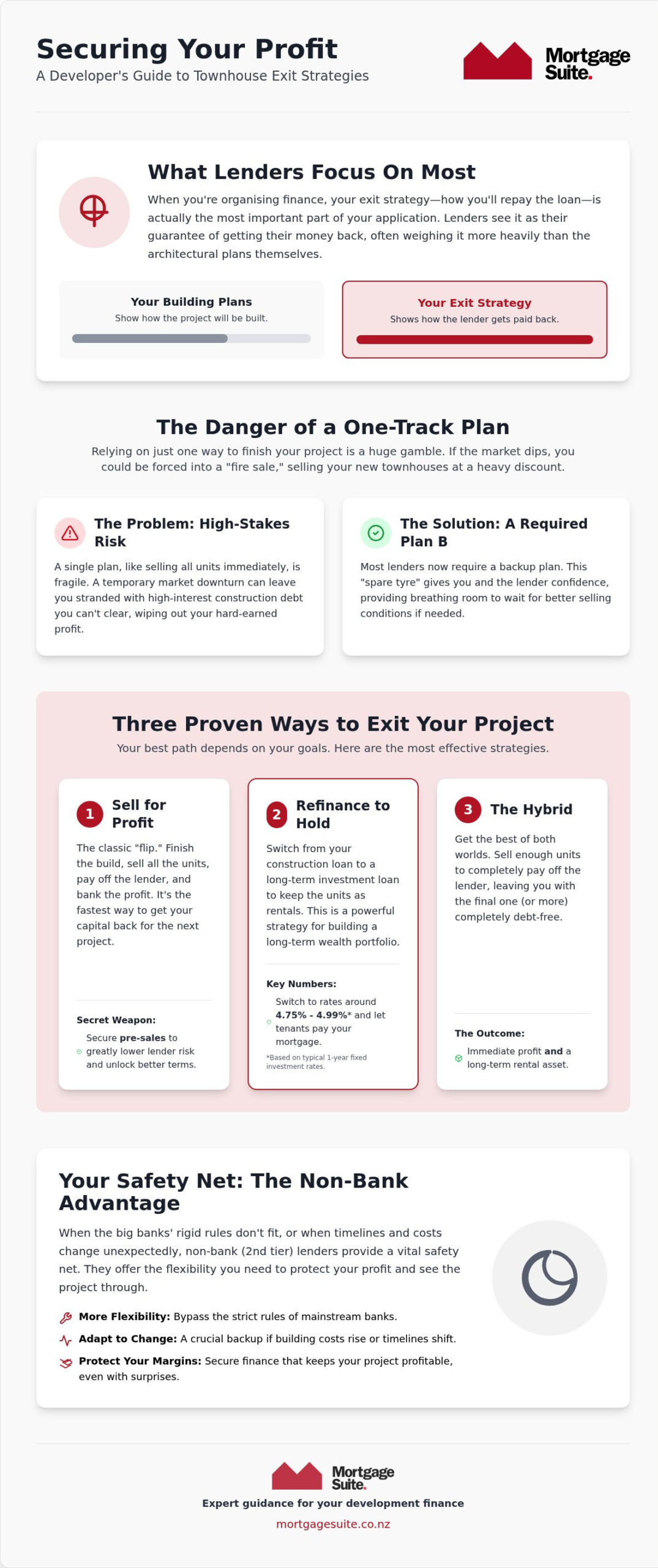
Simply put, an exit strategy is your roadmap for paying back the money you borrowed once the building work is done. It’s a vital part of the real estate development process, acting as the final chapter that proves your project is a success. When you’re looking at financing a townhouse development nz, the start is exciting, but the finish is what keeps the bank happy. Lenders aren’t just looking at your architectural plans; they’re looking at how you’ll get their money back into their hands.
Lenders often care more about your exit than your entry because that’s where the actual risk lives. If you don’t have a clear way to settle the debt at the end, you might find yourself stuck in a “fire sale.” This is a stressful spot where you’re forced to sell your units at a heavy discount just to pay back the lender. It’s a quick way to see years of planning and hard work vanish. In the 2026 market, where residential building costs rose 1.1% in the June quarter, having a solid exit plan is your best tool for protecting your profit.
The Lender’s Perspective: What They Are Looking For
Lenders want to see that your numbers add up for the current environment. They look for what we call “credible exits,” which are paths to repayment grounded in reality rather than hope. A credible exit is a clear, documented route to paying off the debt that doesn’t rely on luck or a perfect market. This might include confirmed pre-sales where buyers have already signed on the dotted line, or a formal letter from a bank promising to take over the debt with a long-term loan once the units are finished. They want to know that even if the market shifts slightly, the project remains a safe bet for their capital.
Why a “Single Plan” Approach is Risky
Relying on just one way to finish your project is a massive gamble. If your only plan is to sell every unit the moment they’re built, a temporary market dip can leave you stranded with high-interest debt and no way to clear it. Most lenders now require a secondary fallback option before they’ll even consider financing a townhouse development nz. Think of this backup like a spare tyre; you hope you don’t need it, but you can’t realistically start the journey without it. Having a Plan B, such as keeping the units as rentals, gives you the breathing room to wait for a better selling window while still meeting your financial obligations.
The Three Most Effective Ways to Exit Your Townhouse Project
Choosing your path forward depends entirely on your long-term goals and the temperature of the 2026 market. Once your townhouses are finished, you need a clear route to transition from high-interest construction debt to your final financial outcome. Whether you want a quick cash injection or a lifelong stream of rental income, your choice will dictate how you structure the project from day one. Financing a townhouse development nz requires looking past the construction phase to ensure you aren’t left with a debt you can’t service when the hammer falls on the final nail.
Strategy 1: Selling for a Profit (The Clean Break)
The most common goal for many developers is the “flip.” You finish the build, sell the units, pay off the lender, and pocket the remaining profit. This is the fastest way to get your capital back so you can jump into your next venture. Pre-sales are the secret weapon here. By securing buyers before the first sod is turned, you significantly lower the lender’s risk. When you’re organising financing a townhouse development nz, having pre-sales in place can often unlock better terms and smoother approvals because the bank sees a guaranteed exit. It removes the stress of wondering if the units will sell once they’re finally on the market.
Strategy 2: Refinancing to Hold (The Wealth Builder)
If you prefer building long-term wealth, you might choose to keep the units as rentals. This involves switching from a construction loan to a lower-rate residential investment loan. With one-year fixed rates for investment properties in August 2026 sitting around 4.75% to 4.99%, this move allows you to benefit from capital growth while the tenants pay down your mortgage. It’s a great way to build a portfolio, but you need to make sure the numbers work. You can use our mortgage calculator to check if the expected rental income will comfortably cover your new loan repayments. This strategy is particularly effective when the rental market is strong and property values are steadily rising.
Strategy 3: The “Keep and Sell” Hybrid
A hybrid approach offers the best of both worlds and is increasingly popular among savvy New Zealand developers. You might sell three out of four townhouses to clear all your debt with the lender, leaving the final unit completely debt-free. This “pure profit” unit becomes a high-yield asset in your portfolio without you needing to tip in more of your own cash. It’s a brilliant way to grow your net worth while maintaining excellent cash flow. This method provides a safety net; if the market isn’t quite right for selling all units, you can pivot and keep more of them as rentals. If you’re unsure which path fits your specific project, we can help you explore the most profitable options for your situation.
Contingency Planning: What to Do When Plan A Hits a Snag
The reality of building in New Zealand is that time is your biggest variable. It usually takes between 12 and 18 months to take a project from the first shovel in the ground to the final code compliance certificate. A lot can happen in that window. When you started financing a townhouse development nz, the market might have been soaring, but by the time you’re ready to sell, things could look different. Unexpected building delays or the 3.5% annual rise in construction costs can quickly eat into the profit you worked so hard to calculate.
A solid fallback strategy isn’t about being pessimistic. It’s about staying in control of the situation even when things get a bit hairy. Without a Plan B, you risk losing the property to the bank during a temporary dip or being forced into a deal that doesn’t serve you. By preparing for the “what-ifs” now, you ensure that a single snag doesn’t derail your entire financial future. It’s much easier to make calm decisions when you already have a secondary path mapped out.
Market Shifts and Price Adjustments
Imagine your townhouses are finished, but the market has shifted and they’re worth 10% less than your initial appraisal. This is where your “equity cushion” becomes your best friend. This cushion is the gap between what you owe the lender and what the property is worth, often made up of your own cash or the value in the land. In the 2026 market, a 20% margin of error is a standard safety net that most successful developers use to protect themselves. It means that even if prices soften, you still have enough room to pay back the loan without dipping into your personal savings or facing a shortfall.
Bridging the Gap with Short-Term Finance
Sometimes, the units are perfect and the price is right, but the buyers are just taking a little longer to show up. If your construction loan is nearing its end and the lender is knocking, you can use bridging finance to take the pressure off. This short-term option lets you pay off the original construction lender, giving you an extra few months to find the right buyer. When you are looking at financing a townhouse development nz, remember that bridging finance is a strategic tool rather than a last resort. It means you don’t have to accept a low-ball offer just because you’re in a hurry to settle the debt. You can learn more about how these structures work in our guide to property development loans. This breathing room is often the difference between a project that just breaks even and one that delivers a healthy return.
The 2nd Tier Advantage: How Non-Bank Lenders Save the Day
Mainstream banks have really tightened their belts lately. In August 2026, many developers are finding that the big banks stick to rigid rules that don’t always suit the reality of a busy building site. If you are organising financing a townhouse development nz, you might find that traditional lenders demand a level of pre-sales that feels out of reach before you’ve even broken ground. This is where 2nd tier lenders become your most valuable asset. They aren’t just a backup plan; they’re a strategic tool that looks at the common sense of your project rather than just ticking boxes on a corporate form.
At Mortgage Suite Ltd, we specialise in finding these alternative paths when the big banks say no. We don’t just find you a loan; we help you see how these lenders can actually save your project if things stall or if your original bank pulls back. Using a non-bank lender gives you the flexibility to keep moving without being held hostage by a bank’s changing appetite for risk. We act as your expert negotiator to ensure you get a deal that keeps your profit margins intact.
Why 2nd Tier Lenders are More Flexible
The biggest advantage of a 2nd tier lender is their focus on the big picture. While a mainstream bank might demand that every single unit is sold before they release a cent, non-bank lenders often require far fewer pre-sales. They look closely at the value of the finished project and your own track record as a developer. If you have a solid plan and a great site, they’re often willing to back you even if you don’t fit the standard bank profile. This is a fair dinkum solution for projects that are fundamentally sound but need a lender who can think outside the square.
Using Non-Bank Loans to “Bridge to Bank”
Many successful developers use a 2nd tier loan as a temporary bridge to get the build finished. Even though the interest rates are higher, usually starting from 9.5% in early 2026, the flexibility they offer can be worth every cent. Once the townhouses are built and you have your code compliance certificate, the risk for a mainstream bank drops significantly. At that point, you can often refinance back to a traditional bank at a lower rate. This strategic move allows you to keep the momentum going on financing a townhouse development nz even if your primary bank has had a change of heart about your project. It’s a clever way to keep your capital moving and ensure you don’t miss out on the next big opportunity.
If you’re feeling stuck with a bank that doesn’t understand your vision, we can help you explore a more flexible path forward with a lender who sees the value in your project.
How to Execute Your Exit Strategy with Mortgage Suite
At Mortgage Suite, we believe that financing a townhouse development nz is about much more than just signing a loan agreement. It’s about building a comprehensive plan that carries you from the first site visit through to the day you settle your debt. Krish Krishna brings over 20 years of banking experience to the table, which means he understands the inner workings of both mainstream banks and 2nd tier lenders. He knows exactly what makes a credit manager say “yes” and, more importantly, how to structure your application so it stands out for all the right reasons from the very start.
We act as your dedicated advocate and negotiator throughout the entire process. If a mainstream bank offers a deal that feels too restrictive or demands too many pre-sales, we don’t just accept it as the only option. We look for alternative paths or negotiate better terms that protect your profit and your sanity. Our goal is to ensure you aren’t just getting across the finish line, but doing so with the financial reward you deserve for all your hard work and investment. We bridge the gap between the rigid world of institutional banking and your personal needs as a developer.
Our Consultative Approach
Our process starts with a simple, honest conversation about your goals. We want to know if you’re looking for a quick clean break by selling the units or if you’re building a long-term rental portfolio to secure your future. Once we know where you’re headed, we help you organise your documentation so it’s “bank-ready” before you even apply. This proactive step saves weeks of back-and-forth and shows lenders that you’re a professional who understands the 2026 market. You can see how this personal approach has helped other developers by reading our client reviews.
Ready to Get Sorted?
The best time to plan your way out of a loan is before you even put a shovel in the ground. Many people wait until the build is nearly finished to think about their exit, but that often leaves you with fewer options and much more stress if the market shifts. By sorting your strategy early, you can build with total confidence, knowing exactly how you’ll move on to your next venture. Don’t let the paperwork or bank rules slow you down. Reach out to us for a chat about your next townhouse project; we’re here to help you get the result you’re after.
Secure Your Project’s Future Today
Your project’s success isn’t just about the build; it’s about the finish line. By planning your exit strategy before you even break ground, you protect your hard-earned profit and ensure you’re ready for whatever the 2026 market throws your way. Whether you choose to sell immediately, hold for long-term growth, or use a hybrid approach, having a solid Plan B is your greatest asset. It gives you the freedom to make decisions based on profit rather than pressure.
When you’re organising financing a townhouse development nz, you don’t have to go it alone. With over 20 years of banking expertise, we act as your dedicated negotiators to find the best terms possible. We are specialists in 2nd tier lending solutions, providing the essential flexibility you need when mainstream banks feel too rigid. We’ll help you navigate every challenge so you can move on to your next venture with total confidence. Let’s map out your project’s finish line together; contact Mortgage Suite today.
We’re ready to help you turn your townhouse vision into a profitable reality.
Frequently Asked Questions
What is the most common exit strategy for small townhouse developments?
The most common way to finish a project is selling the completed townhouses to pay off the construction debt. This allows you to realise your profit quickly and move on to your next build. While keeping units as rentals is growing in popularity, most small-scale developers prefer the clean break of a sale. It clears the books and provides the capital needed for the next site acquisition without carrying long-term debt.
Do I really need pre-sales to get a development loan in 2026?
In 2026, mainstream banks almost always require pre-sales to cover a significant portion of the loan. However, if you are organising financing a townhouse development nz through a 2nd tier lender, they often have much more relaxed rules. They might allow you to start building with few or even no pre-sales if the project’s value and your experience are strong. This flexibility is why many developers choose non-bank options to get moving faster.
Can I change my exit strategy halfway through the project?
You can certainly pivot your plan, but it’s vital to keep your lender in the loop. If you originally planned to sell but decide to keep the units as rentals, you’ll need to arrange a new long-term loan to pay off the construction finance. This is a common move when the market softens. Just ensure your new loan is approved before the construction debt is due to avoid any stressful gaps in your funding.
What happens if my townhouse doesn’t sell by the time the loan is due?
If your units don’t sell by the time the loan is due, you have a few options to avoid a forced sale. You could look at bridging finance to give you more time or a residual stock loan to lower your interest costs while you wait for buyers. These tools act as a safety net, ensuring you don’t have to accept a low offer just because the clock is ticking on your original loan.
Is 2nd tier lending much more expensive than a big bank?
Non-bank lenders do charge higher interest rates, often starting from 9.5% in early 2026, compared to mainstream bank rates of 6% to 8%. While the interest is higher, the total cost might be lower when you consider the smaller pre-sale requirements and faster approval times. For many projects, the extra interest is a fair trade for the flexibility and speed that allows the development to actually go ahead.
How much deposit do I usually need for a property development loan in NZ?
Most New Zealand development lenders require you to contribute between 25% and 40% of the total project cost as equity. This can be in the form of cash or the value already held in the land. Having a larger deposit of 30% to 35% generally makes it much easier to secure competitive financing a townhouse development nz. It shows the lender you have skin in the game and provides a safety buffer for everyone involved.
Can I use the equity in my own home as part of my exit strategy?
Using the equity in your family home is a very common way to fund the deposit for a townhouse project. Instead of needing a massive pile of cash, you can use the value built up in your current property to secure the new loan. This is a strategic way to get started, but it’s important to understand how it affects your total debt. We can help you calculate how much equity you can safely tap into.
What is a “residual stock loan” and how does it help with exits?
A residual stock loan is a specific type of finance used for units that are finished but haven’t sold yet. It allows you to pay off the expensive construction loan and replace it with a cheaper, more flexible facility. This is a brilliant exit tool because it lowers your monthly interest costs while you wait for the right buyers. It takes the pressure off your cash flow and protects your final profit margins.