
First Home Loan with Bad Credit NZ: Your 2026 Guide to Getting a ‘Yes’
Does a single missed payment from three years ago mean you’re locked out of the property market forever? Many Kiwis believe a less-than-perfect credit score is a permanent “no” when applying for a first home loan with bad credit nz. It’s heart-breaking to feel like the big banks are judging your entire future based on a past mistake you’ve already moved on from. You’ve likely felt the sting of a quick rejection or struggled to make sense of credit report jargon that feels designed to keep you on the sidelines.
We believe that life happens, and a number on a screen shouldn’t define your ability to provide a home for your family. Securing your own place is still achievable in 2026 by looking beyond mainstream options toward lenders who value your whole story. This guide will show you how to find these flexible providers and explain the actual costs involved in the current market. We’ll provide a clear, supportive roadmap to help you move past the stress and finally get the “yes” you’ve been waiting for.
Key Takeaways
- Learn what your credit record actually shows lenders and why a few missed bills don’t have to be a permanent roadblock.
- Discover why mainstream banks might decline you and how 2nd tier lenders offer a more flexible path to a first home loan with bad credit nz.
- Understand the role of human underwriters who look at the story behind your numbers rather than just relying on an automated computer score.
- Get a simple five-step plan to tidy up your current financial habits and prove to lenders that you’re a reliable borrower today.
- Find out how expert negotiation and over 20 years of banking experience can help bridge the gap between you and your first home.
What Does ‘Bad Credit’ Really Mean for a First Home Buyer in NZ?
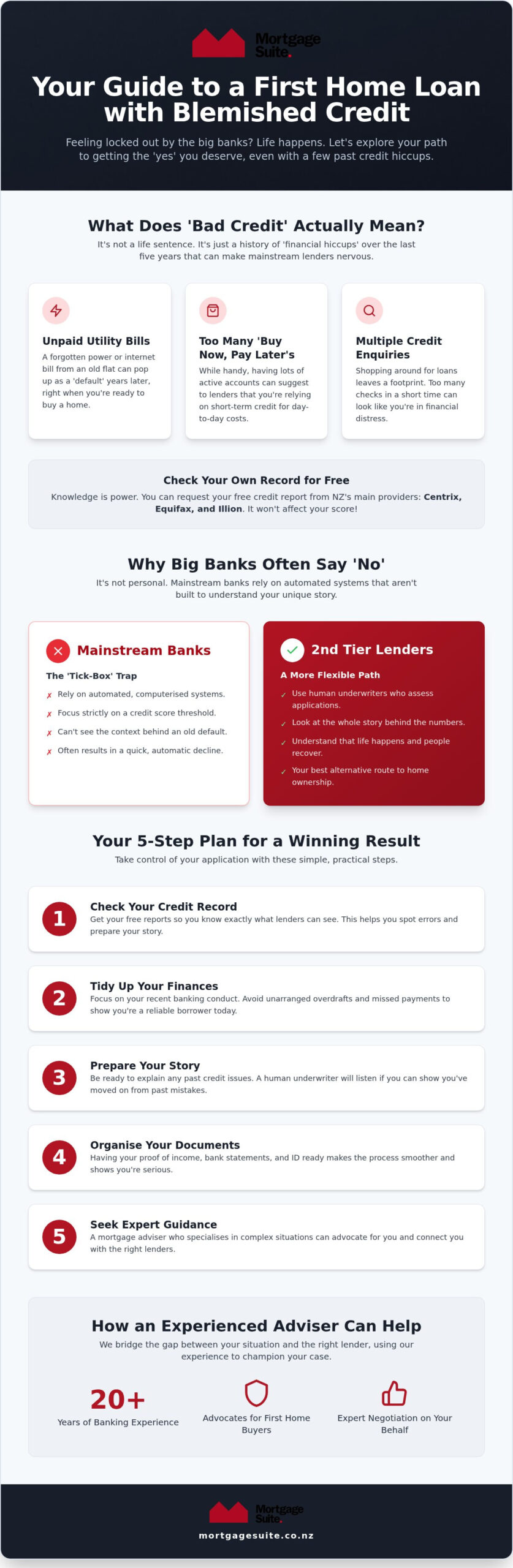
In New Zealand, your credit history acts like a financial diary. It records how you’ve handled bills and loans over the last five years. When you apply for a first home loan with bad credit nz, the lender isn’t just looking at a single number; they’re looking at your patterns. Essentially, bad credit is a history of “financial hiccups” that makes mainstream banks nervous. They use this data to guess how likely you are to pay them back on time. If they see a pattern of late payments, they might decide the risk is too high for their standard “tick-box” systems.
Understanding What ‘Bad Credit’ Really Means helps take the mystery out of the process. It isn’t just about big debts or bankruptcy. Even small things like a missed phone bill or a late credit card payment can stay on your record for years. These small marks tell a story about your financial discipline, even if you’ve since become much better at managing your money. Lenders want to know they can trust you with a mortgage, so they look at these past actions as a guide for the future.
Common Credit Hiccups That Trip Up Kiwis
You might be surprised by what shows up on a report. Often, it’s the small things that cause the most trouble during an application. These aren’t always signs of being “bad with money,” but they can flag you as a higher risk in a bank’s computerised system.
- Unpaid utility bills: Power or internet bills from an old flat often go unnoticed. You might move house and forget a final payment, only to find it’s become a “default” years later when you’re finally ready to buy.
- Too many ‘buy now, pay later’ accounts: Services like Afterpay or Laybuy are convenient, but having multiple active accounts can signal to a lender that you’re struggling to cover day-to-day costs.
- Multiple credit enquiries: If you’ve been shopping around for a car loan or a personal loan, every time a company checks your credit, it leaves a footprint. Too many of these in a short space of time can make you look like you’re in financial distress.
How to Check Your Own Credit Record for Free
Before you start your journey toward a first home loan with bad credit nz, you need to see what the lenders see. You don’t have to pay a cent to get this information. In New Zealand, you can request your report from the three main providers: Centrix, Equifax, and Illion. It’s a good idea to check all three because they don’t always show the same information. A default might show up on one but not the others, and you want the full picture.
One of the best things about checking your own record is that it doesn’t hurt your credit rating. These are called “soft” enquiries. By getting these reports early, you can spot any errors or old debts you’ve forgotten about. This gives you the chance to start tidying things up and preparing your story before you sit down with a lender. Knowledge is power, and knowing exactly what’s on your record is the first step toward getting that “yes.”
Why Mainstream NZ Banks Say No (And Why It’s Not the End of the Road)
Walking into your local bank branch only to be told “no” is a crushing experience. It feels personal, as if the bank is judging your character based on a few numbers on a screen. However, it’s helpful to remember that the “Big Four” banks operate like massive machines. They process thousands of applications every week and rely on automated systems to do the heavy lifting. If you are seeking a first home loan with bad credit nz, these automated systems often act as a wall rather than a gate.
The ‘Tick-Box’ Trap
Banks use computerised “tick-box” systems that lack human common sense. These programmes are designed to find the “perfect” borrower. If your credit score doesn’t hit a specific threshold, the system triggers an automatic decline. It doesn’t matter if you now have a high income or a massive deposit. The computer doesn’t stop to ask why you had a default three years ago; it just sees the mark and moves on to the next file.
There is also a big difference between “conduct issues” and “historic defaults.” Conduct issues involve recent messiness, like unarranged overdrafts or missed payments in the last few months. Historic defaults are old mistakes from years ago. While a human might see that you’ve turned a corner, a bank’s software often treats them with the same level of suspicion. This rigid approach is partly due to the strict environment created by the Credit Contracts and Consumer Finance Act. Even with the official government lending law changes designed to bring more balance to the market, banks remain very conservative.
The Real Reason for the Decline
When a bank declines you, they often give a vague reason like “you don’t meet our criteria.” This is usually about how much risk the bank is willing to take at that specific time. Banks want the safest possible bets to keep their shareholders happy. Even the Kāinga Ora First Home Loan scheme, which is designed to help people into homes, still maintains relatively strict credit requirements. It’s a great tool, but it isn’t a silver bullet for everyone. If you’ve been declined, it’s rarely a reflection of your worth. It’s just a sign that your situation doesn’t fit that specific bank’s narrow rules.
A specialist broker can often find out the actual reason for a decline, which allows us to address the issue head-on. To learn more about how these factors influence your application, you can explore our Mortgage School for expert guidance. If you’ve been told “no” recently, it might be time to talk to a specialist who looks at your whole story instead of just a tick-box. Finding a different type of lender can change your entire outlook on home ownership.
2Nd Tier Lenders: Your Alternative Route to Home Ownership
When the big banks turn you away, it is easy to feel like your property dreams are over. However, there is a whole world of lenders beyond the household names you see on every street corner. These are often called 2nd tier or non-bank lenders. They are professional financial companies that specialise in providing mortgages to people who don’t fit the standard bank requirements. If you are looking for a first home loan with bad credit nz, these lenders are often the key to getting a “yes” because they operate very differently from mainstream institutions.
The biggest difference is the human element. While a bank relies on a computer to say yes or no, 2nd tier lenders employ a specialist team who actually review your application and listen to your story. They still follow the Credit Contracts and Consumer Finance Act 2003 to ensure they are lending responsibly, but they are much more willing to look at the context of your situation. This means they are often more comfortable with past defaults, being self-employed, or other life events that would cause a bank to immediately decline your file.
Mainstream Bank vs. 2nd Tier Lender
It is helpful to view a non-bank loan as a “bridge” rather than a forever home for your mortgage. Mainstream banks offer the lowest interest rates, but their rules are incredibly strict and they usually prefer a 20% deposit if your credit isn’t perfect. In contrast, 2nd tier lenders are much more flexible. They might accept a smaller deposit or a more complex credit history, though they charge a slightly higher rate to cover the extra risk they are taking on.
We often recommend a “Stepping Stone Plan” for our clients. This involves staying with a 2nd tier lender for one or two years to get your foot in the door. During this time, you prove you are a reliable borrower by making every payment on time. Once your credit record clears and you have built up some equity in your home, we then help with moving your loan to a different bank later to secure those lower mainstream rates. It is a proactive way to start your home ownership journey sooner.
What to Expect with a Non-Bank Loan
We believe in being completely honest about the trade-offs involved. Because these lenders take on more risk, they do charge more for their services. You can typically expect an interest rate that is 1% to 3% higher than the headline bank rates. You can use our Mortgage Calculator to see exactly how these different rates would affect your weekly repayments and make sure the numbers work for your budget.
While paying a bit more in interest feels tough, it is often much cheaper than waiting years for your credit record to be perfectly clean. If house prices continue to rise while you are waiting, the cost of the house could increase by far more than the extra interest you would pay over a couple of years. Getting into a first home loan with bad credit nz now allows you to start building your own equity instead of paying off someone else’s mortgage while you wait for your score to improve.
5 Steps to Organise Your Application for a Winning Result
You cannot change the mistakes of the past, but you can certainly control how you handle your money today. Lenders aren’t just looking at the hiccups you had years ago; they want to see that you are now a safe pair of hands. Preparation is 90% of the battle when your credit isn’t perfect. We recommend gathering every piece of evidence that explains your past credit issues so you can present the full picture to the bank. Getting a first home loan with bad credit nz is much easier when you focus on showing that you have truly turned a corner.
The ‘Clean-Up’ Phase
Before you start looking at open homes, you need to tidy up your financial life. This phase is about proving that your old habits are gone and you are ready for the responsibility of a mortgage. Even small actions can have a big impact on how the person reviewing your file sees your application.
- Step 1: Settle old debts. Pay off any small unpaid bills or defaults immediately. While the mark stays on your record for five years, seeing that you have settled the debt makes a massive difference. It shows you take your current obligations seriously.
- Step 2: Close unused accounts. Get rid of credit cards or high-interest store cards you don’t use. Lenders look at your total available credit limits as potential debt, even if the balance is zero. Closing them can actually increase the amount you are allowed to borrow.
- Step 3: Show perfect account behaviour. Aim for at least three months of “clean” bank statements. This means no unarranged overdrafts and no missed automatic payments. It is about proving you have the discipline to manage your money every single week.
Telling Your Story
The final steps involve moving beyond the numbers and providing the human context that a computerised bank system would usually ignore. This is where your application for a first home loan with bad credit nz truly comes to life and stands out from the pile.
Step 4: Write a simple explanation. If a major default was caused by a one-off event like a medical emergency or a relationship breakup, you should explain that. Be honest and detail what has changed since then to ensure it won’t happen again. A human decision-maker appreciates this transparency and it helps them understand the person behind the paperwork.
Step 5: Partner with a specialist. You need an advocate who knows which lenders will be most sympathetic to your specific situation. We know how to package your application so it highlights your strengths. You can see how others in similar spots succeeded by reading our Client Reviews. If you are ready to start this process, contact our team at Mortgage Suite Ltd today to see how we can help you turn your situation around.
How Mortgage Suite Ltd Advocates for First Home Buyers
Securing a first home loan with bad credit nz isn’t just about finding a lender who will listen. It’s about having an advocate who knows how to translate your life story into a language that lenders understand. At Mortgage Suite Ltd, we know that your credit report is only one part of your financial identity. Krish Krishna uses over 20 years of banking experience to look past the numbers and focus on the person behind the application. We understand exactly how lenders think because we’ve spent decades on the other side of the desk. This insider knowledge allows us to anticipate their questions and address their concerns before they even ask.
We don’t just send off a digital application and hope for the best. We negotiate and argue your case directly with the people who make the final decisions. We also have access to a wide range of 2nd tier lenders that you often cannot deal with directly as a member of the public. Our goal is to find a solution that fits your actual life, not just a bank’s rigid spreadsheet. We believe everyone deserves a fair go at home ownership, and we work tirelessly to bridge the gap between your past hiccups and your future home.
The Power of Professional Negotiation
The way an application is packaged can make all the difference. We don’t just show the lender your defaults; we highlight your strengths, such as a stable job, a solid deposit, or your history of paying rent on time. This is like creating a professional CV for your finances. Having a veteran banker on your side gives the lender more confidence. They know that if we’re backing your application, we’ve already done the hard work to ensure you’re a reliable borrower. You can learn more about Krish’s background and our philosophy by visiting our About Us page.
Your Long-Term Home Loan Partner
Our relationship with you doesn’t end once you get the keys to your new house. We stay in touch to help you plan for the future. As we discussed earlier, the goal for many of our clients is to eventually move back to a mainstream bank once their credit record is clear. We’ll be there to help you recognise when the time is right to make that transition, ensuring you always have the most affordable option available.
Because we offer a national service, we can help you no matter where you’re looking to buy across New Zealand. Whether you’re just starting to think about buying or you’ve recently been declined by your own bank, we’re here to help. Reach out to us for a conversational, no-pressure chat about your options. We’ll give you honest advice and a clear path forward, helping you secure that first home loan with bad credit nz so you can finally stop renting and start owning.
Take the First Step Toward Your New Front Door
Owning your own home in 2026 is still within reach, even if your credit record has a few marks from the past. You’ve seen that while mainstream banks rely on rigid computer systems, there are flexible lenders who value your actual story. By tidying up your recent account conduct and presenting a clear explanation of past events, you can demonstrate that you’re a reliable borrower today. This preparation is the key to moving from a “no” to a “yes.”
Securing a first home loan with bad credit nz is often about finding the right bridge to get you into the market sooner. With over 20 years of banking expertise, our team at Mortgage Suite Ltd specialises in “outside the box” lending and provides national NZ-wide support to help you navigate this journey. We handle the tough conversations with lenders so you don’t have to. We believe in your potential and are dedicated to finding a solution that fits your life.
Book a friendly chat with our team to explore your home loan options
You don’t have to navigate this process alone. We’re here to support you and help turn your home ownership dreams into a reality.
Common Questions About Buying Your First Home With Bad Credit
Can I get a first home loan in NZ with a 500 credit score?
Yes, you can certainly secure a first home loan with bad credit nz even if your score is around the 500 mark. While mainstream banks usually look for scores above 700, 2nd tier lenders are far more interested in your current ability to manage money. They’ll look at your income, your deposit, and the story behind the low score. If you can show your habits have improved, many alternative lenders will consider your application.
How long does a default stay on my NZ credit record?
In New Zealand, a default stays on your credit record for five years from the date it was first listed. It doesn’t matter if you pay it off the next day or three years later; the mark remains visible to lenders for that full period. However, a “paid” default is much more attractive to a lender than an “unpaid” one. It shows you’ve taken responsibility for your past debts and resolved the issue.
Will I need a bigger deposit if I have bad credit?
You generally will need a larger deposit if your credit history isn’t perfect. While some buyers with clean credit can access loans with a 5% or 10% deposit, lenders often require at least 20% for those with credit issues. This extra equity reduces the risk for the lender. Having a larger deposit also demonstrates that you have the financial discipline to save, which helps build trust during the application process.
Are interest rates much higher for 2nd tier home loans?
Interest rates for 2nd tier loans carry a “risk premium,” so they are typically higher than mainstream bank rates. You can expect to pay between 1% and 3% more than the special rates advertised by the big banks. While major banks might offer rates around 5% in 2026, 2nd tier rates can range from 6.84% to over 11%. It’s a temporary cost to get you into the property market sooner.
Can I use my KiwiSaver for a deposit if I have bad credit?
Yes, you can still use your KiwiSaver funds for a deposit even if your credit history is less than perfect. The rules for withdrawing your KiwiSaver are set by the government and your provider, not by the mortgage lender. As long as you’ve been a member for at least three years, you can usually withdraw your balance. This is a vital tool for building the 20% deposit often required for alternative loans.
What happens if my bank has already declined my home loan application?
If your bank says no, it simply means you don’t fit their specific, narrow lending criteria. It isn’t a final judgement on your dream of home ownership. Many Kiwis successfully secure a first home loan with bad credit nz after being declined by their own bank. The key is to stop applying at other mainstream banks, which can further damage your score, and talk to a specialist who understands the alternative lending market.
How can a mortgage broker help me if my credit is poor?
A broker acts as your personal advocate and negotiator. We use our 20 years of banking experience to “package” your application so it highlights your current strengths rather than just your past mistakes. We also have access to a wide range of 2nd tier lenders that don’t deal with the public directly. We handle the hard conversations with underwriters and push for a “yes” when a bank’s computer system says “no.”
Is it possible to ‘fix’ my credit score quickly before applying?
You can’t instantly erase past defaults, but you can improve how you look to a lender in about three months. Start by paying off any small outstanding debts and closing down unused credit cards or store accounts. Most importantly, ensure your bank statements show at least 90 days of perfect conduct with no missed payments or unarranged overdrafts. This recent “clean” history is often more important to a human underwriter than an old mistake.