
Getting on the Property Ladder with a Low Income in NZ
Could a lower income still be enough to buy your first home? If you’re thinking about getting on the property ladder with low income nz, it’s understandable to worry that repayments will stretch your budget too far. A modest deposit or a declined application can add to that uncertainty, but neither tells the whole story.
Lenders consider more than your income. They’ll look at your regular spending, existing debts and whether you could manage repayments if interest rates rose. Their criteria can differ, so a “no” from one bank isn’t necessarily the end of your options.
This guide explains how lenders assess affordability and what practical steps could strengthen your application. You’ll learn how to review spending and debt, compare deposit and co-borrowing pathways, and consider how your property choice may affect a lender’s decision. Mortgage Suite can help you understand lender fit and negotiate on your behalf. There’s no promise of an outcome, but a clearer picture of your options can make your next move feel more manageable.
Key Takeaways
- Getting on the property ladder with low income nz depends on more than your pay. Lenders also consider debts, spending and whether repayments look manageable.
- A serviceability stress test checks how your budget might cope if lending conditions change. Plan around repayments you could sustain.
- Compare the trade-offs of a larger deposit, low-deposit lending, family support or buying with another borrower before choosing a pathway.
- Organise your financial records, review regular commitments and build a realistic budget to present a clearer home loan application.
- A broker can help you understand lender fit and compare bank and private lender options, without guaranteeing approval.
Getting on the property ladder with a low income in NZ: what makes it possible?
Saving a deposit while paying rent, bills and everyday expenses can feel like a tough balancing act. Your first home doesn’t have to be perfect or permanent. The aim is to find a property you can afford to maintain and repay over time, without leaving your household stretched to breaking point.
For Kiwis, getting on the property ladder with low income nz isn’t decided by one salary figure. Lenders consider your income alongside your deposit, regular spending, debts and the property you want to buy. The wider context of housing affordability in New Zealand helps explain why the process can feel challenging, but your application is assessed on its full financial picture.
What lenders look at beyond your income
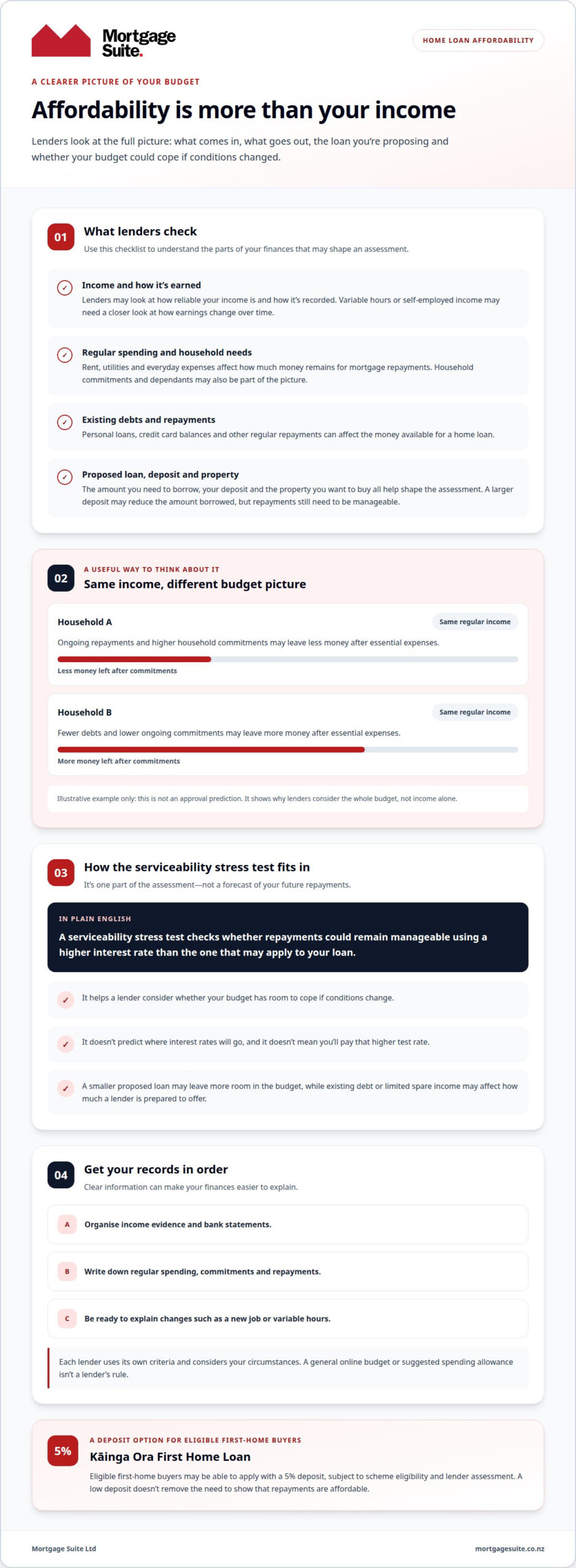
Lenders want to understand how reliable your income is and how much of it is already committed. They may look at your employment pattern, regular household expenses, debt repayments and the loan repayments you’re proposing. A steady salary is one part of the picture. Variable hours or self-employed income may need a closer look at how earnings are recorded and how they change over time.
Two households with the same income can receive different affordability assessments. One may have fewer debts and lower ongoing commitments, while the other supports dependants or has regular repayments to manage. The property matters too, because the amount you need to borrow and the lender’s view of the property affect the application. No single income level guarantees approval or rules it out.
Why a smaller deposit is only part of the picture
Your deposit and your ability to manage repayments answer different questions. The deposit affects how much you need to borrow and whether the lender’s criteria allow the proposed loan. Repayment affordability is about whether your income can support that loan alongside your other commitments. A larger deposit may reduce the amount borrowed, but you’ll still need to show that repayments are manageable.
Low-deposit lending may suit some first-home buyers, depending on the lender’s criteria, the property and your circumstances. A modest deposit doesn’t automatically close the door, but it doesn’t mean every option will fit. Consider the purchase as a whole: the loan size, ongoing repayments and room in your budget for everyday needs. Mortgage Suite’s mortgage calculator can help you explore how different repayment settings may affect your budget, though it can’t determine a lender’s decision.
For a closer look at first-home lending and deposit pathways, see Home Loans for First Home Buyers in New Zealand: 2026 Guide. Rather than asking whether your income is “high enough” on its own, start by working out what you could sustainably afford and which lender may assess your circumstances fairly.
How lenders assess affordability when your income is limited
A lender’s assessment goes beyond whether your income looks steady on paper. The lender considers what comes in, what regularly goes out, what you already owe and what repayments a new home loan would add. This gives them a fuller picture of whether the proposed loan could fit your circumstances.
Income, spending and existing commitments
Lenders may consider how your income is earned and recorded, along with regular household spending and debt repayments. Rent, utilities and everyday needs affect the money left for a mortgage. Existing commitments, such as personal loans or credit card balances, may also shape the assessment. The aim is to understand your actual financial position, not judge your spending choices.
Clear records make your finances easier to explain. Keep income evidence, bank statements and details of regular repayments organised. Be ready to explain changes such as a new job or variable hours. Don’t assume a general online budget or suggested spending allowance is a lender’s rule. Each lender assesses applications using its own criteria and your circumstances.
Illustrative household example: Imagine two households earning the same regular income. One has ongoing repayments and higher household commitments; the other has fewer debts and more money left after essential expenses. Their borrowing assessments may differ, even though their incomes match. This isn’t an approval prediction. It shows why a lender looks at the whole budget.
How a serviceability stress test affects borrowing
A serviceability stress test is a hypothetical repayment assessment using a higher interest rate than the one that may apply to your loan. It helps the lender consider whether repayments could remain manageable if conditions changed. It doesn’t predict where interest rates will go or mean you’ll pay that higher test rate. It’s one way to check whether your budget has room to cope with a change.
For a lower-income household, the proposed loan size can be particularly relevant. A smaller loan may leave more room in the budget, while existing debt or limited spare income may affect how much a lender is prepared to offer. The lender also considers the deposit and property, so the stress test isn’t the only factor.
Eligible first-home buyers may be able to apply for a low-deposit loan through the Kāinga Ora First Home Loan, which allows a 5% deposit subject to scheme eligibility and lender assessment. That deposit option doesn’t remove the need to show that repayments are affordable.
Before discussing lender fit, organise your income and debt records and write down your regular commitments. The How to Qualify for a Home Loan in NZ guide offers a useful qualification checklist. Understanding these moving parts can help you plan for getting on the property ladder with low income nz without treating one lender’s decision as the final word.
Which first-home pathways may suit a lower income in NZ?
There isn’t one route that suits every first-home buyer. A larger deposit, low-deposit lending, help from family or buying with another person can each change what’s possible, but they also bring different responsibilities. The right fit depends on your household budget, the property you’re considering and the lender’s criteria. Compare each option as part of a plan you could manage over time, not just by how quickly it might lead to a purchase.
Low-deposit lending and the First Home Loan
Saving a larger deposit can reduce how much you need to borrow, but it may take longer and requires balancing saving with everyday commitments. Low-deposit lending may offer another route for eligible buyers, although lenders still assess repayment affordability and the property. A smaller deposit doesn’t guarantee a loan or mean every property will be suitable security.
The Kāinga Ora First Home Loan is a scheme administered by Kāinga Ora – Homes and Communities, with its own eligibility requirements. Check the current criteria before planning around it, as they may change. Compare the likely repayments and your budget as carefully as the deposit requirement. Getting into a home only helps if the loan remains manageable.
Family support and buying with another person
Family help can take different forms, such as a gift or a loan. Agree clearly on whether the money must be repaid, when repayment is expected and how it could affect the family member’s own plans. A shared understanding can help protect relationships and make the source of funds clear during an application. Family support isn’t essential to exploring other pathways.
Buying with a partner, relative or friend can bring more income and savings into the application. It also means making decisions together about the property, repayments and what happens if one person wants to sell or can no longer contribute. Put your agreement in writing and get independent legal advice about ownership arrangements before committing.
Some shared loans involve joint and several liability. In plain English, each borrower can be responsible for the full debt, not only their agreed share. If another borrower misses repayments, the lender may still expect you to meet the loan obligations. Make sure you both understand this responsibility and can discuss difficult scenarios openly.
A sensible plan for getting on the property ladder with low income nz starts with comparing trade-offs, not assuming one option is automatically best. Saving more may mean waiting; family support needs clear terms; and co-buying requires trust and careful agreements. Low-deposit schemes have eligibility rules, and lenders assess each application on its circumstances. Choose a pathway that fits your financial position and leaves room for everyday needs, rather than stretching your budget to reach a deposit or purchase sooner.
How to strengthen a low-income home loan application
A stronger application starts with a clear picture of what you earn, what you owe and what you could comfortably repay. You don’t need to make your finances look perfect. Present them accurately so the lender can assess your situation and discuss suitable options.
Work through these steps before applying:
- Map your finances. List your regular income, household spending, debt repayments and savings. Include everyday needs such as food, transport and bills, and leave some room for changing circumstances.
- Gather your records. Put recent income information, bank statements and details of regular commitments in one place. A clear, consistent set of records can help explain your position.
- Review what you owe. Check that your records reflect current balances and repayments. If you spot an error or an unclear transaction, find out what it relates to before the lender assesses your application.
- Discuss lender fit. Share your goals and financial position before settling on a borrowing target. Different lenders may assess an application differently, and a mainstream-bank decline isn’t necessarily the end of the conversation.
Get your income and financial records organised
Bring together evidence that reflects how you’re actually paid, such as payslips or records of contract and self-employed income. If your hours or earnings vary, describe that pattern plainly and provide records that show it. Don’t present a strong month as guaranteed income. If your work or income has changed, explain when and how, rather than leaving the lender to guess.
Check that your stated commitments match your records. A missed payment, an unfamiliar transaction or a debt that has been repaid may need context. Clear information won’t guarantee approval, but it can help the lender assess your application accurately.
Choose a realistic next step before applying
Think about repayments that would fit your actual household budget, not just the largest borrowing figure you might be offered. Include regular bills and everyday spending, and leave breathing room for unexpected household needs. Mortgage Suite’s mortgage calculator can help you estimate repayments and compare different loan amounts. Treat the result as a planning guide, not a lender decision.
A headline interest rate is only one part of a home loan. The loan structure, repayment settings and fit with your plans matter too. Before making an offer or choosing a loan, discuss how your income pattern, deposit and preferred property may affect lender options. This can help you set a sensible borrowing goal and identify what information to prepare next.
If you’d like support weighing up those details, talk through your home loan options with Mortgage Suite. A personal discussion can help you understand lender fit and possible next steps, without promising a particular outcome. Preparation won’t remove every hurdle, but it can make getting on the property ladder with low income nz feel more considered and manageable.
How Mortgage Suite can help you explore a home loan on a lower income
Working out which lender may suit your circumstances can be difficult when your income is modest or varies. Mortgage Suite starts by understanding what you want to achieve and how your finances work, then discusses lender options that may fit. You’ll get a clearer view of borrowing capacity, deposit requirements and property suitability, so you can consider a practical next step without feeling judged.
What a mortgage broker can do when income is tight
A broker can help you understand how different lenders may view your income, commitments and deposit. Mortgage Suite works with bank and private lenders, including non-bank options, so you can consider lender fit beyond a single bank’s assessment. That doesn’t mean every lender will be suitable or that an application will be approved.
Mortgage Suite can negotiate with lenders on your behalf, presenting your circumstances and seeking terms that may suit your needs. Negotiation is support, not a promise of approval. Founder Krish Krishna began Mortgage Suite in 2000 after 18 years in banking, bringing experience across lending decisions and borrower situations to the conversation.
A straightforward way to get started
You don’t need every detail sorted before discussing your options. Share your goal, income pattern, deposit position and regular commitments as clearly as you can. If something has changed or feels complicated, explain it openly. A useful discussion starts with your real circumstances, not an assumption that every borrower has the same path.
Together, you can talk through a manageable borrowing goal, the sort of property that could fit and which bank or non-bank lending options may be worth considering. For Kiwis, getting on the property ladder with low income nz isn’t about chasing the largest possible loan. It’s about understanding your choices and weighing them against repayments and household needs.
Mortgage Suite’s service is free of charge with no obligation. You can also read Mortgage Suite reviews to learn about other clients’ experiences. A mainstream-bank decline doesn’t necessarily end the conversation, though no broker can guarantee a lending outcome.
If you’re ready to talk through your circumstances and possible next steps, Discuss your home loan options with Mortgage Suite.
Take your next step with a clear plan
Your first step doesn’t have to be a mortgage application. It could be deciding what kind of home would work for your household, setting a repayment amount you’re comfortable with or listing what you’d like to understand before speaking with a lender. A clear goal can make the choices ahead feel less daunting.
Getting on the property ladder with low income nz is a process, not a test you have to pass in one go. If you’re not quite ready to apply, use what you’ve learned to shape a plan and revisit it as things change. If you’re ready to explore your options, a conversation can help you understand what information to prepare and what a sensible next move could look like.
Discuss your home loan options with Mortgage Suite and take the next step at a pace that feels right for you. Your path may take time, but you don’t have to work it out alone.
Frequently Asked Questions
Can I buy a house in NZ on a low income?
It may be possible, but your income alone doesn’t decide whether a lender will consider your application. They’ll look at your regular commitments, existing debt, deposit and proposed repayments. Criteria differ between lenders and can change. Start by mapping your household budget, then consider what type of property and loan size may fit it. A smaller first-home goal could be worth exploring if it supports more manageable repayments.
What is a low-deposit home loan in New Zealand?
A low-deposit home loan lets a buyer contribute a smaller share of the property’s value than a lender may usually expect. It isn’t automatically available to every buyer. Lender criteria, the property and your ability to manage repayments all count. Before planning around a particular option, understand its current requirements and how the deposit could affect loan terms and repayments, not just whether it helps you make an offer sooner.
Can I get a Kāinga Ora First Home Loan if I have a low income?
A low income alone doesn’t confirm eligibility or rule you out. The Kāinga Ora First Home Loan has specific requirements, and the lender still considers whether repayments appear manageable for your circumstances. Check the current scheme information on the Kāinga Ora website before making plans around it, as eligibility rules can change. You can then discuss your income, household situation and intended property with Mortgage Suite to consider whether it may be a suitable route.
Does a small deposit mean I cannot get a home loan?
Not necessarily. Some lending pathways may consider buyers with a smaller deposit, but the lender’s current criteria and your overall financial position matter. The property and loan structure can also affect the decision. Rather than assuming one deposit rule applies to everyone, work out what repayments could fit your budget and compare how different deposit levels might change the options available. A smaller deposit doesn’t guarantee approval.
Can my family help me get onto the property ladder?
Family support may help, but agree on the arrangement before including it in a home-buying plan. Clarify whether support is a gift or must be repaid, and what expectations come with it. The lender may need to understand the arrangement, so explain it accurately. Talk through how it could affect everyone’s finances and future plans. Family assistance can support an application, but it doesn’t guarantee a loan.
Can I buy my first home with another person if my income is low?
Buying with someone else may make a joint application possible, but the lender assesses the applicants’ combined circumstances and commitments. Before applying, agree how you’ll handle ownership, repayments, household responsibilities and a change in plans, such as one person wanting to sell. Get legal advice about documenting ownership. Also understand whether each borrower could be responsible for the full loan, not only their intended share.
How can I improve my chances of getting a home loan on a low income?
Start by setting out your income, regular spending, debts and savings, then gather records that support what you’ve listed. Check that the information is accurate, especially if your income varies or a commitment has recently changed. Choose a borrowing goal that leaves room for household needs. Getting on the property ladder with low income nz may involve comparing lenders, but preparation can’t guarantee approval. Mortgage Suite can help you discuss options that fit your circumstances.