
Home loan affordability in NZ: estimate how much you can borrow
Your salary alone doesn’t determine how much you may be able to borrow. A home loan affordability calculator in NZ can provide an estimate, but lenders also consider your credit history, existing debts, deposit and the money left after regular expenses.
It’s understandable to feel uncertain when working out what’s within reach. A calculator can help you find a starting point, but its result isn’t the same as a lender’s assessment. Existing repayments and everyday spending can reduce the amount that looks affordable on paper, while your deposit affects how much you need to borrow.
This guide explains how these factors shape your borrowing capacity, what information an affordability calculator may ask for, and why its estimate can differ from a lender’s decision. You’ll get a clearer picture of your finances and the next steps to consider as you plan a home purchase.
Key Takeaways
- Your credit history and existing debt repayments can affect how much a lender considers affordable, so look beyond your salary alone.
- Your deposit influences how much you need to borrow. Kāinga Ora, Homes and Communities says eligible first-home buyers may be able to borrow with a 5% deposit through a First Home Loan.
- Your monthly surplus matters: lenders assess what may remain after regular expenses and repayments, including when testing whether repayments could remain manageable if rates rise.
- Affordability calculators provide an estimate using details such as income, debts, expenses and deposit, but they don’t replace a lender’s full assessment.
- Understanding the factors behind your estimate can help you prepare for a home loan conversation and consider a suitable next step.
How do your credit report and debts affect how much you can borrow?
Your income is only part of a lender’s affordability assessment. Your credit report shows how you’ve managed borrowing, while repayments on existing debts reduce the income available for a mortgage. A credit issue doesn’t define you, but its details can influence how a lender assesses your application.
A lender may consider repayment history, missed payments, defaults and current credit commitments. A credit card can matter even if you pay it off each month, because its limit gives you access to further borrowing. Personal loans, car finance and buy-now-pay-later commitments can also reduce the income available for mortgage repayments.
Look at your whole monthly budget. For example, two households with the same income and deposit can have different borrowing capacity if one has higher loan repayments or regular card balances. Lenders also consider whether your spending and repayments leave room for a mortgage over the long term.
- Credit cards: Include the limit and balance when listing your commitments.
- Personal or car loans: Record the repayment and remaining loan term.
- Buy-now-pay-later: Include active commitments in your debt picture.
- Credit history: Look for inaccurate account details or repayment records.
If you find an error in your credit record, contact the organisation that supplied the information and ask for a correction. Keep records of repayments and resolved debts so you can explain a past issue clearly in an application. Accurate details help a lender assess your current position rather than rely on a mistaken entry.
How can I improve my mortgage affordability in New Zealand? Reduce existing debt where possible, avoid taking on new credit and review recurring commitments. Check your credit record for errors and build your deposit to strengthen your overall borrowing position.
A mortgage calculator for your home-loan figures can help you explore how income, debts and repayments interact. Use it to compare how a change in a regular repayment affects the estimate. Keep your figures accurate, including credit commitments, so the result reflects your current situation rather than an incomplete version of it.
Loan-to-value ratios and deposit requirements
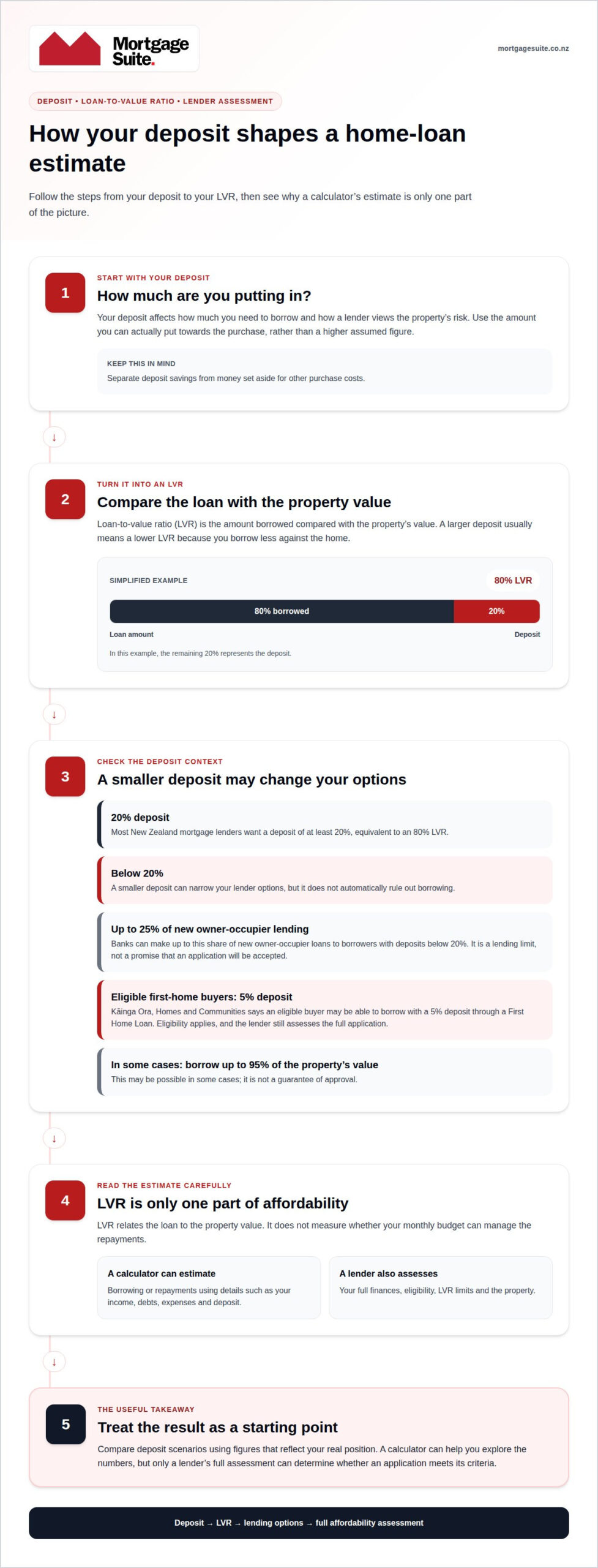
Your deposit affects both the size of your mortgage and how a lender views the property’s risk. Loan-to-value ratio, or LVR, compares the amount borrowed with the property’s value. A larger deposit usually means a lower LVR because you need to borrow less against the home.
For example, a NZ$640,000 mortgage on a home valued at NZ$800,000 has an 80% LVR. The remaining 20% represents the deposit in this simplified example. Most New Zealand mortgage lenders want a deposit of at least 20%, equivalent to an 80% LVR. A smaller deposit can narrow your lender options, though it does not automatically rule out borrowing.
Rules allow some lending above an 80% LVR. Banks can make up to 25% of new owner-occupier loans to borrowers with deposits below 20%. This is a limit on the share of new lending, not a promise that a particular application will be accepted. In some cases, borrowers may be able to borrow up to 95% of a property’s value, meaning a smaller deposit covers the rest.
Eligible first-home buyers may have another route. According to Kāinga Ora, Homes and Communities, a First Home Loan in New Zealand can allow eligible first-home buyers to borrow with a 5% deposit. Eligibility matters, and the scheme’s deposit option does not remove the lender’s assessment of income, debts, credit history or the property. Your deposit is one part of the overall application.
When using a home loan calculator, enter the deposit you can actually put towards the purchase. A higher assumed deposit can make the borrowing estimate look more comfortable than your real position. Separate savings for the deposit from money set aside for other purchase costs. LVR relates the loan to the property value; it doesn’t measure your monthly ability to make repayments.
What risks and limitations should I know about NZ home loan calculators? A calculator can estimate borrowing or repayments, but it may not reflect a lender’s LVR limits, eligibility criteria or assessment of your full finances. Treat the result as an initial estimate, not a lending decision.
To make the estimate more useful, compare a few deposit scenarios and note how each changes the loan amount and LVR. A mortgage calculator can help you explore those figures. For first-home buyers, the First Home Loan’s 5% deposit option is worth understanding alongside the standard 20% deposit expectation.
Monthly surplus income and interest-rate rises
Your monthly surplus is what remains after regular income and expenses are considered. Lenders assess it alongside repayments and debt-to-income rules when deciding whether a mortgage may fit your budget.
Repayments as a share of income
Repayment affordability as a share of income compares fixed payments with your before-tax income. Some financial guidance suggests keeping fixed payments, including mortgage and other loan payments, to 30-40% of before-tax income. This is a broad budgeting guide, not a lender’s approval rule. Your household costs, other debts and income stability can all affect the amount left for repayments.
A percentage can help you spot budget pressure before applying. If mortgage repayments take a large share of your income, an unexpected bill or rate rise may leave less room in your budget. Compare your likely repayment with regular spending and current loan commitments, rather than relying on income alone.
Lender assessments and calculator inputs
Lenders use income and expenses to assess whether mortgage repayments fit your finances. A calculator may ask for earnings, regular household spending, existing debts, deposit and loan amount. Lenders can assess those details differently, including how they treat expenses and available income. The same figures can therefore produce different borrowing estimates.
For a useful comparison, keep your inputs consistent. Include recurring costs and debt repayments, then see how changing the mortgage amount affects your monthly surplus. A lower estimate from one lender doesn’t mean another will assess your application in the same way.
Test rates in affordability checks
A serviceability stress test checks whether repayments could remain manageable at a higher interest rate than the loan’s actual rate. Banks use this hypothetical rate to test affordability if conditions change. The test rate isn’t necessarily the rate you’ll pay, and it can reduce the borrowing amount shown by a calculator.
There isn’t one test rate that applies to every NZ bank or borrower. Banks set their own assessment approaches, so a calculator may not match each lender’s test. Compare the assumptions used rather than treating one estimate as a lending decision.
Debt-to-income rules add another limit. New Zealand banks have had to limit high debt-to-income lending since 1 July 2024. For owner-occupiers, high debt-to-income lending means total debt, including the new mortgage, exceeds six times before-tax income. Reserve Bank rules limit banks to 20% of new owner-occupier lending to borrowers whose debt would exceed six times their income.
For example, a New Zealand household earning NZ$120,000 and owing NZ$20,000 in other debt would be in high-DTI territory if it borrowed more than NZ$700,000. This is a lending threshold, not a borrowing target; household surplus and repayment stress tests still matter.
How do mortgage affordability calculations differ between NZ banks and lenders? Banks and lenders can use different assumptions about income, expenses and test rates. These differences can lead to different estimates from the same financial details.
What are current NZ mortgage test rates and how do banks use them? Test rates vary between lenders and change over time. Banks use them to assess repayments at a higher hypothetical rate, so a calculator’s result depends on the rate assumption it uses.
What are current NZ mortgage interest rates and typical loan terms? Actual interest rates vary by lender, loan structure and borrower circumstances, so there is no single rate for every application. A New Zealand mortgage can be a 30-year commitment, making both repayment affordability and the chosen loan structure important.
How do NZ home loan affordability calculators estimate how much you can borrow?
A home loan affordability calculator in NZ estimates a borrowing range by combining income, expenses, debts, deposit and repayment assumptions. It works backwards from the repayment you may be able to manage, then estimates a loan size using its interest rate and loan term.
Start with the income fields. A calculator may ask for salary, regular contract income or other earnings, then account for existing debt repayments and household expenses. It subtracts these outgoings to estimate the money available for a mortgage. For example, higher regular spending leaves less room for repayments, even if your income stays the same.
The calculator then applies its repayment assumptions to the amount available. The interest rate and loan term affect the estimated repayment: a higher rate generally means more interest in each repayment, while a longer term spreads repayments over more time. The result is an estimate, not a figure based on income alone.
Your deposit also shapes the calculation. A larger deposit means you need to borrow less for the same purchase, changing both the loan size and likely repayments. The calculator may also use the property value to estimate the loan-to-value ratio. Keep the purchase price and deposit realistic so the result reflects the home you’re considering.
Different calculators can return different results because their assumptions may vary. One might use a different interest rate, term, expense allowance or method of treating income. A calculator may not account for every detail a lender considers, such as variable earnings or the full effect of existing credit limits. Read the result alongside its inputs.
To make an estimate more useful, change one input at a time and compare the results. For example, keep income and expenses steady, then adjust the deposit. Next, restore the deposit and test a different repayment assumption. This shows which change has the biggest effect on the estimated borrowing amount, without confusing several changes at once.
Check the output carefully. Some tools show an estimated maximum loan, while others focus on repayments or a purchase budget. These figures answer different questions. A maximum borrowing estimate may not account for other purchase costs or the monthly spending you want to preserve.
Use a home loan affordability calculator in NZ as a planning guide, not a lending decision. A lender assesses your full application and may use different assumptions from an online tool. If the result leaves little monthly breathing room, try a lower loan amount and compare the repayment effect. Accurate income, debt and spending details make the estimate more relevant.
What income and expenses do NZ mortgage affordability calculators require?
Before using a calculator, organise your financial records so each figure covers the same household and timeframe. This is especially useful if you share bills, receive irregular pay or earn rent from flatmates. Clear records help you spot assumptions that could make an estimate less relevant to your plans.
For variable earnings, separate regular pay from amounts that change across seasons or contracts. For example, if your income rises during busy periods, don’t base your budget only on those stronger months. Consider how your household would manage during quieter periods, too. This gives you a more grounded way to judge whether a possible repayment fits your circumstances.
Flatmate income can also be treated differently from wages. Some New Zealand lenders count 70% to 80% of flatmates’ rent as income when assessing a mortgage application. If rent contributes to your household budget, compare your estimate with and without it. That shows how much your borrowing picture may rely on income from someone who isn’t a borrower.
- Shared bills: Separate your household’s portion from costs paid by others.
- Irregular earnings: Distinguish dependable income from seasonal or occasional amounts.
- Flatmate rent: Note how much of your budget depends on this contribution.
- One-off spending: Keep unusual purchases separate from regular household patterns.
Next, scan your account activity for recurring payments that are easy to overlook. A streaming subscription, regular donation or membership may seem small on its own, but several commitments can affect how much you choose to keep available each month. Avoid counting a shared payment twice if it’s already included in a combined household figure.
Use the same approach for money coming into a shared household. If another person contributes to groceries or utilities but isn’t applying for the loan, don’t treat their contribution as guaranteed income without considering what happens if the arrangement changes. A simple household budget can show which costs remain yours to meet.
Once your figures are organised, compare the calculator’s assumptions with your own budget. The purpose isn’t to make every number fit a preferred result. It’s to notice where the estimate depends on variable earnings, shared arrangements or spending you may not be able to change. For support discussing how those details affect your borrowing position, talk through your home-loan options.
Mortgage Suite
Mortgage Suite Ltd can help you make sense of an affordability estimate and consider how your income, debts, deposit and monthly surplus fit together. If a calculator’s figure feels out of reach, or a mainstream bank has declined your application, that doesn’t necessarily mean you’re out of options. Your circumstances may call for a different lending approach.
Mortgage Suite Ltd provides home loans, including for first-home buyers, and residential investment property loans. It also offers business and property development loans. The right path depends on your goals and financial position, so a calculator result is a useful starting point for a more considered discussion.
For support understanding your borrowing options, contact Mortgage Suite Ltd.
Set your borrowing priorities before you move ahead
Before taking the next step, decide what a manageable mortgage looks like for your household, not just what a calculator says you could borrow. Think about how much monthly breathing room you want for changing plans and everyday life. This gives you a clearer starting point for discussing what matters most to you.
A home loan affordability calculator in NZ can help frame that conversation, but your priorities matter too. If a mainstream bank’s response has left you unsure where to turn, a decline doesn’t have to be the final word on your plans. Focus your next conversation on the borrowing structure and repayment level that fit your circumstances.
Share your goals and circumstances with Mortgage Suite Ltd to explore a path that fits your needs. Contact Mortgage Suite Ltd to start a conversation and take your next property decision one step at a time.
Frequently Asked Questions
How much can I borrow for a mortgage in New Zealand?
There’s no single borrowing amount that applies to every New Zealand home buyer. A lender considers your income, regular expenses, existing debts, deposit and the property you want to buy. For a useful starting estimate, enter accurate figures in a calculator and compare different loan amounts with repayments you could manage. Your preferred budget may be lower than the maximum a lender might consider.
How much deposit do you need to buy a house in NZ?
Most New Zealand mortgage lenders want a deposit of at least 20%, although some lending options allow less. The deposit you’ll need depends on the property, your finances and the lender’s criteria. For instance, if you’re considering a property above your current budget, compare the deposit needed at different purchase prices. Keep funds for other purchase needs in mind rather than treating every dollar saved as deposit money.
How much will a bank lend on a property?
A bank doesn’t decide how much to lend based on the property value alone. It also considers whether your income and budget can support repayments, along with your deposit and its assessment of the property. A valuation may affect the amount a lender is willing to advance. If it comes in below the agreed purchase price, you may need to revisit your funding plan or borrowing amount.
What’s an LVR?
LVR means loan-to-value ratio. It compares the mortgage amount with the property’s value, expressed as a percentage. A smaller loan against the same property value produces a lower LVR. Lenders use this measure when considering how much of a property’s value they’re financing. Consider it alongside your repayment budget, since a lower LVR doesn’t by itself show whether repayments fit your income.
How much deposit do first-home buyers need in New Zealand?
For many first-home buyers, the usual deposit target is 20%, but eligible buyers may have another option. Kāinga Ora, Homes and Communities says a First Home Loan can allow eligible first-home buyers to borrow with a 5% deposit. Eligibility applies, and buyers still need to meet the lender’s assessment. The scheme can be worth exploring if saving a 20% deposit feels out of reach.
How do student loans, credit cards, and buy now pay later affect NZ borrowing capacity?
Repayments on student loans and buy-now-pay-later accounts can leave less income available for mortgage payments. Credit cards may also affect an assessment, including when the lender considers the available credit limit. For a clearer estimate, include each commitment and its regular payment, not just larger debts. Paying down balances or closing credit you no longer need may change your overall debt picture.