
Mortgage approval with bad credit in NZ: what lenders assess
Bad credit doesn’t automatically prevent a mortgage application in New Zealand. For mortgage approval with bad credit in NZ, lenders assess your full application, including whether the borrowing fits your financial position. A past credit issue matters, but it is not the whole story.
If you’ve been declined or feel uneasy about applying, it’s natural to wonder whether trying again is worthwhile. The uncertainty can feel heavy, especially when buying a home matters to you. Understanding how lenders assess applications can help you decide what to prepare and which questions to ask.
This guide explains the factors lenders consider and practical ways to present your circumstances clearly. You’ll learn how to prepare for a lender’s review, weigh your options and choose a sensible next step. The aim is to help you approach the process with confidence, without treating a credit setback as a personal judgement or assuming the outcome in advance.
Key Takeaways
- Lenders assess whether your income can cover regular expenses, existing debt and likely mortgage repayments, not just your credit history.
- A paid, older default may be viewed differently from a recent unpaid one, so explain the circumstances and show how your finances have changed.
- Your property’s assessed value and the equity available can affect how a lender views the application and the security for the loan.
- Review your credit report for errors, avoid unnecessary credit applications and organise clear records of your income and spending.
- A decline from a mainstream bank doesn’t automatically close off other options; different lenders have different criteria for home loans.
Income, expenses and existing debt
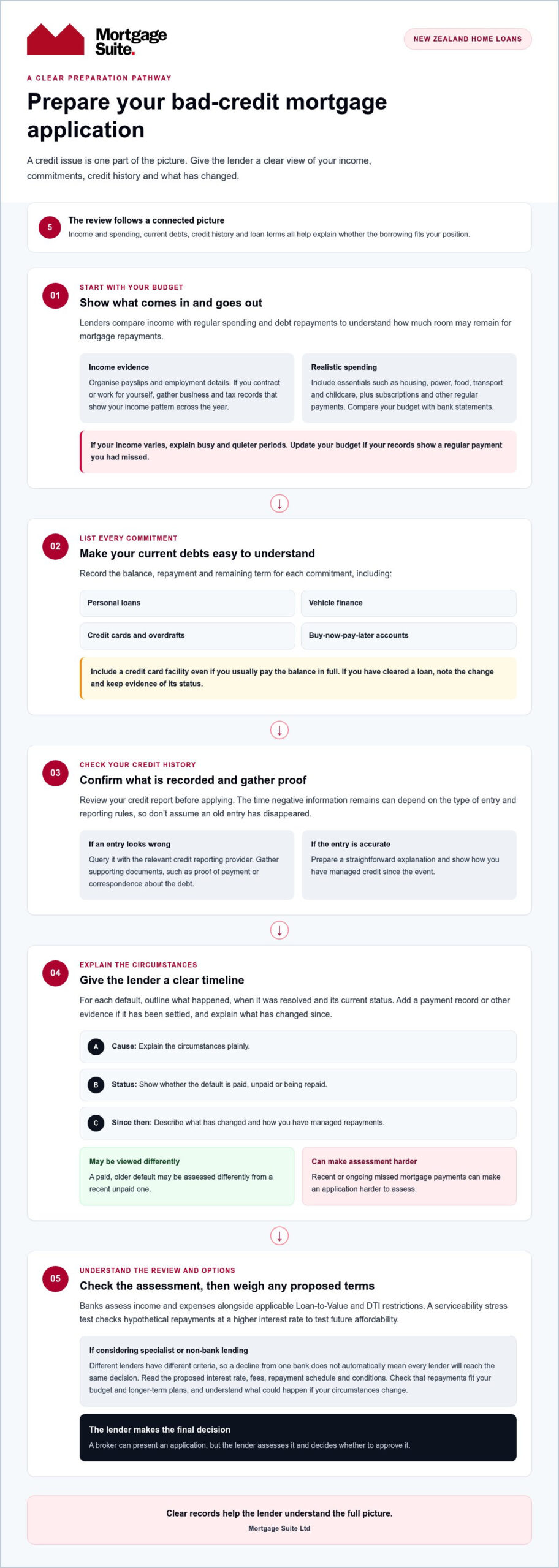
A lender compares your income with regular spending and debt repayments to assess how much room remains for a mortgage. The aim is to understand your household budget, not just your salary. For example, two applicants with similar incomes may have different borrowing capacity if one supports dependants or has higher regular commitments.
Show where your income comes from and how reliably it arrives. Employed applicants can organise payslips and employment details. If you earn through contracting or self-employment, gather business and tax records that show your income pattern across the year. A seasonal earner, for example, can distinguish a busy period from quieter months, helping the lender understand typical income rather than an unusually strong week.
Build a realistic record of household spending before applying. Include regular essentials such as housing, power, food, transport and childcare, as well as subscriptions and other recurring payments. Compare your bank statements with your budget. If your records show a sports fee or childcare payment you left out, update the budget rather than relying on an estimate that understates your commitments.
List every current credit commitment, including personal loans, vehicle finance, credit cards, overdrafts and buy-now-pay-later accounts. Record each balance, repayment and remaining term. A credit card limit can matter even if you usually pay the balance in full, so include the facility, not just the amount currently owed. If you’ve recently cleared a loan, note the change and keep evidence of its status.
The Reserve Bank’s current Loan-to-Value and DTI restrictions apply to banks’ residential lending in New Zealand. These restrictions sit alongside a bank’s assessment of your income and expenses. A serviceability stress test assesses hypothetical repayments at a higher interest rate to test future affordability. It considers how the proposed repayments fit your budget under that assessment.
Before applying, prepare a simple monthly budget and compare it with your account activity. Highlight variable income, one-off expenses and debts nearing repayment. If you’re already struggling to meet mortgage payments, contact your lender as early as possible. A clear summary of what you can afford and where you’re under pressure gives the lender useful context for discussing your position.
Lender assessment of credit history and defaults
For a bad-credit application, prepare identification, income evidence, bank statements, debt details and records showing the status of any default. How long negative information remains on a New Zealand credit report depends on the type of entry and reporting rules.
Lender options for bad-credit borrowers
Mainstream banks and non-bank lenders assess home loan applications against their own criteria. A decline from one bank doesn’t automatically mean every lender will reach the same decision. A lender may look closely at the cause of a default, whether it has been paid, your recent repayment history and the strength of the rest of your application.
A paid, older default may be assessed differently from a recent unpaid default. Recent or ongoing missed mortgage payments can make an application harder to assess. Explain clearly what happened, when you resolved it and what has changed since. Where applicable, include a payment record or other evidence that the default is settled.
Non-bank or specialist lending may provide another route when a mainstream bank’s criteria don’t fit your circumstances. Read the proposed loan terms carefully, including the interest rate, fees, repayment schedule and any conditions. Consider whether repayments remain manageable and how the loan fits your longer-term plans. A mortgage broker can present an application, but the lender makes the final decision after assessing it.
How long negative credit information remains
There isn’t one timeframe for every type of negative entry on a New Zealand credit report. The entry type and reporting rules affect how long information remains visible, while lenders may weigh an older paid default differently from a recent unpaid one. Don’t assume an old entry has disappeared; review your report before applying.
If you believe an entry on your credit report is wrong, contact the relevant credit reporting provider to query it. Gather supporting documents, such as proof of payment or correspondence about the debt. If the information is accurate, prepare a straightforward explanation and show how you’ve managed credit since the event. This gives the lender context instead of leaving a negative entry unexplained.
Organise your application documents into clear groups: identity, income, regular spending, current debts and credit history. Include a short timeline for each default, covering the original issue, any repayment arrangement and its current status. If circumstances contributed to missed payments, explain them plainly and show what has changed. Consistent records help the lender compare your explanation with the information in your application.
With specialist lending, consider the whole arrangement, not only whether an application can proceed. Check how repayments are structured, whether the terms suit your income pattern and what could happen if your circumstances change. Make sure you understand all fees and conditions before committing. Comparing proposed repayments with your household budget can help you judge whether the loan is sustainable.
Property value and home equity
There isn’t one deposit amount that suits every bad-credit home loan application. The deposit depends on the property value, the amount borrowed and the lender’s assessment of your application. A larger contribution can reduce the amount you need to borrow, but lenders also consider whether repayments fit your finances and how your credit history affects the application.
The property matters because it secures the mortgage. The lender considers its value alongside the loan amount, rather than relying only on the price you hope to pay. If the lender’s valuation is below the purchase price, you may need to reconsider your contribution or the property you’re considering.
Home equity is the property’s value minus the debt secured against it. For example, a New Zealand property worth NZ$800,000 with a NZ$500,000 mortgage has approximately NZ$300,000 in equity before other costs or secured debts. This is an estimate, not necessarily money you can freely use for another purpose.
Other lending secured against the property can reduce the equity available. If you’re relying on an existing home, list each secured debt and use current balances, not the original loan amounts. For example, a separate loan secured against the same property must be considered alongside the mortgage when assessing the overall position.
A lender’s valuation can differ from your estimate. The property’s condition, features and sale evidence may affect its assessed value. If the valuation is lower than expected, you may need to adjust the loan request. That can affect the deposit you need to contribute, so leave room to revisit your figures before committing to a purchase.
The Reserve Bank’s current Loan-to-Value restrictions apply to banks’ residential lending in New Zealand. These restrictions limit how much a bank can lend compared with a property’s value. They form one part of the assessment, alongside the bank’s own criteria and your financial position. Non-bank lenders assess applications under their own criteria.
Before applying, write down the property’s estimated value, proposed mortgage, deposit or available equity, and any debts secured against the property. Keep the figures separate and identify which funds are available for the purchase. If your credit history includes a default, explain it accurately. Equity can support the security assessment, but it doesn’t replace the lender’s review of your finances.
Steps to improve a mortgage application
A clear application helps lenders understand your finances and credit history. Focus on accurate records, manageable debt and a straightforward explanation of past issues.
Strengthening a mortgage application
Strengthening an application means making your financial position easier to assess before you apply. Complete, consistent information helps a lender understand your current repayment habits alongside earlier credit problems.
- Avoid unnecessary credit applications, which can add new enquiries to your credit history.
- Pay existing bills and debt repayments on time, and keep records showing your payment history.
- List every debt and credit facility accurately, including balances and repayment commitments.
- Explain any default clearly, including whether it has been paid and what changed afterwards.
Check that your application, bank statements and supporting documents tell the same story. If you’ve cleared a debt, for example, include evidence of its current status rather than relying on memory. If your income or spending has changed, explain when and why. A short, factual explanation is more useful than leaving a lender to interpret a gap or mismatch.
Review your recent account activity before applying. Regular unarranged overdraft use or missed payments may prompt questions about how you manage repayments. Avoid taking on new debt while preparing your application, and keep your spending records up to date. These steps won’t erase past credit events, but they can show how you manage your finances now.
Checking and correcting a credit report
Reviewing your credit report means checking the information held about your borrowing and repayment history. Before applying, look for errors, unfamiliar accounts and debts recorded with the wrong status. If you believe an entry is incorrect, contact the relevant credit reporting provider to query it.
Compare each entry with your records, such as account statements, payment confirmations and correspondence about a debt. Note the creditor, account details and what you believe is wrong. Send the provider evidence supporting your query, and keep copies of your request and any response.
If the entry is accurate, prepare a brief explanation for the lender rather than disputing it. Include the circumstances, whether the debt has been paid and any steps taken to prevent a repeat. For example, explain how a repayment arrangement brought an overdue account up to date, if applicable. Keep your explanation consistent with the dates and documents in your application.
After reviewing your report, update your application documents to reflect any corrected information. Keep the provider’s response with your records so you can explain a change if the lender asks about it. Avoid applying for several new credit facilities while you prepare. A tidy, consistent file gives a clearer picture of your current position.
Which New Zealand banks and non-bank lenders offer home loans to borrowers with bad credit?
There isn’t one fixed list of New Zealand lenders that accepts every bad-credit application. Banks and non-bank lenders assess applications using their own criteria, so the decision depends on your full financial picture, not just the type of lender.
A mainstream bank may assess your income, debts, credit history, deposit and property security together. If one bank declines, that doesn’t automatically determine how another lender will view your circumstances. For example, an older paid default and a recent unpaid default may be assessed differently.
Non-bank lenders may be another option when a bank’s criteria don’t suit your application. They still assess whether repayments are manageable and whether the property supports the lending. Their criteria and loan terms can differ, so compare the whole arrangement rather than focusing only on whether an application can proceed.
Before approaching a lender, organise a clear summary of:
- Your income sources and regular household spending.
- Every current debt, repayment and credit facility.
- Any default, including its status and what has changed since.
- The property value, deposit or available equity.
This helps show how your current position addresses the concerns behind an earlier decline. If the issue was a default, include evidence of payment where relevant. If existing debt affected affordability, show the current balances and repayments. The lender can then assess your application against its criteria using up-to-date information.
Compare the proposed interest rate, fees, repayment structure and loan conditions. A lower advertised rate doesn’t necessarily mean refinancing will reduce the overall cost. Refinancing expenses can include interest, loan fees, legal costs, valuation costs and break costs on an existing fixed-rate loan. Include these in your comparison before deciding whether a new loan suits your plans.
A non-bank or specialist loan may have different terms from a mainstream bank’s offer. Read the repayment schedule and conditions, and consider whether payments remain manageable if your income or expenses change. A repayment that fits today’s budget, for example, may feel different after a change in work hours or household costs.
To narrow your options, prepare one complete, accurate application rather than making unnecessary credit applications to several lenders. Explain the reason for the credit issue, what has improved and how the proposed repayments fit your budget. Different criteria may offer another route, but each lender makes its own assessment.
Mainstream banks and non-bank lenders may both consider home loan applications from borrowers with bad credit. Which lender may suit you depends on its criteria and your full financial picture.
Mortgage Suite: Home Loans to First Home Buyers
Mortgage Suite Ltd can help you explore Home Loans to First Home Buyers if your credit history has made the next step feel uncertain. A mainstream bank’s decision isn’t the whole picture: your income, debts, deposit and property plans all help shape an application.
Bring together your credit report, details of any defaults, income records and a clear summary of your current debts. Mortgage Suite Ltd can help you understand how these pieces fit together and discuss home loan options suited to your circumstances. The aim is to clarify your position and help you consider the lending structure, repayments and longer-term plans, rather than focusing on one headline rate.
If you’re ready to discuss your first-home application, contact Mortgage Suite Ltd to talk through your next steps.
Take your next step with a clear plan
A credit setback can make planning a home purchase feel daunting, but it doesn’t define every future lending conversation. Use your next step to understand what a lender may need to see and whether your plans fit your current financial position.
For mortgage approval with bad credit in NZ, focus on presenting your circumstances clearly and choosing a loan structure that remains workable over time. Mortgage Suite Ltd can discuss Home Loans to First Home Buyers, Residential Investment property loans and Business Loans, depending on the purpose of your borrowing.
A lender makes the final decision after assessing your application, so approval isn’t guaranteed. A thoughtful conversation can still help you identify what to prepare and which questions matter for your next move.
Contact Mortgage Suite Ltd to discuss your borrowing plans and take the next step with a clearer picture of your options.
Frequently Asked Questions
Can you get mortgage approval in New Zealand with bad credit?
Yes, it may be possible, because lenders assess applications using their own criteria and consider more than a credit entry. They may weigh the type and status of the issue alongside your current finances and the property securing the loan. A recent unpaid default differs from an older paid one. The lender makes the final decision after reviewing your application, so approval isn’t assured.
What credit score do NZ mortgage lenders require?
There isn’t one credit-score number that guarantees mortgage approval in New Zealand. Lenders use their own criteria, and a score is only one part of the information they may consider. They also assess the details behind negative entries, your current financial position and the property. If you’re unsure what appears on your file, review your credit report before applying and query any information you believe is incorrect.
How do missed payments, defaults, debt collection, and bankruptcy affect a NZ mortgage application?
Missed mortgage payments, defaults, collection activity and bankruptcy can all prompt closer scrutiny of your credit history. Recent or ongoing missed mortgage payments can make refinancing more difficult. A lender may assess an older paid default differently from a recent unpaid one. For debt collection or bankruptcy, be ready to explain the circumstances and provide accurate records of the current status. Don’t leave unresolved entries unexplained.
How can you improve your chances of mortgage approval with bad credit in New Zealand?
Prepare before applying: review your credit report, query any incorrect entry with the relevant reporting provider and avoid unnecessary credit applications. Make sure your explanation of past problems matches the dates and status in your documents. If your situation has changed, describe how, such as a debt being paid or income becoming more consistent. A complete, accurate application helps lenders assess your current position.