
Refinance Commercial Property NZ: The 2026 Guide to Better Business Rates
Is your current bank acting as a partner in your growth, or are they more like a silent landlord taking a massive cut of your monthly profits? For many business owners across New Zealand, high interest repayments are doing more than just tightening the belt; they’re actively stalling expansion plans. If you feel like your lender has become too restrictive or simply isn’t listening, it’s time to realise that you don’t have to stay settled in a loan that no longer serves you. Learning how to refinance commercial property NZ is often the single most effective way to reclaim your cash flow and put your equity back to work.
It’s completely normal to feel a bit overwhelmed by the technical side of switching lenders, especially with the 2026 market shifts and the growing range of non-bank options. We’re here to help you cut through the confusion and find a path that actually fits your business cycle. In this guide, you’ll discover how to slash your interest costs, unlock hidden equity for your next big move, and decide whether a mainstream bank or a flexible non-bank lender is your best bet. We will walk you through the latest interest rate trends and the exact steps to secure terms that give your business the breathing room it deserves.
Key Takeaways
- Discover why the current 2026 market environment provides a great opportunity to lower your monthly repayments and boost your cash flow.
- Learn how to unlock the hidden value in your buildings to fund new equipment, hire staff, or fuel your next business expansion.
- Understand the simple steps to refinance commercial property NZ so you can find a lender that actually works with your business cycle.
- Get a clear list of the paperwork you’ll need to organise to make your application as smooth and stress-free as possible.
- Find out how a seasoned expert can handle the tough negotiations with lenders to secure the better rates and terms you’re after.
Why Refinance Commercial Property in NZ During 2026?
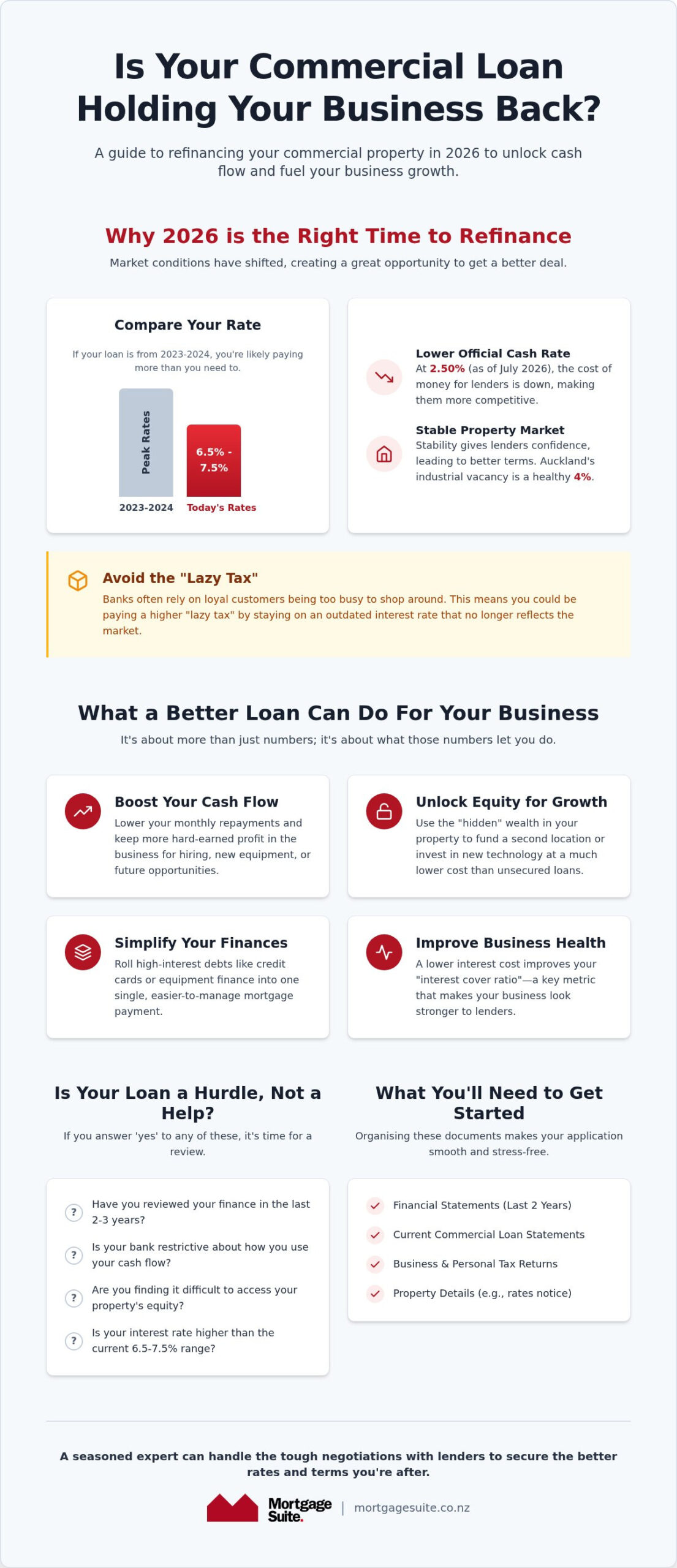
Refinancing isn’t nearly as complex as the banks make it sound. In plain English, it’s simply the process of replacing your existing Commercial mortgage with a new one that offers better terms, lower costs, or more flexibility. Many business owners fall into a “loyalty trap,” believing their long-term bank will automatically give them the best deal because of their history. In reality, banks often rely on you being too busy to look elsewhere. This leads to what we call a “lazy tax,” where you stay on an interest rate that’s significantly higher than what a new lender would offer to win your business.
The current environment makes 2026 a particularly smart time to refinance commercial property NZ. With the Official Cash Rate (OCR) sitting at 2.50% as of July 2026, we’ve seen commercial interest rates settle into a range of 6.5% to 7.5%. If your current repayments are based on the peak rates of previous years, you’re likely overpaying. The Reserve Bank’s shift toward easing monetary policy means the “cost of money” for lenders has dropped, and they’re now competing much harder to get healthy businesses onto their books.
Is Your Current Commercial Loan Outdated?
If you haven’t reviewed your finance in the last two or three years, your loan is probably out of step with your business needs. Loans from 2023 or 2024 were often written under much stricter conditions and higher stress test rates. Today, you might find that a floating rate gives you more flexibility to make lump sum payments, or a fixed rate could lock in a much lower cost than you’re currently paying. If your bank is being restrictive about how you use your cash flow or making it difficult to access your own equity, it’s a clear sign your mortgage has become a hurdle rather than a tool for growth.
The 2026 NZ Market Outlook
New Zealand’s commercial market is currently in a recovery phase after the slowdown of previous years. While some sectors are still finding their feet, industrial properties are showing real strength, with Auckland’s vacancy rate rising slightly to 4% as of August 2026. This stability gives lenders more confidence to offer better terms to borrowers. When property values stabilise, your loan-to-value ratio often improves, making you a “safer” bet for a new lender. This shift in the market opens the door to better rates and more flexible terms that weren’t available when the market was more volatile.
The Biggest Perks: Better Cash Flow and Unlocking Your Equity
Refinancing isn’t just about moving numbers from one bank to another. It’s about what those numbers allow you to do with your day-to-day operations. When you refinance commercial property NZ, the most immediate win is often a significant boost to your cash flow. By moving from the higher rates of previous years to the 2026 market averages, which currently sit between 6.5% and 7.5%, you can keep more of your hard-earned profit inside the business. This extra cash isn’t just a “saving”; it’s capital you can use to hire a new manager, upgrade your fleet, or build a buffer for future opportunities.
Another strategic move is debt consolidation. If your business has accumulated high-interest debt through credit cards or short-term equipment finance, you can often roll these into your commercial mortgage. This simplifies your life with one easy-to-manage payment and slashes the amount you’re losing to interest. Additionally, lowering your interest costs improves your “interest cover ratio.” This is a key metric lenders use to judge your business health, and a stronger ratio makes you look much more attractive if you ever need to borrow more or decide to sell the business later on.
Unlocking Equity for Business Growth
Equity is simply the difference between what your building is worth and what you still owe the bank. As property values have stabilised in 2026, many owners are finding they have a “hidden” pool of wealth sitting in their bricks and mortar. Instead of taking out expensive unsecured business loans, which often come with high rates and short payback periods, you can use this equity to fund your next big move. It’s a far more affordable way to grow. For example, we’ve seen businesses use their property equity to fund a second location or invest in new technology without the stress of high-interest repayments. If you’re curious about your own position, it’s a good idea to explore your options with someone who knows the market inside out.
Managing Your Monthly Repayments
Sometimes, the best way to support your business cycle is to change how you pay. Switching from a standard principal and interest loan to an interest-only period can give you massive relief during a growth phase or a quiet season. You might also consider extending your loan term. While this means you’ll pay more interest over the life of the loan, it can drastically lower your monthly bills right now, giving you the breathing room you need to focus on expansion. You can see exactly how these changes might look for your budget by using our mortgage calculator to model different scenarios.
Mainstream Banks vs. 2nd Tier Lenders: Why Your Current Bank Might Not Be the Best Fit
Most business owners in New Zealand naturally head to the “Big Four” banks when they want to refinance commercial property NZ. It makes sense on the surface; you likely have your everyday accounts there and a long history. However, mainstream banks often operate like giant machines with very rigid settings. If your situation doesn’t fit their exact mould, they’ll simply say no. This is usually because their systems are designed for simple, predictable income, which isn’t always the reality for a thriving, growing business.
This is where 2nd tier lenders come in. Think of them as the specialised alternative to the big banks. They aren’t “lesser” lenders; they just have different rules. While a big bank might decline you because your latest tax return shows a dip due to a one-off expansion cost, a 2nd tier lender will look at the bigger picture. They’re often funded by private investors or smaller institutions, allowing them to be much more flexible and pragmatic about who they lend to and why.
When the Big Banks Say No
Banks often decline perfectly healthy businesses for reasons that have nothing to do with your ability to pay. It could be that they’ve already reached their “quota” for commercial loans in your specific industry, or perhaps they’re worried about a slight fluctuation in your cash flow. Fixing these issues often requires “bank talk” that most business owners don’t have time for. With over 20 years of experience inside the banking system, I know exactly what these lenders are looking for and how to present your case to find a “yes.” If the big banks aren’t playing ball, it’s often a sign you need to look at our guide on 2nd tier lenders in New Zealand to see what else is possible.
The Benefits of a Non-Bank Commercial Loan
Non-bank lenders are built for speed and common sense. They don’t have the massive layers of red tape that slow down mainstream approvals. If you need to move quickly to secure a new opportunity, a non-bank lender can often provide an answer in days rather than weeks. They are also much friendlier toward self-employed people. If your books aren’t “bank perfect” but your business is solid, they offer flexible income verification that focuses on your actual cash flow today. While their interest rates might be slightly higher than a bank’s “teaser” rate, the ability to actually get the money and use it to grow your business often far outweighs that small difference in cost.
Sometimes, paying a fraction more in interest to a flexible lender is the smartest move you can make. It allows you to bypass restrictive bank conditions that might be holding your business back. Once your business has reached its next milestone, we can always look to move you back to a mainstream bank later on. It’s all about having a strategy that fits where your business is right now.
How to Get Sorted: A Simple Checklist for Your Commercial Refinance
Success in a refinance isn’t just about finding a lower rate; it’s about preparation. If you walk into a meeting without your “paperwork ducks” in a row, you’re giving the lender a reason to say no or offer you less favourable terms. To refinance commercial property NZ effectively, you need to show the lender that your business is stable and your property is a safe bet. This starts with a clear understanding of your current financial position and the strength of your tenants.
- Organise your financials: You’ll generally need two to three years of clean financial statements. Lenders want to see consistent profit and your ability to cover the new repayments easily.
- Review your leases: The quality of your tenants and the length of their remaining lease matter immensely. A long-term lease with a reputable business makes your property much more attractive to a bank.
- Check your valuation: Most lenders will require an independent valuation that is less than six months old. In the 2026 market, where values have stabilised, an up-to-date report is essential to prove your equity.
- Compare the market: Don’t just take the first offer. Use a specialist who can shop your deal around to both mainstream banks and 2nd tier lenders.
The Paperwork You Actually Need
Lenders are looking for a clear narrative of your business success. They’ll scrutinise your profit and loss statements and balance sheets to ensure your cash flow is healthy. However, they also look at your lease details. They want to know who is paying the rent, how long they’ve been there, and when their lease expires. If you’re self-employed, showing a clear distinction between your personal income and business expenses helps the lender see the full picture. Providing this information upfront makes you look professional and organised, which builds trust with the credit team.
The Valuation Hurdle
A commercial valuation is far more detailed than a residential one. It’s not just about the building’s size; it’s about the income it generates. To get the best result, ensure your property is well-maintained and all maintenance records are ready for the valuer to see. Small improvements to the building’s appearance or energy efficiency can sometimes lead to a better valuation result in today’s quality-focused market. For more practical tips on getting your building ready for inspection, you can explore our Mortgage School. If you’re ready to see what better rates look like for your business, you can get in touch with us today to start the comparison process.
How Mortgage Suite Makes Your Refinance Easy and Stress-Free
Refinancing can feel like a second full-time job, and you already have one of those. When you decide to refinance commercial property NZ, you shouldn’t have to spend your evenings deciphering bank policies or your mornings chasing up loan managers. We act as your dedicated advocate, taking the stress out of the process and making sure the lenders are working for you, not the other way around. Our goal is to handle the heavy lifting so you can stay focused on what you do best: running your business.
Our approach is built on 20 years of inside banking knowledge. Krish Krishna, our founder, has spent two decades seeing how the big banks make their decisions from the other side of the desk. This experience is your secret weapon in negotiations. We know the “bank talk” and the specific requirements that get a deal over the line. Whether it’s a mainstream bank or one of New Zealand’s flexible 2nd tier lenders, we search across the widest possible range of options to find the terms that actually fit your business goals.
A Personal Touch in a Corporate World
We believe in a personal touch in what can often feel like a very cold, corporate industry. Every business is different, and we take the time to understand your specific story before we start talking to lenders. You can read our latest reviews to see how we have helped other Kiwi business owners find a better path forward. To us, you’re not just a loan application; you’re a partner. If you want to learn more about us and our passion for NZ business, we’re always happy to share our background and philosophy.
Your Next Steps to a Better Deal
Getting started is simple and completely stress-free. We offer a “no jargon” promise, which means we’ll explain every option in plain English so you can make a decision with total confidence. With the 2026 market showing signs of stability and lenders eager for quality business, now is the perfect time to review your position before rates shift again. A quick, no-obligation chat is all it takes to see if we can put more cash back into your pocket. We’ll look at your current situation, listen to your plans for growth, and give you a clear, honest assessment of what’s possible.
Take Control of Your Business Growth Today
Choosing to refinance commercial property NZ is about much more than just chasing a lower percentage. It’s a strategic move to reclaim your cash flow and secure the flexibility your business needs to thrive in this 2026 market. You now understand how current interest rates and the rise of flexible non-bank lenders have completely changed the landscape. By breaking free from the “loyalty trap” and looking beyond mainstream banks, you can finally unlock equity that might otherwise sit idle.
At Mortgage Suite, we bring over 20 years of banking and finance experience to every negotiation. We provide a national service across all of New Zealand with a personal touch that big institutions often lack. We are specialists in finding solutions when banks say no, ensuring you get terms that actually fit your business cycle. Ready to see how much you could save? Chat with our commercial experts today. Taking that first step is the best way to ensure your property is working as hard as you are.
Frequently Asked Questions
How much does it cost to refinance a commercial property in NZ?
Refinancing involves a few different costs, including establishment fees, legal fees, and valuation charges. Some banks charge up to 1.00% of the total loan amount as an establishment fee, though this can vary between lenders. You’ll also need to pay for a solicitor to handle the title transfer and mortgage registration. While these costs are upfront, the monthly savings from a better interest rate usually cover these expenses within the first year.
Can I refinance my commercial property if I have bad credit?
Yes, you can still find competitive options, but you’ll likely need to work with a 2nd tier or non-bank lender. These specialists focus more on your property’s value and your current business cash flow rather than just your past credit score. This approach allows you to refinance commercial property NZ and move forward with your plans while you take the time to rebuild your credit profile with a more flexible partner.
How long does the commercial refinancing process usually take?
A standard refinance typically takes between four to eight weeks from your first enquiry to the final settlement. This timeline depends on how quickly you can gather your financial statements and how fast an independent valuer can visit your property. If you’re in a hurry to secure a new opportunity, some non-bank lenders can provide an initial approval in just a few days, which significantly speeds up the earlier stages of the process.
What is the maximum I can borrow against my commercial property?
In the current 2026 market, most lenders will allow you to borrow up to 70% of the property’s value for existing buildings. This means you generally need at least 30% equity or a deposit. If you’re looking at a new build, some lenders might increase this to 80%. It’s also important to remember that since July 2024, debt-to-income rules generally cap your total borrowing at seven times your annual income.
Do I need a new valuation to refinance my business property?
Almost every lender will require a fresh, independent valuation that is less than six months old. This ensures the bank is lending against the actual market value today rather than an outdated figure. Because commercial property values are closely tied to lease terms and market yields, this report is a vital tool for lenders to assess their risk. We can help you organise this through the lender’s approved list of valuers.
Is it worth refinancing if I have a fixed-rate mortgage with a break fee?
It often is, but it depends on how much you’ll save over the long run. A break fee is the bank’s way of covering the interest they lose when you leave a fixed term early. If the new interest rate is significantly lower than your old one, the monthly savings might pay back that fee within a few months. We can help you run the numbers to see if the switch makes sense.
Can I use the equity from my commercial property to buy a home?
You certainly can, and many business owners use this strategy to grow their personal wealth. By using the equity in your commercial building as a deposit, you can often secure a residential property without needing a massive cash sum. This is a smart way to make your business success work for your family. We specialise in structuring these loans to ensure your business and personal assets are handled correctly.
What is the difference between a bank and a 2nd tier lender for commercial property?
Mainstream banks have very strict rules and prefer simple, low-risk loans. 2nd tier lenders are much more flexible and are willing to look at the “human story” behind your business. When you refinance commercial property NZ with a 2nd tier lender, you’ll often find they have less red tape and faster approval times. They are an excellent choice if your situation doesn’t fit the standard bank mould or if you’re self-employed.