
Subdivision Finance NZ: How to Fund Your Property Development in 2026
What if the most valuable asset you own isn’t the house you’re living in, but the patch of grass sitting right behind it? Many Kiwis realise they’re sitting on a goldmine, yet the path to actually tapping into that wealth feels blocked by a wall of red tape. It’s frustrating when you have a solid plan, but mainstream banks turn you away because their lending boxes are just too small for your unique project.
We understand that the high upfront costs for consultants and the uncertainty of new planning laws can feel overwhelming. You deserve a clear, stress-free path to making your development a reality. This guide is designed to help you master subdivision finance NZ by showing you how to secure funding that covers both your land and construction costs. We’ll explore why non-bank lenders are often the better partner for these projects in 2026, especially with the recent shift to the Planning Bill and Natural Environment Bill. You’ll learn exactly how much equity you need and how to choose a loan that works for your specific goals, moving you from a simple idea to a finished title.
Key Takeaways
- Understand how specialised loans cover everything from council fees to physical site works, ensuring no part of your project is left unfunded.
- Learn how to use staged payments to manage your cash flow effectively while your land is being divided.
- Discover why non-bank lenders often offer more flexibility than mainstream banks when you are looking for subdivision finance NZ.
- Get a clear roadmap for your project, starting with a feasibility report to ensure your development is actually profitable.
- Find out how a professional advocate can navigate the lending market for you, removing the stress of dealing with rigid bank criteria.
What Exactly is Subdivision Finance in NZ?
Think of subdivision finance as a specialised toolkit for your property. While a normal mortgage helps you buy a home, this type of funding is specifically built to help you split one title into two or more. It is a flexible funding tool for unlocking land value by turning a single plot into multiple profitable assets. When you look into subdivision finance NZ, you’ll quickly find it covers far more than just the dirt. It needs to account for “soft costs” like council fees and “hard costs” like the physical civil works required to get the land ready for building.
Mid-2026 has become a unique time for property owners across the country. With the Natural Environment Bill and the Planning Bill replacing the old Resource Management Act, the rules around What is land subdivision have shifted. These new laws are designed to speed up the process and cut down on the compliance costs that used to make projects drag on for years. For many Kiwis, this change has opened a window of opportunity to develop land that might have been too difficult to touch in the past.
Why a Standard Home Loan Usually Isn’t Enough
Standard home loans are built for stability. Banks like to see a house that is already finished so they have something solid to secure their money against. When you start a subdivision, you’re essentially asking them to lend on a promise of what the land will become. Most mainstream banks are quite rigid here. They want to see high regular income today, rather than the profit you’ll make in twelve months’ time.
This is why you need a loan structure that allows for progressive drawdowns. Instead of getting a lump sum, your lender releases money in stages as you reach specific milestones. This might be when the council signs off on your plans or when the driveway and services are installed. Using the equity in your existing property is often the best way to kick things off, providing the initial deposit needed to get the ball rolling.
Common Costs You Need to Fund
Budgeting for a project involves more than just paying a surveyor. You need to fund the “big three” expenses: council contributions, civil engineering, and legal fees. Council fees alone can be a significant hurdle, often requiring payment before you even get your new titles. Civil works, such as connecting power, water, and sewerage, are the physical backbone of your project and usually require the largest slice of the budget.
Having a contingency fund in your finance package is non-negotiable. Unexpected issues under the ground can pop up at any time, and having a buffer ensures your project doesn’t grind to a halt. If you want to see where you currently stand, you can use our mortgage calculator to estimate your equity. It’s a great first step to see if you have enough “skin in the game” to secure the subdivision finance NZ you need to move forward.
How Subdivision Funding Works: The Practical Side
Getting your head around the mechanics of subdivision funding is easier than you might think. Most projects start with a simple refinance of your existing land to secure subdivision finance NZ. This allows you to tap into the value you’ve already built up in your property. From there, the money is released in stages. This milestone-based approach ensures that you only pay interest on the money you’ve actually spent. It’s a disciplined way to keep your project on track and within budget.
Lenders are primarily interested in the “end value” of your project. This is the total market price of the new sections once the titles are officially registered. To feel confident, a lender needs to see how they will get their money back. Whether you plan to sell the lots or keep them as investments, having a clear exit strategy is vital. This process is underpinned by New Zealand’s Property Law Act 2007, which provides the legal structure for property ownership and security in our market.
Equity vs. Cash: What Do You Need to Bring?
In the 2026 market, lenders want to see that you have a personal stake in the project. Banks typically require a developer contribution of 30% to 40%, but second-tier lenders are often more flexible, sometimes accepting as little as 20%. You don’t necessarily need a pile of cash sitting in a savings account. Many of our clients use the equity in their current home to fund the civil works and council fees. If your goal is to hold onto the finished properties, you’ll eventually transition to Residential Investment Property Loans NZ once the new titles are issued.
Interest Rates and Fees in the Subdivision Space
It is common to see interest rates for subdivision finance NZ that are higher than your average home loan. In 2026, these rates often sit between 9% and 16% for private funding. While that might seem high at first glance, remember that these are short-term loans designed to get you to the finish line. Most developers choose “capitalised interest,” which means you don’t have to worry about monthly repayments during the construction phase. The interest is simply added to the loan and settled at the end. When you look at the total profit potential of your land, the interest cost is usually just a small investment to unlock a much larger reward. If you’re unsure how these numbers stack up for your specific site, talking to a specialist can help clarify your options.
Mainstream Banks vs. 2nd Tier Lenders: Why the Bank Might Say No
Banks are often the first port of call for many, but they can be incredibly rigid. They prioritise your current regular income over the potential profit of your project. If your salary doesn’t meet their strict formulas, they’ll likely say no, even if you’re sitting on a goldmine. This is why many successful developers look for subdivision finance NZ outside of the big four banks. 2nd tier lenders take a different approach. They focus on the strength of the deal and the quality of the asset rather than just your payslip.
There is a common myth that non-bank lenders are only for people with poor credit history. That’s simply not true. Most people using these lenders are savvy investors who need speed and flexibility that a traditional bank can’t provide. In 2026, a mainstream bank might take 8 to 16 weeks to approve a development loan. A non-bank lender can often get the green light in 4 to 8 weeks. When you’re navigating subdivision finance NZ, that speed can be the difference between a project that succeeds and one that stalls.
The Flexibility of 2nd Tier Lending
Alternative lenders look at what your land will be worth once it’s divided. They understand that a self-employed person or someone with a complex business structure might not look “perfect” on a standard bank application. Securing 2nd Tier Lender New Zealand funding allows you to move forward based on the future value of your property. It removes the barriers that often stop great projects before they even start.
This is where having an expert like Krish Krishna on your side makes a huge difference. With over 20 years of banking experience, he knows exactly how to “translate” your project into a language that lenders understand. He acts as a bridge between the rigid world of institutional finance and your personal goals, advocating for you at every step of the process.
When to Stick with a Bank (and When to Move)
Banks are still a good option for very simple, low-risk projects where you have plenty of extra cash and a very straightforward income. If your project has a low loan-to-value ratio and you aren’t in a rush, a bank might offer a lower interest rate that suits a slow-paced development.
However, many developers now use a “hybrid” approach. They fund the messy, high-cost construction phase with a 2nd tier lender to get the job done quickly and without the stress of bank pre-sale requirements. Once the new titles are issued and the risk is lower, they refinance back to a mainstream bank. Having a broker who understands both worlds is your biggest advantage. We help you navigate these transitions, ensuring you always have the right funding for each stage of your journey.
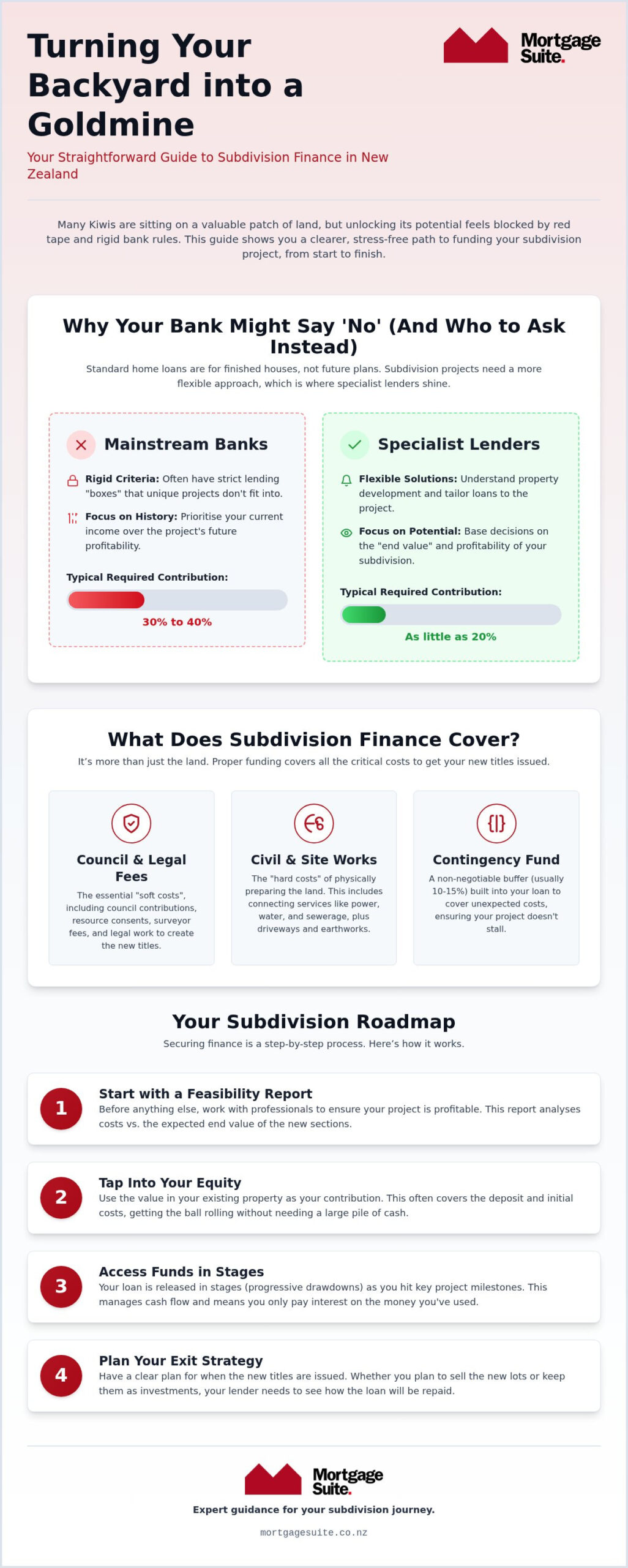
Steps to Secure Your Subdivision Finance in 2026
Securing the right funding for your project isn’t just about filling out a form; it’s about proving your project’s potential. Lenders want to see a clear path from your initial idea to the final sale or refinance. Following a structured process helps you avoid the common pitfalls that cause applications to stall. Here is how you can move from a patch of grass to a funded development project:
- Step 1: Get a feasibility report. You need to know for certain that the project actually makes money after all costs are considered.
- Step 2: Organise a registered valuation. This needs to reflect the “as-if-complete” value, showing what the land will be worth once it’s divided.
- Step 3: Prepare your “loan story.” This is where you explain who you are, exactly what you are building, and how you will pay the loan back.
- Step 4: Engage a specialist broker. Working with Mortgage Suite ensures you find a lender that actually understands subdivision finance NZ.
- Step 5: Secure your “Letter of Offer.” Once you have this in hand, you can confidently start your civil works and get the machinery on site.
The Importance of a Registered Valuation
Standard online estimates or council valuations are practically useless when you are looking for subdivision finance NZ. Lenders require a professional report from a registered valuer who understands the local zoning and the specific development potential of your site. A good valuer looks at the future value of the individual titles you are creating. This “as-if-complete” figure is what gives you the borrowing power to cover your construction costs. Getting this right can significantly increase the amount a lender is willing to provide, often making the difference between a project that’s a “go” and one that stays on paper.
Preparing Your Documentation
Lenders feel more comfortable when they see you are organised. They will want to see your resource consents, any fixed-price contracts with builders or engineers, and a realistic timeline for the works. Keeping your paperwork tidy from the start prevents frustrating delays during the approval process. If you want to dive deeper into how to prepare your application, check out our Mortgage School for more tips on getting “loan-ready.”
We believe that every developer deserves a steady hand to guide them through these requirements. If you’re ready to see what’s possible for your land, reach out to our team today for a conversational chat about your funding options.
Partnering with Mortgage Suite for Your Subdivision Journey
Choosing the right partner for your development is just as important as choosing the right builder or engineer. In a market that can sometimes feel unpredictable, having the steady hand of an expert like Krish Krishna is invaluable. We don’t just process applications; we act as your dedicated negotiators and advocates. When you are searching for subdivision finance NZ, you need a team that knows how to present your project to alternative lenders so they see the same profit potential that you do.
We take the heavy lifting of the application process off your shoulders. This allows you to focus on the actual project, whether that’s coordinating with civil contractors or managing the council requirements. While we provide national service across New Zealand, our focus is always on your specific project and your personal success. We treat your subdivision as a partnership, ensuring you feel supported from the first feasibility study through to the final title registration.
Experience That Counts
With over two decades of experience in the banking and finance industry, we’ve navigated almost every possible loan scenario. This deep institutional knowledge allows us to bridge the gap between the rigid world of traditional banking and the personal needs of individual borrowers. Our reviews reflect our commitment to client success, showing that we value long-term relationships over simple transactions. We understand the hurdles you face because we’ve spent years helping hundreds of Kiwis overcome them.
Ready to Chat About Your Land?
If you’re standing on your land wondering where to start, the best first step is a no-obligation conversation. We can help you look at the numbers and see what’s truly possible for your property. For those who are moving beyond just splitting the land and are ready to start building, our guide to Property Development Loans NZ offers a deeper look at funding the construction phase. Subdivision finance NZ is a significant step toward building your wealth, but you don’t have to do it alone. We are here to provide the expertise and the advocacy you need to turn your land into a successful development.
Ready to Turn Your Land into a New Future?
You now have a clearer picture of how to navigate the world of subdivision finance NZ. We’ve seen that while mainstream banks have their place, the real flexibility for developers in 2026 often lies with second-tier lenders who look at the deal rather than just your salary. By focusing on a strong feasibility report and a professional valuation, you can unlock the true value of your property without the usual stress.
At Mortgage Suite, we bring over 20 years of banking and brokerage experience to your project. We specialise in those 2nd tier and non-bank lending options that make projects happen, providing national coverage across New Zealand. We aren’t just here to push paper; we’re here to be your partner and negotiator to ensure you get the best possible outcome.
Talk to Krish Krishna about your subdivision project today.
Taking that first step toward subdivision is a major milestone, but with the right guidance, it’s one you can take with absolute confidence. We’re ready to help you unlock the potential in your land.
Frequently Asked Questions
Can I get subdivision finance if the bank has already said no?
Yes, you certainly can. Mainstream banks often have very narrow criteria, but second-tier lenders are far more interested in the project’s profitability and the end value of the land. If the deal makes sense and the asset is strong, we can often secure funding even if your local bank branch has turned you away. It’s about presenting your project’s potential in the right way to the right alternative lenders.
How much deposit do I need for a subdivision loan in NZ?
For most projects, you’ll need between 20% and 35% of the total project cost as a contribution. While mainstream banks often demand 40% or more for land development, non-bank lenders are generally more flexible. You don’t always need this in cash; many developers use the equity sitting in their existing home to meet this requirement. This allows you to start your project without draining all your personal savings at the beginning.
What is the difference between a 2nd tier lender and a traditional bank?
The main difference is what the lender chooses to focus on. Traditional banks are obsessed with your regular weekly income and strict formulas for how much you can afford to pay back from your salary. In contrast, a 2nd tier lender looks at the asset itself and the potential profit once the project is finished. This makes them a perfect fit for developers who have complex business structures or non-standard income.
Can I use the equity in my current home to fund the subdivision?
Yes, using your home’s equity is a very common way to kickstart a project. You can often refinance your current mortgage to release funds for “soft costs” like council contributions and legal fees. This is a strategic way to get your subdivision finance NZ moving without needing a large cash deposit. It leverages the value you’ve already built up to create even more wealth through your land development.
How long does it take to get subdivision finance approved?
Non-bank lenders are typically much faster, often providing approval within 4 to 8 weeks. In comparison, mainstream banks can take anywhere from 8 to 16 weeks to move through their rigid internal processes. Speed is vital in development to keep your contractors on schedule and avoid rising costs. Working with a specialist broker helps streamline this process, ensuring your documentation is organised and ready to go from day one.
Do I need resource consent before I can apply for funding?
You can certainly begin the application process and get an indication of interest before you have consent. However, most lenders will require a resource consent to be granted before they issue a formal offer or release any funds. Having your consent ready shows the lender that your project is realistic and has the green light from the council, which significantly reduces their risk and speeds up your final approval.
What happens if my subdivision project faces delays?
Delays are a reality of development, which is why we always recommend building a contingency fund into your budget. If your project hits a snag, having capitalised interest helps because you aren’t pressured by monthly repayments while work is stalled. The most important step is to keep your broker in the loop. We can negotiate with your lender to ensure your subdivision finance NZ remains stable while you get the project back on track.
Is subdivision finance more expensive than a regular mortgage?
Yes, interest rates for development are higher than a standard home loan, often ranging from 9% to 16% for private funding in 2026. This reflects the higher risk involved in land development compared to buying a finished house. However, because these are short-term loans, the total interest cost is usually a small fraction of the profit you’ll make. It’s an investment in unlocking the hidden value of your land.