
Using Home Equity to Buy an Investment Property in NZ: 2026 Guide
Wondering whether your home could help fund a deposit on an investment property? For Kiwis researching leveraging equity for investment property nz, it’s natural to ask how much a lender might let you borrow and whether repayments on two properties would fit your budget.
Equity is the gap between your home’s value and the amount you owe. It isn’t automatically money you can borrow. A lender will also look at your income, existing debts and ability to manage repayments if circumstances change. That can feel like a lot to weigh up, especially when different loan structures can affect how your home and investment property are connected.
This guide explains the difference between equity and borrowable funds, what lenders may assess, and how to think through the commitment alongside your household plans. You’ll also find practical steps for preparing to discuss suitable lending structures. Mortgage Suite helps clients explore residential investment property lending options based on their circumstances and goals, with advice that’s free of charge and comes with no obligation.
Key Takeaways
- Understand how home equity is calculated, and why the amount you may be able to borrow can be different from your total equity.
- Learn what information to gather before discussing whether your home could help fund an investment property deposit.
- Compare separate and combined lending structures to see how they can affect the way you track repayments and secured debt.
- Use a practical checklist to consider your goals, household finances and ability to manage repayments if rental income changes.
- Explore what leveraging equity for investment property nz could involve, with Mortgage Suite helping you consider lending options from banks, private lenders and non-bank lenders.
What does home equity mean when buying an investment property in NZ?
Using equity in your home can seem like a faster way to fund an investment property deposit than saving a separate cash deposit. But equity isn’t money sitting in your bank account, and having it doesn’t automatically mean you can borrow against it. A lender assesses your full application before deciding whether to offer additional lending and, if so, how much.
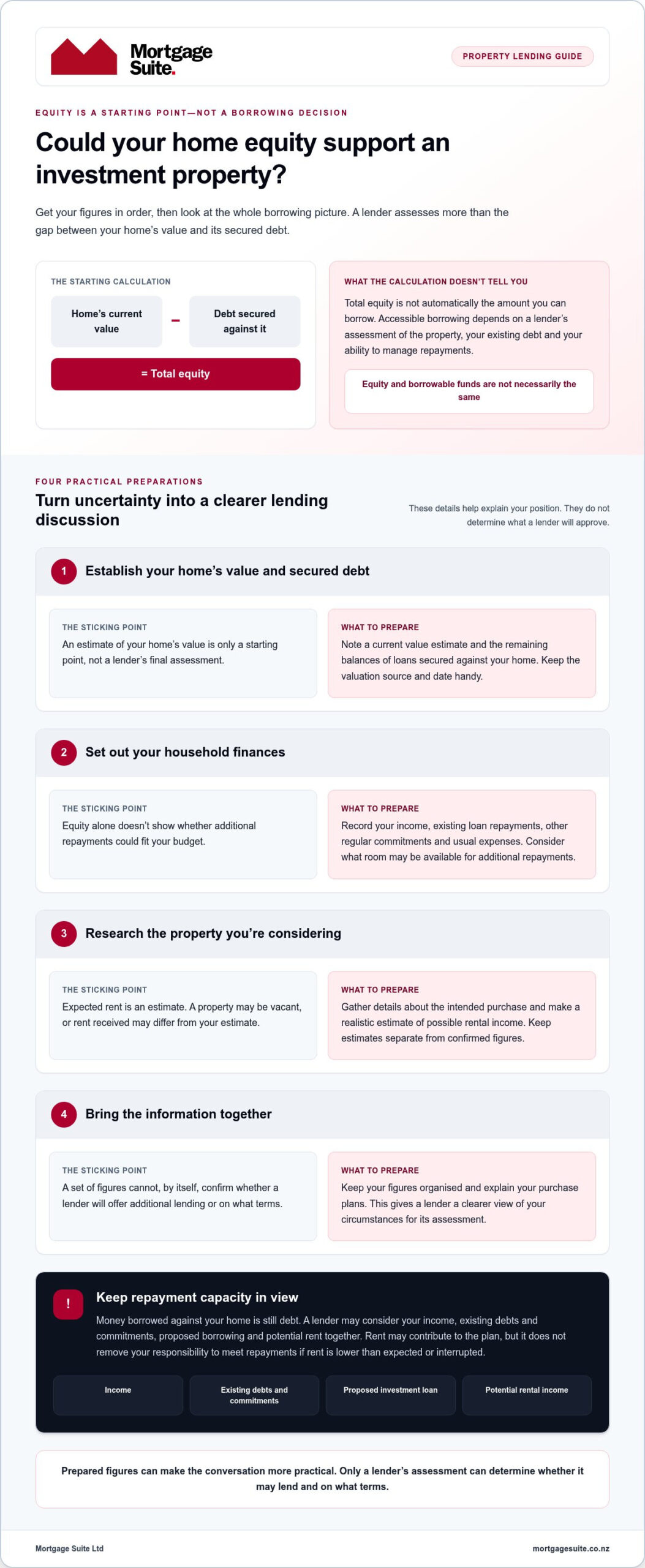
In simple terms, home equity is your property’s current value minus the debt secured against it. If your home’s value changes or you pay down the loan, the gap between those figures changes too. That gap is your total equity, not an amount you can assume is available to borrow.
How does equity build up in your home?
Each time you repay some of your loan principal, you reduce the debt secured against your home. If the property’s value rises, that can also increase the difference between its value and the loan balance. A fall in value can reduce the gap. Property values can move in either direction, so don’t build a borrowing plan around an assumed future increase.
Total equity is the difference between your home’s value and secured debt. Accessible borrowing is the amount a lender may be willing to advance after assessing the property, your existing debt and your ability to manage repayments. The two figures aren’t necessarily the same.
Can home equity help with an investment property deposit?
It may. A lender could consider providing additional lending secured against your existing home, with the borrowed funds contributing towards a deposit on an investment property. Whether this suits you depends on your circumstances and the lender’s assessment. Understanding home equity can help explain why it may support borrowing, but it doesn’t tell you how much you could access.
Keep the repayment side in view. Money borrowed against your home is still debt, even if it’s used for a deposit rather than everyday spending. You’ll need to account for the additional repayments alongside your existing home loan and any lending for the investment property. Rent may contribute to the plan, but it doesn’t remove your responsibility to meet repayments.
For example, a lender may look at your home’s value and the debt already secured against it, then consider your income, regular commitments and the proposed investment loan. The assessment covers your whole borrowing picture, not equity in isolation. If you’re considering using your home’s equity to fund an investment property, separate what you know about your home’s value from what a lender has agreed you may borrow. That gives you a clearer starting point for your next steps.
How to work out whether your home equity could support a purchase
Before making plans around a deposit, gather the figures that describe your current position. They’ll help you have a focused affordability discussion, but they won’t tell you how much a lender will approve. That decision depends on an assessment of your full application, including the proposed purchase and your ability to manage repayments.
- Start with your home’s value and secured debt. Note a current estimate of your home’s value and the remaining balances of loans secured against it. Keep the source and date of the valuation handy. An estimate is a starting point, not a lender’s final assessment of the property.
- Set out your household finances. Record your income, existing loan repayments and other regular financial commitments. Include your usual expenses so you can consider what room may be available for additional repayments.
- Research the property you’re considering. Gather details about the intended purchase and make a realistic estimate of possible rental income. Treat rent as uncertain: the property may be vacant, or the rent received may differ from your estimate.
- Bring the information together for a lending discussion. Keep your figures organised and explain your purchase plans. This gives a lender a clearer view of your circumstances, but only its assessment can determine whether it may lend and on what terms.
What figures should you gather first?
Use recent information where you can, and separate confirmed figures from estimates. Your loan balance is a current debt figure, while a rental estimate is only a guide. Note how you arrived at each figure so you can explain what you know and what still needs to be assessed. This preparation can make a conversation about borrowing against home equity more practical.
You can also use Mortgage Suite’s mortgage calculator to explore repayments. Treat any result as an estimate, not an approval or a substitute for a lender’s assessment.
How do lenders assess whether repayments are manageable?
Lenders look at your overall ability to meet repayments, not just the equity in your home. They may consider your income, existing debts and commitments, proposed borrowing and potential rent together. Rental income can inform the discussion, but it doesn’t replace your ability to manage repayments if rent is lower than expected or interrupted.
The wider assessment matters when using home equity to help fund an investment property. Lending criteria and relevant New Zealand lending settings can change, so base decisions on current requirements rather than outdated figures or assumptions.
Having your information ready doesn’t commit you to borrowing. It gives you a practical starting point to discuss your goals and options, and to understand what a lender may need to assess your application.
Compare ways to borrow against home equity, and understand the trade-offs
If you’re considering using your home’s equity, the loan structure matters as well as the amount you borrow. It can affect how you keep track of repayments and which properties are tied to the debt. When exploring leveraging equity for investment property nz, it helps to understand the basic differences before discussing options. There isn’t one structure that suits every borrower. Your circumstances, goals and the lender’s terms all matter.
Separate loan portions or combine lending?
A separate loan portion can make borrowing for different purposes easier to identify in your records. Combined lending may link borrowing across properties in a different way, depending on the lender’s terms. These are broad concepts, not promises about a particular lender’s products. Structures and conditions vary, so understand the terms of any lending you’re considering before deciding what to pursue.
| Structure | How it may work | What to consider |
|---|---|---|
| Separate loan portions | Borrowing for different purposes is kept in distinct loan portions. | This may make it easier to identify which borrowing relates to which purpose. You’ll still need to understand the repayment terms and what security applies to each portion. |
| Combined lending | Borrowing may be arranged in a way that links lending across properties, subject to lender terms. | Consider how the connected lending could affect your repayments, records and the properties secured against the debt. |
Use the comparison to frame questions rather than choosing based on the structure’s name. Find out how each option would be recorded, what repayments would apply and which property or properties would secure the borrowing. That can help you see how the arrangement fits together, including what may happen if your plans change later.
What risks should you weigh before using home equity?
Additional borrowing means additional repayments and a larger overall debt commitment. If the borrowing is secured against your home, your home forms part of the lending arrangement, so take the repayment pressure seriously. A change in household income, higher expenses or a period without rental income could make the combined commitment harder to manage.
Consider whether your household budget could still meet repayments if rent came in below your estimate or stopped temporarily. Property values and rental income aren’t guaranteed to rise or remain steady, so don’t rely on either as a sure way to cover the debt. A plan for leveraging equity for investment property nz should account for less favourable circumstances, not just the outcome you hope for.
Think, too, about how the structure could affect future plans. If you want to sell one property, change your lending or adjust repayments, the arrangement and lender terms may matter. Before proceeding, make sure you understand what is secured against each property and how you’ll manage repayments across the loans.
Using equity can form part of a purchase plan, but it doesn’t remove the need to consider affordability and security. A discussion based on your circumstances and goals can help you compare options without assuming that separate or combined lending is automatically the right fit.
A practical checklist before using equity for an NZ investment property
Before deciding whether to use your home’s equity, test the idea against your goals, household budget and comfort with extra debt. A checklist won’t tell you whether a lender will approve borrowing, but it can help you prepare for a clearer conversation and identify questions to work through first.
Check your goals and room in the household budget
Start with why you want to buy and how long you expect to hold the property. Your plans can shape what you need from the lending arrangement, so be clear about what matters to you beyond securing a deposit.
- Clarify your plans. Note why you’re considering a rental property and your expected timeframe for holding it.
- Review household finances. List regular income, expenses, existing debt and repayments, as well as any future plans that could affect your budget.
- Allow for changes. Consider whether repayments would remain manageable if household income fell, expenses increased, rent came in lower than expected or the property was temporarily without a tenant.
- Check your comfort level. Think about whether you’re comfortable adding debt secured against your home, not just whether the proposed repayments appear manageable today.
Try a few repayment scenarios before settling on a plan. The mortgage repayment calculator can help you explore estimated repayments, but it can’t predict future rental income or confirm that a lender will approve an application. Treat the results as a planning aid, not a decision.
Prepare for a lender conversation
Having useful details together can make the discussion more focused. Gather current information about your home’s estimated value and secured loans, your income and commitments, and the investment property you’re considering. Keep estimates separate from confirmed figures, especially for possible rent.
Before the conversation, write down the points you want clarified. For example:
- How could the borrowing be arranged, and what would secure each part?
- How would repayments be set up, and what flexibility might be available?
- What would happen to the lending structure if your plans changed?
- Which details or documents would the lender need to assess your full application?
Use the discussion to understand possible options and how they fit your circumstances. It doesn’t guarantee lending approval, and only the lender can decide after assessing your application. Current criteria and lending settings can also affect the outcome, so don’t treat an initial conversation or estimate as a final answer.
If you’d like support weighing up residential investment property lending and preparing your questions, talk with Mortgage Suite about your next steps. A thoughtful conversation can help you get sorted without rushing into a commitment.
How Mortgage Suite can help you explore investment property lending
Working out whether your home equity could support an investment property can bring up plenty of questions. You may be weighing up what additional borrowing could mean for your household, which lender options to explore and how the loans might be arranged. Mortgage Suite helps clients explore residential investment property lending in light of their circumstances and goals, so you can make sense of the options without being pushed towards a decision.
What happens when you discuss your borrowing goals?
The conversation starts with your plans and financial circumstances. You can talk through the property you’re considering, your existing lending and what you hope the purchase will achieve. That context helps shape a discussion about possible ways to structure the borrowing and what information a lender may need to assess your application.
Mortgage Suite works with banks, private lenders and non-bank lenders. Your adviser can explore options that may fit your situation and negotiate with lenders on your behalf. The aim is to give you clear guidance, not to promise an outcome. Any lending remains subject to the relevant lender’s assessment of your full application.
This support can help if you’re unsure how to compare different lender approaches or how an additional loan could sit alongside your current home loan. You can raise the questions that matter to you, including how the proposed borrowing fits your household plans. The discussion is tailored to your circumstances, rather than assuming one lending structure is right for every borrower.
Take a straightforward next step
You don’t need to have every detail settled before talking. Sharing what you know about your plans, income, existing commitments and property can make the first conversation more useful. If you’re still weighing up whether the added responsibility feels manageable, that’s part of the discussion too. There’s no pressure to proceed simply because you’ve asked about your options.
Mortgage Suite’s advisory service is free of charge with no obligation. Founder Krish Krishna brings over two decades of banking experience and has personally settled well over a billion dollars in residential, commercial and business loans. That experience informs a practical, client-focused approach, while each lender still makes its own decision about an application.
Take a calm first step to understand what may be possible and what to consider next. Talk through your home loan options with Mortgage Suite, with no commitment to proceed.
Take your next step with a clear plan
Before moving ahead, give yourself room to decide whether the proposed borrowing still feels workable beyond the initial purchase. Set out what you need to understand before making a commitment, such as how repayments fit your plans and what a lender’s assessment would mean for you. You don’t need every answer before starting that conversation.
Using home equity to fund an NZ investment property is a significant household decision, not just a way to put together a deposit. Take time to weigh the opportunity against the ongoing responsibility, and make sure you’re comfortable with the lending arrangement before proceeding. A discussion can help you clarify possible options without obliging you to continue.
If you’re ready to talk through your circumstances and goals, discuss your investment property lending options with Mortgage Suite. A calm, informed first step can help you decide what feels right for your next move.
Frequently Asked Questions
Can I use equity in my home to buy an investment property in NZ?
Yes, a lender may consider lending against your home to help fund an investment property deposit. The funds would be borrowed and secured as agreed with the lender, rather than coming from savings. Approval depends on your full application, including existing debt, household income and the proposed purchase. Before making an offer, clarify whether any borrowing is conditional and what steps remain before finance is confirmed.
How do I calculate the equity in my home?
Subtract the debt secured against your home from its current estimated value to get an estimate of your total equity. Check your latest loan statements and note the date and source of your property-value estimate. If more than one loan is secured against the home, account for each balance. This calculation is a useful starting point, but a lender may assess the property and borrowing differently.
Can I borrow all the equity in my home?
No, you shouldn’t assume that all your equity can be borrowed. A lender may require you to retain a margin in the property and will also assess whether the proposed repayments are manageable. The amount, if any, available to borrow depends on the lender’s criteria and your circumstances. A calculation of your home’s equity alone can’t confirm how much lending may be offered.
What happens if rental income does not cover the investment property repayments?
You’re still responsible for meeting the loan repayments, so your household budget may need to cover any shortfall. Rent may be lower than expected or the property may be empty for a period. Consider whether your income can support repayments during those times, alongside existing commitments. Build your plans around rent being uncertain, rather than relying on it to cover every repayment.
Is using home equity for an investment property risky?
It can increase your financial risk because you’re taking on more debt, and your home may secure some of that borrowing. If your income changes, repayments rise or rental income is interrupted, keeping up with the combined commitments may become harder. Property values and rental income can also change. Think through how you’d manage those situations before deciding whether the added borrowing fits your plans.
Do I need a separate loan to use home equity for an investment property?
Not necessarily. Depending on the lender and your circumstances, borrowing may be set up as a separate portion or linked with existing lending. Separate portions can make it easier to identify what borrowing relates to, while linked arrangements may connect lending across properties. Understand how repayments would be managed and which properties would secure the borrowing. The available structure and terms depend on the lender.
Can a mortgage adviser help if my bank does not offer a suitable option?
Yes. A mortgage adviser can review your goals and circumstances, discuss why your bank’s option may not fit, and explore whether another lending pathway could suit. A bank’s decision isn’t necessarily the final word on your plans, but a different lender will still assess your application and may reach its own decision. An adviser can help you understand the possibilities without promising that finance will be approved.