
Commercial construction finance Auckland: 12 month terms
Commercial refinance loan rates from alternative lenders typically range from 6.65 percent to 8.99 percent, according to market research. For short-term capital needs, bridging finance nz typically lasts for up to 12 months to cover project timelines. The decisions that shape your build are practical ones: which funding path matches your equity and site timeline, what the full cost of borrowing looks like once fees are included, and whether a short facility gives you enough room before refinance or sale.
Key Takeaways: Commercial construction finance in Auckland uses a progress-draw structure with alternative lender rates between 6.65% and 8.99% to fund projects over 12-month terms.
- Alternative lenders provide commercial refinance rates from 6.65% to 8.99% for short-term capital.
- Avoid 12-month terms unless your project timeline accounts for potential council or material delays.
- Choose non-bank lenders for faster approvals and flexible equity requirements when mainstream banks decline.
- The drawdown process involves four steps including site inspections to verify work before payment.
Match equity and timeline to a construction finance path that fits
Your equity levels and site timelines decide which lending route makes sense for your build. Early-stage planning often collapses when the funding option does not match the cash you can put in or the speed of the programme. Picking a path that fits those two constraints saves time and money.
Typical situations we sort with clients:
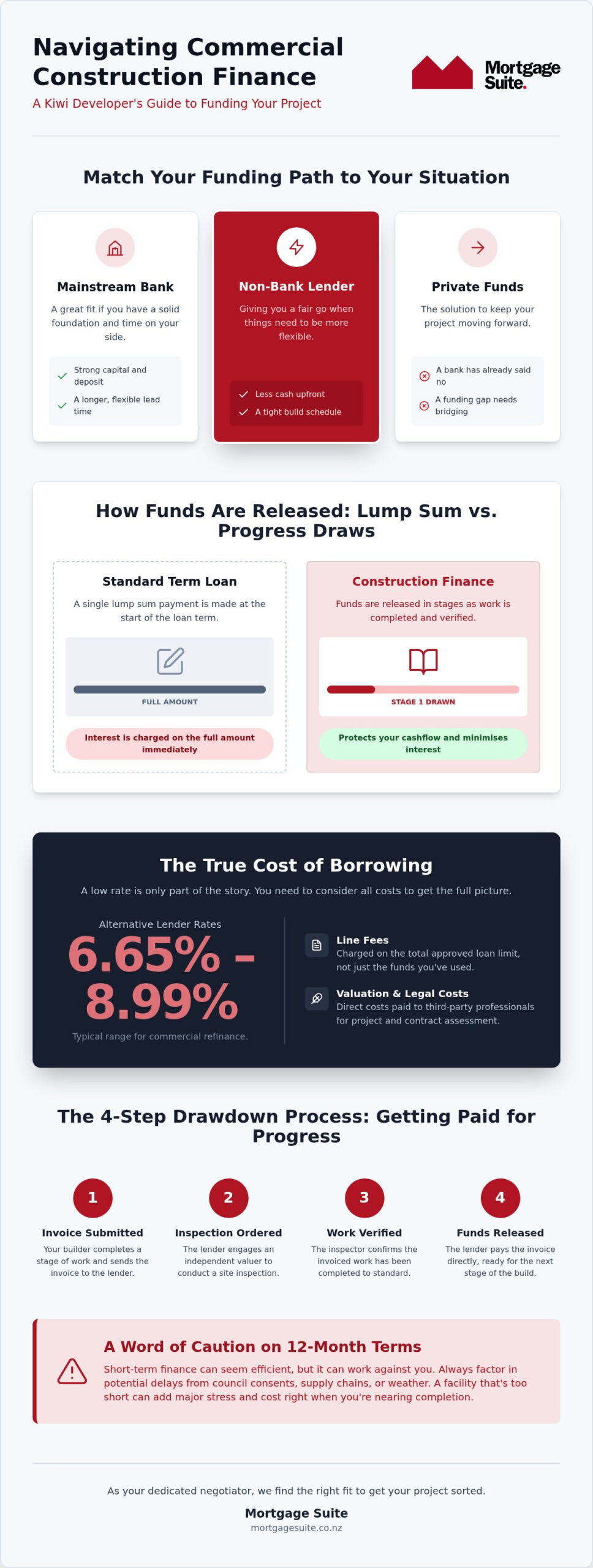
- Strong capital and a longer lead time: a mainstream bank facility can suit you if serviceability and deposit margins stack up.
- Less cash upfront or a tight build calendar: non-bank lenders give you a fair go with practical flexibility on structure and timing.
- A bank has already declined the application: private funds can bridge the gap so land, siteworks, or base construction do not stall.
A mainstream bank suits Kiwis with solid capital and longer lead times. If you have less cash upfront or tight build schedules, non-bank lenders offer a fair go with practical flexibility. Funding large-scale land subdivisions (big land projects) still needs clear milestones so each release of capital lines up with completed work.
Talk to us first so flexible terms keep construction on track. Mortgage Suite Ltd acts directly on your behalf as your dedicated negotiator.
Progress-draw structures that suit Auckland commercial builds
Standard property loans pay out in one lump sum, whereas commercial construction finance releases money gradually. Development funding works as a managed drip-feed rather than a single payout: lenders hold funds until builders finish specific stages of work.
Your Cashflow stays protected from premature interest because the drawdown process releases money in stages. That staged structure helps you manage risk on big land projects (large-scale land subdivisions). Standard bank term loans simply lack this staged flexibility.
Finance options depend heavily on project type. Commercial builds typically use progress-draw loans, while standard land purchases suit simpler structures. Getting the facility structured to the build gives the project a fair go.
If mainstream lenders seem hesitant about your development plans, a traditional bank decline is not the end of the journey. You still have sound options with non-bank lenders. Working with Mortgage Suite means having a dedicated advocate to negotiate with suitable lenders on your behalf. Construction remains a major driver of national economic activity, so getting sorted early on structure and timing makes a real difference to delivery.
Full borrowing cost: rates, fees, and what you actually pay
Comparing initial interest rates with establishment costs gives you the actual cost of borrowing for your build. Line fees and lender legal costs add up quickly, so a low advertised rate can cost you far more over the life of the facility. If you are managing a major development or a big land project (large-scale land subdivision), evaluate the whole cost package, not only the headline figure. A lender with slightly higher interest but no ongoing administration charges is often the stronger financial move.
| Fee Component | Estimated Market Structure |
|---|---|
| Refinance Loan Rates | 6.65% to 8.99% |
| Line Fees | $50 Charged on total facility |
| Valuation & Legal | 2020 Paid directly to providers |
Lenders base line fees on the entire approved loan limit, not only the funds drawn. Funding a small $50,000–$300,000 addition differs from a full build. If you need to refinance short-term debt to clear expensive bridging, alternative lenders offer specialised solutions. Commercial refinance loan rates from alternative lenders range from 6.65 percent to 8.99 percent, according to current market rates.
Brokers who understand long-term development goals help you weigh rate, fees, and exit in one view so you get a fair go on the full package.
Among Mortgage Suite Ltd’s Google reviews, Baycom (5★) wrote:
"We have dealt with Krish for over 20 years and in that time we have purchased 5 properties. Krish is knowledgeable, professional, and responsive. We would highly recommend Krish and Mortgage Suite to anyone looking to invest in property, Steve & Rosie Bower"
Long-term client relationships show how tailored advice helps property investors move through purchase, refinance, and the next project with one steady hand.
Commercial loan criteria you can meet without a bank-only plan
Commercial lenders assess your equity, property location, Cashflow, and experience before approving project funding.
Client work shows rigid deposit demands often take project leaders by surprise. Mainstream banks usually demand higher deposit margins for commercial builds than for residential ones. You will generally need a clear business plan and solid equity to get sorted.
Equity is set as a share of project value and varies with scale, location, and lender appetite. Mainstream banks apply a serviceability stress test so you can handle rate shifts. Legal structures matter on large-scale land subdivisions: clear development contracts help parties manage shared risk across the programme.
A bank decline is not the end of the road. Non-bank lenders offer flexibility when trading history is complex. Our team acts as your dedicated negotiator to secure a fair go. Review practical 2026 finance guidance when you want to compare structures, then let us chat through your numbers.
Drawdowns that protect Cashflow across each build stage
A clear payment schedule keeps the build moving while holding interest costs down. Commercial construction finance typically aligns with project milestones so you only pay for completed work. Releasing funds in controlled stages protects cash reserves throughout the build. Lenders require proof of progress before paying out each stage.
The drawdown process works in structured steps:
- Submit invoice: You send the certified builder invoice to your lender for review.
- Site inspection: An independent assessor inspects the property to verify completed work.
- Approve payment: The lender verifies the work matches the base construction contract stages.
- Release funds: Finance pays out the approved milestone amount to your contractor.
Managing this timing carefully prevents awkward pauses on site. If you need temporary gap funding while selling another asset, a bridging finance term lasts up to 12 months. Mortgage Suite acts as your personal advocate so you get sorted with lenders before the first claim is due.
Tip: Ensure your base construction contracts align with loan stages to avoid out-of-pocket delays during drawdowns.
Joint ventures and presale underwriting when bank channels close
Securing non-traditional equity support or presale underwriting gives you a safety net when traditional bank channels close off.
Pairing with an equity partner can strengthen the capital stack before a single brick is laid. Standard lenders usually demand heavy pre-commitments, while alternative joint ventures bring flexible cash in earlier.
Presale underwriting works as a firm backing agreement: a promise to purchase uncommitted units if public buyers fall short. It functions like cover on project momentum and can satisfy strict lender criteria without forcing panic discounts. Mainstream rejections do not mean the vision is dead.
We negotiate these backing structures directly so you keep control of the build schedule. Structured well, equity support protects total profits rather than simply diluting them. Ask us to map JV and presale options against your current term sheet.
When a 12-month construction term works against you
Short-term construction loans create severe refinancing pressure if the building schedule stalls or sales take longer than expected.
Brief 12-month terms leave little room for council delays or slow material deliveries. A minor hold-up can force expensive loan extensions right when the budget is tightest. A short loan term behaves like a timer on a pressure cooker. Kiwis building larger projects often need more time to complete base construction and secure final buyers.
A mainstream bank decline on your timeline does not mean the build is over. Mortgage Suite Ltd works as your personal advocate to negotiate flexible terms that match the actual build pace.
If short-term funding looks like the only door open, we can help you get sorted with a structure that leaves room for real-world delays. Reach out for a friendly chat about term length and exit.
Property development finance that keeps your schedule moving
Fast finance approvals keep construction schedules on track and limit costly project delays. Setup costs vary with facility size, valuation, and legal work, so you should budget them as part of the full capital stack rather than as a surprise at drawdown.
Slow bank processing creates real stress for Kiwi developers. Working directly with private lenders often speeds up decision times compared with traditional channels. Mainstream approvals can drag on for months, whereas non-bank options focus heavily on your equity safety net and overall project viability.
If a retail bank manager hesitates, your goals remain achievable. We act as your personal advocate, negotiating flexible terms so you get sorted without losing momentum. Mainstream declines are rarely the end of the road. Contact Mortgage Suite for a friendly, confidential chat about holding your timeline.
Frequently asked questions
What is property development finance?
Property development finance is a specialised loan designed to fund major building projects or big land projects. Mainstream banks often pull back from complex builds, but we help Kiwis get sorted with tailored funding structures. It covers the costs of turning bare ground into completed real estate, moving in stages from siteworks to final base construction. If a traditional bank manager said no to your project, non-bank alternatives can help you keep moving forward.
How do 12-month construction and bridging terms work in Auckland?
Short-term construction and bridging facilities are commonly used to cover a defined build or gap period, and bridging finance nz typically lasts for up to 12 months. That window only works if council timeframes, materials, and sales line up with the exit you have planned. If the programme needs more room, we compare longer or more flexible structures so you are not forced into a costly extension at the worst moment.
What types of loans are available?
Funding options range from short-term bridge funding to long-term facility structures tailored for commercial property developments. You can access specialised capital for initial earthworks, a term loan for completed assets, or short-term bridging finance which typically lasts for up to 12 months. When you need to refinance commercial property, alternative lenders offer commercial refinance loan rates that usually fall between 6.65 percent to 8.99 percent, according to market listings. Mortgage Suite guides you through each option so you secure a fair go without getting stuck in red tape.
How does a construction loan differ from a standard home loan?
Standard home loans provide the entire principal upfront, whereas a construction facility releases cash gradually in stages. This controlled release is known as the drawdown process, which protects both you and your lender as work progresses. You only pay interest on the money you have actually drawn down to pay contractors. This structure keeps your monthly costs lower during the early phases of your build.
How are payments structured during the construction phase?
Payments are drawn down progressively after an independent valuer inspects the building work completed at each milestone. You usually make interest-only payments on the drawn balance, easing Cashflow stress while the build is under way. Once council issues the final Statement of Compliance, your facility can convert into a standard term loan or be paid off through sales. Talk to Mortgage Suite about negotiating payment terms that match your contract stages.
Getting your Auckland build moving in 2026
Securing the commercial construction finance Auckland projects need can feel heavy when mainstream bank criteria keep shifting. You do not have to read those guidelines alone.
The same questions you started with still steer the outcome: which path fits your equity and timeline, what you will pay once rates and fees sit together, and whether a short facility leaves enough room before refinance or sale. Mortgage Suite Ltd advisers work as your personal advocate to negotiate flexible funding for your site. Whether you need help with big land projects or standard build funding, options exist beyond a basic bank decline.
Explore pathways with our finance calculator, then reach out to the team for a friendly, confidential chat about your plans so you can get sorted with a structure that matches the build you are actually delivering.