
First home buyer loans NZ: 2026 deposit rules and cash-back offers
You can buy your first home in New Zealand under 2026 deposit rules with as little as 10% equity in many cases, or 5% on qualifying New Builds, and still chase lender cash-back where the offer fits your term. Working around current lending rules helps you secure government support and lender cash incentives without wasting months on the wrong pathway. We can help you get sorted with a lender that fits your goals.
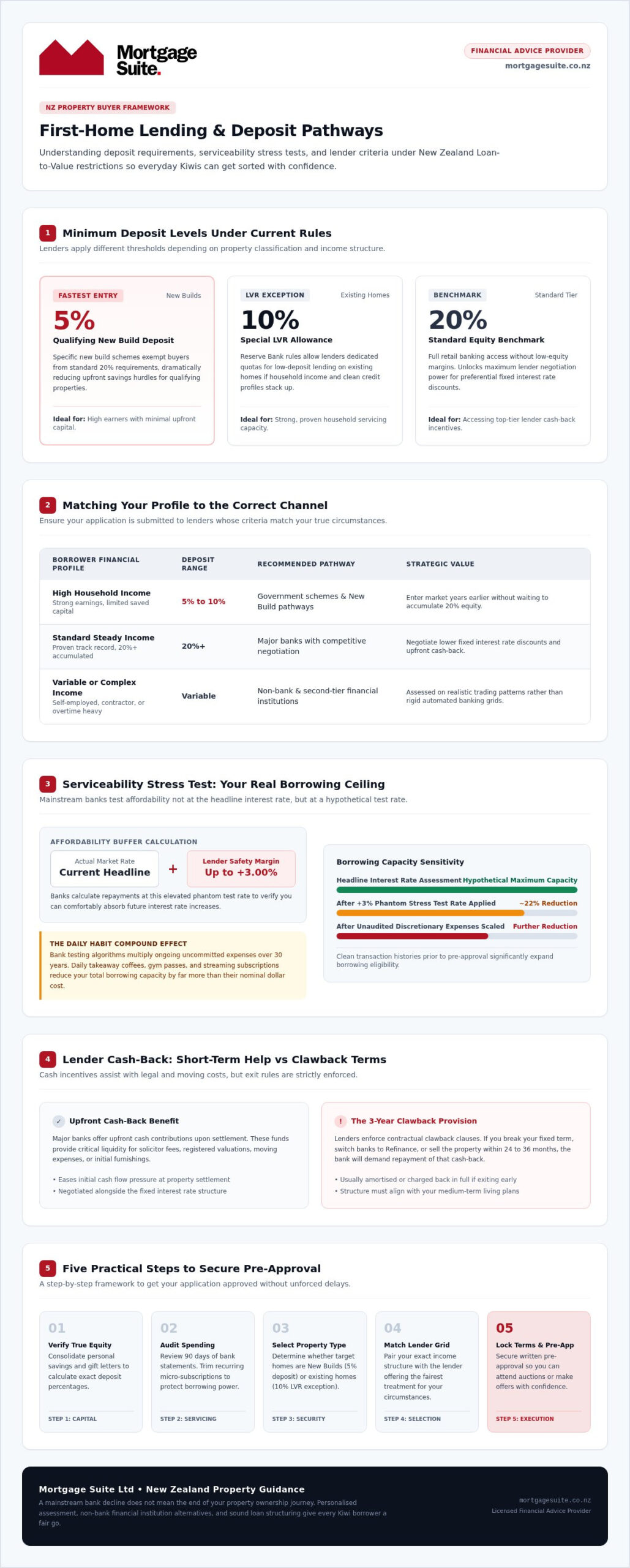
Key Takeaways: You can secure first home buyer loans in NZ with a 5% deposit for new builds or 10% for existing properties under LVR exceptions.
- Lenders apply stress tests using phantom interest rates up to 3% above current market rates.
- Unless you maintain your fixed term, banks strictly enforce clawback provisions on cash-back incentives.
- Best-for high earners to target 5% to 10% deposit schemes rather than waiting for 20%.
- Bank calculators treat daily coffee or streaming subscriptions as significant reductions to total borrowing capacity.
Match your deposit and income to the right first-home path
Your path to property depends on deposit size and household income, so match both to the right lender before you lodge a full file. With clients we see that pairing deposit level to lender early saves weeks of frustration: banks strictly review income, while alternative lenders offer more flexibility on complex files.
Three situations come up often:
- High income with a smaller deposit: apply for low-deposit government or New Build pathways (5%-10%) rather than waiting for 20%.
- Steady standard income with 20%+ saved: negotiate a locked-in interest rate (fixed interest rate) and compare cash-back against the rate.
- Complex or variable income: explore non-bank and 2nd tier lending so serviceability is judged on real patterns, not a single rigid grid.
Kiwis with strong earnings can secure a First Home Loan with a 10% deposit under Loan-to-Value restrictions. If your bank says no, switching banks later (Refinance) remains an option once equity grows. You get sorted faster when the strategy fits the file you actually have.
| Financial Profile | Deposit Level | Immediate Next Step |
|---|---|---|
| High Income | 5% to 10% | Apply for low deposit government schemes |
| Standard Income | 20%+ | Negotiate a locked-in interest rate |
| Complex Income | Variable | Explore non-bank lending options |
You deserve a fair go on whichever row matches your life right now.
Yes, you can buy with a 10% deposit under LVR rules
Yes, you can secure a property with a 10% deposit under Loan-to-Value restrictions, provided you meet standard bank affordability criteria. Local rules allow Reserve Bank Loan-to-Value restrictions to include special low-deposit exceptions for buyers, so mainstream bank grids can feel rigid while usable options still sit beside them.
Think of these central bank rules like a nightclub door policy: most guests need a standard entry pass, yet venue security keeps dedicated spots open for specific buyers. For first-home buyers, some specific “New Build” schemes let you get started with as little as a 5% deposit. That is a separate pathway from a standard 20% existing-home purchase, and from the 10% LVR exceptions used when income and credit stack up cleanly.
Saving large reserves is tough when rent and living costs already claim most of the month. Working alongside our team through the first-home buyers guide gives you a fair go when negotiating with lenders. We act as your dedicated advocate so you get sorted without unnecessary stress.
Tip: Check if your prospective property qualifies as a New Build to immediately slash your deposit requirement to 5%.
Stress tests set your real borrowing limit, not the sticker rate
Banks set your home loan limit with a serviceability stress test that checks whether repayments stay affordable if interest rates rise. From client work we see that bank calculators often apply phantom interest rates up to three percent above actual market rates. That testing margin protects both you and the lender from future shocks.
A detail many buyers miss: those test rates also scale up routine daily expenses, which cuts borrowing capacity harder than the cash spent suggests. A daily coffee run or streaming subscription reduces total borrowing power by more than the nominal amount leaving your account. Kiwis often get declined by mainstream lenders simply because the formulas treat tight budgets harshly.
Presenting income and expenses clearly changes the outcome. Working with first-home buyer advisers helps you show actual income so you get sorted with a fair go rather than a blunt decline letter.
Cash-back helps upfront costs if you can hold the fixed term
Our direct professional experience shows that financial institutions rely on clawback provisions to retrieve money if you exit early, and lenders enforce those rules strictly.
You must keep your locked-in interest rate for the set term to avoid paying the funds back. If you switch banks later within three years, the bank can take that cash right back. Our team acts as your personal advocate to negotiate fair terms, and you can read more on options for Kiwis in the first-home buyer articles.
Among Mortgage Suite Ltd’s Google reviews, Baycom (5★) wrote:
"We have dealt with Krish for over 20 years and in that time we have purchased 5 properties. Krish is knowledgeable, professional, and responsive. We would highly recommend Krish and Mortgage Suite to anyone looking to invest in property, Steve & Rosie Bower"
Working with an experienced adviser across multiple purchases keeps your long-term finance structure steadier against strict clawback terms. Ask us to line up the cash-back against the rate and the clawback window before you sign.
2026 Government first-home criteria hinge on income and caps
Government criteria for first-home support depend on household income, regional house caps, and total personal assets. Mainstream banks enforce those limits tightly, yet missing one grant does not end your property goals. In professional practice, applying with a 10% deposit under Loan-to-Value restrictions through a non-bank financial institution often gives more practical flexibility than waiting years to fit rigid government boxes.
From client work, buyers often get turned down by big lenders simply because earnings sit slightly over a threshold, and that outcome usually causes unnecessary panic. As detailed on the Inland Revenue Department 2026 KiwiSaver guide, special withdrawal rules apply when buying your initial home. Think of government grants as a narrow gateway, while tailored lending acts as a wide, accessible driveway.
Mortgage Suite Ltd works as your dedicated negotiator to secure a fair go when the first door closes. If mainstream banks say no, we look for answers on 2nd tier and non-bank paths. Reach out for a friendly, confidential chat to review where you sit against 2026 criteria.
When a low-deposit home loan costs you more than it saves
A 10% deposit under Loan-to-Value restrictions can backfire when your monthly budget has no room for unexpected expenses. From client work we see that buying with minimal equity creates real pressure: extra fees push regular payments higher than the spreadsheet suggested at offer time.
High loan-to-value margin fees often sit on top of your standard interest rate. Mainstream banks usually charge those extra margins when you borrow over eighty percent of a property’s value, and the premiums eat into income while you also lose interest-rate discounts. Banks still run strict serviceability stress tests on these files, which makes approval harder on a tight budget.
This route works poorly when costs already feel close to the edge, because it slows long-term equity growth as well. If rising costs worry you right now, talk with Mortgage Suite to explore safer deposit and structure pathways before you stretch to the maximum.
Secure home loan pre-approval in five practical steps
Pre-approval gives you clear spending boundaries before you make an offer on a home. From client work we see bank assessments run faster when paperwork is ready from day one, which cuts avoidable delays. Many first-home buyers are surprised to learn that our services are usually at no cost to them.
- Gather documents: Collect your recent payslips, bank statements, and proof of ID.
- Calculate your deposit: Combine your savings, family gifts, or cash assistance toward a 10% deposit under Loan-to-Value restrictions (or 5% on a qualifying New Build).
- Run a serviceability stress test: Check your monthly budget against higher hypothetical interest rates.
- Submit your application: Pass your file to a broker who matches your goals with suitable lenders.
- Get sorted: Receive written confirmation of your approved limit.
Getting pre-approved works like a pre-paid ticket to an auction: you know your ceiling before you bid. If you expected a large broker fee, remember our help comes free for most buyers. Contact us when you want that written limit in hand.
Split fixed and flexible balances so rate rises hurt less
Splitting your loan balance gives you flexibility when household income drops unexpectedly. Fixing a portion locks in repayments, while placing the rest in an offset account helps you pay the home down faster without losing access to emergency funds.
From client work we see rigid single-structure loans cause heavy stress during sudden life changes. Keeping extra money in a linked account reduces calculated interest daily, yet leaves cash available if money gets tight. Think of your mortgage structure like a Swiss Army knife: two tools beat one heavy blade when conditions change.
That mix suits Kiwis who want steady repayments beside quick cash access. Mortgage Suite helps you get sorted with a customised setup so Your Home Loan stays Our Priority when rates or income shift. Book a time and we will map fixed and flexible portions around your budget.
Frequently asked questions
Can you buy your first home with a 10% deposit?
You can buy a home with a 10% deposit under Loan-to-Value restrictions through low-deposit options at mainstream banks or non-bank lenders, and some New Build schemes go as low as 5%. Low-deposit applications bring extra lender checks, so strong bank statements help you get sorted quickly. Our team acts as your dedicated negotiator when deposit funds feel tight.
How much cash back can I get?
Lenders periodically offer cash incentives of $2,500–$150,000 to first-home buyers, but exact amounts depend on current bank offers and your overall loan size. We review changing bank promotions so you can weigh each incentive against the rate, the fixed term, and clawback rules before you commit.
How do I check how much I can borrow?
You calculate borrowing capacity from household income, everyday expenses, and existing personal debts, then a lender runs its own serviceability test. A mainstream-bank decline does not mean you have run out of choices for buying a house. Talking with a mortgage broker helps uncover flexible non-bank avenues and clear next steps.
How much could you afford to borrow?
Your affordable limit depends on passing a lender serviceability assessment that tests your ability to pay higher rates. Sorting your budget early keeps property searches realistic and avoids unnecessary strain. Reach out for a friendly chat to calculate your true borrowing power before you make offers.
How much deposit do I need to buy a house?
Most standard existing-property purchases require a twenty percent deposit, but select options allow lower equity. Specific New Build schemes let you buy with as little as a 5% deposit, and 10% pathways exist where LVR exceptions and income allow. First-home buyers often learn that our broking services usually come at no cost while you work toward those deposit levels.
Getting sorted with your first home purchase
Buying your first property in New Zealand in 2026 still turns on the same questions you started with: which deposit path fits you (5%, 10%, or 20%+), whether cash-back is worth the clawback term, and how stress tests shape your true limit. A mainstream bank decline is rarely the end of the road for Kiwis looking for a fair go. As advisers at Mortgage Suite Ltd, we advocate on your behalf for tailored lending and sensible cash-back choices. First home buyer loans NZ become simpler when you have a dedicated negotiator in your corner, matching long-term goals to the right lender so you step into the market with confidence. Get in touch with Mortgage Suite today to get sorted.