
Equity Release for Investment NZ: How to Fund Your Next Property in 2026
Borrowing the absolute maximum against your family home is the quickest way to stall your property plans before they begin. When looking into equity release for investment NZ buyers often assume that getting the green light from a bank manager is the hardest hurdle. Yet between tough serviceability stress tests and shifting Loan-to-Value restrictions, many Kiwis worry about risking the family home through messy cross-securitisation. If the borrowing process feels daunting, that hesitation is completely natural.
Fortunately, growing your portfolio does not mean putting your personal security at risk. You can access your built-up equity safely to fund a residential rental purchase while keeping your own home protected. We will walk you through how to calculate your usable equity accurately, structure your lending cleanly, and secure finance approval so you can get sorted without the guesswork.
Key Takeaways
- Discover how equity release for investment NZ works, turning built-up property value into a usable deposit for your next residential rental purchase.
- Learn how to calculate your true borrowing capacity by keeping a twenty percent equity safety net on your primary residence.
- Protect your family home from risky cross-securitisation by structuring separate loan facilities across your properties.
- Prepare the right documentation, including certified accounts and expenditure records, to satisfy lender serviceability stress tests.
- Keep your investment momentum going with 2nd tier lenders if your regular bank turns down your application.
What Equity Release for Investment Means for Kiwi Homeowners
Many online guides define equity release purely as a retirement scheme for seniors wanting cash in their golden years. That narrow definition leaves working Kiwis in the dark. For active property buyers, what is home equity really comes down to? Simply put, it is the difference between your property’s current market value and the debt you owe against it. Using equity release for investment NZ wide is about borrowing against that built-up value to fund a deposit on a residential rental property.
Instead of waiting years to save a massive cash deposit from your salary, you tap into the capital gain your current home has earned. You keep your cash savings intact while your existing property acts as financial backing for the new purchase.
Investor Mortgage Top-Ups vs Retirement Reverse Mortgages
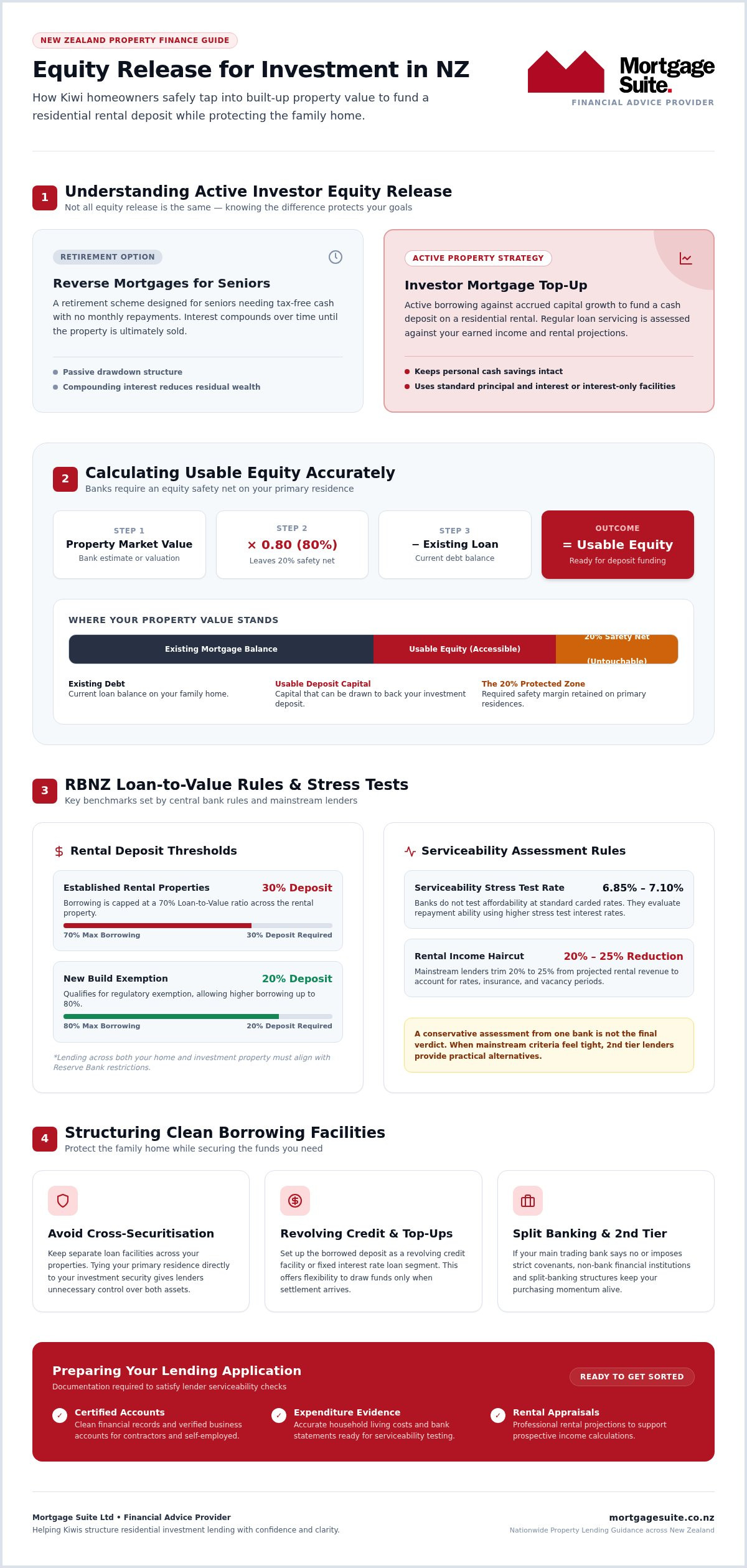
A reverse mortgage suits seniors who want tax-free cash without making monthly payments, with the interest compounding until the house sells. In contrast, an investor mortgage top-up is active borrowing. Lenders assess your current earned income and rental projections to ensure you can manage regular payments. Rather than eroding your wealth, this approach lets you take out residential investment property loans using standard principal and interest or interest-only facilities.
How Built-Up Property Value Serves as a Cash Deposit
Securing a rental deposit does not require emptying your bank account. Here is how your home’s value steps in:
- Security over cash: The lender uses the equity safety net in your primary residence to establish a new loan segment.
- Deposit funding: That new borrowing acts as the cash deposit for the investment property, meeting standard purchase requirements.
- Flexible options: You can set up the borrowed deposit as a revolving credit facility or a fixed interest rate loan to suit your strategy.
This process gives everyday Kiwi homeowners a fair go at expanding their wealth. You can learn more about how mortgage structures operate by visiting the Mortgage Suite educational resources. With the right foundation in place, you can move forward with confidence and get sorted for your next investment.
Calculating Your Usable Equity Under Reserve Bank Rules
Working out how much you can borrow often brings a sharp reality check. Total equity is simply your home’s estimated market value minus your outstanding home loan. However, usable equity release for investment NZ homeowners can actually access is quite different. Banks do not allow you to borrow every dollar of value, as regulations and internal risk policies step in to maintain financial stability.
Calculating Usable Equity Beyond the Eighty Percent Line
Lenders insist on keeping an equity safety net of twenty percent on your primary residence. To find your usable portion, take the current bank desktop estimate or registered valuation of your home and multiply it by 0.80. Next, subtract your current home loan balance from that figure. The remaining sum represents the capital you can draw against your home to fund your investment plans.
Understanding Reserve Bank Loan-to-Value Restrictions for Rentals
The Reserve Bank of New Zealand enforces Loan-to-Value restrictions to manage lending risks across the housing market. For established residential rental properties, mainstream banks generally require a thirty percent deposit, meaning borrowing is capped at a seventy percent ratio on the investment property. While new builds qualify for an exemption that allows a twenty percent deposit, buying an existing house requires significant backing. Your borrowing across both properties must align neatly with these central bank guidelines.
If you want to run the numbers on your own home and test different scenarios, you can test your numbers using an online mortgage calculator to see where you stand.
Passing the Serviceability Stress Test with Mainstream Banks
Having enough equity is only half the battle; proving you can afford the repayments is the other. Even if actual carded mortgage rates sit lower, mainstream banks assess your borrowing capacity using a serviceability stress test rate between 6.85% and 7.10%. Lenders also apply haircuts to your numbers, often shaving 20% to 25% off projected rental income to allow for rates, insurance, and vacancies.
Facing strict bank criteria can feel discouraging, but remember that a conservative calculation from one lender is not the final word on your borrowing journey.
Structuring Your Facility: Revolving Credit, Top-Ups, and Split Banking
How you arrange your borrowing matters just as much as how much you borrow. A poorly structured loan can tie your hands financially, complicate your tax accounting, and leave your primary residence exposed. Getting equity release for investment NZ right means creating a deliberate borrowing architecture that separates your personal living costs from your investment activity.
Revolving Credit Facilities vs Fixed Term Loan Top-Ups
Setting up your borrowed deposit as a revolving credit facility gives you practical flexibility. Think of it as a pre-approved line of credit secured against your home. You do not pay a cent of interest until you actually draw down funds to pay a purchase deposit at an auction or signing. Once your residential rental purchase settles, you can choose to convert that drawn balance into a fixed interest rate term loan for repayment certainty, or keep a portion floating for quick repayment.
Why Split Banking Protects Your Family Home
Mainstream banks love cross-collateralisation because it bundles all your securities under one roof. If your family home and rental property secure every loan jointly, the bank controls the proceeds if you ever sell. Should market values drop or rental income dip, the bank can freeze funds or dictate terms across both assets.
Split banking breaks this stranglehold. Here is why savvy Kiwis use it:
- Asset isolation: You release equity from Bank A to secure the deposit, then take the remaining seventy percent mortgage with Bank B.
- Control over sales: If you sell the rental down the track, Bank B cannot demand you use surplus profits to pay down the mortgage on your family home.
- Negotiating strength: Working across different lenders gives you options if one bank suddenly tightens its serviceability rules.
Using an Offset Account for Cashflow and Interest Management
An offset account links your everyday operational savings directly to a floating loan portion. Instead of earning taxable interest on rental income or maintenance reserves, the balance reduces the total loan amount used to calculate your daily interest charge. Keeping extra cash sitting against floating debt lowers your monthly costs without locking away your reserves.
Structuring these facilities properly protects your lifestyle while funding your property goals. You can explore how these banking setups work in detail through our mortgage school guides.
Steps to Secure Your Property Investment Finance
Securing approval for equity release for investment NZ lenders require thorough groundwork. Mainstream banks enforce detailed scrutiny on every application, but taking an organised approach removes much of the friction and helps you present a clean financial profile.
Preparing Financial Documentation for Lender Assessment
Banks assess your bank statements line by line, evaluating discretionary spending and regular commitments under responsible lending guidelines. If you run a business or work on contract, lenders will want to see two full years of finalised, certified accounts alongside your personal tax summaries. Before approaching any lender, check your borrowing capacity by testing your figures on our mortgage calculator to ensure your budget holds up.
Due Diligence: Valuation and Professional Building Report Checks
Once you hold a conditional mortgage pre-approval, protecting your capital becomes the priority. Lenders often insist on an independent registered valuation to verify the property’s security value before confirming final loan release. At the same time, always commission an experienced inspector to inspect the property and supply a detailed building report. This check uncovers deferred maintenance, moisture issues, or structural defects that could affect bank appetite or trigger the Small Apartment Rule on smaller units.
Navigating Alternative Options with a 2nd Tier Lender
Getting a decline from a traditional high-street bank can feel like a setback, but it does not mean your investment journey is over. If your income includes contracting, irregular company distributions, or recent self-employment, a non-bank financial institution can assess your real-world affordability rather than relying on an inflexible automated scorecard.
You can explore how these alternative pathways work in our guide on 2nd tier lender New Zealand solutions. If you are ready to put an effective borrowing structure together, talk to our team to get your property finance on track.
Partnering with Mortgage Suite to Fund Your Investment
Securing the right loan is rarely about filling in an automated online form and hoping for the best. When managing equity release for investment NZ property buyers need a dedicated partner who understands how credit committees think. That is where Mortgage Suite steps in. As an accredited Financial Advice Provider, we serve as your personal advocate across major retail banks and specialist lenders, ensuring your lending structure protects your lifestyle from day one.
Our founder, Krish Krishna, brings over twenty years of banking and mortgage advisory experience to your corner. Having worked inside mainstream institutions, he knows how to position borrowing requests to gain approvals that standard channels often miss. You can discover more about us and our independent philosophy to see why Kiwi property owners rely on our steady guidance.
Personalised Advocacy and Dedicated Lender Negotiation
Every borrower’s situation is different, and one-size-fits-all algorithms rarely do justice to ambitious investors. We take the time to map out your long-term wealth goals before presenting a clean, compelling case to credit underwriters. Our focus remains on securing flexible loan structures, negotiating policy exceptions, and making sure you get a fair go.
You do not have to take our word for it either. Read through genuine client reviews to see how our hands-on advocacy has helped Kiwis navigate complex borrowing decisions with confidence.
Solutions for Complex Borrowers and 2nd Tier Lending
If you work as an independent contractor, run a young business, or have multiple income streams, mainstream bank branch managers often push back. We believe a conservative bank assessment should never halt your property goals. Mortgage Suite works closely with trusted non-bank financial institutions to secure 2nd tier loans that do not fit mainstream banks.
Whether you require standard bank finance or an alternative lending structure, our team arranges the right facilities to match your growth. Explore our guidance on residential investment property loans NZ to see how strategic funding can turn your home equity into long-term financial security.
Take the Next Step Toward Growing Your Property Portfolio
Building wealth through residential rental property does not require waiting decades to save a separate cash deposit or risking the family home. By understanding how equity release for investment NZ works, you can tap into accrued capital while maintaining a twenty percent equity safety net. Structuring your debt with split banking isolates your assets, keeps your accounting clean, and ensures you retain full control over your future sales proceeds.
You do not have to tackle lender stress tests or strict criteria on your own. As an accredited Financial Advice Provider delivering nationwide New Zealand service, Mortgage Suite brings over two decades of hands-on institutional banking expertise to your corner. Whether negotiating mainstream bank terms or securing non-bank financial institution lending for complex profiles, our focus is on finding the right fit for your situation. Talk with Krish and the team at Mortgage Suite to get your investment finance sorted and start planning your next property move today.
Frequently Asked Questions
How much equity do I need to buy an investment property in NZ?
You generally need enough equity to cover a thirty percent deposit for an existing residential rental property, while maintaining a twenty percent equity buffer on your personal home. For new builds, the required deposit drops to twenty percent under Reserve Bank rules. To assess your capacity, calculate eighty percent of your property’s value, subtract your existing mortgage, and see if the remaining usable equity covers your intended purchase deposit.
Is equity release for investment the same as a reverse mortgage?
No, equity release for investment NZ property buyers use is completely different from a retirement reverse mortgage. A reverse mortgage is tailored for seniors looking to draw cash without making monthly payments, allowing debt to compound over time. In contrast, investor equity release involves standard active borrowing based on your current earned income and rental projections, requiring ongoing principal and interest or interest-only repayments.
Can I release equity if my income is from contractor or self-employed work?
Yes, contractors and self-employed Kiwis can certainly access built-up equity to fund rental purchases. While mainstream banks often apply rigid criteria and demand multiple years of certified accounts, specialist non-bank lenders take a more practical view. They assess your real cashflow and recent business performance rather than relying on automated scoring systems, ensuring self-employed borrowers get a fair go.
What happens if a mainstream bank declines my equity release application?
A decline from a mainstream bank simply means your scenario did not fit their automated credit criteria, not that your property plans are finished. Retail banks use conservative affordability stress tests that penalise complex income or multiple debt facilities. In many cases, we can restructure your application or secure approval through a non-bank financial institution that provides flexible 2nd tier loans.
How does split banking help protect my home when releasing equity?
Split banking protects your family home by keeping your personal residence and investment property financed through separate lenders. If you place everything with a single bank, they hold cross-collateralised security across both properties and can control the sale proceeds if you sell. Dividing your lending isolates risk, giving you peace of mind when executing an equity release for investment NZ strategy.
Do I have to pay interest on my released equity immediately?
Not if you structure the borrowed deposit as a revolving credit facility or an offset account. With a revolving facility, you only pay interest on the money you actually draw down to pay auction deposits or settlement funds. Until you find a property and sign a contract, your pre-approved limit sits waiting without accruing unnecessary interest charges.
Will I need a registered valuation to access my home equity?
You might not need one if your lender accepts an automated desktop estimate, but higher borrowing levels usually require a full registered valuation. Mainstream banks frequently accept electronic valuations when your debt level is conservative. However, when you are accessing usable equity near the eighty percent threshold, lenders require an independent registered valuer to verify the property’s security value.