
Home Loan for Casual Workers NZ: How to Prepare and Compare Options
Changing hours don’t automatically rule you out of a home loan for casual workers nz. The key is helping a lender understand the pattern behind your pay, rather than judging your application by one quieter week. If your earnings rise and fall between pay periods, it’s understandable to wonder whether a bank will consider the full picture.
There may be options, but lenders can assess casual income differently and their requirements vary. Clear records of your work and earnings can help explain how your income has tracked over time. A decline from a mainstream bank isn’t necessarily the end of the road, either. Other lending pathways may be worth assessing, although none can guarantee approval.
In this guide, you’ll learn what lenders may look for when reviewing casual income, which documents can help explain your circumstances, and how to compare mainstream and alternative options across New Zealand. You’ll also find practical steps for organising your application and questions to ask before you apply.
Key Takeaways
- Casual work doesn’t automatically rule you out. Show how your hours and earnings have tracked over time.
- For a home loan for casual workers nz, gather income records and be ready to explain regular shifts or seasonal changes.
- Lenders can assess casual income differently. Ask what work history and documents each one needs before applying.
- Compare mainstream and alternative options by more than the interest rate. Check the repayment structure, flexibility and how each option fits your plans.
- Mortgage Suite can help organise your income information and discuss lender pathways, without promising a particular result.
Can casual workers get a home loan in NZ? Start with how income is viewed
Changing shifts can make planning a home purchase feel uncertain, especially if your pay varies from one week to the next. But being a casual worker doesn’t decide your home loan application on its own. A lender will assess your income evidence and wider financial situation, and each lender may approach that assessment differently.
Quick answer: Casual workers may be considered for a home loan in New Zealand, subject to the lender’s assessment of their income, commitments and overall ability to manage repayments.
What does casual employment mean when applying for a mortgage?
In everyday terms, casual employment usually means you’re offered shifts or hours as needed, rather than receiving the same set hours every week. Your pattern may still be fairly regular, or it may change with demand, rosters or the season. Describe your actual work arrangement clearly instead of assuming every casual role looks the same to a lender.
A casual employee is paid through an employer, with income recorded through payslips and employment records. A contractor may invoice for work, while a self-employed person generally earns income through their own business. These arrangements can require different ways of showing income, so don’t describe yourself as a contractor if you’re employed casually. If your income comes from contracting or running a business, guidance for self-employed borrowers may be a better fit.
Check that your records make each part of your pay clear. For example, a payslip may list holiday pay separately. The Holidays Act 2003 sets out New Zealand leave entitlements, including rules relevant to casual employees. Keep payslips and other records that explain how your earnings are made up.
Does irregular income automatically mean a home loan decline?
No. Employment type is one part of an application, not the whole story. A lender may also consider the income evidence you provide, your regular financial commitments, your deposit and whether the proposed repayments appear manageable. The information required and assessment method can vary, so ask what the lender needs before assuming how your application will be treated.
Casual employment, by itself, proves neither affordability nor ineligibility. It isn’t a personal judgement on your reliability, either. A lender’s decision reflects its criteria and the information available for your application. If one mainstream bank says no, that doesn’t automatically close off every other pathway. For a home loan for casual workers nz, a clear account of your work pattern and income can help a lender assess the full picture, though it can’t guarantee an outcome.
How lenders may assess casual income for a New Zealand home loan
For a home loan for casual workers nz, a lender may look beyond your latest payslip to understand how your earnings behave over time. It will assess whether the income you can show may support repayments, alongside your other financial commitments. Each lender sets its own criteria, so there isn’t one universal formula or required work history.
What income evidence might a casual worker be asked to provide?
Ask the lender or adviser handling your application which records it accepts and what period it wants to see. Depending on the lender, useful documents may include:
- Recent payslips showing your hours, pay and any separately listed components.
- Your employment agreement, if it explains your role or pay arrangement.
- Bank records showing wages being paid into your account.
- Rosters or written confirmation from your employer, if these help explain shifts that change from week to week.
Keep your explanation straightforward. For example, you might say that your hours usually increase during busy periods, or that shifts are offered according to a changing roster. If you’ve had a quieter patch, explain the context and provide records that show the wider pattern. Evidence won’t guarantee that a lender accepts all your income, but it can make your circumstances easier to understand.
How do affordability checks fit into the assessment?
Income is only one part of the picture. A lender may also consider regular commitments, such as other loan repayments and household expenses, then assess whether the proposed home loan repayments appear manageable. A serviceability stress test checks whether repayments could still be manageable if calculated at a higher interest rate. Whether and how a lender applies this depends on its current policy, so ask what assessment will be used for your application.
Here’s a simple illustration, not a lending rule: imagine your hours vary between quieter weeks and busier ones. A lender may review the available records to understand that pattern rather than treating one week as your usual income. The documents and method it accepts will depend on its criteria.
If you’re a first-home buyer, you can also check whether the First Home Loan scheme may fit your circumstances, and confirm its current eligibility rules with Kāinga Ora. For an early planning estimate, Mortgage Suite’s mortgage calculator can help you explore repayments. It isn’t a lender decision or a promise of how much you can borrow.
If you’d like help organising your income records and considering lender pathways, explore Mortgage Suite’s home loan support.
Mainstream bank or alternative lender: compare home loan pathways
A mainstream bank is one possible route, but it isn’t automatically the right fit for every casual worker. If your income records show a pattern and explain changes in hours or pay, ask a bank how it would assess your particular situation. Don’t rely on assumptions about a lender’s policy. Criteria and evidence requirements can differ.
Alternative, or second-tier, lending may be worth exploring if your application doesn’t fit a mainstream lender’s approach. It isn’t a guaranteed solution, and the terms need careful review. For a separate explanation, look for a 2nd Tier Lender New Zealand guide alongside the comparisons below.
| What to compare | Mainstream lender | Alternative lender |
|---|---|---|
| Assessment fit | Ask how it views your casual income and work pattern under its current criteria. | Ask whether its approach may better suit your circumstances, and what it needs to be comfortable with the application. |
| Evidence requested | Confirm which income records it accepts and the period it wants to review. | Check what documents are needed and how changing hours or pay will be considered. |
| Flexibility | Ask which parts of your circumstances can be considered and what conditions apply. | Clarify where the lender may be flexible, and where its requirements remain firm. |
| Repayment structure | Compare repayment choices and how they fit your budget and plans. | Review the full structure, including how repayments and conditions may affect you over time. |
| Questions to confirm | “How will you assess my casual income, and what evidence should I provide?” | “What are the full terms, conditions and options if my circumstances change?” |
When might a mainstream lender be worth approaching?
It may be worth asking a mainstream lender if you can document your earnings and explain why your hours vary. Give a clear account of your work pattern, then check how the lender will treat your casual income before preparing an application based on an assumption. An organised application can help explain your situation, but it can’t ensure a particular decision.
What should you ask before considering an alternative lender?
Ask how income is assessed, which records are required and what conditions come with the loan. Compare the whole arrangement, including repayment structure and flexibility, rather than focusing only on the headline interest rate. A broker can help you compare potential pathways, but can’t guarantee acceptance or remove lender conditions. When assessing a home loan for casual workers nz, make sure the pathway suits both your evidence and your longer-term plans.
How to prepare a stronger home loan application as a casual worker
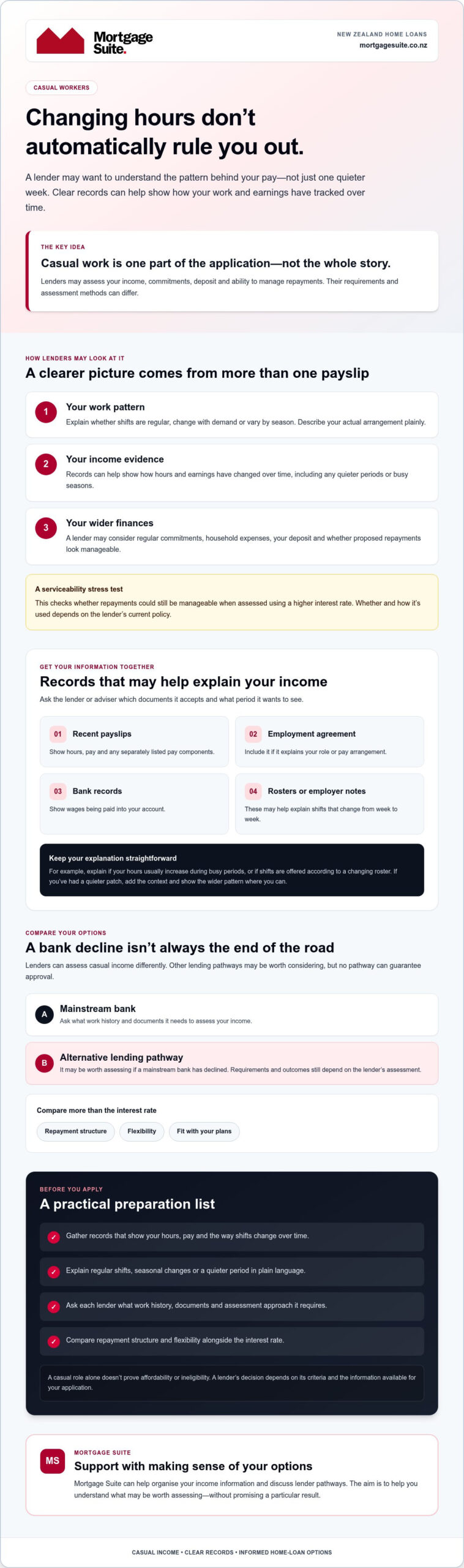
A clear application helps a lender understand your work pattern and your plans. Before you approach lenders about a home loan for casual workers nz, work through these steps to get your information in order.
- Clarify your goal. Note what you hope to buy, your preferred timing and what matters most in a home loan.
- Gather your records. Collect available payslips, employment terms, bank statements and employer details. Ask which documents the lender wants for your application.
- Map your income. Prepare a short timeline of changes in your hours, role or pay, using accurate records. Explain regular shifts or known seasonal changes rather than relying on estimates.
- Review your commitments. List regular repayments and household expenses, along with any likely changes to your household circumstances.
- Ask about lender criteria. Check how the lender assesses casual income, what evidence it accepts and what else it needs to consider your application.
Build a clear record of your work and income
Arrange your documents so your income is easy to follow. Check that dates, figures and details agree across your payslips, bank records and employment information. If a pay amount differs between records, be ready to explain why. Don’t change or leave out information to make your income appear steadier. A straightforward explanation, supported by accurate documents, gives the lender a clearer picture to assess.
Your timeline doesn’t need to be complicated. It could note when you started a role, when your roster changed or when seasonal work affected your hours. Keep the explanation factual, and confirm with your lender or adviser which records will help with its assessment.
Review your goals and borrowing picture before applying
Think about the property you’re aiming for, your deposit position and the commitments that shape your budget. Consider whether your household income or expenses may change. A repayment calculator can help you explore rough scenarios, but it can’t tell you what a lender will approve. The assessment depends on your circumstances and that lender’s criteria.
For plain-English mortgage learning, explore Mortgage Suite’s Mortgage School resources. You can also use its mortgage calculator to plan possible repayments. Treat both as preparation tools, not a lending decision.
If you’d like support organising your income information and discussing possible home loan pathways, talk with Mortgage Suite about your home loan options.
How Mortgage Suite can help casual workers compare home loan options
Working out which lender may suit your casual income can feel like another job on top of everything else. Mortgage Suite arranges home loans through mainstream and alternative lending pathways across New Zealand. It can help you organise your information, clarify your goals and consider which options may be worth exploring.
For a home loan for casual workers nz, the way you explain your work pattern matters. A broker can help bring together details of your shifts, income records and financial commitments so a lender can consider them in context. They can also help you ask useful questions about lender requirements and compare potential options. The lender still makes its own assessment, and no pathway can guarantee approval.
What to expect from an initial home loan conversation
You can expect to discuss how your work and pay are structured, what records you have, what you hope to achieve and which regular commitments affect your budget. It’s also a chance to identify details to check with a lender, such as which income documents it accepts or how it reviews changing hours. The next steps will depend on your circumstances and the lender’s response.
If you’d like to learn more about the people and approach behind the business, visit the Mortgage Suite About Us page.
How to choose your next step with confidence
Before moving ahead, make sure you have accurate income records and a clear explanation of changes in shifts or pay. Ask prospective lenders how they assess casual earnings, what evidence they need and what conditions may apply. As you compare options, look beyond the headline interest rate. Consider the repayment structure, flexibility and whether the loan terms fit your plans. A broker can help you weigh up those details, but can’t remove lender conditions or promise a particular result.
You may also find it helpful to read Mortgage Suite client reviews as one source of information about others’ experiences. Every borrower’s situation is different, so reviews aren’t a guide to the outcome you’ll receive.
If you’re ready to talk through your circumstances without assuming there’s only one route, talk with Mortgage Suite about your home loan options.
Take the next step with a clearer plan
A home loan for casual workers nz may be possible, but casual status alone won’t determine the outcome. Lenders can assess changing income in different ways, so clear records of your pay and work pattern can help them understand your circumstances. Before you apply, organise your documents, review your regular commitments and ask each lender what evidence it needs.
Compare the full loan option, not just the interest rate. Repayment structure, flexibility and conditions all matter when choosing a pathway that fits your plans. A mainstream bank is one possibility, and alternative lending may be worth assessing if your circumstances don’t fit its criteria. Neither route guarantees approval, but a decline from one lender doesn’t have to be the end of your options.
Mortgage Suite works with mainstream and alternative lending channels and can help you organise your income information and discuss possible next steps. If you’re ready to talk through your situation, talk with Mortgage Suite about your home loan options. Contact Mortgage Suite to discuss your circumstances and possible home loan pathways.
Frequently Asked Questions
Can casual workers get a home loan in New Zealand?
Yes, casual workers may be considered for a home loan in New Zealand, but approval depends on the lender’s assessment of the whole application. A lender may look at your income records, work pattern, deposit, regular commitments and whether repayments appear manageable. Being employed casually doesn’t automatically rule you out. If one lender declines your application, ask why and consider whether another suitable lending pathway is worth exploring.
How long do I need to have worked casually before applying for a home loan?
There isn’t one work-history period that applies to every lender. Some lender guidance refers to six to twelve months of casual employment, but requirements can differ and policies may change. Ask the lender or adviser what history it wants to see and whether your previous work in the same industry is relevant. Prepare accurate records for the period requested rather than assuming a particular length of employment will guarantee an outcome.
What income documents do casual workers need for a home loan?
Ask your chosen lender which documents it accepts and what period it wants to review. It may request recent payslips, an employment agreement and bank records showing wages received. If your hours vary, a roster or employer confirmation may help explain your work pattern. Check that dates and figures match across your documents, and be ready to explain any differences. These records support the assessment, but don’t guarantee that all your income will be counted.
Do banks count casual income when assessing a mortgage application?
Banks may include casual income in an assessment, but how they treat it depends on their criteria and the evidence available. A lender may review your income history and consider how consistent your hours and pay have been, alongside your commitments and overall ability to manage repayments. Ask directly how the bank will assess your income before relying on assumptions. The amount it accepts, if any, is a lender decision, not a fixed rule for all applications.
Can I apply for a home loan if my casual hours change each week?
Yes, you can ask about applying even if your hours change from week to week. Give the lender a clear explanation of your work pattern, including regular shifts or known seasonal changes, and provide records that show how your earnings vary. For a home loan for casual workers nz, the lender will assess your evidence and wider financial circumstances under its own criteria. Changing hours don’t automatically mean a decline, but approval isn’t guaranteed.
What can I do if a bank declines my home loan application?
Ask the bank to explain the main reasons for its decision and whether missing or unclear information affected the assessment. You can then review your records, clarify your income pattern or address other concerns before deciding what to do next. A decline from one mainstream bank isn’t a personal judgement or necessarily the end of your options. Mortgage Suite works with mainstream and alternative lending channels, but another lender will make its own assessment.
Is an alternative lender suitable for casual workers seeking a home loan?
An alternative lender may be worth considering if your circumstances don’t fit a mainstream bank’s criteria, but it won’t suit everyone and approval isn’t assured. Before proceeding, ask how your income will be assessed, what evidence is required and what conditions apply. Compare the full loan structure, repayment arrangements and flexibility, not only the interest rate. A broker can help you consider available pathways, but can’t guarantee acceptance or remove a lender’s conditions.