
Debt Consolidation Mortgage NZ: How It Works and What to Weigh Up
What if one easier repayment came with a much longer journey to becoming debt-free? Keeping track of several debts and due dates can be stressful, so it’s understandable that a single, lower repayment sounds appealing. For Kiwis weighing up debt consolidation mortgage NZ options, though, the monthly amount is only part of the picture.
Rolling credit cards or personal loans into a mortgage may simplify repayments and reduce the interest rate on that debt. But it also means securing previously unsecured debt against your home. If you repay it over a longer mortgage term, you could pay interest for longer too. A simpler repayment helps only when the loan structure and your plan to repay it suit your circumstances.
This guide explains how mortgage-based consolidation works and what to compare with a personal loan or keeping debts separate. You’ll also learn what information to gather before discussing your options. Mortgage Suite helps borrowers explore debt consolidation and Refinance options across different lender channels, with advice that’s free of charge and comes with no obligation.
- A debt consolidation mortgage NZ option may bring eligible debts together through a new or restructured home loan, subject to your circumstances.
- Compare the regular repayment with the total interest over the full loan period to understand the longer-term impact.
- Weigh up a mortgage and a personal loan by looking at security, repayment period, repayment structure and your current goals.
- Before exploring options, list each debt, its current repayment and how long remains to repay it.
- Mortgage Suite can discuss debt consolidation and Refinance options with your goals in mind.
What does debt consolidation through a mortgage mean in New Zealand?
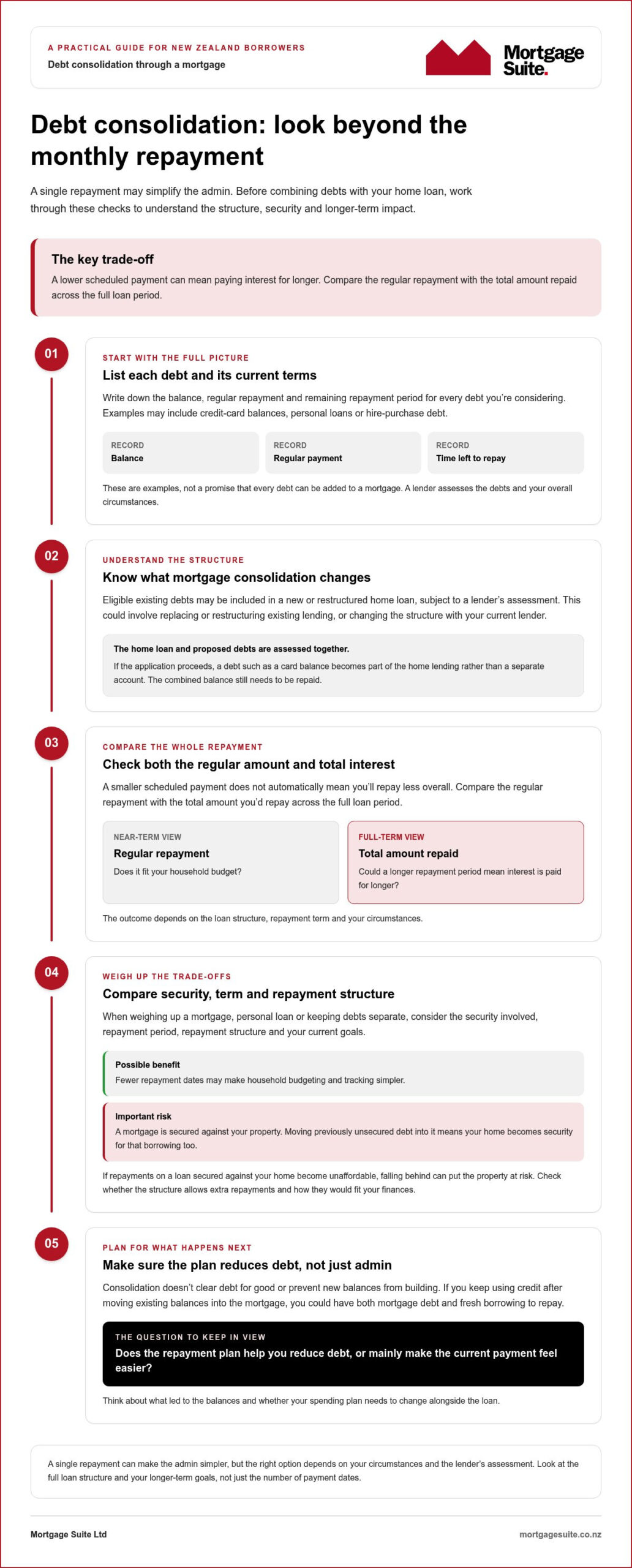
Keeping up with several balances, repayment dates and lenders can feel like a lot to manage. Bringing debts together may make the admin simpler, but the right choice depends on more than having one payment. Here’s how mortgage consolidation works, what a lender may assess and why a single repayment doesn’t automatically mean you’ll repay less overall.
Mortgage debt consolidation means including eligible existing debts in a new or restructured home loan, subject to a lender’s assessment. Unlike personal-loan consolidation, which combines debts through a personal loan, mortgage consolidation uses lending secured against your property. The wider What is debt consolidation? overview explains the general idea, but the mortgage option has its own trade-offs.
How mortgage debt consolidation works
A lender considers your existing mortgage alongside the debts you want to combine and assesses whether a revised loan structure may suit your circumstances. This could involve a Refinance, which means replacing or restructuring existing lending, or changing the structure of lending with your current lender. The details, including how the debt is repaid, depend on your situation and the lender’s assessment.
For example, if you have a home loan and separate credit-card debt, a lender may consider whether the proposed mortgage can cover both. If the application proceeds, the card balance becomes part of the home lending rather than a separate account. You may then have fewer repayments to manage, but the combined balance is still debt that needs to be repaid.
Consolidation can simplify administration, but it doesn’t erase what you owe or guarantee a lower total repayment. If the added debt is repaid over a longer period as part of the mortgage, you may pay interest for longer. The repayment plan should make sense for your budget and longer-term goals, not just reduce the number of dates in your calendar.
Which debts might a borrower consider combining?
People may ask about including credit-card balances, personal loans or hire-purchase debt. These are examples, not a promise that every debt can be added to a mortgage. A lender assesses the debts and the overall application, including whether the proposed lending fits your circumstances. Your existing home loan, property and intended repayment structure also matter.
Before exploring a debt consolidation mortgage NZ option, list what you owe and the repayment arrangements for each debt. Include the balance, regular payment and remaining repayment period. This gives you a practical starting point for comparing possible structures. Some debts may not suit mortgage consolidation, so assess the whole picture rather than assuming everything can be rolled in.
How can mortgage consolidation affect repayments and long-term interest?
Mortgage consolidation can make the regular payment feel more manageable, but that figure alone won’t tell you whether the arrangement works out better over time. Compare the repayment you’d need to make with the total amount you’d repay across the full loan period. The outcome depends on the loan structure, repayment term and your circumstances, so a lower scheduled payment isn’t guaranteed.
Potential benefits of bringing repayments together
Having fewer payment dates to track can make household budgeting simpler. A clear plan can also help you see how much you’re paying towards the combined debt and monitor your progress. Before agreeing to a new structure, check how repayments are set up and whether the plan fits your regular budget. Simpler administration can be useful, but it doesn’t reduce the debt by itself.
It may help to compare repayment estimates across different terms. A mortgage repayment calculator can help you explore how a change in term affects a scheduled payment. Treat the result as an estimate, not a lender decision or a full picture of the overall repayment.
Risks to weigh before adding debt to a mortgage
Mortgage lending is secured against your property. If you add debt that was previously unsecured, such as a personal loan, to your mortgage, your home becomes security for that borrowing too. If repayments become unaffordable, falling behind on a loan secured against your home can put the property at risk. That’s a serious trade-off to weigh alongside the convenience of one repayment.
Consider the repayment period as well. If the consolidated debt is repaid over a longer mortgage term than the original debt would have taken, you may pay interest for longer. A smaller regular payment could therefore come with a higher total amount repaid. Check whether the loan structure allows extra repayments and how those would fit your finances before relying on them to reduce the balance sooner.
Consolidation doesn’t clear debt for good or prevent new balances from building. If you keep using credit after moving existing balances into the mortgage, you could end up with both the mortgage debt and fresh borrowing to repay. Think about what led to the balances and whether your spending plan needs to change alongside the loan.
- Potential upside: fewer repayment dates and a clearer way to track the debt.
- Potential downside: interest may be paid for longer, and unsecured borrowing becomes secured against your home.
- Key question: does the repayment plan help you reduce debt, or mainly make the current payment feel easier?
A debt consolidation mortgage NZ option is worth assessing against both your monthly budget and your longer-term goals. If you’re weighing up how a different mortgage structure could affect your repayments, Mortgage Suite can help you explore debt consolidation and Refinance options with your circumstances in mind.
Mortgage or personal loan for debt consolidation: what should you compare?
There isn’t one option that suits every borrower. A mortgage lets you review your home lending and other debts together, while a personal loan or separate repayments may keep borrowing on a distinct repayment plan. Compare the full structure and how it fits your goals, not just how many payment dates you’ll have.
| What to compare | Mortgage consolidation | Personal loan or separate debts |
|---|---|---|
| Security | The combined lending is secured against your property. | A personal loan may be unsecured; separate debts keep their existing arrangements. |
| Repayment period | Debt added to a mortgage may be repaid over a longer term. | A personal loan may have a shorter, defined repayment period, depending on its terms. |
| Repayment structure | Debt becomes part of your mortgage lending and its repayment structure. | A personal loan has its own scheduled repayments; separate debts keep their individual schedules. |
| Fit with your goals | May suit a homeowner reviewing existing mortgage lending alongside other debts. | May suit someone who wants a separate repayment plan or to avoid securing that debt against their home. |
When mortgage-based consolidation may be worth exploring
If you own a home and want to review your mortgage and several debts as one picture, mortgage-based consolidation may be worth discussing. A lender may consider available equity, your existing lending and whether the proposed repayments are affordable. Having equity doesn’t guarantee approval, and the lender’s decision depends on your full circumstances.
Interest is only one part of the comparison. The amount borrowed, repayment period and loan structure all affect what you repay over time. The mortgage repayment calculator can help you explore how changing a repayment term affects the regular payment, but it won’t show whether a particular option suits your full situation.
When a personal loan or separate repayments may fit better
A separate repayment plan may suit you if you want to pay a debt down over a defined period, subject to a lender’s assessment and the terms offered. Keeping a debt separate can also avoid securing that borrowing against your home. You’ll still need to manage its repayment alongside your other commitments.
Compare the proposed payment with what you currently pay across all debts, then consider the full repayment period and total interest. A smaller regular repayment can look appealing, but it doesn’t show the long-term impact on its own. Think about whether the structure supports your current goals, such as reducing debt steadily or keeping your mortgage arrangements straightforward.
A debt consolidation mortgage NZ option should be weighed against your priorities, property and overall affordability, not judged on one feature alone. Mortgage Suite can help you consider debt consolidation and Refinance options across lender channels, with your circumstances in view. Explore your lending options with advice that’s free of charge and comes with no obligation.
What should you prepare before exploring debt consolidation in New Zealand?
A clear snapshot of your finances can make a debt consolidation mortgage NZ discussion more practical and less daunting. You don’t need to have a preferred loan structure worked out first. Start with the facts, then be ready to explain what you want a new arrangement to achieve.
Build a clear picture of your current borrowing
Gather your mortgage details and a summary of your other debts. Include what you owe, each repayment amount and date, and how long remains on each repayment plan. Add household income and regular commitments so you can see how borrowing fits alongside day-to-day expenses. If any repayments have become difficult to maintain, note that too. It’s useful context, not a reason to feel judged.
- List each debt. Record the lender or provider, balance, current repayment, due date and remaining repayment period. Include credit cards, personal loans and hire-purchase agreements if you have them.
- Gather your mortgage information. Note your current home-loan balance, repayment schedule and remaining term. Include relevant details about the property and any recent changes to your lending arrangements.
- Summarise household income and commitments. Write down income sources and regular expenses, as well as other repayments. This helps you consider whether a proposed payment could fit your usual budget.
- Mark any pressure points. Identify repayments that have become hard to keep up with, or months when several due dates fall close together. This can help focus the discussion on what needs to change.
- Set your priority. Decide whether you mainly want simpler administration, a manageable regular repayment or a clear plan to pay the debt down. You may value more than one outcome, but knowing your main priority helps you weigh up the trade-offs.
Set goals for a proposed new structure
Think beyond having one payment. What would a successful outcome look like for you? You might want predictable repayments, fewer accounts to manage or a clear plan to pay the consolidated debt down within a timeframe that fits your longer-term plans. Consider whether the proposed repayment period supports those plans, rather than focusing only on the amount due each time.
If you want to explore possible mortgage repayments, the Mortgage Suite mortgage calculator can help you model scenarios. Treat any result as an estimate, not a lender decision or a full assessment of your circumstances.
If a mainstream bank has declined your application, include that outcome and any reasons you were given in your summary. It may be a prompt to explore other lender channels, but it doesn’t guarantee a different decision. A lender will assess your full circumstances and the proposed structure.
Once your notes are ready, Mortgage Suite can help you consider debt consolidation and Refinance options with your goals in mind. Discuss your debt consolidation options and decide whether you’d like to take the next step.
How Mortgage Suite can help you explore debt consolidation mortgage options
Once you’ve weighed up the repayment structure, longer-term impact and security involved, it can help to talk through your situation with someone who understands lending. Mortgage Suite helps New Zealand borrowers explore debt consolidation and Refinance options, with your goals and circumstances at the centre of the discussion. The first step is to understand what you need the repayments to achieve, then consider possible lender routes and structures without assuming one answer fits everyone.
Mortgage Suite works with banks, private lenders and non-bank lenders. These different lender channels give you options to consider, but they don’t mean a particular loan will be available or approved. Each lender makes its own assessment of your circumstances and the proposed lending.
What a conversation about your options can cover
You can talk through your current borrowing, repayment priorities and wider lending goals. That might include reviewing your existing mortgage alongside other debts, discussing whether a Refinance or different loan structure could fit, and considering how proposed repayments may affect your plans. The focus is on weighing up the whole structure, not simply aiming for one repayment or a lower regular amount.
Mortgage Suite advocates and negotiates with lenders on your behalf, seeking the best possible deal for your circumstances. That is a goal, not a promise of approval or a particular outcome. You can read Mortgage Suite client reviews to hear about other borrowers’ experiences. Each person’s experience is different and doesn’t guarantee what will happen in your situation.
Founder Krish Krishna brings over two decades of banking experience to these conversations and has personally settled well over a billion dollars in residential, commercial and business loans. That experience provides useful context when considering a debt consolidation mortgage NZ option, while the right path still depends on your circumstances and the lender’s assessment.
A straightforward next step
Getting started doesn’t require you to commit to a new loan. Explain what you owe, what’s proving difficult to manage and what you’d like your repayments to achieve. If a mainstream bank has declined an application, that doesn’t have to be the end of the discussion. It may be a reason to explore other lender channels, though no outcome can be guaranteed.
If you’re ready to talk through your circumstances and possible next steps, talk through your loan options with Mortgage Suite and decide what feels right for you.
Take the next step with a clearer plan
You don’t need to decide on a new loan before asking whether consolidation could suit you. A useful next step is to talk through what you want to change, what repayments you can manage and how a proposed structure would fit your plans. That keeps the focus on finding a workable path, not combining debts simply to have one payment.
Mortgage Suite can consider debt consolidation and Refinance options across bank, private and non-bank lenders. Advice is free of charge with no obligation, and founder Krish Krishna brings over two decades of banking experience to the discussion. No lender outcome is guaranteed, but a conversation can help you understand what may be worth exploring based on your circumstances.
If you’re considering a debt consolidation mortgage NZ option, start by sharing your goals and the borrowing picture you’ve prepared. Talk through your loan options with Mortgage Suite and take a steady first step towards a plan that feels right for you.
Frequently Asked Questions
Is debt consolidation through a mortgage the same as refinancing?
No, they’re related but not identical. Refinance means replacing or restructuring existing lending, while mortgage consolidation means including eligible debts, such as a credit-card balance, in mortgage lending. A Refinance may be one way to arrange consolidation, but you can also restructure lending without changing lenders. The important point is to understand what changes in your loan and how the added debt will be repaid.
Can I consolidate debt into my mortgage if I have little equity?
Possibly, but having little equity can limit the amount a lender may be willing to add to your mortgage. The lender will consider the property’s value alongside the total lending you’re requesting and your ability to manage the repayments. For example, a small amount of available equity may not cover all the debts you hope to combine. A lender assessment determines whether a proposed structure may fit.
Does consolidating debt into a mortgage mean I pay less overall?
No, it doesn’t automatically mean a lower total amount repaid. The result depends on the loan’s interest, repayment amount and how long you take to repay the added debt. A lower scheduled payment could mean paying for longer. Compare the full repayment plan, not just the next payment due, and consider whether you can make progress on the balance within a timeframe that suits your plans.
Can I consolidate debt if a bank has declined my application?
You can still explore whether another lending structure or lender channel may suit, but a decline doesn’t mean another lender will approve the application. The reason for the decision matters. It could relate to affordability, property value, existing commitments or other parts of your circumstances. Mortgage Suite can discuss options across bank, private and non-bank lenders, but any lender will make its own assessment and no outcome is guaranteed.
Will my credit cards be closed when I consolidate their balances?
Not necessarily. Paying a card balance from mortgage funds doesn’t, by itself, tell you whether the card account will stay open or be closed. This depends on the lender’s requirements and the arrangements made for your application. If the account remains available, avoid building a new balance while repaying the amount through your mortgage. Otherwise, you could be managing the consolidated debt and fresh card borrowing at the same time.
What happens if my home value changes after consolidating debt?
A change in your home’s value doesn’t automatically alter your loan balance or scheduled repayments. It can, however, affect the equity you have and the relationship between the property value and the amount borrowed. If you later apply to borrow more or change lenders, the lender may assess the property and your overall circumstances again. Don’t rely on a future rise in value to make today’s repayment plan affordable.
Can I still explore mortgage consolidation if I have missed repayments?
Yes, you can discuss your situation, including missed repayments, but they may affect a lender’s assessment. Be upfront about which payments were missed, when this happened and whether the accounts are now up to date. That gives an adviser a clearer picture of the challenge and the options worth considering. A missed payment doesn’t define you, but approval will depend on the full application and lender decision.