
Calculating Home Loan Costs, Interest and Total Repayments
Your repayment depends on more than the amount you borrow. When calculating a home loan, the loan term, repayment frequency, interest rate and repayment structure all affect your regular payments and the total interest you may pay.
It’s natural to want a clear figure before making a major decision, but an estimate is only useful when you understand its assumptions. Changing the repayment frequency or choosing an interest-only period can affect both your regular payments and how quickly you reduce the amount borrowed.
This guide explains how to estimate home loan repayments in New Zealand and what to compare when reviewing mortgage options. Learn how loan size and repayment frequency affect the calculation, how principal-and-interest repayments differ from interest-only payments, and why the lowest regular repayment may not mean the lowest total interest. Understanding these factors helps you build a more realistic picture of borrowing.
Key Takeaways
- Compare repayment frequencies using the same loan details so you can see how payment timing changes your regular repayments.
- Look beyond the interest rate: the loan structure and its flexibility can affect how well repayments fit your plans.
- Use the amount you expect to borrow, rather than the property’s full price, to make your repayment estimate more relevant.
- Separate regular repayments from total interest to understand the longer-term effect of your loan settings.
- An interest-only period can reduce repayments for a time, but it doesn’t reduce the amount borrowed during that period.
Choosing repayment frequency
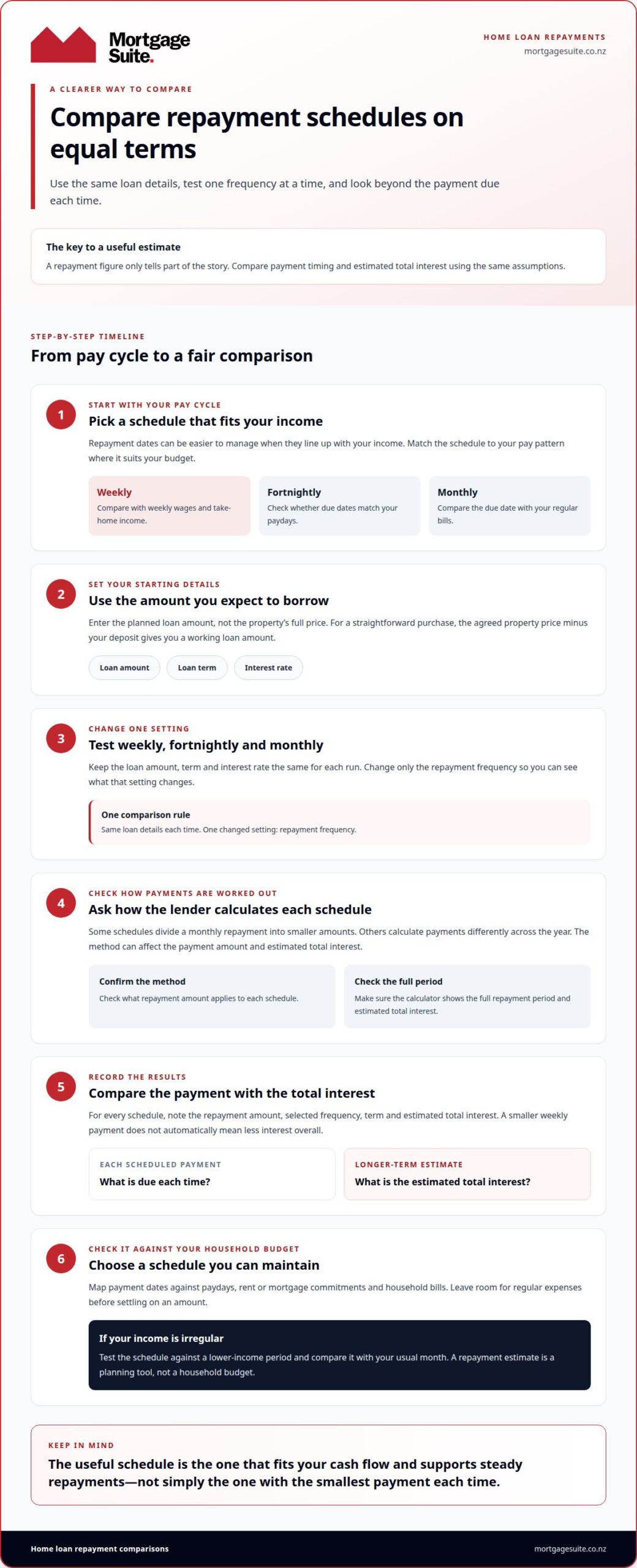
Start with your pay cycle and household budget. Repayment dates are easier to manage when they align with your income. Weekly repayments may suit weekly wages, fortnightly repayments may fit income paid every two weeks, and monthly repayments may suit a monthly salary. Frequency changes the amount due each time and may affect total interest, depending on how the lender calculates repayments. Compare schedules using the same loan amount, interest rate and term so you can see the effect of frequency alone.
Check how the lender calculates more frequent payments. Some schedules divide a monthly repayment into smaller amounts, while others calculate payments differently across the year. Ask what repayment amount applies to each schedule, and check that the calculator shows the full repayment period and estimated total interest. When calculating a home loan, the payment amount alone can be misleading: a smaller weekly payment does not automatically mean less interest overall. Compare the total paid and payment timing using the same loan assumptions.
- Weekly: compare the payment against weekly take-home income.
- Fortnightly: check whether payment dates match your paydays.
- Monthly: compare the due date with regular bills.
For a practical comparison, use the same inputs each time. Enter the loan amount, term and interest rate first. Select weekly, fortnightly or monthly repayments. Record each payment and estimated total interest. A home loan repayment calculator can help you compare those settings. Change only one setting at a time. That makes it easier to identify the effect of frequency. If the figures vary, review the repayment method and assumptions. Keep notes beside each result, including the selected frequency and term.
Your deposit and finance preparation also shape your buying range. In New Zealand, most lenders require first-home buyers to have a deposit of at least 20 % of the amount they are borrowing. Conditional pre-approved finance can help you understand the price range you can buy in. Arrange it with your chosen lender before looking for a property. These steps help you work with a realistic loan amount before comparing repayment schedules. They also connect the estimate to your buying plans, rather than an arbitrary figure.
Finally, choose a frequency you can maintain through changing weeks. Map payment dates against paydays, rent or mortgage commitments, and household bills. Leave room for regular expenses before settling on an amount. If your income arrives irregularly, test the schedule against a lower-income period. Compare that result with your usual month. A repayment estimate is a planning tool, not a household budget. The right frequency is the one that fits your cash flow and supports steady repayments without relying on optimistic assumptions.
Comparing mortgage options
In New Zealand, a fixed interest rate stays unchanged for its agreed period. A floating rate can change when the lender adjusts it, which may affect your repayments or the interest charged. Compare both options using the same loan amount and term.
The rate type affects predictability and flexibility. A fixed rate stays steady during the agreed period, making scheduled repayments easier to plan. When that period ends, a new rate arrangement may change your estimate. A floating rate can move during the loan, so repayments may rise or fall. Check whether the lender changes the repayment amount or keeps it level and adjusts the loan term.
Compare more than the first repayment figure. Use the same loan amount, repayment frequency and term for each option, then note the interest rate, repayment amount and estimated total interest. Update the estimate if the rate changes. This shows how the result responds without treating today’s figure as permanent.
- Fixed: consider how steady repayments fit your budget.
- Floating: consider how a changing rate could affect payments.
- Split: compare each portion separately, then review the combined repayment.
A split loan divides borrowing across different arrangements. For example, one portion could have a fixed rate and another a floating rate. This affects how much of the loan responds to rate changes, and means you need to track separate balances and repayment settings. Enter each portion separately if the calculator allows it, then add the results to estimate your total scheduled repayment. If it cannot model a split, compare each portion separately using consistent assumptions.
An offset account can also affect your comparison. Its balance reduces the loan balance used to calculate interest. For example, while money remains in a linked account, interest may be calculated on a lower balance. The effect depends on the balance and account terms. Compare the same loan with and without the offset, keeping the repayment amount and rate assumptions unchanged, to see how it may affect interest over time.
Use a home loan calculator to test different loan settings. Record each result beside its rate type and repayment assumptions. A lower first repayment doesn’t tell the whole story. Compare payment stability, flexibility and estimated interest together. Then consider which structure suits your income pattern and plans. That gives you a clearer basis for discussing options and choosing a repayment estimate that reflects the loan structure, not just the headline rate.
Entering a loan amount
Most lenders in New Zealand require first home buyers to have a deposit of at least 20 % of the amount they are borrowing. For a repayment estimate, enter the amount you plan to borrow, not the property’s full price.
For a straightforward purchase, start with the agreed property price and subtract your deposit. The result gives you a working loan amount. For example, if your deposit covers part of the purchase, the remaining amount is the starting figure for your estimate. Use the same amount across each calculator comparison. Changing it alongside the interest rate makes it harder to tell which input changed the repayment.
Keep the property value, deposit and borrowing amount distinct in your notes. They represent different parts of the purchase. A calculator’s loan amount field usually asks for the sum you plan to borrow, so check the label before entering a figure. Entering the purchase price instead could make the estimate assume you are borrowing more than intended.
Use this simple sequence before calculating:
- Enter the property price you are working with.
- Subtract the deposit you expect to contribute.
- Enter the remaining borrowing amount in the loan field.
- Check the figure and currency shown by the calculator.
Consider what your estimate includes. If you plan to borrow more than the purchase price, include those amounts in the loan figure. Don’t add an item simply because it appears in your wider budget. Include it only if you intend to borrow it, so the repayment estimate reflects your loan assumptions rather than unrelated household spending.
Use New Zealand dollars when entering the amount. A calculator may display a currency symbol or a separate currency label. Check that you have entered the full amount, with no missing digits or misplaced decimal point. Then compare the displayed loan amount with your notes. A quick check can catch a typing error before it changes the repayment estimate.
Try a second estimate with a different loan amount, keeping the rate, term and repayment frequency unchanged. This shows how borrowing size affects the scheduled payment. Record each amount beside its result. If you are still planning your purchase, treat the figures as scenarios, not as a final borrowing decision.
A home loan calculator can help you test these inputs. Start with one clear loan amount, then change one setting at a time. The resulting comparison is easier to understand when each estimate uses a consistent set of assumptions.
Interest and total repayment estimates
A repayment estimate shows a scheduled payment. The total repayment estimate adds those payments across the loan term, while the interest estimate shows the interest within that total. These figures depend on the loan amount, rate, term and repayment frequency. Enter each assumption carefully, then compare the payment, total repaid and estimated interest together.
Use a calculator to estimate repayments from your loan details. Select the repayment frequency, enter the interest rate and set the loan term, then review the payment shown. A home loan calculator can help you test these inputs. Note each setting, and record a new result whenever you change the rate or term so the comparisons are easy to follow.
Keep scheduled loan repayments separate from other financial commitments. Don’t add unrelated expenses to the loan amount unless you intend to borrow them. Use a separate budget for the rest of your home-buying costs.
In New Zealand, banks assess affordability by reviewing income, regular expenses, existing debt and proposed repayments. They may also use a serviceability stress test to check whether repayments remain manageable at a higher interest rate. Your estimate helps with planning, while a bank’s assessment considers your wider financial position.
Extra repayments can reduce the balance sooner and may lower interest over time. A shorter loan term usually increases each scheduled repayment but reduces the time interest can accrue. Compare these changes using the same loan amount and rate, and check your loan’s repayment conditions before planning extra payments.
If interest rates rise, repayments on a floating-rate loan may increase. A fixed rate stays unchanged for its agreed period, so scheduled repayments generally remain steady during that time. When the fixed period ends, a new rate may change the repayment. Test a higher-rate assumption to see how your budget responds.
Compare scenarios instead of relying on one figure. Start with your current assumptions, then test a higher rate, a shorter term and an extra repayment, changing one setting at a time. Record the new payment and estimated total interest for each scenario. This shows which changes affect cash flow most and which may reduce interest most. A lower regular repayment may mean paying for longer; a higher repayment may reduce the balance faster if it fits your budget.
Keep the estimate separate from your household budget. List your income and existing commitments alongside the proposed repayment, including regular bills and debt payments. Check whether the payment leaves room for those commitments. This helps you assess whether the estimate is workable before a full lending assessment.
Interest-only periods
With interest-only repayments, your payments cover interest rather than the loan balance. The principal, meaning the amount borrowed, stays unchanged during that period. So, interest-only payments on a home loan do not reduce the amount you owe.
Interest-only payments may be lower than principal-and-interest repayments on the same balance, rate and term. But that does not mean the loan costs less overall. Interest continues to accrue, and the original balance remains due. Compare the payment with the balance after each repayment to see whether your debt is actually reducing.
To estimate an interest-only repayment, use the outstanding balance and interest rate. A higher balance or rate means more interest to pay. Repayment frequency also affects how often you make payments. When comparing interest-only with principal-and-interest scenarios, use the same balance, rate and frequency.
Pay close attention to what happens when the interest-only period ends. If the loan then switches to principal-and-interest repayments, the remaining balance must be repaid over the remaining loan term, which may increase scheduled payments. The amount depends on the balance, rate and remaining term. Model both stages instead of looking only at the initial payment.
- During the period: track the balance and interest payments.
- At the changeover: note the remaining balance and term.
- Afterward: compare the new repayment with your budget.
For a clear comparison, record the interest-only payment, then estimate principal-and-interest repayments using the same loan amount, rate and repayment frequency. Keep the term assumptions clear, especially for the period after interest-only payments end. A calculator that models only one stage will not show the full repayment path. Estimate each stage separately, then consider their combined effect across the loan.
Interest-only repayments may suit a particular short-term cash-flow need, but they do not reduce the principal. Consider the purpose of the arrangement and what may change later. If your income is expected to change, for example, compare the later repayment with your expected budget. If the balance remains unchanged, plan how you will manage the move to repayments that reduce the debt.
Use a home loan calculator to compare repayment structures and test different rates. Change one input at a time, and save each estimate with its assumptions, including the balance, rate, frequency and remaining term. This makes the differences easier to explain and discuss. If you are weighing interest-only repayments against reducing the principal, compare the scenarios before choosing a structure.
Mortgage Suite Ltd: Home Loans to First Home Buyers
Mortgage Suite Ltd helps first-home buyers explore home loan options and understand how loan structure affects repayments. If your estimates raise questions about borrowing amount, repayment type or lender fit, a conversation can help put those figures into context.
Mortgage Suite Ltd offers Home Loans to First Home Buyers and Residential Investment property loans. It also offers Business Loans and Property Development Loans. If a mainstream bank’s lending criteria don’t fit your circumstances, 2nd Tier Loans may provide another path to consider. That doesn’t mean every application will suit every lender, so it helps to discuss your goals and financial position openly.
Bring your repayment estimates and the assumptions behind them, such as the loan amount, term and repayment frequency. Mortgage Suite Ltd can help you consider suitable lending options and negotiate with lenders on your behalf. To discuss your next step, contact Mortgage Suite Ltd or visit mortgagesuite.co.nz.
Make your next borrowing decision with confidence
A repayment estimate is more useful when it reflects the plans you are working towards. Before deciding what feels manageable, consider how your borrowing needs could change if your household or work circumstances shift. That wider view can help you choose a direction that supports your priorities, not just today’s budget.
Calculating a home loan gives you a starting point for that decision. The next step is matching your plans with the type of lending you need. Home Loans to First Home Buyers, Residential Investment property loans and Business Loans support different borrowing goals. A clear sense of your priorities can make your next conversation more focused.
Ready to take that step? Discuss your options. You can talk through what matters to you and move forward at a pace that feels right.
Frequently Asked Questions
What formula calculates mortgage repayments using the loan amount, interest rate, and term?
For a standard principal-and-interest loan, the periodic repayment formula is M = P × i(1 + i)n ÷ ((1 + i)n − 1). Here, P is the amount borrowed, i is the interest rate per repayment period, and n is the total number of repayments. Convert the annual rate to the relevant period and match n to your chosen schedule.
How do you calculate total interest and total cost over a home loan term?
Add the scheduled repayments across the loan term to estimate the total amount repaid. Subtract the original amount borrowed to estimate the interest, assuming the rate and repayment schedule stay unchanged. For example, if a calculator shows total repayments and the starting loan amount, subtract the loan amount from the total. If repayments or rates change, add the payments for each period instead.
What New Zealand mortgage calculators can estimate repayments and borrowing power?
A home loan repayment calculator can compare repayments using the loan amount, rate, term and repayment frequency. Conditional pre-approved finance from your chosen lender can help you understand your buying range before looking for a property.