
Bank rejected mortgage solutions in NZ: Can you afford the remaining lending
A bank rejection doesn’t automatically end your borrowing options. Bank-rejected mortgage solutions in NZ depend on why the application was declined and whether your finances can support the lending you need.
It’s understandable to feel unsettled when a lender says no, especially if you’re planning a property sale, changing loans or struggling with repayments. Start by understanding what the lender assessed: whether your income can cover repayments alongside everyday costs, and whether the property and available equity support the proposed lending.
This article explains how lenders assess your ability to service remaining lending, why a mortgage discharge may be declined, and how to communicate with your lender if your circumstances are changing. You’ll also learn what information can help clarify a lending decision and what options may be worth discussing next.
Key Takeaways
- A lender assesses whether your income can cover the remaining repayments alongside everyday expenses, not just whether you have property equity.
- If your finances may change, contact your lender early and explain what is changing and how it could affect repayments.
- A bank’s decision may reflect the information and lending structure in the application; understanding its reasons can help you decide what to address next.
- Clear, up-to-date evidence of your income, expenses, debts and property position can help explain your ability to manage the lending.
- If mainstream lending does not fit your circumstances, Mortgage Suite offers 2nd Tier Loans for lending needs that do not fit mainstream banks.
Ability to service remaining lending
A lender assesses whether you can keep up repayments on the loans that would remain after a sale, refinance or loan change. In New Zealand, everyday spending, including food and travel, also forms part of affordability.
Assessing ongoing repayment capacity
Serviceability means having enough reliable income, after regular expenses and debt repayments, to meet proposed mortgage repayments. It matters when a lender considers releasing security or changing one loan while others continue.
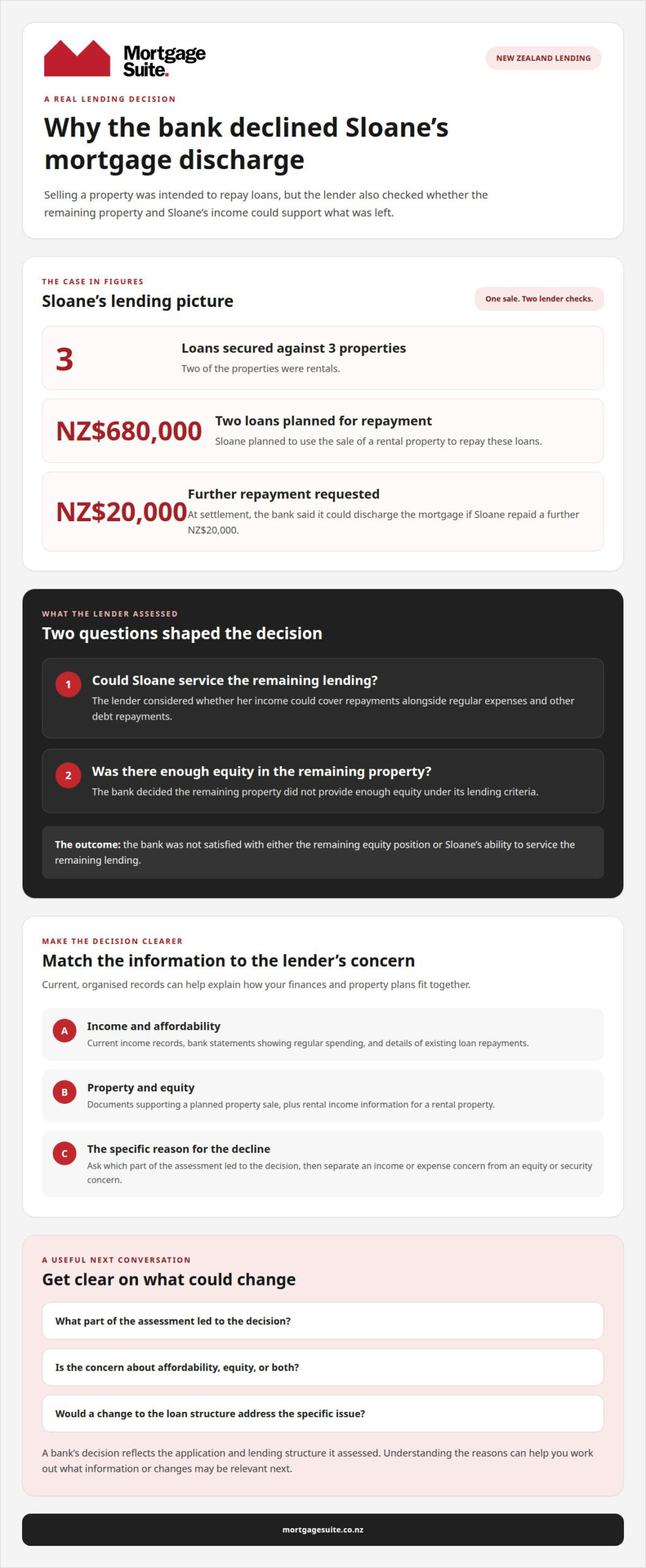
For example, selling a property might clear one debt but leave another mortgage in place. The lender considers whether your income and expenses support the remaining repayments, and whether the remaining property provides enough equity under its lending criteria.
Sloane had three loans secured against three properties, two of them rentals. She planned to use a rental property sale to repay two loans totalling NZ$680,000. Her bank declined to discharge a second mortgage because the remaining property did not provide enough equity to meet its criteria, and it was not satisfied she could service the remaining lending. At settlement, the bank said it could discharge the mortgage if she repaid a further NZ$20,000.
Reasons banks decline applications
A decline means the lender’s assessment did not support the application as presented. It is not a judgement on you. Income changes, existing debts, regular living expenses and property equity can all affect the decision.
New Zealand lenders must consider whether borrowers can afford mortgage repayments, including everyday costs such as food and travel. The Credit Contracts and Consumer Finance Act (CCCFA) sets lender responsibility principles, while the Responsible Lending Code guides those responsibilities. A lender also considers whether the proposed mortgage suits the borrower’s needs.
- Ask the lender which part of the assessment led to the decision.
- Separate an income or expense concern from an equity or security concern.
- Check whether a change to the loan structure would address the specific issue.
Evidence for a stronger application
Useful evidence explains the figures behind your application. Organised records can show how your income, spending, debts and property plans fit together, especially if your finances have changed since the original assessment.
Gather current income records, bank statements showing regular spending, details of existing loan repayments, and documents supporting any planned property sale or income change. For a rental property, include information about its rental income. Match each document to the lender’s stated concern, such as affordability or the equity remaining after a sale.
What alternative mortgage lenders operate in NZ, and how do their rates compare? New Zealand has non-bank and specialist lenders for applications that do not fit mainstream bank criteria. Rates vary by lender, security and loan structure, so compare the full terms rather than assuming there is one standard difference.
What are the risks of using non-bank or specialist mortgage lenders in NZ? Different lending terms can affect repayments, flexibility and your options later. Review the repayment conditions and consider how the loan fits your longer-term plans before agreeing.
Communication about lending decisions
Clear, early communication gives you more time to discuss a change before it affects repayments. Your lender can explain its decision and what information may help clarify the next step.
Timing a further bank application
A further application is most useful when you understand the first bank’s reasons and can address them. You can approach another New Zealand bank after a rejection, but presenting the same circumstances may raise similar concerns.
First, ask the original lender to explain its decision. If your income is about to fall, contact your lender before the change happens. If an unexpected event makes repayments unaffordable, ask about hardship assistance, which may change repayments or provide a repayment holiday.
Broker support after a decline
A mortgage broker can help you understand the decline, organise relevant information and present your circumstances to a suitable lender. This can be useful when the decision involves several factors, such as an income change alongside existing lending.
Ask the broker to explain the proposed approach in plain language, including how the lending would fit your needs and what information supports the application. In New Zealand, a mortgage broker must act with care and skill and be registered as a financial adviser. You can check registration through the Financial Service Providers Register.
Credit score effects
A rejection alone isn’t the same as a missed repayment, so don’t treat the decision as proof that your credit score has changed. The lender’s assessment and your repayment conduct are separate parts of your borrowing history.
Ask what information the lender considered and make sure your records are accurate. If you have missed mortgage payments, raise this separately and explain the circumstances. A New Zealand lender may work with a borrower who has missed one or two payments to develop a programme to repay the debt.
Keep each conversation focused on a clear point: the reason for the decision, what has changed, or what support may help. For example, if your employment has changed, explain how that affects your income and when the change began. If repayments are becoming difficult, contact the lender as soon as you find it hard to pay on time. Early contact gives you a chance to discuss your situation before missed payments build up.
After a call, record the date, who you spoke with, the decision explained and any agreed next steps. Follow up in writing if you need a clear record of the discussion. New Zealand lenders must provide key mortgage information in writing, including repayment amounts and how interest is calculated. If you disagree with how a lender or broker handled your concern, you can make a formal complaint to the provider or seek help from a financial dispute resolution scheme.
A broker can help turn a decline into a practical discussion about your next steps. Talk through your lending options if you’d value support understanding the decision and preparing for further discussions.
Why do New Zealand banks reject mortgage applications?
A New Zealand bank can decline a mortgage when its assessment does not show that the borrowing is affordable or suitable. The reason may relate to income, regular spending, existing debts, property equity or the loan structure, rather than one isolated detail.
Affordability is central to the assessment. A lender must consider whether you can meet repayments while paying everyday expenses, including food and travel. For example, income may look sufficient on its own, but regular household spending and existing loan repayments also affect what remains available for a mortgage.
Changes in employment can alter the picture. If your income has fallen, become less predictable or changed recently, a lender may reassess whether repayments remain manageable. The key is how the change affects your income after expenses and current debt commitments. Explain changes clearly rather than relying on an earlier income snapshot.
Equity and property security can also affect a decision. A lender considers whether the property backing the loan supports the proposed lending under its criteria. If a sale or loan change would leave a mortgage secured against another property, the lender may assess both the remaining debt and the security left behind. You may therefore have a sale plan but still face concerns about the remaining arrangement.
The loan must also suit the borrower’s needs. Under the Credit Contracts and Consumer Finance Act (CCCFA), New Zealand lenders must follow lender responsibility principles. The Responsible Lending Code guides those responsibilities. A lender must consider the amount needed and whether the borrower wants to make lump-sum repayments or add other products. A loan may not fit if its structure does not match the purpose or repayment needs.
- Income and expenses: Consider whether earnings can cover repayments alongside everyday costs.
- Existing commitments: Include current loans when assessing room for another repayment.
- Property security: Consider whether the property supporting the loan meets the lender’s criteria.
- Loan suitability: Check whether the amount and structure fit the borrower’s stated needs.
To clarify the decision, ask the bank to identify its specific concern. If it names affordability, focus the discussion on income, expenses and existing commitments. If it raises equity or security, ask how the proposed lending and property arrangement affect its assessment. A precise reason helps distinguish a problem with the figures from a mismatch between the loan and your plans.
New Zealand lenders must also provide key mortgage information in writing, including repayment amounts and how interest is calculated. Use that information to understand the proposed commitment and identify what the bank assessed. A decline can be difficult to hear, but the stated reason gives you a practical starting point for deciding what comes next.
Can I apply to another NZ bank after a mortgage rejection, and when?
You can apply to another New Zealand bank after a rejection, but first understand what the original lender assessed. A new application is more useful when it addresses the reason for the earlier decision, rather than simply repeating the same information. Finding bank-rejected mortgage solutions in NZ starts with identifying what needs to change or be explained.
There’s no single timing rule that suits every borrower. The right time depends on what has changed, what the first lender said, and whether you can now explain your circumstances more clearly. For example, if your income is expected to drop, contact your current lender before the change happens. If the issue is unclear, ask for the decision and its reasons in writing before approaching another bank.
Start by separating the bank’s concerns. Was the application affected by income, existing commitments, everyday spending, property security or the proposed loan structure? A clear answer helps you decide whether a new application could address the issue. If the concern was an upcoming employment change, waiting until you can document your new income may make your position easier to explain.
A second bank will make its own assessment of your circumstances. It may consider the same broad factors, including whether repayments fit alongside household spending and other debt. Changing lenders alone may not resolve a concern that still applies to your finances. If you’re weighing bank-rejected mortgage solutions in NZ, consider whether a different application structure or updated evidence would explain your position better.
Before applying, prepare a short explanation of what has changed since the first decision. For example, note a change in employment, a debt repayment or a revised property plan. Then organise documents to support those details. If nothing has changed, ask the first bank what information would clarify its decision before submitting another application.
- Get the reason: Ask the first bank to explain the decision in clear terms.
- Identify the change: Note what is different now, such as income or debts.
- Match the evidence: Gather records that support the updated information.
- Discuss timing: Contact your lender before an expected change affects repayments.
Making several applications without understanding the first decline can make it harder to present a clear picture. Instead, record which lender assessed the application, what concern it raised and what evidence you provided. This gives you a practical basis for discussing your next application with a mortgage adviser or lender.
There’s no need to treat a rejection as a final judgement on your plans. A bank decision reflects its assessment of the application and the information available at the time. If your circumstances or supporting evidence change, explain the differences plainly. When a financial change is coming, speak with your lender beforehand and discuss how it may affect your repayments.
What documents or evidence can strengthen a rejected mortgage application in NZ?
Useful evidence addresses the concern behind the bank’s decision. Match each document to a point the lender raised, such as income, expenses, debts or property security. A clear application helps the lender understand your current position instead of relying on figures that no longer reflect your circumstances.
For an income concern, provide recent records showing where your earnings come from and whether they are ongoing. These could include payslips, employment details or business accounts, depending on how you earn. If your work has changed, briefly explain when it changed and how your current income differs from the information in the original application.
To explain spending and commitments, organise bank statements and a current list of debts and repayments. Include regular costs such as rent, utilities, transport and food, alongside credit or loan commitments. Explain any large transaction on a statement. For example, distinguish a one-off car repair from an ongoing monthly expense.
Property-related evidence should make the proposed arrangement easy to follow. For a planned sale, include relevant sale information and explain how you intend the proceeds to affect existing loans. If rental income is part of your financial position, provide records showing the income and the property it relates to. If the bank raised an equity concern, clearly set out property values, lending secured against each property and proposed changes.
Keep your evidence current and consistent. If the application says a debt has been repaid, include information supporting that change. If income or property details differ between documents, explain why. A brief covering note can link the documents to the bank’s concern, so the lender can see how each item relates to your request.
- Income: Gather payslips, employment information or business records that support current earnings.
- Spending: Organise bank statements and explain unusual or one-off transactions.
- Debts: List current loans and repayments, then include evidence for any change.
- Property: Set out sale plans, rental income and lending secured against each property.
Before sending anything, compare the application details with the supporting records. Check that your income, expenses, loan balances and property information tell the same story. If a document is missing or a figure has changed, explain it directly instead of leaving an unexplained gap. This gives the lender a clearer basis for reviewing your application.
If you want help organising evidence around a lender’s stated concerns, get support preparing your next mortgage application.
Mortgage Suite: 2nd Tier Loans- loans that do not fit mainstream banks
Mortgage Suite Ltd can discuss 2nd Tier Loans when your borrowing needs don’t fit mainstream bank criteria. If you’re considering bank-rejected mortgage solutions in NZ, a declined application is a reason to review your circumstances, not a promise that another loan will be suitable.
The next step is to review what the lender assessed, your repayment capacity and the purpose of the borrowing. Mortgage Suite Ltd can help you understand whether a different lending approach is worth exploring and what information will help present your situation clearly. The discussion should also consider whether repayments fit your plansauthorised.
If a mainstream bank has declined your application, contact Mortgage Suite Ltd to discuss your lending situation.
Choose a lending path that fits your next move
A declined application can be a prompt to rethink how your borrowing is presented, not a reason to rush into another commitment. Take time to consider what you need the lending to do, how repayments fit your plans, and what a workable outcome looks like for you.
If you’re looking for solutions after a bank rejects your mortgage in NZ, focus the next conversation on your circumstances and goals, not just the declined application. Mortgage Suite offers home loans to first home buyers, residential investment property loans and business loans, alongside non-bank lending for people who don’t fit mainstream bank criteria. Start with the purpose of the borrowing and the details that shape your ability to manage it.
There’s no pressure to have every answer ready before you talk. Share what the lender said and what you’re hoping to achieve, then explore a sensible next step together. Contact Mortgage Suite to discuss your options and find a way forward that feels considered and manageable.
Frequently Asked Questions
What can I do after a mortgage application is declined in NZ?
Decide whether you want the bank to reconsider the same application or whether your circumstances call for a different borrowing plan. If you seek reconsideration, organise the relevant details into a concise update, such as a corrected income figure or a change in loan purpose. If your plans have shifted, explain the outcome you need, such as buying your first home or funding a business, before discussing suitable lending options.
How can I find out why a bank rejected my mortgage application?
Ask for a clear explanation of the decision and which information or assumption mattered most. Then compare that explanation with your application details. For example, if the bank’s assessment appears to rely on an outdated employment arrangement, point out the difference and provide current details. This helps distinguish a factual misunderstanding from a lending concern that needs a broader response.
Can I appeal a mortgage decision or complain to the bank or a New Zealand financial dispute resolution service?
You can ask the bank to reconsider a decision, particularly if relevant information was inaccurate or has changed. An appeal focuses on the lending assessment; a complaint can raise concerns about how your application or communication was handled. Keep your written account focused on the outcome you’re seeking and the specific issue. A dispute process can address a complaint, but it doesn’t mean the bank must approve the lending.