
Financing a Commercial Property with No Deposit in NZ: What Are Your Options?
What if buying a commercial property didn’t have to wait until you’d saved a cash deposit? For Kiwis exploring financing a commercial property with no deposit nz, the key is understanding that “no deposit” usually means supporting the loan another way, not borrowing the full purchase price against the property alone.
It’s understandable to feel unsure about what a lender might accept, especially if you’ve already had a bank decline. That decision isn’t necessarily the end of the conversation. Lenders look at the security available, your ability to manage repayments and how the property fits their lending criteria. The right approach depends on your circumstances.
This article explains what a no-deposit request can mean and outlines options that may strengthen an application, such as using available property equity or considering a different funding structure. You’ll also learn what information to prepare before discussing your plans with a lender. Mortgage Suite arranges commercial property finance across New Zealand, working with bank and non-bank lenders to help you understand your options and negotiate a structure suited to your needs. Approval is always the lender’s decision.
Key Takeaways
- See what financing a commercial property with no deposit nz could involve and why the right approach depends on your circumstances.
- Understand the key parts of a lender’s assessment, including your business’s ability to manage repayments and the security available.
- Compare possible funding routes and consider what each could mean for your wider financial position.
- Get ready for a lender discussion by organising information about your business, finances and the property.
- Learn how Mortgage Suite can help explore lender options, with brokerage and financial advisory services free of charge and with no obligation.
Can you finance a commercial property with no deposit in NZ? What it really means
A cash deposit can feel like the main obstacle between your business and suitable premises. But financing a commercial property with no deposit nz doesn’t automatically mean a lender will fund the entire purchase price against that property alone. It usually means you don’t have cash available for a deposit, so the lender needs to consider the wider application, including any other security that could support the borrowing.
That distinction matters. A possible funding structure is not the same as approval, and there isn’t one outcome that applies to every borrower. The options depend on your circumstances, the property and the lender’s assessment. A mainstream bank’s decision is one part of the picture, not a judgement on you or your business as a whole.
Does no deposit mean borrowing the entire purchase amount?
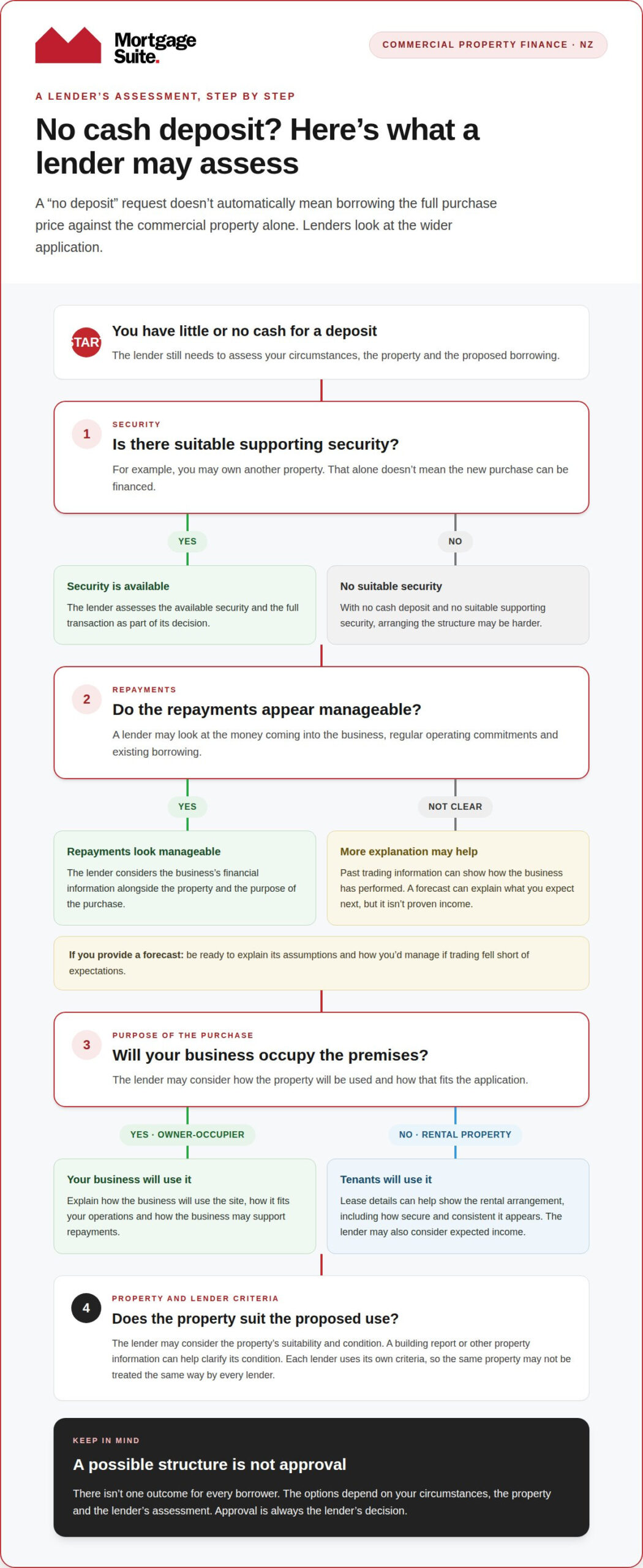
No. “No deposit” describes the cash you can contribute towards the purchase. It doesn’t tell you how much a lender will agree to advance or what other support it may require. A lender may assess whether there’s acceptable security, whether repayments appear manageable and whether the proposed purchase makes sense for your circumstances.
For example, a buyer may have little cash set aside but own another property. That doesn’t automatically make the new purchase financeable. The lender would still need to assess the available security and the full transaction. If there’s no cash deposit and no suitable supporting security, the structure may be harder to arrange. The details matter more than the label.
Commercial mortgages are assessed in relation to the property and the borrower’s ability to meet the loan obligations. For a general overview of commercial mortgages, see how the property can act as security for the borrowing. In practice, a lender considers the proposed security as part of its own assessment. “No deposit” isn’t an automatic route to full funding.
Why commercial property finance differs from a simple home loan
A commercial purchase is tied to a business purpose, so the questions can differ from those for a home. A lender may want to understand what the premises will be used for, how the business fits into the plan and whether the property is suitable for that use. The business’s financial position can also shape how the application is assessed.
An owner-occupier buying premises for their own business may need to explain how the business will use the site and support the repayments. For an investment purchase, the lender may focus more on the property’s rental arrangements and the income expected from it. These are different lending questions, not a guarantee that one type of purchase is easier to fund.
The rest of this guide looks at what lenders may assess, possible ways to support an application and how to organise your information. That gives you a clearer starting point for discussing the purchase and working out which structures may suit your circumstances.
What lenders assess when you seek commercial property finance with no deposit
A lender will look at how the borrower, the property and the purpose of the purchase fit together. For financing a commercial property with no deposit nz, this means showing more than enthusiasm for the premises. The lender needs to understand how you could manage repayments and what security supports the request. The weight given to each part can vary between lenders, so there isn’t one checklist that guarantees an application will pass.
The details also depend on the transaction. A business buying premises to operate from may be assessed differently from a buyer relying on rent from tenants. Lenders can consider the applicant’s financial information alongside the property’s condition, intended use and income arrangements.
How business cash flow and repayment ability are considered
Expect questions about money coming into the business, regular operating commitments and existing borrowing. Together, these help a lender understand whether there appears to be enough room to meet repayments while keeping the business running. The commercial lending requirements outlined by the Corporate Finance Institute offer general context on how lenders may consider cash flow and security. They aren’t a guide to every New Zealand lender’s policy.
Past trading information can help show how the business has performed, while a forecast sets out what you expect to happen next. A forecast may explain a planned move into larger premises or a change in how the business operates, but it isn’t the same as proven income. Be ready to explain the assumptions behind it and how you’d manage if trading fell short of expectations.
How property security, use and lease details can affect an application
The lender may consider whether the property is suitable for the proposed use and what its condition means for the application. A building report or other property information can help clarify the premises’ condition. Lenders assess security using their own criteria, so a property that suits one lender may not be treated the same way by another.
If your business will occupy the premises, explain how you plan to use the site and how that fits your operations. If the property will be rented, lease details may help show the income arrangement, including how secure and consistent it appears. A vacant building, a short lease or a planned change of use could raise different questions. None of these details alone determines the outcome. Lenders consider them alongside the wider application.
- For an owner-occupied purchase: set out the business’s intended use of the property and how it fits your trading plans.
- For a rental property: have the lease information and expected rental arrangements ready to discuss.
- For either type: organise a clear picture of your existing commitments and any supporting security.
Requirements and appetite differ, and a decline from one lender doesn’t necessarily settle what another may consider. Mortgage Suite can help you discuss your circumstances and possible lender matches. You can explore commercial property finance options with a brokerage and financial advisory service that’s free of charge with no obligation.
Comparing possible routes to commercial property finance without a cash deposit
If cash is tight, the next step is to look at what else may support the application. For financing a commercial property with no deposit nz, potential routes can include using equity in another property, offering other acceptable security or considering a lender outside the mainstream banks. These are possibilities to discuss, not standard options every lender will accept.
Use this comparison to think through what each route could involve and what you’d need to understand before committing. The right fit depends on your overall financial position, the property and the lender’s requirements.
| Possible route | What it may involve | Questions to consider |
|---|---|---|
| Existing property equity | A property you already own may be included as supporting security for the proposed borrowing, subject to the lender’s assessment. | What obligations would be secured against it, and what could happen to that property if repayments aren’t met? |
| Other acceptable security | You could discuss whether the lender may accept additional security as part of the overall structure. | Does the lender accept the asset, and what conditions would apply? |
| Non-bank lending | A non-bank lender may assess an application that doesn’t fit a mainstream bank’s criteria. | Does the structure suit your plans and repayment ability, including what happens when the loan term ends? |
Using existing equity or other security
Equity is the value in a property after accounting for lending secured against it. A lender may consider whether some of that value can support a commercial purchase, but it isn’t automatically treated as a deposit or accepted by every lender. Adding another property as security can also put it at risk if the loan obligations aren’t met. Before agreeing, make sure you understand which assets are tied to the borrowing and what that means for you.
Considering bank and non-bank lending options
Banks and non-bank lenders can have different assessment approaches and requirements. A bank decline doesn’t necessarily end the conversation; another lender may consider the application differently. That doesn’t mean an alternative will approve it, or that its structure will suit you. Compare the full arrangement, including repayments, security and obligations over time, rather than focusing only on the headline interest rate.
For a clearer discussion, map out what you can contribute, what security may be available and which risks you’re comfortable taking on. Mortgage Suite works with bank and non-bank lenders to explore options suited to a borrower’s circumstances, without treating any route as a guaranteed outcome.
How to prepare for a no-deposit commercial property finance discussion
A little preparation can make a finance discussion clearer and more useful. You don’t need every answer sorted before you start, but it helps to explain what you want to buy, how you plan to use it and what could support the borrowing. This gives an adviser a clearer picture of the transaction and helps identify where more information may be needed.
Before discussing possible structures, work through these steps:
- Define the purchase purpose. Note whether your business will operate from the premises, whether you plan to lease it to tenants or whether it has another commercial use.
- Set out the repayment picture. Summarise how the business earns income, its regular commitments and how you expect repayments to be managed.
- Identify possible security. List any property or other assets you may be willing to discuss as supporting security, along with existing lending secured against them.
- Gather supporting information. Bring together relevant business, personal and property documents so the discussion can focus on your circumstances.
This isn’t a universal checklist. The information needed can change with the purchase, the borrower and the lender. A finance adviser can help identify gaps and discuss possible lender pathways, while the lender makes the lending decision.
Information to organise before discussing finance
Start with a clear summary of the business’s financial position. Gather available accounts or other trading information, details of current borrowing and a forecast if you’re relying on planned business activity. If there are multiple owners or a proposed ownership arrangement, write down who will be involved and how the purchase is intended to be held.
For the property, collect what you have about its condition and proposed use. If it’s already leased, include the lease details and rental arrangements. A building report or other property reports may also help explain its condition. Make a note of anything still in progress, such as a report or final lease terms.
Questions to clarify before choosing a funding structure
Before settling on a structure, consider: Will your business occupy the premises, will tenants lease it, or will it serve another commercial purpose? Which assets might you consider offering as security, and what would that mean for your wider financial position? What information supports your plan for managing repayments? Clear answers help keep the discussion grounded in your goals and the risks you’re comfortable with.
The documents you need will depend on the transaction, so treat your preparation as a starting point rather than a fixed lender checklist. Mortgage Suite can help you organise your questions and consider what information may be useful in a lender discussion. You can also build your understanding through the commercial property finance learning resources.
If you’d like support to get your plans sorted, start a commercial finance discussion with Mortgage Suite. Begin with the details you have, then work through any gaps as the proposed purchase becomes clearer.
How Mortgage Suite can help with commercial property finance in NZ
A commercial purchase can involve several moving parts, especially if you don’t have cash available for a deposit. Mortgage Suite helps you make sense of the funding discussion by looking at your deposit position, the property and how you plan to use it. The aim is to explore lender options and a structure that fits your circumstances, not to promise an outcome before a lender has assessed the application.
That personal approach matters for financing a commercial property with no deposit nz. A useful conversation can clarify what information may be needed, which parts of the application could raise questions and what options may be worth exploring. You can discuss the plan openly, including any previous decline, without treating it as the final word on your borrowing goals.
A lender conversation shaped around your circumstances
Mortgage Suite works with bank and private lenders, including non-bank options, and can help match your application to lenders whose approach may fit your situation. If mainstream-bank criteria don’t suit the request, other pathways may be discussed. Each lender makes its own decision after assessing the borrower, security and transaction, so exploring an option is not the same as securing approval.
Founder Krish Krishna started Mortgage Suite in 2000 after 18 years in banking. He has arranged well over a billion dollars in residential, commercial and business loans. That experience informs a practical discussion about deposit needs, the property’s suitability and how the proposed finance could be structured around your business plans.
Before considering a route, it’s worth understanding its responsibilities as well as its potential benefits. If a structure involves additional security, for example, you’ll want to know which assets may be tied to the borrowing and what that could mean if repayments aren’t met. Mortgage Suite can help you work through these questions and present your circumstances clearly to a lender, while keeping the lender’s independent assessment in view.
A discussion can help you understand the choices in front of you and decide whether you’re ready to proceed. Take time to weigh the structure against your business plans and the risks you’re comfortable accepting.
A straightforward next step without pressure
To make the discussion more useful, have a short summary ready of what you want to buy, how the property will be used, your business position and any security you may be considering. Bring along relevant financial and property information if you have it. If the purchase involves a development project, the funding questions may differ from buying established premises, so keep the project purpose clear from the outset.
If you’d like to talk through your commercial finance options, start a discussion with Mortgage Suite. You can take it one step at a time, with no assumption that approval is assured.
Take the next step with a clear plan
A commercial property purchase is a major decision, and you don’t need to settle on a funding structure before weighing the trade-offs. Think about what matters most to your business, such as keeping other assets separate, moving ahead with a particular property or choosing repayments that fit your plans. Being clear on these priorities can help you decide what to explore next.
If financing a commercial property with no deposit nz is part of your plans, use the information you’ve gathered to compare possible structures and consider the responsibilities attached to each. Give yourself time to assess how a borrowing decision could affect your business beyond the purchase itself.
When you’re ready to take a practical next step, explore commercial property finance options with Mortgage Suite. Its mortgage brokerage and financial advisory service is free of charge with no obligation, so you can talk through your plans without pressure.
Frequently Asked Questions
Can I get commercial property finance in NZ with no deposit?
It may be possible, but financing a commercial property with no deposit nz depends on the strength of the full application, not just the cash you have available. A lender may consider other property or assets as security, alongside your ability to manage repayments and the purpose of the purchase. For example, a business buying its own premises may present a different case from a buyer relying on rental income. Approval isn’t assured.
How much deposit do I need for a commercial property in New Zealand?
There isn’t one deposit amount that applies to every commercial property purchase. The lender may consider the property type and condition, your financial position, the proposed use and any other security available. A specialised property or a purchase with less established income may raise different questions from a property with a clear business use or lease. The deposit and security requirements depend on the specific transaction.
Can I use equity in another property instead of a cash deposit?
A lender may consider equity in another property as supporting security, but it isn’t automatically accepted as a direct replacement for cash. For example, if you own a home with existing lending, the lender would need to assess its value, current debt and the proposed arrangement. You should also understand that offering the property as security may put it at risk if you can’t meet the loan obligations.
What happens if my bank declines commercial property finance?
A decline from one bank doesn’t necessarily end the process. The reason matters: the issue may relate to the property, your financial information, the proposed security or the lender’s criteria. Once you understand the concern, you can consider whether clearer supporting information or a different structure could address it. A non-bank lender may assess the application differently, but it will still make its own decision and approval isn’t guaranteed.
Can a new business apply for commercial property finance?
Yes, a new business can apply, although limited trading history may mean the lender has less past performance to assess. You may need to explain the business plan, expected income, relevant experience and how the premises will support the operation. For instance, signed customer agreements or a clear plan for bringing the business into the property may help describe the proposal. The lender will assess the whole application, including security and repayment ability.
What information should I prepare for a commercial property finance application?
Prepare a clear summary of the purchase, the property’s intended use, your business income and existing borrowing. Useful supporting material may include recent business accounts, cash-flow forecasts, ownership details, property reports and lease information if tenants are involved. Keep a note of anything that’s still pending, such as a report or final lease terms. The lender’s document requests will vary, so this preparation is a starting point rather than a fixed checklist.
Does Mortgage Suite guarantee approval for a no-deposit commercial property loan?
No. Mortgage Suite doesn’t guarantee approval for a no-deposit commercial property loan. It can discuss your circumstances and explore potential lender options, including bank and non-bank channels, but the lender makes the decision after assessing the application. If you’re unsure how to proceed after a decline or want to understand what may strengthen your case, a discussion can help clarify possible next steps without promising a particular result.