
Flexible home loan options in NZ: compare rates and repayments
The lowest interest rate isn’t always the best fit. Flexible home loan options in NZ also depend on how predictable you want your repayments to be and whether you want room to pay extra. Choosing between fixed, floating and split rates can feel like a lot to weigh up, especially when you’re buying your first home.
A table loan spreads repayments over an agreed term, with each payment covering interest and reducing the amount borrowed. The right structure can make repayments easier to plan for while leaving some flexibility if your income or plans change.
This guide explains how table loans work, what fixed, floating and split rates mean, and how extra repayments may affect your loan. It also covers home loan choices for first-home buyers, so you can understand the options and trade-offs before deciding what may suit your goals.
Key Takeaways
- Understand how a table loan splits each repayment between interest and the amount you owe, and how the balance changes over time.
- Compare fixed, floating and split rates by weighing repayment certainty against flexibility.
- Learn how extra repayments may help reduce your loan, and why fixed-rate conditions can affect how much you can pay.
- Explore first-home buyer loan structures and the factors that shape your borrowing options.
- See how revolving credit links your loan and everyday money, and why it suits some budgeting habits better than others.
Table loans and repayment structure
A table loan keeps repayments regular across an agreed term. Each payment covers interest and repays some of the amount borrowed. Early in the loan, a larger share usually goes towards interest; later, more reduces the principal. With most New Zealand lenders, a table mortgage can have a term of up to 30 years.
These figures show how repayment size and loan length affect the total paid.
A low deposit changes the lending picture. Most New Zealand lenders require a minimum 20% deposit, equivalent to an 80% Loan-to-Value ratio. Eligible buyers can apply for a Kāinga Ora First Home Loan with a 5% deposit. A smaller deposit means borrowing a larger share of the property’s value, so lender criteria and your ability to meet repayments matter.
Offset and revolving credit loans work differently. With an offset account, eligible savings reduce the balance used to calculate interest. Eligibility for offset or revolving credit depends on lender criteria and your financial position, including your income, expenses, deposit and ability to manage repayments. Banks set their own eligibility criteria and product ranges, so there is no universal list of banks offering these arrangements.
Flexible loans also have trade-offs. A floating rate or revolving balance can make repayments less predictable when interest rates change. Easy access to available credit may also make it harder to reduce debt if spending outpaces repayments. An offset arrangement works best when savings remain in linked accounts, reducing the balance on which interest is calculated.
A mortgage broker can compare lender criteria, explain the differences between table, offset and revolving structures, and help prepare an application. They can organise information about your income, expenses, deposit and property plans, then present your circumstances to suitable lenders. This support can clarify whether repayment certainty or access to funds matters more for your plans, without assuming one structure suits every borrower.
The Kāinga Ora First Home Partner scheme required its deposit contribution to be repaid within 15 years.
Fixed, floating and split interest rates
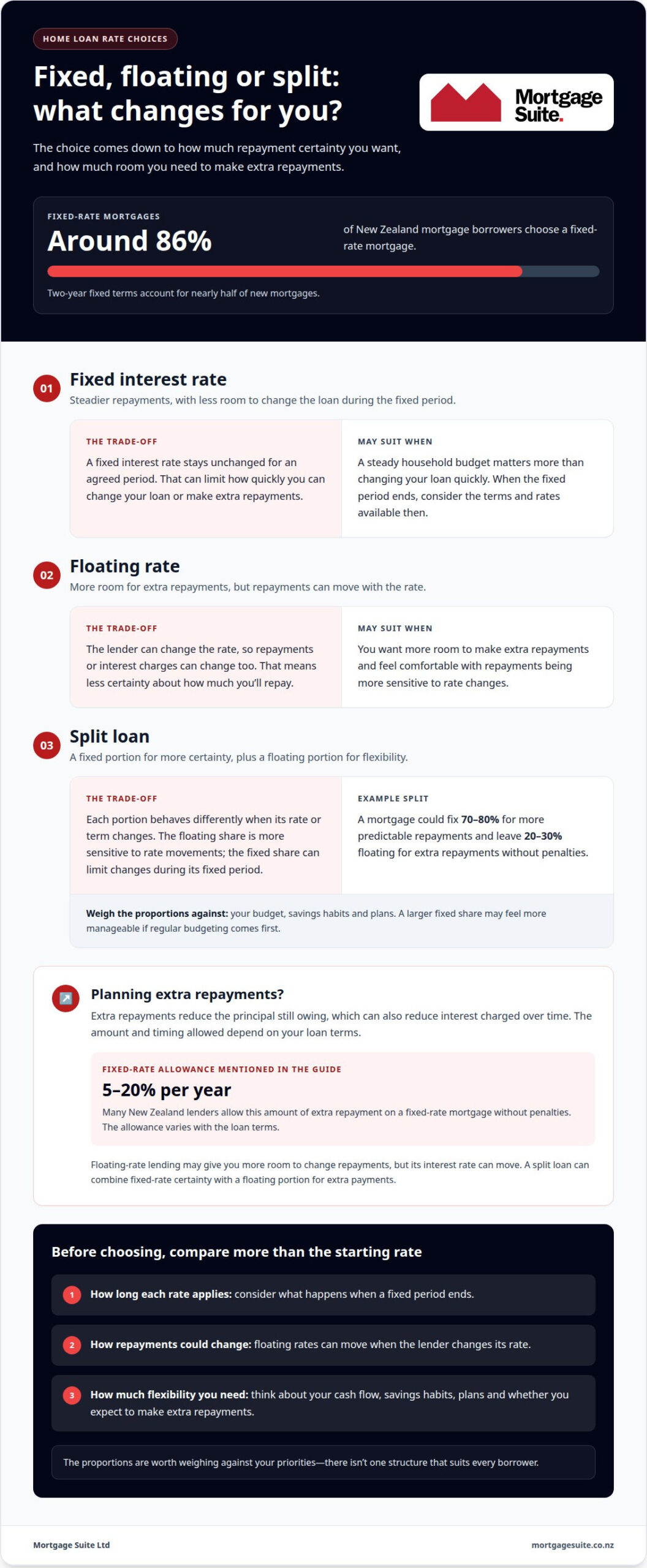
For a New Zealand home loan, “flexible” usually describes how you divide or manage borrowing, rather than a separate interest rate. The main choices are a fixed interest rate, a floating rate, or a split between the two. Around 86% of New Zealand mortgage borrowers choose fixed-rate mortgages, while two-year fixed terms account for nearly half of new mortgages. Those figures show how common fixed terms are, but they don’t make them right for every household.
A fixed interest rate stays unchanged for an agreed period, making repayments easier to plan during that time. It may suit you if a steady household budget matters more than changing your loan quickly. When the fixed period ends, you’ll need to consider the terms and rates available then. If your income or plans may change before that, weigh how much certainty you want against the flexibility you need.
A floating rate can change when the lender changes its rate, so repayments or interest charges can change too. It may give you more room to make extra repayments, but offers less certainty about how much you’ll repay. Flexible home loan options NZ borrowers consider aren’t a separate rate category. They combine different loan structures, and the right comparison depends on the lender’s offer and your priorities.
A split loan combines fixed and floating portions. For example, a New Zealand mortgage could fix 70-80% of the loan for more predictable repayments and leave 20-30% floating for extra repayments without penalties. The fixed portion offers some stability, while the floating portion can provide more repayment flexibility. The proportions are worth weighing against your budget, savings habits and plans.
Before choosing a split loan, consider how each portion behaves when its rate or term changes. A fixed period can limit changes to that portion, while a floating portion makes repayments more sensitive to rate movements. If you expect to make extra repayments, the floating share may help. If regular budgeting comes first, a larger fixed share may feel more manageable.
Compare more than the starting rate. Consider how long each rate applies, how repayments could change and whether the structure gives you the flexibility you need. Someone who values predictable payments, for example, may prefer mostly fixed borrowing, while a borrower expecting to make extra payments may consider keeping part of the loan floating. Comparing flexible home loan options NZ lenders offer means matching the structure to your priorities, rather than choosing a split by default.
Making extra repayments
Extra repayments reduce the principal still owing, which can also reduce the interest charged over time. Scheduled payments on a table loan already repay principal, but paying more can reduce it faster. The benefit depends on how much extra you pay and when. It’s also important to keep repayments affordable, as money paid into a mortgage may be less accessible for everyday needs.
Fixed-rate loans can limit how much extra you repay without a penalty. Many New Zealand lenders allow borrowers to make extra repayments of 5-20% per year on a fixed-rate mortgage without penalties. This allowance gives you some room to use spare income, such as a work bonus, while keeping the agreed fixed interest rate. The amount and timing allowed are part of the loan terms.
Floating-rate lending may give you more room to change repayments, but its interest rate can move. The interest charged and the pace at which the balance falls can change too. A split loan can offer a middle ground: the fixed portion provides repayment certainty, while the floating portion can be used for extra payments. The right balance depends on your cash flow and comfort with changing rates.
Consider whether you’re planning regular extra repayments or an occasional lump sum. Regular additional payments can steadily reduce principal, while a lump sum may make a larger reduction when funds arrive. For example, a borrower receiving a bonus could put some of it towards a floating portion while keeping scheduled payments on the fixed portion unchanged. The loan structure determines how each payment is applied.
Make your repayment plan fit your household budget, not just your mortgage goal. Larger payments can leave less room for changing expenses, repairs or time away from work. If your income varies, keeping scheduled repayments manageable and using extra funds when available may be more workable. Understand how the lender applies additional payments and what limits apply to each loan portion.
Extra payments can affect a fixed loan differently from a floating one. Before increasing a fixed repayment, compare the amount you plan to pay with the lender’s annual allowance. With a split loan, consider whether the floating share is large enough for the extra payments you expect. A smaller floating portion may leave less room for extra payments, while a larger one exposes more borrowing to rate changes.
For instance, a household with regular surplus income may value flexible home loan options in NZ that allow extra payments throughout the year. Someone whose spare funds arrive irregularly may prefer occasional lump sums. Neither approach suits everyone. Match your repayment pattern to your income, spending commitments and loan terms, so extra payments support your plans without making the rest of your budget difficult to manage. Comparing flexible home loan options in NZ can help you weigh that trade-off.
Mortgage choices for first-home buyers
Your first home loan needs to fit both the purchase and your day-to-day budget. In New Zealand, most mortgages have a term of 25-30 years, spreading repayments over a longer period. A longer term usually means smaller scheduled repayments than a shorter term, but interest accrues for longer. Consider how repayments may fit your income, regular expenses and plans to make extra payments.
Deposit size affects which lending options may be available. Most New Zealand lenders require a minimum 20% deposit, equivalent to an 80% Loan-to-Value ratio. Eligible buyers can apply for a Kāinga Ora First Home Loan with a 5% deposit. A lower deposit can help eligible buyers enter the market sooner, while increasing the proportion borrowed and the lender’s assessment of the application.
Choosing a repayment structure is another important decision. A fixed interest rate can make repayments more predictable during its agreed period. A floating rate can change when the lender adjusts its rate, affecting repayments. Splitting the loan can combine fixed and floating portions, balancing certainty with room for extra payments. Your income pattern and budgeting preferences can help determine which structure makes sense.
Some support schemes have changed. New Zealand’s First Home Grant ended in May 2024 and is no longer available. That means older advice referring to the grant may not reflect current choices. The Kāinga Ora First Home Loan remains a separate option for eligible buyers, with its own deposit requirement and lending assessment.
Lenders assess more than your deposit. They consider your income, existing debt, regular expenses, the property and whether repayments appear manageable. For example, two buyers with similar deposits may have different borrowing capacities if one has higher ongoing commitments. Lenders also consider the proposed loan structure, so repayment affordability matters alongside the headline rate.
Pre-approval can help clarify your borrowing range before you make an offer, but it is not final approval for a specific property. The lender still needs to assess the purchase and its details. For a first-home buyer, pre-approval can help connect the deposit, likely repayments and loan structure before committing to a purchase. Understanding these factors can make the next decision easier to weigh up.
How do revolving credit home loans work in NZ?
A revolving credit home loan combines borrowing with an account you can use for everyday money. The lender sets a credit limit, and your balance changes as income arrives and you make payments or withdrawals. Interest is charged on the amount owing, so a lower balance can mean less interest. Unlike a table loan, the balance does not automatically follow a set repayment schedule.
For example, a salary paid into the linked account reduces the amount owing. You can then use available credit for household bills or other spending. If spending stays below income over time, the balance can gradually fall. If withdrawals match or exceed deposits, the debt may stay near its limit. Regular income and careful spending habits are therefore central to managing this structure.
This flexibility may suit borrowers with predictable income who can keep spending under control. It may be less comfortable if you rely on available credit for routine costs, because the loan balance can remain high. A revolving facility also does not set the same automatic path towards repaying principal as a table loan. You need a clear plan to reduce the debt, not just keep the account within its limit.
Compare this structure with an offset arrangement. An offset account links savings to a mortgage, reducing the balance used to calculate interest while keeping those funds accessible. With revolving credit, the loan balance itself changes as money enters and leaves the account. The distinction matters: one links savings to borrowing, while the other gives you access to credit within an agreed limit.
Lenders assess whether the facility fits your finances and repayment capacity. Your income, regular spending, existing debts, deposit and property all help shape the application. A lender may also consider how you’ll manage withdrawals and keep the balance moving down. For example, a borrower with regular surplus income may manage a revolving facility differently from someone whose income is irregular or already committed to household expenses.
There are trade-offs to consider. A flexible balance can make it easier to access funds, but that access can also tempt you to borrow again after making progress. Interest rates can change, affecting the interest charged on the outstanding balance. The available credit limit is not a repayment target: keeping the balance close to it for long periods can slow progress towards paying off your home loan.
Before choosing revolving credit, compare its moving balance with the predictability of scheduled repayments. Consider how income timing, bills and spending habits would affect the account month to month. If you want help weighing those factors against your home-loan plans, discuss a suitable loan structure.
Mortgage Suite Ltd
Mortgage Suite Ltd helps you weigh home loan structures against your deposit, income and plans. If you’re buying your first home, the team can help you consider repayment flexibility alongside the rate, so your choice reflects your budget rather than one headline figure.
Bring your questions about fixed, floating, split or revolving credit lending to a discussion about your borrowing needs. Mortgage Suite Ltd can help you understand how different structures may fit and support you through a home loan application. If a mainstream bank has declined your application, that decision does not automatically end your options. Your circumstances can also be considered against other lending pathways.
For guidance based on your goals and financial circumstances, contact Mortgage Suite Ltd to discuss your flexible home loan options nz.
Make your next borrowing decision with confidence
Before taking your next step, consider what you want your home loan to make possible, both now and as your circumstances change. Clear priorities can keep the decision grounded in your plans, rather than pressure to settle on an option before you’re ready.
If you’re still weighing flexible home loan options in NZ, a conversation can help connect your priorities with your borrowing circumstances. Discuss what matters to you, where you feel unsure and what you’d like to understand better. That gives you a clearer starting point for considering your next move.
When you’re ready, contact Mortgage Suite Ltd about your options. Take the next step at a pace that feels right for you.
Frequently Asked Questions
Interest rate: fixed, variable or both?
Choose based on how much certainty your household budget needs and whether your income or plans may change. Before deciding, consider when fixed periods would end and whether several repayments could change around the same time. Compare how each choice would fit your budget if regular expenses rose or your income changed, not just how repayments look today.
What flexible home loan options are available in New Zealand?
New Zealand lenders offer different ways to arrange and manage home borrowing, but terms and available combinations vary. Start by matching the features you need to your money habits: consider whether you keep savings accessible, receive income regularly or expect occasional lump sums. This helps narrow the options to discuss and makes it easier to compare the conditions attached to each lender’s offer.
Can you split a New Zealand home loan between fixed, floating, offset, and revolving credit?
Combining all four in one lending arrangement depends on the lender’s products and account setup. Before proceeding, have the proposed structure mapped out by portion, including how repayments are allocated and when each part can be changed. This makes it easier to see whether the arrangement fits your plans, rather than assuming every feature can be combined simply because each is available separately.
Are there NZ rules or loan-to-value restrictions that affect flexible home loans?
Yes. Loan-to-Value restrictions can affect how much a lender may advance compared with the property’s value, while lenders also assess affordability and their own criteria. A flexible structure does not remove those checks. For your application, the lender will consider the property, deposit, income, expenses and existing debts together. These factors can affect both your borrowing capacity and which lending arrangements are suitable.
How do I apply for a flexible home loan in New Zealand?
Compare fixed, floating, split, offset or revolving options against your budget and your need for repayment certainty or flexibility. A mortgage broker can organise details about your income, expenses, deposit and property plans, compare lender criteria and present your circumstances to suitable lenders.