
Gifting a Deposit for a House in NZ: How It Affects Buying
A gifted deposit can help you buy a home in New Zealand: lenders accept gifts, usually with a signed declaration that the money doesn’t need to be repaid. Gifting a deposit for a house in NZ may help you reach the common 20 per cent deposit target, but it won’t increase your income or change how a lender assesses your ability to manage repayments.
It’s understandable to feel unsure about the paperwork and what family support means for your application. A gift, a family loan and a guarantee are treated differently, so be clear about which arrangement applies before relying on the funds.
This guide explains how lenders assess each option, what documents they may request and how relationship property rules can affect a family contribution. You’ll also learn how a gifted deposit differs from borrowed money, why lenders need to know where the funds came from, and what to consider if a mainstream bank’s criteria don’t fit your circumstances.
Key Takeaways
- A family gift may help bridge a deposit shortfall, but lenders still assess your income and ability to manage repayments.
- Be prepared for the lender to trace the gifted funds and ask for a signed declaration confirming they don’t need to be repaid.
- Whether family money is a gift, a loan or a guarantee affects your application in different ways, especially when repayments or family property are involved.
- Gift duty was abolished in New Zealand for gifts made on or after 1 October 2011, but relationship property and asset testing may still matter.
- If a mainstream bank’s criteria don’t suit your circumstances, another lending option may be worth exploring.
Deposit, debt-to-income and affordability limits
A family contribution can help close the gap between your savings and a deposit target. In New Zealand, 20 per cent is a common deposit target, but lenders assess each application against their own criteria. A NZ$100,000 gift, for example, could bridge a shortfall for a buyer who otherwise has enough income to manage the loan. It doesn’t automatically mean the lender will approve the full amount you hope to borrow.
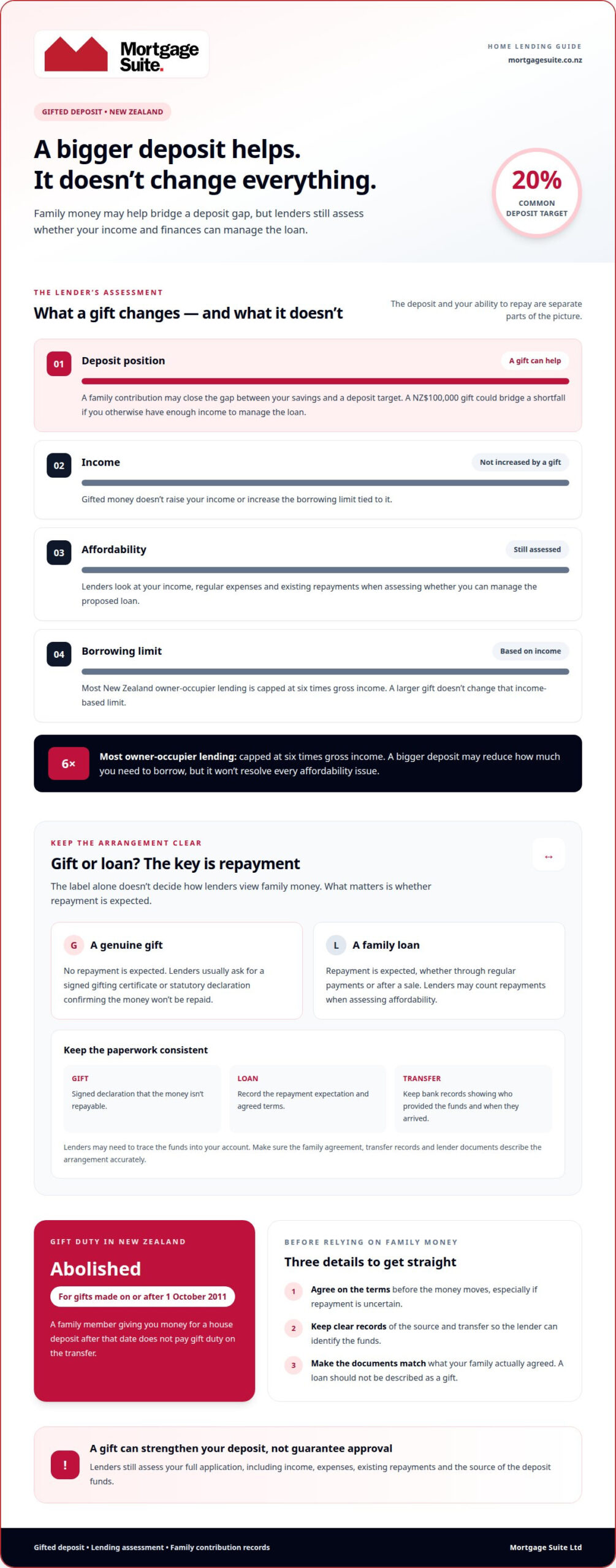
Your deposit and your ability to repay are separate parts of a lender’s assessment. Most New Zealand owner-occupier lending is capped at six times gross income. A larger gift may improve your deposit position, but it doesn’t raise your income or increase the borrowing limit tied to it. Lenders also assess affordability, including your income, regular expenses and existing repayments. A gift can help with the upfront contribution without changing these other parts of your application.
For example, a lender may see a buyer with a larger deposit but still assess the proposed repayments against their income and commitments. If your deposit includes family money, the lender needs to trace the funds into your account. Keep the transfer record and details of its source so the contribution is easy to identify during the application. Some lenders may also expect you to contribute savings of your own. Requirements can vary depending on the lender and the size of the gift.
Before relying on a gifted deposit, separate the deposit question from the affordability question. A mortgage repayment calculator can help you explore how different loan amounts affect estimated repayments. Treat the result as a planning aid, not a lender’s assessment. Your actual borrowing capacity depends on the full application, including income and financial commitments. A bigger deposit may reduce the amount you need to borrow, but it cannot resolve every affordability issue.
Family arrangements can change after money has been advanced. If parents later expect repayment, the contribution may need to be recorded as a debt rather than described as a gift. In New Zealand, a deed of acknowledgement of debt or a section 21 agreement can be made after parental money has been advanced, provided the relationship is still intact. The document should reflect what the family actually agreed, including whether repayment is expected. That distinction matters because a genuine debt can affect the lender’s view of your commitments.
Talk through the arrangement before the funds move, especially if there’s any uncertainty about repayment. Clear records help the lender understand the deposit’s source and nature, and help family members avoid different assumptions later. The practical distinction is simple: a gift isn’t expected to be repaid, while a loan creates an obligation. Make sure the transfer record and agreement match the arrangement.
Is there gift duty in New Zealand?
No. New Zealand gift duty was abolished for gifts made on or after 1 October 2011. A family member giving you money for a house deposit after that date does not pay gift duty on the transfer.
That answers the tax question, but it doesn’t establish whether the money is genuinely a gift. The key difference is whether the recipient is expected to repay it. If a parent transfers money with no repayment expected, it’s a gift. If the parent expects repayments, it’s a loan, even if the family calls it a gift.
For a home loan application, describe the arrangement accurately. New Zealand lenders usually ask for a signed gifting certificate or statutory declaration confirming the money won’t be repaid. This helps distinguish a deposit contribution from another debt that could affect your ability to meet repayments.
For example, imagine a parent transfers funds on the understanding that the buyer will repay them after selling another asset. That expectation makes it a loan, not a gift. By contrast, a transfer with no repayment arrangement is a gift. A written record can prevent confusion if family members later remember the agreement differently.
Before the transfer, agree on the terms and keep the supporting records together. These may include:
- Gift: a signed declaration that the money is not repayable.
- Loan: a record of the repayment expectation and agreed terms.
- Transfer: bank records showing who provided the funds and when they reached the buyer.
These records matter even though gift duty no longer applies. A lender may need to trace the deposit funds and assess any repayments as part of your financial commitments. If the paperwork says “gift” but the family expects repayment, the mismatch may raise questions during the application.
Keep the description consistent across the family agreement, bank transfer records and lender documents. If the money is a loan, describe it as one rather than signing a declaration saying it won’t be repaid. A clear distinction helps everyone understand the arrangement and gives the lender an accurate picture of your deposit and debts.
Was it a gift or a loan, and why does it matter?
A genuine gift can strengthen your deposit without adding a repayment to your monthly budget. A family loan is different: New Zealand lenders may count its repayments when assessing affordability, potentially reducing the amount they’re willing to lend. The label alone doesn’t determine the arrangement. What matters is whether repayment is expected.
For example, if a parent transfers money for the buyer to keep, with no repayment expected, that’s a gift. If the parent expects regular payments or repayment after a sale, it’s a loan. A gift may increase the deposit available, but it doesn’t increase your income or change the lender’s assessment of whether you can afford the repayments.
That distinction affects both the loan application and the family’s expectations. If a contribution is repayable, the lender needs to account for that obligation alongside the proposed mortgage and other commitments. A family loan used to acquire the family home is also a relationship debt under section 20 of New Zealand’s Property (Relationships) Act 1976. The arrangement can therefore matter if the couple later separates.
The home itself has separate relationship-property rules. Under section 8 of the Property (Relationships) Act 1976, the family home is relationship property regardless of when it was acquired or who paid for it. Section 10(4) treats the family home and family chattels as relationship property unless a Part 6 agreement provides otherwise. So, a parent’s gift towards the deposit doesn’t automatically make the home the recipient’s separate property.
Section 10 of the same Act generally treats property gifted to one partner by a third person as separate property. But that treatment can change if the gift becomes intermingled with relationship property so extensively that keeping it separate would be unreasonable. In practice, money used to buy a shared family home can raise different questions from a gift kept separately.
Consider a parent gifting funds to one adult child, who then uses them to purchase a home with their partner. The gift may be separate property, while the family home remains relationship property under section 8. The gift’s source and the property’s legal status are not necessarily the same thing.
If parents intend the contribution to be repaid or protected, the family should record that intention clearly. A section 21 agreement under the Property (Relationships) Act 1976 can set out how property is treated between partners. Clear terms help distinguish a gift from a loan and explain how the family expects the contribution to be treated.
Can you use a gifted deposit to buy a house in NZ?
Yes, New Zealand lenders accept gifted deposits, but a family contribution can have effects beyond your mortgage application. How it’s transferred, recorded and used may matter for relationship property and Residential Care Subsidy asset testing.
Gifts and relationship property
A parental gift is money given without an expectation of repayment, but using it for a family home doesn’t automatically make the home separate property. Under section 10 of the Property (Relationships) Act 1976, a third-party gift to one partner is generally separate property unless it becomes intermingled with relationship property so extensively that treating it separately would be unreasonable.
This distinction matters because section 8 treats the family home as relationship property, regardless of when it was acquired or who paid. For example, a parent might give money to one adult child, who then uses it to buy a home with their partner. The gift and the home can be treated differently under the Act.
Transferring and sourcing the deposit
For lending checks, tracing a gift means showing where the funds came from and how they reached your account. Use a traceable bank transfer from the family member’s account into yours, and keep the transfer records and gift declaration.
A cash deposit or several unexplained transfers can make the source harder to follow. A clear record linking the giver, transfer and amount helps the lender understand where the deposit came from. The lender may also ask for a signed declaration confirming the money isn’t expected to be repaid.
Residential Care Subsidy asset testing is separate from mortgage approval, and gifts may be assessed differently depending on when they were made. For gifts made more than five years before applying, the Ministry of Social Development – Work and Income will not count up to NZ$27,000 per year.
For gifts made during the five years before an application, Work and Income will not count up to NZ$8,500 in assets gifted each year. The stated allowance across that period between a person and their partner is NZ$42,500. These asset-testing allowances don’t determine whether a lender accepts the gift as a deposit.
Keep the gift’s purpose and transfer records together, especially if you’re also considering a Residential Care Subsidy application. For instance, a bank statement showing the transfer, alongside a declaration describing it as a non-repayable gift, provides a clearer record than an unexplained deposit. If the funds were actually lent, describing them as a gift could misrepresent the family arrangement.
Clear records help distinguish the deposit’s source from how it may be treated under relationship property or subsidy rules. A gift can support a home purchase, but it doesn’t by itself determine who owns the home or how a future asset assessment will treat the transferred money.
Differences between a gift, family loan and guarantee
If you’re gifting a deposit for a house in NZ, first decide whether your family is giving you money, lending it or offering property as security. A gift adds money to the deposit, a family loan must be repaid, and a guarantee supports the lending without transferring cash to the buyer.
A gift is money given without an expectation of repayment. It can help bridge a deposit shortfall, but it doesn’t increase your income or change the lender’s assessment of whether you can afford the repayments. For example, a parent may transfer savings to their child, who then puts them towards the purchase. A lender may ask for a signed declaration confirming the contribution isn’t repayable.
A family loan provides funds that the buyer agrees to repay. The lender may include those repayments in its affordability assessment, which can reduce the amount it’s prepared to lend. If parents expect regular payments after helping with the deposit, those payments sit alongside the proposed home loan repayments. Calling the transfer a gift won’t change the debt if repayment is expected.
A family guarantee works differently. A family member offers property as additional security for the home loan instead of giving the buyer cash. This may remove the low equity margin on a small deposit, but it doesn’t increase the buyer’s income or provide extra deposit money. The supporting family member’s property is involved, so the arrangement has implications beyond the buyer’s own finances.
These options can all involve family support, but they create different obligations:
- Gift: money contributes to the deposit and isn’t expected to be repaid.
- Family loan: the buyer receives money but has an obligation to repay it.
- Guarantee: family property supports the lending, with no deposit cash transferred.
Consider a buyer whose family can help but whose deposit is short. A gift may increase the deposit contribution. If the family needs its money returned, a loan may be more accurate, although repayments can affect borrowing capacity. If the family has property but can’t provide cash, a guarantee may be worth discussing with the lender.
Before gifting a deposit for a house in NZ, make sure the arrangement reflects what everyone intends. The paperwork, transfer and lender assessment should consistently show whether the funds are repayable or property is being offered as security. A mismatch can confuse the application and strain family relationships later.
If you’re weighing these options against your borrowing plans, talk through your home-loan options before settling on an arrangement.
Mortgage Suite Ltd
Mortgage Suite Ltd can help you understand how a family gift, loan or guarantee fits your home-buying plans. If you’re buying your first home, its home loans for first-home buyers can be considered alongside your deposit and borrowing needs. Mortgage Suite Ltd also offers residential investment property loans, business loans and property development loans.
If you’re unsure how to describe family support to a lender, or a mainstream bank’s criteria don’t fit your circumstances, Mortgage Suite Ltd can help you consider suitable lending options. A decline from one bank doesn’t automatically close off every path, although each lender assesses applications differently. Talk through your plans, the family contribution and any repayment expectations with Mortgage Suite Ltd.
Contact Mortgage Suite Ltd to discuss your situation and possible next steps.
Plan your next move with confidence
Before making an offer on a home, include the family contribution in your wider plan. Talk openly about what everyone expects, how the arrangement fits with your future repayments and whether it leaves room for changes in your circumstances. A clear conversation now can help you make decisions with less pressure later.
If you’re considering gifting a deposit for a house in NZ, focus on finding a lending approach that fits your goals, not just putting the deposit together. Mortgage Suite Ltd can help you work through your options and consider how family support fits your borrowing plans. If your situation feels complicated, a mainstream bank’s response doesn’t have to be the final word.
Contact Mortgage Suite Ltd to discuss your home-buying plans. A considered next step can help you move towards a home that works for you.
Frequently Asked Questions
What does it mean for the parents later?
If parents expect repayment, that debt may affect how relationship property is calculated later. Section 20D of New Zealand’s Property (Relationships) Act 1976 provides for relationship debts to be deducted before the net relationship property pool is divided. This means the family’s records can matter beyond the mortgage application. For instance, a parent’s documented claim may be relevant if the couple separates and their property is divided.
What if the money has already gone into the house?
There may still be options for documenting the arrangement, but timing and the couple’s circumstances matter. A section 21 agreement can set out how partners intend property to be treated. However, a New Zealand court may set aside such an agreement if giving effect to it would cause serious injustice. That makes independent legal advice useful before signing, particularly where the home has already been bought or family money has been used.
What counts as a gifted house deposit in New Zealand?
It’s money provided towards a home purchase without an obligation to repay it. The giver might contribute funds for a particular purchase rather than provide money for general spending. For example, parents might provide a sum specifically for their child’s share of a home bought with a partner. Make the purpose and terms clear, especially if the buyer’s circumstances change before the purchase is completed.
What gift letter does a New Zealand bank require for a home loan deposit?
There isn’t one universal letter format for every lender. A clear letter can identify the giver and recipient, state the amount and purpose of the contribution, and explain whether the giver expects anything in return. Keep the wording consistent with the family’s actual agreement. If the buyer’s plans change, such as deciding to purchase with a partner, the original letter may no longer fully describe the arrangement.
Can gifted funds count toward the minimum deposit for an NZ mortgage?
Gifted funds can contribute to the deposit, but the lender’s requirements determine how they’re treated in a particular application. Before committing to a purchase, consider whether the lender’s conditions fit the timing and form of the family contribution. For example, a gift intended for one buyer may need a different explanation if that buyer later purchases jointly. The stated source of the deposit should fit the purchase being financed.
Do NZ banks accept gifted deposits from parents, relatives, or non-family members?
New Zealand banks accept gifted deposits, but the giver’s relationship to the buyer may be relevant to how the lender reviews the application. Be accurate about who provided the funds, particularly if they came from a family friend or someone outside the immediate family. For example, don’t describe a contribution as parental support if someone else supplied it. Clear, consistent details help avoid confusion about the transaction.
How does a gifted deposit affect mortgage approval and servicing checks in NZ?
A gift can increase the deposit available, but it doesn’t answer every question in a mortgage application. The lender also considers whether the proposed purchase fits the buyer’s wider financial position. If the gift comes with conditions, such as an expectation that the buyer will repay it after a future event, those terms may affect how the lender assesses the arrangement. Make any conditions explicit rather than relying on family assumptions.
Are there tax, gift duty, or benefit implications when gifting money for a house deposit in New Zealand?
Gift duty no longer applies to gifts made on or after 1 October 2011, but a transfer can still matter for benefit-related asset assessments. If the giver may apply for a Residential Care Subsidy, the timing and records of earlier gifts can be relevant. Keep a dated record of the transfer and its purpose. That gives the giver clearer information when considering how a future application could treat their assets.