
Business Loan Requirements NZ: Your 2026 Guide to Getting Funded
What if the reason your funding feels out of reach isn’t your bank balance, but simply the way you’ve packaged your story? Most Kiwi business owners feel a sense of dread when they start looking into business loan requirements NZ, fearing that a single slip-up in their paperwork will lead to an instant decline. It’s exhausting to feel like you’re speaking a different language than the person sitting across the desk at a big bank.
We understand that your business is more than just a set of numbers on a page. You deserve a clear path to the capital you need to grow, whether you’re looking for a standard bank loan or a more flexible second-tier option. This guide is here to give you back your confidence by laying out exactly what lenders are looking for in 2026. We’ll help you tick every box, from preparing financials that tell the right story to finding a lender that actually values your hard work.
You’ll find a straightforward checklist of the documents you need, tips on valuing your assets for security, and a look at alternative funding sources that might be the perfect partner for your next big move.
Key Takeaways
- Learn why lenders care most about your ability to repay comfortably rather than just your current bank balance.
- Discover the three main business loan requirements NZ lenders check, including how to use your assets as a solid backup plan.
- Understand why being turned down by a big bank isn’t the end of the road and how flexible lenders look at your whole story.
- Find out how to tidy up your credit score and tax records to make your application look professional and ready for approval.
- See how having a mentor with 20 years of banking experience can act as a shortcut to getting your funding secured.
Understanding the Basics of Business Loan Requirements in NZ
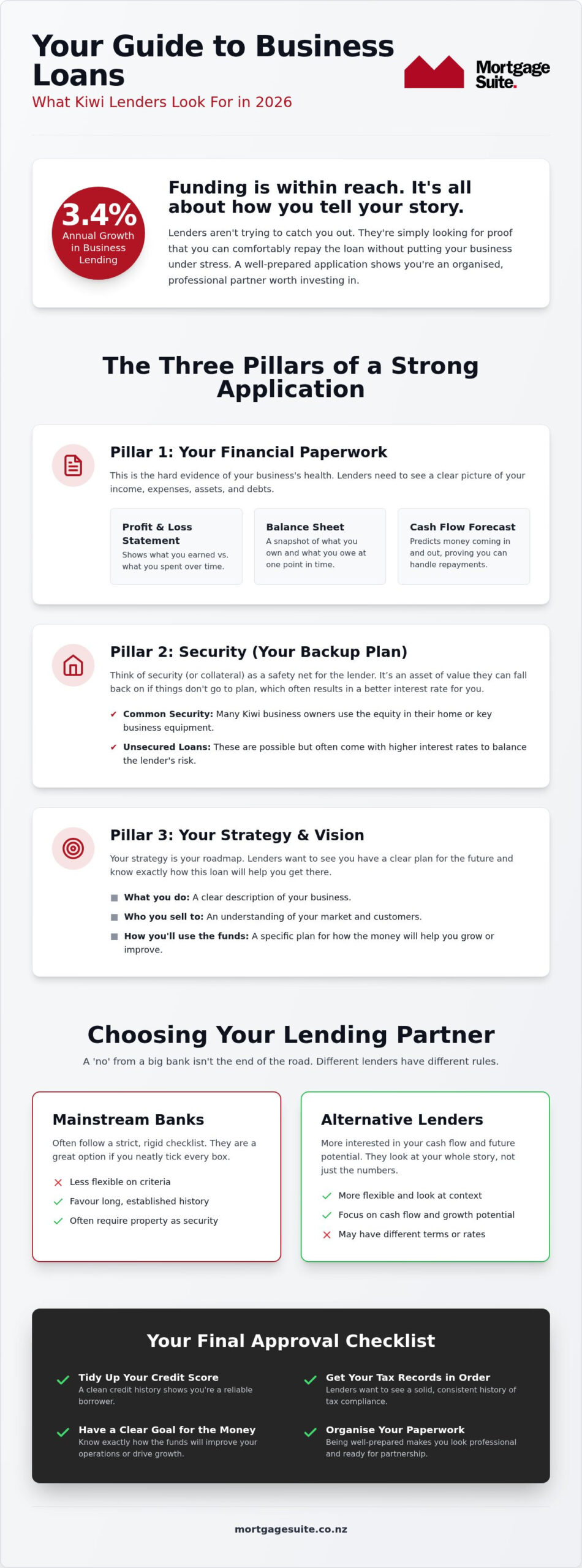
Think of business loan requirements NZ as a professional introduction. These aren’t just boxes to tick to make life difficult; they’re a set of standards that prove your venture is a safe bet for a lender. Lenders aren’t looking for reasons to say no. They’re searching for evidence that you can pay the money back comfortably without putting your business under stress. With business lending showing a 3.4% annual growth in 2026, the money is certainly available for those who can present a solid case.
These rules aren’t the same across the board. They shift depending on your situation. If you’re buying an existing company, the lender wants to see the previous owner’s numbers. If you’re starting fresh, they’ll look at your vision and your personal financial habits. Every lender has their own ‘rule book’ too. A big bank might follow a strict, rigid checklist, while a non-bank lender might be more interested in your cash flow and future potential.
Why Do Lenders Ask for So Much Information?
It often feels like a hurdle, but this process is actually about building a partnership. Lenders take on risk when they fund you, so they need to understand the full picture to feel confident. Your character as a business owner matters just as much as your bank balance. They want to see that you’re organised, honest, and capable of handling challenges. When you’re well-prepared, you look like a professional partner rather than a risky gamble. Given that the non-performing loan ratio for business loans sits at 1.1% in 2026, lenders are naturally careful about who they trust. Having a mentor who understands the ‘inside secrets’ of bank approvals can make this whole process feel much less daunting.
New Business vs. Established Business Requirements
Startups have a different mountain to climb. Since there’s no history to look at, lenders rely heavily on your business plan and financial forecasts. They need to see that you’ve done your homework and understand your market. For established businesses, the focus shifts to your track record. They’ll want to see steady earnings and solid tax records from the last few years. Regardless of your stage, you must have a clear goal for the money. Lenders want to know exactly how those funds will help you grow or improve your operations. If you want to dive deeper into how these processes work, you can check out our mortgage school for more insights.
The Three Pillars of Your Loan Application: Financials, Security, and Strategy
Success with a lender usually comes down to three main areas. These form the backbone of most business loan requirements NZ banks or private lenders look for. It’s not just about having a high turnover; it’s about showing that you have a clear grip on your money, a backup plan for the unexpected, and a sharp vision for the future. When you can present these three pillars clearly, you move from being just another applicant to being a professional partner worth investing in.
Sorting Your Financial Paperwork
Your financials are the hard evidence of how your business is actually doing. Lenders will typically ask for a Profit and Loss statement, which is a simple summary of what you made versus what you spent over a set period. They will also want to see a Balance Sheet. Think of this as a snapshot of what you own and what you owe at a specific point in time. A cash flow forecast is a prediction of the money coming in and out over the next year. This is vital because it proves you can afford the loan repayments even during slower months. To get a better handle on your potential numbers, try using the Mortgage Suite calculator to see how different loan amounts might fit your budget.
Understanding Security and Collateral
Think of security as a safety net for the lender. It is something of value they can fall back on if things don’t go to plan. Many Kiwi business owners use the equity in their home or specific business equipment to secure a loan. This often helps you get a better interest rate because the lender feels more protected. While some lenders offer unsecured options where you don’t need to put up a physical asset, these often come with different terms or higher interest rates to balance the risk. If you’re unsure how to value your assets, our team can help you look at the options that best suit your situation.
Crafting a Strategy That Wins Approvals
Your strategy is your roadmap. Lenders want to know what you do, who you sell to, and exactly how you’ll use the borrowed money to grow. They also want to see your “Plan B” for tough times. This shows them you’re a proactive leader who thinks ahead. Remember, the person behind the business is just as important as the numbers. Your experience and reputation act like a professional CV that builds trust. If you want more tips on how to present your case effectively, our Mortgage School is a great place to start learning the ropes.
Mainstream Banks vs. Alternative Lenders: Choosing the Right Path
Selecting the right lender is often the most critical decision you’ll make in your funding journey. Mainstream banks generally operate with a one-size-fits-all approach. They have rigid checklists, and if your situation doesn’t perfectly align with their internal rules, you might find your application stalled. In contrast, alternative or non-bank lenders are often more flexible. They tend to look at the bigger picture, focusing on your current cash flow and future potential rather than just your past paperwork. This flexibility is a key part of why understanding the full range of business loan requirements NZ has to offer is so important.
At Mortgage Suite, we specialise in 2nd tier lenders in New Zealand. We know that every business has a unique story, and sometimes that story needs a different type of listener than a traditional bank manager. Having a guide who knows the inside secrets of how different lenders think can save you months of frustration.
When the Bank Says “No”: Why It’s Not the End
Being turned down by a big bank can feel like a major setback, but it’s rarely the end of the road. Banks often decline applications for reasons that have nothing to do with the quality of your business. Common hurdles include having a trading history shorter than two years, using security that doesn’t involve a family home, or having a recent period of lower profit due to expansion costs. A “no” from a mainstream bank is often just a “not here” rather than a “not ever.” An expert mentor can often re-package your application to highlight your strengths to a lender that values your specific industry or growth stage.
The Pros and Cons of Non-Bank Funding
Alternative funding is a powerful tool, but it’s important to be clear about the trade-offs. The biggest advantage is speed. While a bank might take weeks to process a file, some alternative lenders can offer a decision within 24 to 48 hours. This speed allows you to jump on opportunities that won’t wait. However, you should expect different fee structures or higher interest rates. For many Kiwis, these loans act as a stepping stone. You use the funds to reach your next milestone, improve your financial position, and eventually move back to a mainstream bank when your business meets their more traditional business loan requirements NZ criteria.
How to Organise Your Application for the Best Chance of Approval
Preparing your application is often where the real work happens. It is not just about gathering papers; it is about presenting a clear, professional story that makes a lender want to say yes. When you approach business loan requirements NZ with an organised mindset, you demonstrate that you are a reliable partner who takes their finances seriously. A well-prepared file can be the difference between a quick approval and a long, drawn-out decline.
Follow these five practical steps to get your application ready for a lender’s desk:
- Step 1: Check your credit score. Surprises are for birthdays, not loan applications. Knowing your score early allows you to fix any errors before a lender sees them.
- Step 2: Tidy your tax and GST filings. Lenders look for stability. If your tax records are messy or behind, it suggests your business might be under pressure.
- Step 3: Separate your bank accounts. Mixing personal and business money makes it difficult for a lender to see your true profit. Keep things clean and distinct.
- Step 4: Explain the “why” in plain English. You don’t need fancy words. Just explain exactly how the money will help your business grow or become more efficient.
- Step 5: Let a broker review it first. We act as a second pair of eyes to catch small mistakes that could lead to a decline.
Cleaning Up Your Financial Habits
Lenders love consistent, clean bank statements. In the months leading up to your application, try to avoid “buy now, pay later” schemes. While these are convenient, some lenders view them as a sign that your cash flow is tight. Reducing unnecessary personal spending and paying down small personal debts can also significantly boost your borrowing power. It shows you have the discipline to manage your money well, which gives the lender confidence that you’ll handle their funds with the same care.
The Power of a Professional Presentation
First impressions matter in the world of lending. A tidy, well-organised folder of documents shows that you are prepared and professional. If you have had a bad credit patch or a difficult trading period in the past, be honest about it. Lenders appreciate transparency, and explaining how you’ve moved past those challenges is far better than trying to hide them. You can read our Mortgage Suite reviews to see how other Kiwi business owners have successfully shared their stories to get the funding they needed. If you are ready to start your journey, contact our team to discuss how we can help you package your application for success.
Partnering with a Specialist to Secure Your Business Funding
Meeting the various business loan requirements NZ lenders set out can feel like a full-time job. This is where having a seasoned mentor makes all the difference. Krish Krishna brings over two decades of banking and brokerage experience to your side of the table. This isn’t just about filling out forms; it’s about using those years of “inside secrets” to act as a shortcut for your application. Instead of guessing what a credit manager wants to see, you have someone who has been in that seat and knows exactly how to frame your story for success.
A specialist broker acts as your advocate and negotiator. We don’t just pass on your papers; we fight for the best possible terms on your behalf. One of the biggest advantages is the sheer breadth of choice. With just one application, you gain access to dozens of different lenders, from the big name banks to flexible 2nd tier options. This saves you from having to repeat your story over and over again to different institutions, letting you stay focused on what really matters: running your company.
Why Experience Matters in a Fluctuating Market
The financial world doesn’t stand still. With the Official Cash Rate held at 2.25% in late 2026, interest rates and lending rules are constantly shifting. Navigating these changes requires a steady hand and deep institutional knowledge. A broker knows which lenders are “hungry” for new business in your specific industry at any given time. This real-time insight is invaluable when you’re looking for competitive rates or more flexible terms. You can learn more about our background and how we support Kiwi businesses on our About Us page.
Taking the Next Step with Confidence
Getting started doesn’t have to be a daunting process. It usually begins with a quick, no-obligation chat where we look at where your business stands today. From there, we build a tailored plan that matches your goals with the right lender. We handle the heavy lifting, the follow-up calls, and the complex negotiations so you don’t have to. Our goal is to move you through the process with ease and transparency. Your business has a bright future, and we’re here to help you secure the capital needed to reach that next milestone. Let’s work together to turn those growth plans into a reality.
Take the Next Step Toward Your Business Goals
Securing the capital you need to grow shouldn’t feel like an uphill battle. By focusing on clear financials and a sharp strategy, you have already laid the groundwork for a successful application. It is important to remember that meeting the business loan requirements NZ lenders expect is often about how you tell your story. If a mainstream bank isn’t the right fit, alternative and 2nd tier lenders offer the flexibility and speed that many Kiwi businesses need to thrive in a changing market.
With over 20 years of banking expertise, we act as your steady hand and dedicated negotiator. We specialise in 2nd tier and alternative lending, ensuring you have access to a wide range of options with just one conversation. You deserve a personalised service that removes the hurdles and focuses on your success. Talk to Krish and the team about your business loan today to see exactly where you stand. We are here to help you move forward with confidence and look forward to being part of your growth journey.
Frequently Asked Questions
What are the minimum requirements for a business loan in NZ?
Minimum business loan requirements NZ usually include a solid business plan, financial statements from the last two years, and proof that your cash flow can cover repayments. Lenders want to see that you understand your market and have a clear goal for the money. While mainstream banks have rigid checklists, alternative lenders might focus more on your current turnover and future potential. Being prepared with tidy records is always the best way to start.
Can I get a business loan if I have bad credit?
You can certainly secure funding with a less than perfect credit history by looking beyond mainstream banks. We specialise in 2nd tier loans for those who don’t fit standard criteria, focusing on your business’s current performance rather than past mistakes. A dedicated negotiator can help explain the context of your credit score to a lender. This approach often helps you get the capital you need while you work on rebuilding your financial reputation.
How much deposit do I need for a business loan in New Zealand?
Most lenders in New Zealand look for a deposit or equity contribution between 20% and 50% of the total loan value. The exact amount depends on the type of asset you’re buying and the level of risk the lender sees in your industry. If you are using existing property as security, you might not need a cash deposit at all. Every situation is unique, so it’s best to discuss your specific assets with a specialist.
Do I have to use my house as security for a business loan?
You don’t always have to use your family home as a backup for a business loan. While banks often prefer the security of residential property, many alternative lenders allow you to use business equipment, vehicles, or commercial property instead. Some even offer unsecured loans based on your revenue trends and cash flow. Choosing the right security depends on your comfort level and the specific terms offered by different lenders across the market.
How long does it take to get a business loan approved?
The time it takes to get an answer depends entirely on the type of lender you choose. Mainstream banks are often thorough and can take several weeks to process an application. On the other hand, many non-bank lenders specialise in speed and can provide an approval within 24 to 48 hours. Having all your documents organised and ready to go before you apply is the most effective way to speed up the entire process.
What documents do I need to show my lender?
You will generally need to provide your latest profit and loss statement, a balance sheet, and at least six months of bank statements. Lenders also want to see your recent GST and income tax filings to ensure your records are up to date. A clear business plan and a cash flow forecast are vital for showing how the loan will be repaid. Keeping these documents in a tidy, digital folder makes the application much smoother.
Is it better to go to a bank or a broker for a business loan?
A broker is often the better choice because they offer you access to dozens of lenders with just one application. While a bank can only sell you its own products, a broker acts as your advocate and negotiator to find a deal that actually fits your business needs. With over 20 years of experience, we know which lenders are most likely to say yes to your specific scenario, saving you time and stress.
Can I get a loan for a startup business with no trading history?
Getting a loan for a startup is possible, but the focus shifts from your history to your future potential. Since you don’t have past trading figures, you’ll need a very strong business plan and detailed financial forecasts. Lenders will also look closely at your personal credit history and professional experience in the industry. You might need to provide some form of security or a personal guarantee to give the lender the confidence they need.