
Choose between a business loan and personal equity
A start-up loan doesn’t always need your home as security. An equity loan for a New Zealand business start-up involves borrowing against property equity, while personal equity means contributing your own funds. These options can seem similar when you’re getting a new venture off the ground, but they create different responsibilities for you and your household.
It’s understandable to feel cautious when your business is new and its income is still taking shape. Choosing funding isn’t just about accessing money. You also need to consider repayments, the assets tied to borrowing, and how much personal money you’re comfortable putting into the venture.
This article compares those trade-offs in practical terms. It explains how cash-flow forecasts can help you assess repayment capacity, how security and funding structures affect risk, and what personal contributions mean for a start-up plan. You’ll also learn what lenders may assess, so you can approach your funding decision with clearer questions.
Key Takeaways
- Forecast income and outgoings across the first six to 12 months of trading to clarify how much funding your startup may need.
- Assess whether scheduled repayments fit your expected cash flow before taking on debt.
- Weigh the effect of offering an asset as security against keeping it outside the business borrowing arrangement.
- Prepare a business plan and relevant financial details to help explain how the startup will operate and repay borrowing.
- Compare borrowing with contributing personal funds, considering both repayment commitments and the money you place at risk.
Cash flow forecasts and repayment capacity
For a home equity loan, New Zealand banks assess available property equity, income, existing debt and regular household expenses. They consider whether your income can support the proposed repayments alongside current commitments. A start-up’s forecast can help show how business income may contribute.
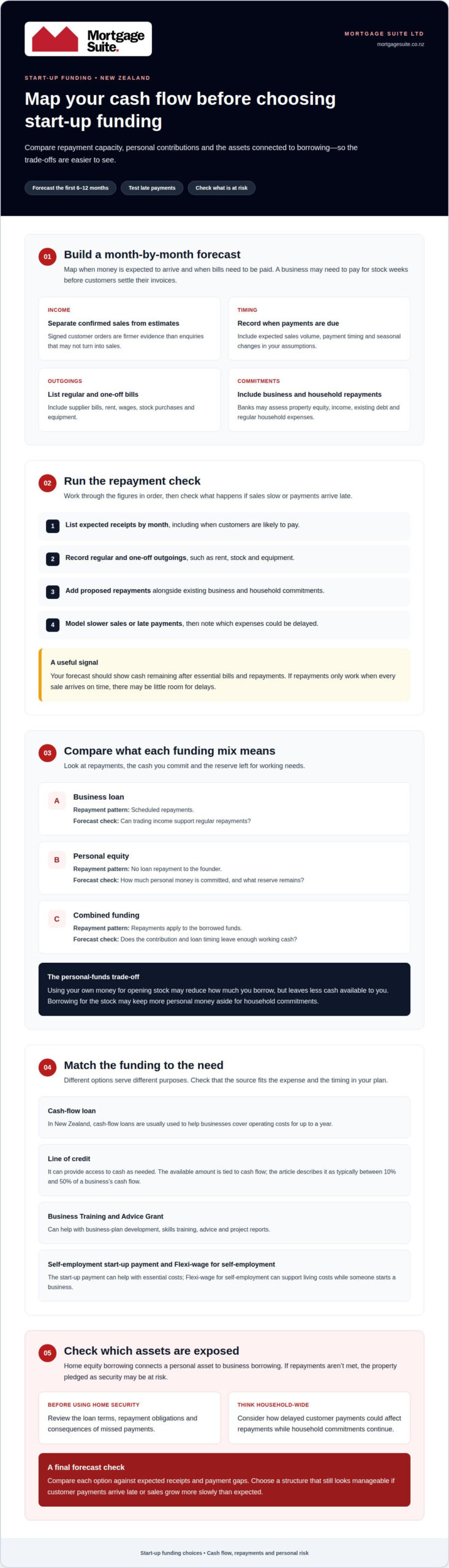
Build a forecast covering the first six to 12 months of trading. Map expected customer payments against supplier bills, rent, wages and other operating expenses. Include the timing of each item: a business may need to pay for stock weeks before customers settle their invoices.
Separate confirmed income from estimates. Signed customer orders, for example, provide firmer evidence than enquiries that may not turn into sales. Record the assumptions behind projected revenue, including expected sales volume, payment timing and seasonal changes. This helps reveal where a cash shortfall could arise.
Use these steps to test whether the proposed repayments fit:
- List expected business receipts by month, including when customers are likely to pay.
- Record regular and one-off outgoings, such as rent, stock purchases and equipment.
- Add the proposed repayments and existing business and household commitments.
- Model slower sales or late payments, then identify which expenses can be delayed.
A forecast should show the cash left after essential bills and debt repayments. If repayments are manageable only when every sale arrives on time, the plan may leave little room for delays. Adjust sales timing and costs to see which assumptions have the greatest effect on repayment capacity.
| Funding option | Repayment pattern | Forecast detail to assess | Main cash-flow question |
|---|---|---|---|
| Business loan | Scheduled repayments | Expected operating cash after each payment | Can trading income support regular repayments? |
| Personal equity | No loan repayment to the founder | Personal funds committed and remaining | What personal reserve remains available? |
| Combined funding | Repayments apply to borrowed funds | Contribution and loan timing | Does the mix leave enough working cash? |
Using personal funds for an opening stock order may reduce the amount you borrow, but it also leaves less cash available to you. Compare that with borrowing for the stock and keeping more money for household commitments. Mortgage Suite Ltd can help you model these scenarios so the trade-off is easier to see.
Choose a structure that remains manageable if customer payments arrive late or sales grow more slowly than expected. A month-by-month forecast lets you compare funding options against actual payment timing, rather than relying only on a headline sales target.
Carefully evaluate the timing of repayments and access to working funds when planning your business startup. In New Zealand, cash flow loans are usually used to help businesses cover operating costs for up to a year. A line of credit can offer another way to manage cash needs, with the available amount tied to cash flow. In New Zealand, a line of credit is typically between 10% and 50% of the value of a business’s cash flow. Compare each option with forecast gaps and expected receipts, and check that the business can meet its obligations if income is delayed.
Comparing funding costs and risks
Funding options differ in how you access money, make repayments and put assets at risk. Compare the structure and commitments before choosing a route for your start-up.
Alternative business funding
A home equity loan uses your property as security, while a business loan is assessed as business borrowing. An overdraft provides access to a facility as needed, rather than a single lump sum. Start-up funding can also include personal contributions or government support, which don’t involve the same scheduled loan repayments.
New Zealand support options are available that don’t require home equity. The Business Training and Advice Grant can help with business-plan development, skills training, advice and project reports. The self-employment start-up payment can help with essential costs, while Flexi-wage for self-employment can support living costs as someone starts a business.
Match each option to the need it addresses. A grant for business advice won’t serve the same purpose as funding for equipment, while an overdraft is designed to provide access to cash as needed. Check that the funding source fits the expense and timing in your plan.
Risks of using home security
Using your home as security connects a personal asset to business borrowing. If repayments aren’t met, the property pledged as security may be at risk. Unlike funding that doesn’t use your home as security, this option can put pressure on your household’s housing arrangements if the business struggles.
Consider a start-up facing delayed customer payments: the business may have less cash available for repayments, while household commitments continue. Before securing borrowing against your home, examine the loan terms, repayment obligations and consequences of missed payments. Consider both the uncertainty of the business and your personal circumstances.
Compare options by asking what the funding supports, how repayments work and which assets are exposed. A home-backed loan may provide access to funds, but it puts your home within the borrowing arrangement. A business loan, overdraft, personal contribution or grant has a different structure and purpose.
Choose an approach that fits the start-up’s purpose without overlooking the effect on your personal finances. If you’re considering home security, weigh the business plan against the consequences for your household, not just the funds available.
Asset-backed business loans
Home equity borrowing uses a property as security for funds. In New Zealand, the structure and permitted use determine how this funding compares with other business finance.
Home equity lending options
Home equity lending can take the form of extra borrowing against a property, a separate loan split or a revolving facility secured against the home. A separate split keeps the new borrowing distinct from the existing home loan. A revolving facility lets you draw funds as needed instead of receiving one lump sum.
These structures differ in how you access and repay funds. A lump sum may suit a defined purchase, such as equipment, while a revolving facility may suit costs that arise at different stages. In either case, the home secures the borrowing, and repayments are due under the agreed terms.
Yes, you can use home equity borrowing for start-up expenses if the lender approves that purpose. Funds might cover equipment, initial stock or fit-out work. The proposed use, available equity, repayment capacity and security all affect the application assessment.
Using loan funds for a startup
Using home equity for a start-up puts business funding against a personal asset. It can provide funds before a new venture has a trading history, but you still need a clear plan for how the money will be used and repaid. Keep business spending separate from household transactions so each use of the borrowed funds is easy to trace.
Can you use a home equity loan to fund a New Zealand business start-up? Yes, if the lender accepts the business purpose and the application meets its lending assessment. Set out the planned expenses, their timing and the repayment source. For example, explain whether the funds will pay for equipment upfront or cover stock purchases in stages.
Tie the amount borrowed to identified expenses rather than treating available equity as a spending target. If the start-up needs less than the full amount, borrowing only what the plan requires can limit unnecessary debt. The repayment obligation remains personal, even when the business receives the funds.
Tax and interest deductibility
For tax purposes, using a home as security does not, by itself, determine whether interest is deductible. The use of the borrowed funds matters. Keep loan statements, invoices and business records showing where each drawdown went, especially if one facility funds both household and business expenses.
For example, record a transfer used to buy business equipment separately from any personal withdrawal. Mixed use can make it harder to identify the portion connected with business activity. Keep the loan purpose, transaction records and accounting treatment consistent, then ask a New Zealand tax professional to assess the specific business use.
Before choosing an asset-backed loan, write down the funding structure, planned business expenses and repayment source. This gives you a clearer basis for weighing access to home equity against the personal commitment it involves.
Business loan application steps and documents
A clear application links the amount requested to the start-up’s purpose and repayment plan. For a new business without trading history or steady revenue, lenders rely on the business plan and the founder’s personal credit history.
Prepare a funding pack explaining how the venture will operate, what the money will pay for and how repayments could be made. Include documents to support each claim rather than relying on broad sales estimates or informal notes.
- Set out the funding purpose. Break the requested amount into specific uses, such as equipment, stock, fit-out work or early operating expenses. Supplier quotes or purchase estimates can help show how each portion will be spent.
- Build the business plan. Describe the product or service, intended customers, sales approach and day-to-day operating needs. A plan for a mobile coffee business, for example, could explain its locations, equipment and expected trading hours.
- Show forecast income and expenses. Include expected sales, supplier payments, rent, wages and other regular commitments. Explain the assumptions behind projected sales, such as customer numbers, pricing and the time needed to build demand.
- Explain repayment capacity. Show how repayments fit alongside business expenses and the founder’s personal commitments. Include a slower-sales scenario, then explain how the business would manage its obligations if customer payments arrived later.
- Gather personal and business records. Organise the founder’s credit information, identification, personal financial details and any records already available for the business. If the business has started trading, include relevant account statements and sales records.
- Describe any security or personal contribution. Identify assets offered as security and explain any funds the founder is putting into the venture. Keep the proposed security separate from the forecast so the lender can assess both clearly.
Consistency matters. If the plan forecasts equipment purchases before opening, the supporting quotes and cash-flow forecast should show the same timing. If the founder has existing repayments, include them when explaining household affordability rather than leaving a gap in the application.
Before submission, arrange the information in the same order as the funding request: purpose, plan, forecast, supporting records and repayment explanation. This makes it easier to follow how the business will use the funds. A start-up loan application is stronger when each projected income source has a clear basis and each major expense is explained.
A lender may ask for more details after reviewing the initial pack. Keep a dated copy of the submitted forecast and plan so you can explain any revised figures. If sales expectations change, update the forecast and note what changed, such as a delayed opening or a different supplier arrangement.
Personal investment and equity contributions
Putting your own money into a start-up can reduce how much you need to borrow. It also exposes those personal funds to the business’s performance, while a loan creates scheduled repayments. In New Zealand, lenders consider a founder’s personal investment or equity when assessing a loan application.
Personal contributions can cover start-up costs such as initial stock, equipment or set-up work. For example, a founder might use personal funds for a small equipment purchase and seek borrowing for other planned expenses. Show each contribution clearly in the funding plan, distinguishing money already committed from funds you may need to borrow.
Keep a record of where personal funds come from and how they enter the business. A transfer record and matching entry in the business accounts can help explain the contribution. If you contribute an asset rather than cash, describe it and explain how it supports the business’s operations.
A founder contribution differs from an investor’s contribution. An angel investor may provide start-up capital in exchange for a stake in the business. In New Zealand, angel investors may also lend money, take a percentage of profits or ask for partial ownership. Clarify whether an offer is a loan, a share of profits or an ownership stake, as each affects the business differently.
Before deciding how much personal money to commit, work through these points:
- List the start-up expenses the contribution will cover.
- Keep enough personal funds available for household needs and unexpected bills.
- Record any investor arrangement in writing, including whether it involves repayment, profit sharing or ownership.
- Update the funding plan to show how the contribution changes the amount you need to borrow.
A larger personal contribution may reduce the loan you request, but it also leaves less of your own money outside the business. Consider what happens if sales take longer to build or the business needs extra working cash. A balanced plan can combine founder funds and borrowing without treating all available savings as money that must go into the venture.
Use a loan repayment calculator to explore how a different borrowing amount changes estimated repayments. Then compare those repayments with your business forecast and personal commitments. The calculator can help with the borrowing side of the decision; it doesn’t assess the value of an ownership stake or whether an investor’s terms suit your plans.
Mortgage Suite: Business Loans
Mortgage Suite Ltd can help you explore Business Loans when your start-up needs funding beyond personal contributions or home equity. We’ll consider your business plan, cash-flow forecasts, proposed repayments and available security, then help you understand how the lending structure fits your goals.
A decline from a mainstream bank doesn’t automatically end the conversation. If your circumstances or start-up plans make borrowing complicated, a discussion can help clarify the options and the information that supports an application. You can weigh the business funding need against personal commitments before deciding on your next step.
If you’re ready to discuss funding for your start-up, contact Mortgage Suite Ltd.
Choose a funding path that supports your next move
Your next step is to set a clear boundary between business funding and personal security. Decide what you’re comfortable contributing, what the business needs funding for and which risks you’re prepared to carry. This gives you a practical basis for discussing an equity loan for a New Zealand business start-up alongside other funding structures.
Mortgage Suite Ltd can help you consider Business Loans in the context of your wider financial goals. Its lending support also includes Home Loans to First Home Buyers and residential investment property loans. A conversation can help you work through how your business plans and personal commitments fit together, without assuming one funding approach is right for every founder.
If you’re weighing your options or want to discuss a funding plan for your start-up, contact Mortgage Suite Ltd to discuss your options. A thoughtful next step can help you move forward with a clearer sense of what you’re taking on and what matters most to your business.
Frequently Asked Questions
How long does approval take?
Approval timing varies by lender and application. Some online lenders may decide within a business day, while a traditional bank start-up loan application can take a few weeks. A new business may need more explanation if it has no trading history, so a complete plan and consistent supporting documents can help the lender assess the request.
How much can I borrow for a startup?
New Zealand start-up loans commonly range from NZ$5,000 to NZ$500,000, depending on the funding need and application. Unsecured start-up loans are often available for amounts under NZ$50,000. These are general market ranges, not a borrowing promise or a specific offer. The amount considered depends on the business plan, repayment capacity, credit history, security and how the funds will be used.
What interest rate can a startup expect?
There isn’t one standard rate for every start-up loan. The rate depends on the loan structure, security, credit history and the lender’s assessment of repayment capacity. For context, the Reserve Bank of New Zealand reported an SME new overdraft rate of 10.06% in August 2026. That figure is an overdraft benchmark, not a quoted rate for a start-up loan or home equity borrowing.
How much can I borrow against my home equity in NZ, and how is it calculated?
The available amount depends on your property’s assessed value, existing home lending and the lender’s assessment of repayments. As a starting point, consider the property value less the home loan and other debt secured against it. That isn’t necessarily the amount available to borrow: income, regular commitments, the loan purpose and the lender’s security requirements also affect the decision.