
Auckland broker for comparing banks and non-bank lenders
A mainstream bank’s answer isn’t always the last word on your borrowing options. Mortgage Suite Ltd can present your application to multiple lenders, including banks and non-bank lenders, and help compare options for a first home, an investment property, a self-employed application or a business. A broker arranges lending rather than lending money directly, so the right match depends on your goals, finances and the lender’s criteria.
Comparing lenders can feel like another job on top of an already big decision. A low headline rate may catch your eye, but the loan structure, repayment flexibility and fit with your plans matter too.
Here, you’ll learn what a Mortgage Suite Ltd broker does, how lender comparisons work and what can shape an application. We’ll also cover the different needs involved in buying your first home, applying with self-employed income, purchasing an investment property or seeking business and commercial finance, so you can see what to prepare and what the next steps may look like.
Key Takeaways
- Compare loan options by more than the headline rate: consider repayment flexibility and how the lending structure fits your plans.
- For a first home or rental property, understand how your deposit, income and property choice can shape the options available.
- Self-employed applicants can present their income using business records, including bank statements and profit-and-loss records.
- Business and commercial lending needs can differ from a standard home loan, so the purpose of the funds and how they’ll be repaid matter.
- Mortgage Suite can help explore home loans, residential investment property loans and business finance, including options beyond mainstream banks.
First-home buyer and property investor loans
A first-home loan and an investment loan serve different goals, so lenders assess each application in context. Compare the deposit, income evidence, property and repayment structure before choosing a direction.
First-home buyer mortgage advice
First-home mortgage advice can help you understand what lenders may consider before you make an offer. An adviser can review your deposit, income, regular commitments and the property you’re considering, then explain how these details affect possible loan structures. For example, a pre-approval can help you set a borrowing limit before attending open homes. Treat it as a guide, not a final loan offer.
In New Zealand, ask which Financial Advice Provider is responsible for the advice and how its disclosure and complaints process works. A reputable adviser should explain their role, the lenders they can approach and why a suggested option may suit your circumstances.
Auckland brokers may charge fees, while other payment arrangements can apply. The amount depends on the arrangement and your case, so ask for the fee, when it would be payable and any other payment details in writing before proceeding.
To find a suitable Auckland mortgage broker, compare how they explain lender choices, their advice process and relevant experience. Ask how they’ll present your application and what happens if a lender declines it. Clear answers help you understand the service before sharing documents or making decisions.
Using a broker also has limitations. Their lender panel may not include every available option, and a lender can still decline an application. Ask how the broker is paid and whether lender relationships affect the options they present. You remain responsible for deciding whether the proposed repayments fit your budget.
Loans for property investors
Residential investment property loans are assessed against both your financial position and the property’s role in your plans. Discuss the purchase purpose, deposit, expected rental income and how you’ll manage repayments if the property is vacant. These details help frame an application and show whether a proposed structure suits your wider financial commitments.
Compare repayment flexibility as well as the interest rate. A fixed interest rate keeps repayments stable during the agreed fixed term, while floating rates can vary with benchmarks such as swap rates. Floating rates may allow large repayments without a penalty, which can suit investors planning to reduce debt faster. Consider how each structure fits your cash flow and plans.
Before progressing, ask the adviser to explain the recommended loan structure, repayment options and lender criteria in plain language. A clear comparison should connect each option to your deposit, income and property goals, rather than focus on the interest rate alone.
Self-employed mortgage applications
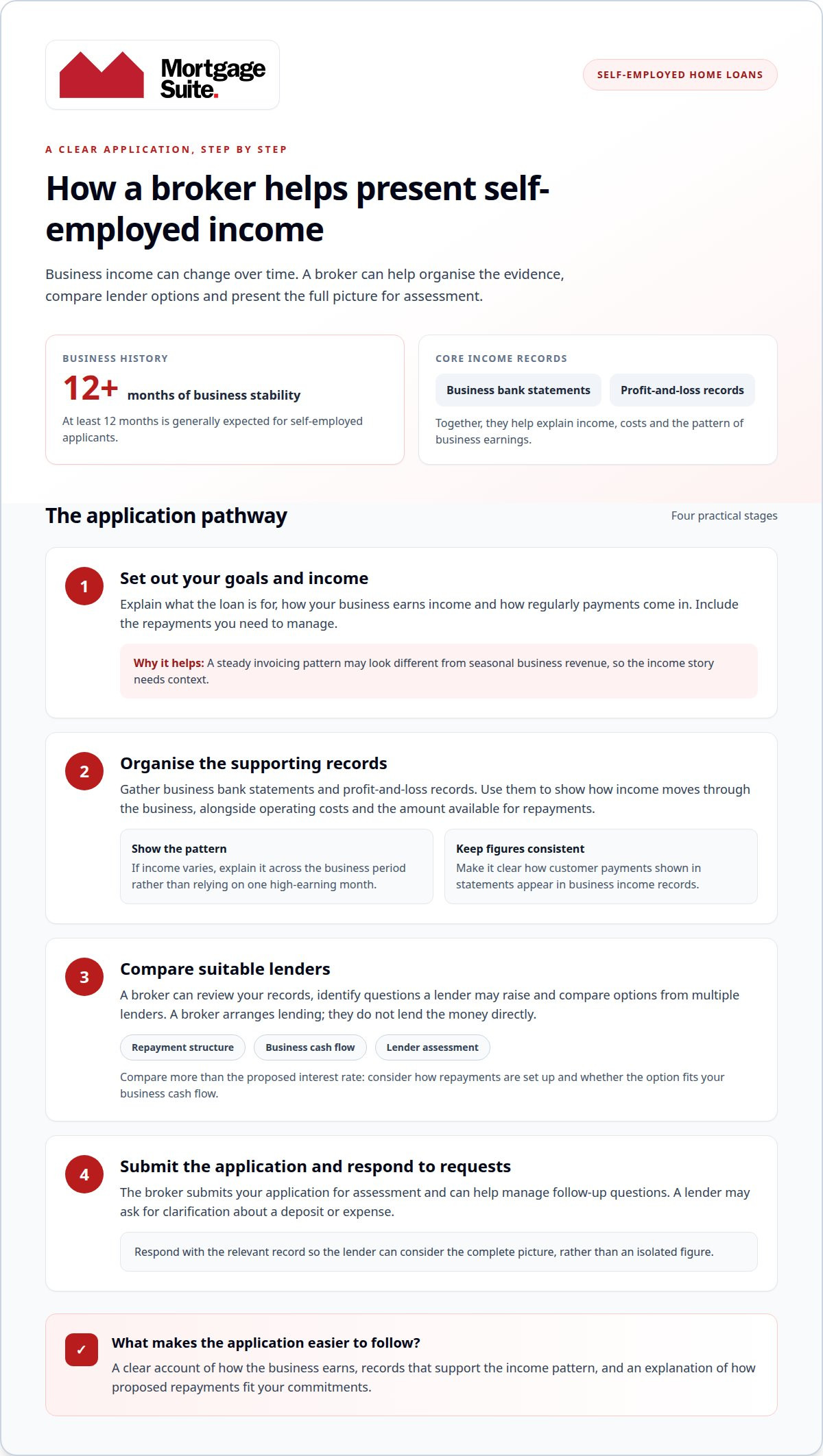
Self-employed income can be harder to present than a regular salary, especially when business earnings change between periods. In New Zealand, applicants are generally expected to show at least 12 months of business stability, and lenders can assess bank statements alongside profit-and-loss records.
Start by explaining how your business earns income and how regularly it receives payments. A contractor with steady invoices, for example, may present a different pattern from a business owner whose revenue changes seasonally. The lender considers the evidence alongside existing commitments and proposed repayments, rather than looking at one strong month alone.
Mortgage application documents
Prepare business bank statements and profit-and-loss records that show how income moves through the business. These documents help explain revenue, operating costs and the amount available to support repayments. If income varies, use the records to show the pattern across the business period, rather than relying on a single high-earning month.
Keep the figures consistent across the records you provide. For example, if a bank statement shows a customer payment, the profit-and-loss record should make its place in business income understandable. Organised documents give the lender a clearer picture of your application and reduce confusion over how you earn.
Business stability matters alongside the amount earned. A trading history of at least 12 months is generally expected for self-employed applicants, while the records help show how that business has performed. If you recently changed the way you work, explain the change and show how your current income is supported by the available evidence.
Steps to a mortgage through a broker
The steps are to discuss your goals and business income, organise supporting records, compare suitable lenders, then submit an application for assessment. A broker acts as an intermediary, presenting your application to multiple lenders rather than lending the money directly.
Start by setting out the loan purpose, the income your business generates and the repayments you need to manage. The broker can then review your bank statements and profit-and-loss records, identify questions a lender may raise, and prepare an application that explains how the figures fit together.
After comparing lender options, the broker submits the application and helps manage follow-up requests. A lender may ask for clarification if a deposit or expense needs explaining. Responding with the relevant record keeps the assessment moving and helps ensure the lender considers the complete picture, not an isolated figure.
Compare more than the proposed interest rate. Ask how repayments are structured, what the lender’s assessment focuses on and whether the option fits your business cash flow. If one mainstream bank declines the application, that decision does not automatically settle what other lenders may consider. Different lenders can assess the same income evidence under different criteria.
Before accepting an offer, make sure you understand the repayment amount, loan structure and any conditions attached to the lender’s decision. A broker can explain those details in plain language, so you can weigh the commitment against your business income and household budget.
Business and commercial loans
A business loan and a commercial property loan address different needs. A business owner seeking equipment finance has a different purpose from a company buying premises. Start by defining what the funds will pay for, how the business expects to repay them, and which assets support the request. That gives a lender a clearer basis for assessing the application.
For a business loan, explain the use of funds in practical terms. For example, a wholesaler might need working capital to pay suppliers before receiving customer payments. A lender can assess the business’s income, expenses, existing debt and repayment capacity against that purpose. A clear cash-flow picture helps show how repayments fit alongside regular operating costs.
Prepare records that make the business’s finances easy to follow. These may include business bank statements, profit-and-loss records and details of current borrowing. If income changes across the year, explain the pattern, such as higher sales during a seasonal trading period. Match the requested loan amount to a defined need, rather than presenting an unexplained figure.
Commercial property finance focuses on the property and its role in the business. A company purchasing its own premises, for instance, can explain how the site supports its operations and how repayments fit its trading income. The lender considers the property alongside the applicant’s financial position. Assess the loan against the planned use, ownership structure and repayment approach.
A term loan is provided as a lump sum with a defined repayment schedule and end date. That structure may suit a specific purchase, such as a business asset or property, where the amount and purpose are known. Compare its repayment pattern with the expected benefit of the purchase. For example, equipment should support business activity throughout the loan period.
Before an application is presented, organise the key details:
- Purpose: describe the purchase, operating need or property transaction.
- Repayment plan: explain which business income will meet repayments.
- Financial records: provide statements and profit-and-loss information that support the figures.
- Security: identify any property or business assets offered to support lending.
For a commercial property purchase, also set out the proposed use and expected contribution to the business. For example, operating from owned premises may differ from buying a property to earn rent. Those distinctions affect how the lender understands the transaction and assesses its repayment source.
If a mainstream bank declines an application, treat the decision as information about that lender’s assessment, not a verdict on the business. Another lender may consider the purpose, records or security differently. A well-organised application helps explain the business case and gives lenders the details needed to assess it.
Comparing banks and non-bank lenders
There isn’t one best Auckland mortgage broker for every borrower. Compare how each broker explains lender choices, presents your circumstances and weighs loan structure alongside the interest rate. A useful comparison connects the lender’s criteria to your borrowing purpose, income and repayment plans.
A bank lends directly and assesses your application under its own lending criteria. A non-bank lender is also a direct lender, but its assessment approach and loan terms may differ. A broker acts as an intermediary and can present your application to multiple lenders. That can help you see alternatives if one lender’s criteria don’t fit your circumstances.
Compare the whole loan, not just its advertised rate. Check the repayment structure, any conditions, flexibility for extra repayments and how long a fixed interest rate applies. For example, a lower rate may not suit a borrower who values repayment flexibility more. Ask the broker to explain the trade-offs in plain language, using your own goals.
Non-bank lending can be relevant when an application doesn’t fit a mainstream bank’s usual criteria. Second-tier loans are options for borrowers who don’t fit mainstream banks. The lender still assesses the application, including its purpose, income, repayments and supporting information. A different lender may offer another path, but the terms and assessment can differ.
Use these points to compare a broker’s approach:
- Lender range: ask whether the broker can present your application to banks and non-bank lenders.
- Reasoning: expect a clear explanation of why a lender may suit your income and loan purpose.
- Loan structure: compare repayment options and conditions, not only the headline rate.
- Communication: find out how the broker will explain lender feedback and any next steps.
For example, a self-employed borrower may need an application that explains variable business income clearly. One lender may assess that evidence differently from another. A good comparison shows how the records support the application and why each proposed lender is worth considering. It doesn’t treat a bank’s decline as a final judgement on the borrower.
Before choosing a broker, ask how they’re paid and whether lender relationships affect the options presented. Request a written comparison that outlines the proposed lender, repayment structure, conditions and relevant trade-offs. This gives you a clearer basis for deciding, rather than relying on a broad claim that one lender is always best.
The right Auckland broker is one whose lender access and explanation fit your needs. Compare their approach using the same questions and your actual borrowing goals. A careful discussion should leave you understanding why a bank or non-bank option is being considered, and what the lender will assess.
The best fit is a broker whose lender range matches your circumstances and who clearly explains lender choices, loan structure, conditions and trade-offs. Compare how each broker handles your income and loan purpose, communicates lender feedback, and explains how they’re paid and whether lender relationships affect the options they present.
What types of brokers operate in Auckland, New Zealand?
An Auckland broker may focus on home lending, specialist applications or business finance. A mortgage broker acts as an intermediary, rather than lending money directly, and can present your application to multiple lenders. The useful distinction is the type of borrowing they handle and whether that matches your plans.
A residential mortgage broker works with home-loan applications. That can include a first-home purchase, a move to another home or borrowing for a rental property. For example, a first-home buyer may need help understanding how their deposit and income shape lender choices. An investor may need a discussion centred on the property’s purpose and planned repayments.
Some brokers focus on applications with less straightforward income or circumstances. A self-employed applicant, for instance, may need their business income explained through bank statements and profit-and-loss records. A broker familiar with those applications can help present the records clearly and approach lenders whose criteria may suit the case. The broker arranges the application; the lender makes its own assessment.
Business and commercial finance brokers work with funding for business purposes or commercial property. A business seeking funds for equipment has a different borrowing purpose from a company purchasing premises. Describe the planned use of funds and repayment source, then identify a broker whose work includes that kind of application.
Bank lending staff have a different role from brokers. They discuss lending offered by their own bank, while a broker can take an application to multiple lenders. That distinction matters if you want to compare a bank’s proposal with options from other lenders. Ask which lenders the broker can approach and how they’ll explain the differences.
To work out which type fits, match the broker’s focus to your application:
- Buying your first home: look for experience with residential home-loan applications and pre-approval.
- Applying with business income: ask how the broker presents self-employed earnings.
- Buying a rental property: discuss residential investment lending and repayment plans.
- Funding a business or premises: choose a broker whose work includes business or commercial finance.
Before sharing documents, explain your goal in one clear sentence, such as buying a first home or funding business premises. Then ask how the broker will handle that specific application, which lenders they can approach and how they’ll outline each option. Those answers help you understand whether their focus fits your borrowing needs.
Mortgage Suite
Mortgage Suite Ltd helps you compare lending options around your goals, income and borrowing needs. If you’re buying your first home, investing in residential property or seeking finance for a business or property development, the team can help present your application to suitable lenders and explain the differences in plain English.
A mainstream bank’s decline doesn’t necessarily end your options. Mortgage Suite Ltd can also consider second-tier lending for applications that don’t fit mainstream bank criteria, while explaining the terms and trade-offs involved. The focus is on helping you make an informed choice, not promising a particular outcome.
If you’d like to talk through your borrowing plans and possible next steps, contact Mortgage Suite Ltd for a free, no-obligation conversation.
Take the next step with a clear borrowing plan
Before moving ahead, decide what a useful lending outcome needs to do for you. You might want confidence about your first home purchase, room to grow a business, or a structure that supports a property purchase over time. Being clear about that priority gives an Auckland broker a practical starting point for discussing suitable options.
Mortgage Suite offers Home Loans to First Home Buyers, Residential Investment property loans and Business Loans. The next step is a conversation about your goal, your circumstances and the questions you want answered. From there, you can understand which lending options may fit and what information an application needs.
You don’t need to have every detail sorted before starting. Bring the outline of your plans, including what you’re hoping to finance and what feels uncertain. Mortgage Suite can help you talk through the lending path and possible next steps, with no obligation to decide on the spot.
Contact Mortgage Suite about your loan and take the next step with a clearer sense of direction.
Frequently Asked Questions
What documents do Auckland brokers need to assess a loan application?
Prepare documents that show your income, commitments and the purpose of the loan. For a self-employed application, this can include business bank statements and profit-and-loss records. A first-home buyer might also prepare information about their deposit, regular expenses and the property they’re considering. For example, someone buying with another person should be ready to explain how each applicant contributes to repayments and manages shared commitments.
How do Auckland mortgage rates and lending criteria compare across banks?
Rates and lending criteria can differ between banks, so compare offers using the same borrowing details. Look beyond the advertised rate: consider repayment structure, conditions, flexibility and how long any fixed rate applies. For example, ask how each bank would assess the same income and deposit, then compare its written offer and requirements. This makes differences easier to understand without assuming the lowest headline rate is automatically the best fit.
What should first-home buyers in Auckland ask a mortgage broker?
Ask which lenders they can approach, how they’ll compare suitable loan structures and what a pre-approval does and doesn’t cover. You could also ask what may change between pre-approval and a final offer, and which conditions you’ll need to meet. If you’re buying with another person, discuss how the application reflects both incomes and shared repayments. Clear answers help you understand the decision before you make an offer.
How are mortgage brokers in New Zealand regulated and checked?
Ask which Financial Advice Provider is responsible for the advice and how its disclosure and complaints process works. You can also compare the broker’s explanation of lender choices, advice process and relevant experience.
Do Auckland mortgage brokers charge fees, and how much?
Auckland brokers may charge fees, but the amount depends on the arrangement and your case. Ask for the fee, when it is payable and any other payment details in writing before proceeding.