
Family trust property investment in NZ: roles and control
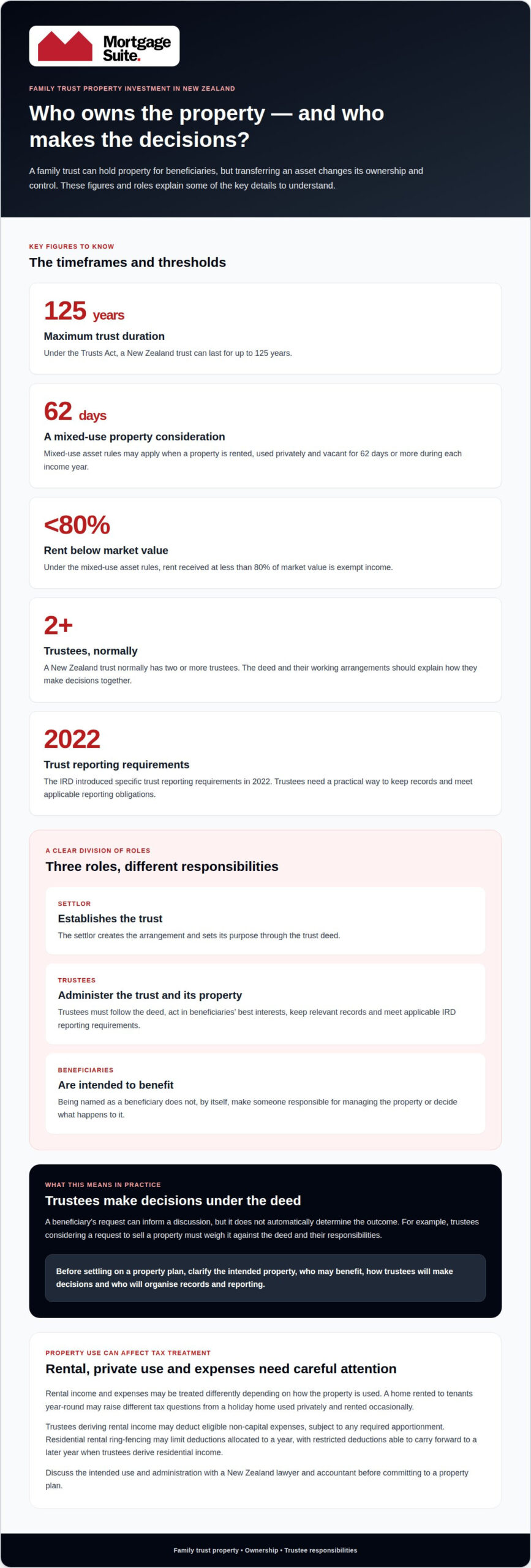
A family trust can give a family a structure for holding property, but it also changes who owns and controls that property. For family trust property investment in NZ, the trustees hold trust assets and must act under the trust deed in the beneficiaries’ best interests. A trust can last up to 125 years under the Trusts Act.
If you’re considering a family trust property investment in NZ, it’s natural to want clarity about what a trust can achieve and what control you may be giving up. A trust is more than a name on a property title: its structure affects who makes decisions and how the property is managed for beneficiaries.
This guide explains why families use trusts, what settlors, trustees and beneficiaries each do, and how ownership and control work after property is transferred. You’ll also learn how long a New Zealand trust can last and how property lending may fit into the decision, helping you approach the next conversation with a clearer picture.
Key Takeaways
- Weigh a family trust’s potential benefits against its ongoing administration and compliance responsibilities before deciding whether it suits your plans.
- Understand how settlors, trustees and beneficiaries have different roles, and why trustees’ decisions must follow the trust deed.
- Recognise that transferring property to a trust changes who owns and controls it; trustees manage the assets for beneficiaries.
- Keep the trust’s time horizon in mind: under the Trusts Act, a New Zealand trust can last up to 125 years.
- Consider how property lending fits into your plans, including whether residential investment property finance could support a trust-owned property.
Why have a family trust?
A family trust may suit a property plan when the family has a clear purpose for holding the asset and can support its ongoing administration. The Trusts Act 2019 applies to express trusts in New Zealand, including family trusts. Before settling on this structure, map the intended property, beneficiaries and trustee decision-making arrangements. That makes it easier to discuss whether the trust’s purpose matches the family’s actual plans.
Professional advice helps connect a legal structure with how the property will be used. A New Zealand lawyer can explain how the deed supports the intended ownership and what decisions trustees can make. An accountant can assess how rental income and expenses are treated. For example, a property rented to tenants year-round may raise different tax questions from a holiday home used privately and rented out occasionally.
Mixed-use property needs particular attention. New Zealand’s mixed-use asset rules may apply if a property is rented and used privately, and is vacant for 62 days or more during each income year. Under those rules, rent received at less than 80% of market value is exempt income. A family considering private use alongside short-term letting should discuss those details before choosing how the property will be held.
Expense treatment also depends on the property’s activity. Under section DA 1 of the Income Tax Act 2007, trustees deriving rental income may deduct eligible non-capital expenses, subject to any required apportionment. If a rental activity makes a loss and falls outside the mixed-use asset rules, residential rental ring-fencing under subpart EL may limit deductions allocated to that year. Restricted deductions may carry forward to a later year when trustees derive residential income.
For example, trustees considering a property that family members will sometimes use privately should discuss its expected rental and personal use with their lawyer and accountant. Those professionals can assess whether mixed-use rules apply, how expenses should be apportioned and whether ring-fencing affects deductions. This helps the family understand the tax treatment before committing to a property plan.
Ongoing administration matters too. The IRD introduced specific trust reporting requirements in 2022, so trustees need a process for keeping records and meeting applicable reporting obligations. Before establishing a trust, agree who will organise property records, document decisions and coordinate tax reporting. A trust is more likely to fit the plan when the family understands these responsibilities and has a practical way to manage them.
Roles of settlors, trustees and beneficiaries
A settlor establishes the trust, trustees administer it, and beneficiaries are the people it is intended to benefit. These roles matter in everyday decisions, such as whether to repair a rental property or how to respond to a beneficiary’s request. The trust deed provides the framework, so family members should understand which decisions belong to trustees and who may benefit.
The settlor’s role is to create the arrangement and set its purpose through the deed. For example, a parent establishing a trust around a rental home may want the property managed for their children. That intention needs to be reflected in the trust’s terms. Once the trust is established, the settlor’s wishes do not replace the trustees’ responsibilities or give the settlor automatic authority over each property decision.
Trustees make and administer decisions for the trust. A New Zealand trust normally has two or more trustees, so the deed and their working arrangements should make clear how they will make decisions together. If a tenant reports damage, trustees may need to consider the property’s condition, the trust’s responsibilities and the beneficiaries’ interests. Recording the decision and the reasons for it helps show how trustees handled the matter.
Trustees of a rental-property trust must follow the deed, act in beneficiaries’ best interests, keep relevant records and meet applicable IRD trust reporting requirements. Records of rental income, property expenses and trustee decisions, for example, help support the trust’s administration and reporting. These responsibilities remain with the trustees even if a family member helps with practical tasks.
Beneficiaries may be individuals or a group identified in the deed. Their role differs from a trustee’s: being named as a beneficiary does not, by itself, make someone responsible for managing the rental home. If an adult child asks trustees to sell a property, trustees must consider the request in light of the deed and their responsibilities. The beneficiary’s view can inform the discussion, but it does not automatically determine the outcome.
Clear role boundaries are especially useful when one person holds more than one role. A settlor may also be a trustee or beneficiary, but each decision still needs to be considered in the capacity in which it is made. For example, a parent who is both trustee and beneficiary should distinguish personal preferences from decisions made as a trustee for the trust.
Before relying on a particular arrangement, ask a New Zealand lawyer to explain the deed’s roles and powers using a real property decision. Discuss how trustees should handle a repair, a beneficiary’s request or a disagreement between trustees. Working through these examples can reveal whether everyone understands their role before a decision arises.
Trust asset ownership and control
Transferring a property to a family trust changes who owns and controls it. This distinction matters when weighing personal ownership, family plans and possible legal claims.
Trust Ownership and Personal Ownership
Personal ownership means you own the investment property yourself; trust ownership means trustees own it under the trust deed. An NZ investment property may be held personally or through a trust, depending on your goals and circumstances. Transferring an asset to a trust can change who owns and controls it. Trustees manage it under the deed and must act in beneficiaries’ best interests.
The change affects who makes property decisions. For example, a settlor who wants to retain direct control may find that trust ownership does not suit that aim. A family planning for named beneficiaries may prefer a deed-based structure, while recognising that trustees, not the former owner personally, control the trust property.
Transferring Assets into a Trust
Transferring an asset means placing ownership with the trustees under the trust arrangement. A New Zealand trust may be established with an initial property transfer as small as NZ$1, but transferring an existing home or investment property requires separate consideration. The transfer changes legal ownership, so the settlor gives up personal control of that asset.
Before proceeding, consider the deed, intended beneficiaries and effect on the settlor’s finances. Transferring a rental property, for example, may affect who receives its income and who decides how it is managed. A lawyer can explain the legal effect, while an accountant can consider the tax implications. The decision should fit the family’s purpose, not just the transfer process.
Asset Protection and Clawback Risks
A family trust does not make property immune from legal claims. In certain circumstances, trust property may be transferred back or otherwise clawed back. The Property (Relationships) Act 1976 allows a court to set aside certain transfers to a trust or order compensation where a transfer defeats a partner’s rights.
That limitation matters when planning for relationship property. A transfer should not be treated as a guaranteed way to keep assets beyond a partner’s claims. The circumstances and purpose of the transfer matter, so legal advice before moving property can help clarify the risks and limits of the trust.
Buying an Investment Property Through a Trust
A New Zealand family trust can buy an investment property through its trustees, who acquire and hold the property for the trust. The deed guides their decisions, including how they manage the asset for beneficiaries. Before buying, clarify that the trust’s terms support the intended property and identify who will make decisions.
For inheritance planning, the deed names the beneficiaries and sets the framework trustees follow. Beneficiaries may benefit from trust property, but that does not give them personal ownership or day-to-day control. Review the deed alongside the purchase plan so trustees understand their responsibilities and the family’s intended outcome.
Trust duration and extensions
The Trusts Act sets the maximum duration of a New Zealand trust at 125 years. Before the Act changed that limit, trusts were generally limited to 80 years. That longer maximum gives families more time to plan how trust property may be managed across generations.
Duration is not the same as a promise that a trust will continue for the full 125 years. The trust deed and the family’s circumstances shape how long the arrangement remains useful. For example, a trust holding a rental property for children and grandchildren may have a different purpose from one created for a shorter family plan. Read the deed’s terms alongside that purpose.
Families considering an extension should start by identifying the trust’s stated end date and the Trusts Act’s 125-year maximum. The maximum is a legal limit, not an automatic extension date. A plan to keep holding a property beyond the deed’s stated period needs proper legal review. That review should consider what the deed says, the intended beneficiaries and how trustees will manage the asset.
Consider the practical effects of a trust continuing over time. A family’s beneficiaries may change as children grow up, and trustees may change too. If a trust owns a rental home, future trustees still need clear guidance on managing the property and considering beneficiaries’ interests. Reviewing the deed as family circumstances change can help ensure its purpose and instructions remain aligned.
The earlier 80-year limit also matters when reading older trust documents. A family with an existing trust should distinguish the historical limit from the current 125-year maximum under the Trusts Act. The changed maximum does not, by itself, explain what happens under a particular deed or resolve its terms. A New Zealand lawyer can interpret the document and explain how its duration provisions apply.
For a new family trust, discuss its intended lifespan before settling the deed. Set out the family’s purpose, who may benefit and how trustees should approach property decisions over time. Then have a lawyer explain the duration clauses and how they relate to the Trusts Act’s maximum. This gives trustees a clearer framework and helps the family avoid assuming that a long-term plan automatically extends the trust.
Reasons for setting up a family trust
Families usually consider a trust because they want a defined way to hold and manage assets. The reason should be specific, such as keeping a property under trustee management for named beneficiaries. Starting with that purpose helps test whether the trust deed, trustee roles and property plan all support the same outcome. A trust is a structure for managing assets, not an investment strategy in itself.
One reason may be to organise decisions about a family property. For instance, parents might want trustees to manage a rental home for their children rather than leaving ownership and decisions to one family member. The deed can identify who may benefit and guide trustee decisions. It can also give the family a shared reference point when questions arise about repairs, rental income or future plans.
A trust may also suit families who want property managed across generations. The Trusts Act 2019 allows a trust to continue for up to 125 years, subject to the deed and applicable rules. A long horizon can make it useful to consider future beneficiaries and how trustees should approach decisions over time. The family should still be comfortable with trustees holding control, rather than expecting the original owner to direct every choice.
Some families value clearly separated responsibilities. A settlor establishes the trust, trustees manage its assets, and beneficiaries may benefit under its terms. This arrangement can make decision-making more deliberate. For example, trustees considering a major repair can record how it supports the property and beneficiaries rather than relying on an informal family conversation. Clear roles matter most when relatives have different views or expectations.
Tax should not be the only reason to establish a trust. Trust income, distributions and reporting bring obligations, while transferring property changes who owns and controls it. A family considering a rental property should weigh the intended benefit against the administration, trustee responsibilities and loss of personal control. If the main aim is simply to buy an investment property, compare trust ownership with personal ownership before proceeding.
There is no single reason that makes a trust suitable for every family. Write down the property’s purpose, intended beneficiaries and decision-making approach, then ask a New Zealand lawyer and accountant to assess the structure. Their advice can help connect the deed with the family’s legal and tax position. To discuss how property finance fits your plans, talk through your property finance plans.
Mortgage Suite: Residential Investment property loans
Mortgage Suite Ltd can help you explore residential investment property loans when a family trust is part of your property plans. The trust’s ownership structure, intended purchase and borrowing arrangements all matter when considering how finance may fit.
Bring your property goals and borrowing details to the discussion. Mortgage Suite Ltd can help you understand lending options and negotiate with lenders, including when a mainstream bank’s criteria do not suit your circumstances. The focus is on finding a lending structure that aligns with your plans, not treating a trust as a shortcut to approval.
If you’re weighing up finance for a trust-owned rental property, contact Mortgage Suite Ltd to discuss your plans.
Take the next step with a clear finance plan
Before moving ahead, connect your borrowing plan with the trust’s purpose. Consider how the proposed property, ownership arrangement and loan repayments fit your wider family plans. Understanding these moving parts can make conversations about family trust property investment in NZ more focused and help you decide what to explore next.
Mortgage Suite Ltd can discuss finance options through its Home Loans to First Home Buyers, residential investment property loans and Business Loans. If you’re considering a trust-owned property purchase, bring your plans and borrowing questions to the discussion. The team can help you consider lending options and negotiate with lenders, without promising a particular outcome.
Contact Mortgage Suite Ltd to discuss your options. A considered next step can help you move forward with greater clarity and confidence.
Frequently Asked Questions
How does a trust operate?
A trust operates through its deed, which sets out how trustees manage assets for beneficiaries. For example, when trustees hold a rental property, they make decisions about its management under the deed rather than treating it as their personal property. The settlor establishes the arrangement, while beneficiaries may benefit from it. Clear records of property decisions and income help trustees administer the trust and meet its reporting responsibilities.
How long does a trust last?
A New Zealand trust can last up to 125 years under the Trusts Act. The deed may set an earlier end point, so the maximum doesn’t mean every trust runs for that long. If your family is planning for property to benefit future generations, consider the deed’s duration alongside its purpose and the practicalities of changing trustees over time.
What about tax?
Tax treatment depends on whether trust income is retained or distributed, and on the type of income. Since 1 April 2024, retained income exceeding NZ$10,000 after deductible expenses is taxed at 39%. Rental deductions may also be affected by residential rental ring-fencing rules in subpart EL. Keep income and expense records organised so the trust’s tax position can be assessed against its actual activity.
What are the risks?
A key risk is giving up personal ownership and control when property enters the trust. Trustees then make decisions under the deed, and a transfer may be challenged in certain circumstances. For example, the Property (Relationships) Act 1976 allows a court to set aside certain transfers or order compensation if a transfer defeats a partner’s rights. Consider the transfer’s effect on family relationships and future decisions before proceeding.
Who can appoint and remove trustees?
The trust deed sets out who can appoint or remove trustees. The power can affect more than administration: under section YB 11 of New Zealand’s Income Tax Act 2007, a person with that power may be associated with the trustees, subject to the professional-services-provider exclusion. This can matter when assessing tax rules that depend on associations. Have the deed’s appointment provisions reviewed alongside the trust’s tax position.
What are the costs and tax implications of holding rental property in a family trust in NZ?
Holding rental property in a trust brings ongoing administration, record-keeping and tax reporting responsibilities. Rental income is generally attributed for tax purposes to the person who owns the land or holds an interest in it. Trustees may deduct eligible non-capital expenses under section DA 1, subject to required apportionment. The trust’s tax position depends on its rental activity, expenses and whether income is retained or distributed.
How is rental income from a trust taxed in New Zealand, including the trustee tax rate?
Since 1 April 2024, trustees generally pay 39% tax on retained trust income above NZ$10,000 after deductible expenses. Income paid to a beneficiary over 16 within six months of the tax year’s end is taxed at that beneficiary’s personal rate. Rental deductions may be limited by ring-fencing rules when the activity makes a loss. The trust’s records help establish how income and deductions are treated.
What are the bright-line property rules for trusts in New Zealand?
The bright-line rules can affect the tax treatment of profit when residential property is sold. A trust’s ownership does not, by itself, determine the outcome. The relevant purchase and sale dates, property circumstances and whether an exclusion applies can all matter. Keep records of when the trust acquired the property and other relevant transaction details, then assess the sale against the rules that apply to the situation.