
Financing Speculative Builds in NZ: The 2026 Builder and Developer Guide
Getting turned down by a mainstream bank doesn’t mean your residential project is dead in the water. For years, trading banks have insisted on pre-sales before releasing a single dollar of construction debt. When you’re looking at financing speculative builds nz wide, waiting months for off-the-plan buyers can stall your momentum and tie up valuable working capital.
We know how frustrating it feels when traditional lenders treat a viable project like an unacceptable risk simply because you haven’t locked in unconditional contracts. You shouldn’t have to put your business on hold while stressing over Loan-to-Value restrictions or juggling cashflow across each build stage. The reality is that project structure and the right lender match matter far more than pre-sales.
In this guide, you’ll discover how to secure competitive funding through second-tier lenders and non-bank alternatives that back uncontracted residential builds. We explore practical ways to assess feasibility, manage equity buffers, and protect your profit margins so you can give your project a fair go and get sorted with confidence.
Key Takeaways
- Understand how financing speculative builds nz wide is achievable without pre-sales by partnering with flexible second-tier lenders.
- Compare mainstream bank criteria against alternative funding paths that evaluate project feasibility rather than personal income stress tests.
- Learn the equity margins and project checks lenders expect before backing your siteworks and base construction.
- Keep your build cashflow running smoothly by structuring the staged drawdown process to absorb unforeseen delays.
- Discover how an experienced financial adviser acts as your personal advocate to negotiate practical loan terms and get sorted quickly.
Understanding Speculative Builds and Construction Finance in New Zealand
Most online guides discuss construction lending as if every project is a family building their dream home. That advice doesn’t help commercial builders and developers. A speculative build involves constructing a residential dwelling specifically to sell on the open market, without a confirmed buyer or signed sales contract before breaking ground.
Undertaking a spec build means you carry complete construction exposure. While an owner-occupier project relies on progress payments funded by the eventual homeowner, financing speculative builds nz wide requires facilities tailored to an unsold asset. You need a lending structure that preserves your working capital and protects your equity from ground breaking through to final settlement.
The Mechanics of a Speculative Residential Development
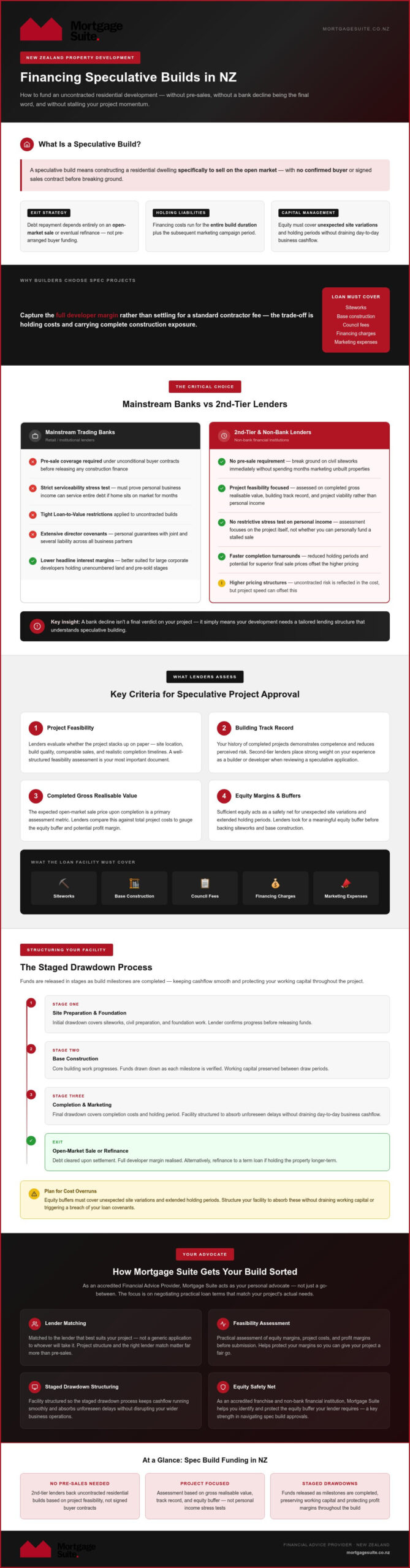
Builders choose speculative projects to capture the full developer margin rather than settling for a standard contractor fee. The trade-off is holding costs. Your loan facility must carry everything from initial siteworks through to completed base construction, while factoring in financing charges, council fees, and marketing expenses until the property sells.
Key differences from standard residential builds include:
- Exit strategy: Debt repayment depends entirely on an open-market sale or eventual refinance rather than pre-arranged buyer funding.
- Holding liabilities: Financing costs run for the entire duration of the build and the subsequent marketing campaign.
- Capital management: Equity must cover unexpected site variations and holding periods without draining your day-to-day business cashflow.
Why Traditional Banks Restrict Speculative Building Loans
Mainstream retail banks treat uncontracted builds with hesitation. From an institutional credit perspective, an uncontracted house represents elevated credit risk. Without pre-sales, there is no unconditional proof that the debt will clear immediately upon completion.
To offset this, trading banks impose tight Loan-to-Value restrictions and run every applicant through a strict serviceability stress test. They often demand proof that your personal business income can service the entire debt facility if the home sits on the market for several months. When conditions shift, retail lenders pull back even further, leaving viable projects stalled. Getting turned down by a bank manager isn’t a final verdict on your project; it simply indicates that your development needs a tailored lending structure that understands speculative building.
Mainstream Banks vs 2nd Tier Lenders for Speculative Construction
Selecting your funding partner dictates whether your project starts next month or sits in limbo. When looking at financing speculative builds nz builders quickly discover a fundamental split in the lending environment: traditional retail trading banks versus second-tier lenders. Understanding how these two groups approach risk is critical for protecting your margins and maintaining momentum on site.
Mainstream Bank Facilities: Strict Hurdles and Pre-Sale Rules
Trading banks offer lower headline interest margins, but their entry criteria are tough. Mainstream institutions typically mandate that a developer achieves substantial pre-sale coverage under unconditional buyer contracts before releasing any construction finance. For an independent builder aiming to build and sell at full completion value, this requirement stalls the entire process.
Banks also impose extensive director covenants, routinely demanding personal guarantees with joint and several liability across business partners. While bank funding works well for large corporate developers holding unencumbered land and pre-sold stages, it leaves little room to move for independent builders who want to capitalise on open-market demand.
2Nd Tier and Non-Bank Lending: Agility Without Pre-Sale Demands
A non-bank financial institution operates under a different commercial philosophy. Rather than running your business income through a restrictive serviceability stress test, second-tier lenders focus primarily on project feasibility, your building track record, and the completed gross realisable value of the asset.
This approach allows you to break ground on civil siteworks immediately without spending months marketing unbuilt properties. While alternative lenders account for the uncontracted risk in their pricing structures, builders often offset this cost through faster completion turnarounds, reduced holding periods, and superior final sale prices. Reviewing our guide on 2nd tier lender New Zealand options explains how these alternative pathways keep construction moving. If you want to explore funding options suited to your specific build timeline, you can connect with the team at Mortgage Suite to get sorted with a workable development package.
Key Criteria Lenders Assess Before Approving Speculative Project Finance
When you apply for financing speculative builds nz lenders look beyond standard payslips. Because there is no unconditional sales contract locked in, credit teams evaluate your project as a commercial venture. They need clear evidence that you can complete the build on schedule, handle unforeseen site variations, and sell the finished dwelling profitably.
Equity Contribution, Security Margin, and Loan-to-Cost
Lenders evaluate your financial commitment through loan-to-cost calculations alongside the completed market valuation. Your equity acts as a safety margin against market swings, whether contributed via cash, unencumbered land, or secondary residential property. Holding an equity safety net reassures underwriters that your business can absorb holding costs if marketing takes longer than planned.
Builder Qualifications, Consents, and Planning Approvals
Securing project finance requires verified trade credentials and complete regulatory approvals. Lenders examine your track record, preferring Licensed Building Practitioners with established delivery histories. They also review consented plans and an independent building report where applicable. If you are developing subdivided land, providing a council Statement of Compliance confirms all infrastructure conditions are met before drawing down funds.
Feasibility Appraisals and Clear Exit Strategies
A workable feasibility study demonstrates that your build remains profitable even if material costs rise or sales timelines stretch out. Lenders scrutinise your projected sales price against independent valuations to verify realistic returns.
Every proposal also requires a viable fallback strategy. If open-market buyer demand cools upon completion, transitioning the property onto residential investment property loans NZ wide allows you to tenant the home, generate immediate cashflow, and sell when the market recovers.
Structuring Your Facility: Drawdowns, Cost Overruns, and Working Capital
Cashflow management makes or breaks a residential development. Securing approval for financing speculative builds nz wide is only half the battle. How your loan facility is structured across each construction milestone determines whether sub-trades get paid on time and whether work keeps moving on site.
Navigating the Construction Drawdown Process
Lenders do not hand over construction funding in a single lump sum. Instead, the drawdown process releases money in staged tranches as your project hits agreed physical milestones: foundation completion, framing, lock-up, interior linings, and practical completion.
Before releasing each payment, the lender usually requires a progress inspection from an independent valuer or quantity surveyor. Administrative holdups often happen when site paperwork falls behind. Savvy builders keep invoices, subcontractor declarations, and council inspection records organised so the surveyor can sign off the claim quickly, helping you get sorted without stalling progress on site.
Protecting Cashflow Across Siteworks and Base Construction
Managing cashflow requires dividing early civil siteworks from above-ground base construction. Lenders view earthworks, retaining walls, and underground drainage as higher financial risks because unexpected soil conditions or weather disruptions can quickly create cost variations.
To guard against these surprises, lenders mandate a contingency buffer built directly into your facility. This capital reserve acts as a financial shock absorber. It ensures unexpected variations don’t swallow your working capital or force you to halt trades halfway through framing. Exploring our guide on property development loans NZ outlines how tailored capital structures keep builders moving forward.
If you are planning your next project and want to structure funding that keeps your cashflow intact, reach out to Mortgage Suite to negotiate a facility tailored to your building timeline.
Securing Your Speculative Build Loan with Mortgage Suite
Arranging development debt is rarely straightforward, especially when trading banks pull back from uncontracted residential projects. For builders financing speculative builds nz wide, having a seasoned professional in your corner transforms borrowing from an uphill battle into an organised, clear pathway. Mortgage Suite operates as your personal advocate and dedicated negotiator across both traditional retail banks and alternative credit markets.
Founder Krish Krishna brings over two decades of institutional banking and property finance experience to every deal. Our team understands how credit committees evaluate risk, and we know how to present your feasibility numbers, builder credentials, and costings so underwriters see the true strength of your project.
The Advantage of an Accredited Financial Advice Provider
A mainstream bank decline is simply a prompt to explore more agile lending structures. As an accredited Financial Advice Provider, Mortgage Suite connects you directly to non-bank lenders who actively back speculative developments without pre-sale hurdles. We match your project timeline with institutions suited to your build stage, ensuring you receive competitive terms that support your profit margins. Take a moment to read our client reviews page to see how we assist property developers across the country.
Preparing Your Application and Taking the Next Step
Assembling a complete submission package early prevents unnecessary delays and keeps your siteworks on schedule. We help you gather the key elements credit teams require:
- Consented architectural plans and engineering specifications.
- Itemised construction budgets including allocated contingency buffers.
- Independent registered valuations detailing the completed open-market value.
- Proof of past building projects confirming trade reliability.
Every Kiwi developer deserves a fair go when creating quality new housing. Connect with Mortgage Suite today to discuss your next residential development, review your funding options, and get sorted with a lender who backs your vision.
Bring Your Next Speculative Build to Life
Building without pre-sales gives you full control over your developer margins, but retail bank hesitation shouldn’t slow your progress. Second-tier lenders evaluate real project feasibility and completed asset values rather than rigid personal serviceability tests. By structuring staged drawdowns with sensible contingency buffers, you can protect your equity and keep sub-trades moving smoothly from initial siteworks through to completion.
When you are financing speculative builds nz wide, having an experienced lending advocate in your corner makes all the difference. Founder Krish Krishna brings over two decades of institutional banking and property finance experience to every deal. As an authorised Financial Advice Provider with direct access to leading nationwide non-bank channels, Mortgage Suite works to secure the practical terms and flexible structures your project needs to succeed.
You don’t have to navigate development finance alone. Discuss your speculative build project with Mortgage Suite today to get your funding sorted and give your build a fair go.
Frequently Asked Questions
Can I get financing for a speculative build in New Zealand without pre-sales?
Yes, securing construction finance without pre-sales is entirely achievable through second-tier and non-bank lenders. While mainstream trading banks demand pre-sales to eliminate repayment risk, alternative lenders assess project feasibility, builder track record, and the completed gross realisable value. When financing speculative builds nz wide, partnering with flexible lenders allows you to break ground without waiting for off-the-plan purchasers.
How much equity do I need to secure finance for a speculative residential build?
Most development lenders require an equity contribution between 20% and 30% of total project costs. You can provide this equity through cash, unencumbered land, or equity secured against existing property. Holding a solid equity buffer reassures underwriters that your business can absorb unexpected holding periods or site adjustments without placing the project under financial strain.
What is the main difference between a standard construction loan and a speculative build loan?
A standard construction loan finances a dwelling for an owner-occupier who services the mortgage through personal income. In contrast, a speculative build loan is a commercial facility designed for an uncontracted asset intended for open-market sale. Speculative facilities rely on the final sale or refinance to clear the debt rather than regular PAYE income assessments.
Will a mainstream bank decline prevent me from getting speculative build finance?
No, a bank decline does not stop you from securing development funding. Mainstream institutions follow rigid underwriting models that routinely turn away uncontracted projects. Second-tier lenders take a commercial approach, evaluating the strength of the development rather than strict retail stress tests. Working with an experienced financial adviser ensures your proposal is presented to lenders willing to give you a fair go.
How does the drawdown process work during a speculative construction project?
The drawdown process releases funds in stages as your build reaches agreed physical milestones. Typical stages include completed earthworks, framing, lock-up, interior linings, and practical completion. Before releasing each tranche, an independent valuer or quantity surveyor inspects the site to certify completed work, ensuring your sub-trades get paid on time while keeping construction moving forward smoothly.
What happens if my speculative build does not sell immediately upon completion?
If your property does not sell immediately, you can refinance the short-term construction facility onto a residential investment property loan. This exit strategy allows you to tenant the property, generate rental income, and service the debt comfortably. Transitioning the debt prevents forced price reductions and gives you the flexibility to wait for optimal market conditions.
Why do lenders require contingency funds for speculative building projects?
Lenders mandate contingency allocations to absorb unexpected variations during construction. Unforeseen ground conditions during siteworks, supply delays, and minor trade variations can quickly push costs above initial estimates. When financing speculative builds nz wide, maintaining a dedicated contingency reserve protects your working capital and ensures work does not stop if unexpected expenses arise.