
Technical Guide to Finance for Minor Dwelling NZ Projects
Securing finance for minor dwelling nz work typically requires an equity top-up or a staged construction loan, with bank Loan-to-Value restrictions limiting borrowing up to 80% for owner-occupiers and65-70% for property investors. Total project funding must cover costs that vary significantly based on whether you choose a simple prefab or a custom build. Working with a dedicated financial adviser helps you get sorted with the right lender, so you can weigh equity use, staged drawdowns and deposit size before you commit.
Key Takeaways: Finance for a minor dwelling in NZ requires 20% equity for owner-occupiers or30-35% for investors, typically funded via equity top-ups or staged construction loans.
- Lenders generally limit borrowing to 80% LVR for homeowners and65-70% for property investors.
- It is not worth it if poor positioning ruins backyard access and reduces land appeal.
- Choose a staged construction loan if you want to pay interest only as work advances.
- The article recommends adding a 15% contingency margin to quotes to cover unexpected siteworks.
Equity, construction loans or savings: which path fits your build
Before you pick a product, match the funding path to the situation you are actually in:
- You already hold strong equity in the main home: an equity top-up against that property is often the simplest route, keeping repayments on one facility.
- You want to limit interest while the build runs: a dedicated construction loan with staged drawdowns means you pay interest only on funds released as work advances.
- A mainstream bank has declined you, or your income is complex: non-bank and 2nd tier lending pathways can still move the project forward when standard criteria feel too rigid.
You can fund a granny flat (minor dwelling) build using equity, a construction loan, or personal savings.
Using existing equity in your home keeps payments streamlined because you borrow against your current property to fund the new project rather than opening a separate build facility from day one.
A dedicated construction loan suits you when you prefer progressive release of funds. With staged drawdowns, interest applies only to the money already used as base construction moves ahead.
If you want to keep family close and pool resources, shared funding options sit inside our family finance Archives, Mortgage Suite mortgage brokers hub and can make the project achievable without stretching one household alone.
A mainstream bank decline does not leave you without a path. Non-bank lenders offer alternative criteria when traditional rules do not fit your file.
Book a friendly chat with Mortgage Suite when you want a clear read on which of these three routes fits your equity, timing and risk comfort.
How much a minor dwelling really costs you in NZ in 2026
Quoted shell prices rarely match what you will actually pay once site and consent work land on the invoice. Building a granny flat involves direct costs alongside project fees that shift with design choice, site slope and local council requirements. Budgeting for building the shell (base construction) is only your first step toward getting sorted.
Total commitments also depend on deposit requirements, interest rates and initial bank fees. Many Kiwis meet unexpected expenses during ground and site preparation work (siteworks). You might need bridging finance support from Mortgage Suite to cover Cashflow while building. Mortgage Suite helps you line those costs up against serviceability before you sign.
Alternative lenders remain available if a bank steps back on a complex build. Tailored non-bank funding suits property owners who need short-term flexibility; mainstream banks still fit standard projects where you hold a larger cash deposit. As your dedicated advocate, our specialists push for a balanced deal on the file you actually have.
Tip: Always add a 15% contingency margin to your base construction quote before submitting loan applications to cover unexpected siteworks.
Request a personalised quote when you want those figures tested against your equity and income.
LVR limits: how much equity banks expect before they lend
Bank criteria for a granny flat turn on how you borrow and how much equity you can show.
Mainstream lenders enforce strict Loan-to-Value restrictions (LVR restrictions) across New Zealand. Owner-occupiers typically need a twenty percent deposit or equity safety net. Property investors face tougher boundaries, usually requiring thirty to thirty-five percent equity.
What few people think of: you can top up equity by securing borrowing against your main home rather than running a separate construction loan. Building the shell this way can act as a financial bridge, treating the project as a simple property cash-out and avoiding a full progress-payment structure.
If you run a firm, Cashflow during additions gets tight fast. You might explore business finance guidance from our brokers so commercial capital stays separate from the residential project.
A decline from your local manager is not the end of the road. Lenders apply serviceability stress tests differently, so another bank may still say yes on the same numbers.
Our team acts as your dedicated negotiator to secure a fair go on equity structuring. Tell us if you want a friendly, zero-pressure chat about your options.
Among Mortgage Suite Ltd’s Google reviews, Baycom (5★) wrote:
"We have dealt with Krish for over 20 years and in that time we have purchased 5 properties. Krish is knowledgeable, professional, and responsive. We would highly recommend Krish and Mortgage Suite to anyone looking to invest in property, Steve & Rosie Bower"
That file shows the arc clearly: repeated purchases over two decades, steady broker support on each deal, and five properties settled with the same adviser relationship intact.
What lenders treat as a minor dwelling on your title
A granny flat is a self-contained secondary home built on the same property as a main house. Building one helps you create extra living space for extended family or generate steady rental income.
Proposed settings have pointed toward allowing small standalone units up to 60 square metres without a building consent. You must still meet local council district plans and environmental standards. Council rules vary nationwide, so checking local rules is vital before any site work starts.
Local rules and lender settings can feel heavy when you plan the project. If a bank declines the first request, alternative lenders often still have a route to get you sorted. Structured property funding notes in our franchise finance resource hub show how clear packaging helps you reach the same property goals.
Need finance for minor dwelling nz? Compare 3 funding structures
The structure you choose decides whether you pay interest on the full build sum from day one or only as stages complete. Funding structures vary with your goals and existing equity; the right pick can save you thousands over the project.
| Funding Structure | Best Fit For | Primary Benefit |
|---|---|---|
| Equity Cash-Out | Homeowners with high equity | Access funds upfront instantly |
| Construction Progress Draw | Large custom builds | Pay interest only on drawn funds |
| Personal or Non-Bank Loan | Complex income or bank declines | Flexible approval terms |
An equity cash-out lets you draw funds against your main house and cover costs directly, without waiting on stage certificates.
Progress payments suit stage-by-stage projects: you only pay interest on funds released during the staged building the shell phase.
Non-bank options give you a fair go when traditional banks hesitate. Refinancing (moving your mortgage) onto a flexible structure keeps the project moving when a standard panel says no.
Talk with Mortgage Suite Ltd when you want these three structures modelled against your equity and build quote.
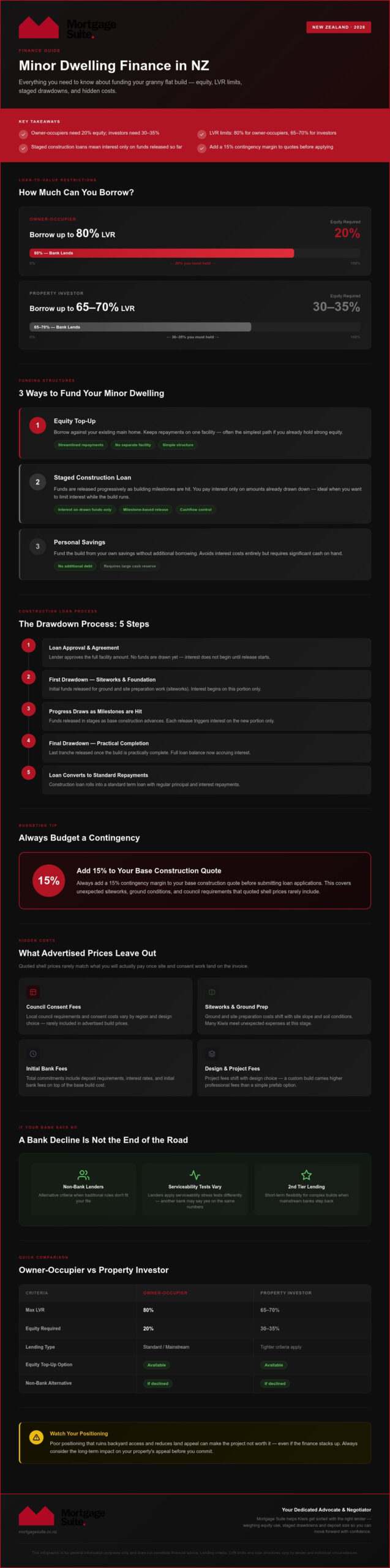
5 Drawdown steps that protect you from early interest drag
Construction payments need careful organisation as the build advances. This sequence helps you get sorted through each release without paying interest ahead of completed work:
- Submit plans: Pass your consented design and fixed-price contract to your financial adviser for initial lending assessment.
- Complete groundworks: Your lender releases early funding after your builder finishes siteworks.
- Finish the shell: Stage payments become available as workers complete building the shell.
- Final inspections: Council inspects the property to issue a Code Compliance Certificate (CCC) before final funds release.
- Move in: Transfer remaining funds so you can complete the project and collect the keys.
Staging payment requests too early can trigger interest charges before work finishes. Mortgage Suite helps you time each funding release so Cashflow stays protected. A dedicated negotiator beside you keeps every payout step plain and on schedule.
Hidden costs your advertised granny flat price leaves out
Advertised prices usually cover base construction (the core building work excluding items such as land, fencing and landscaping) rather than the full turnkey cost. Ground preparation before building gets underway can push the total up quickly. Council consent fees, utility connections, driveways and siteworks rarely sit inside the headline figure. Think of advertised pricing like buying a new car without tyres or a steering wheel: you hold the structure, yet you cannot use it yet.
Planning for those extras prevents budget stress later. A fair go on finance starts with the complete cost picture before you sign contracts.
The team at Mortgage Suite Ltd can help you map these extras into the right construction facility so the loan matches the real project, not only the brochure number. Ask for a personalised cost review when you are ready to lock the full budget.
When a secondary unit can cut the value you expect
Adding a granny flat does not automatically lift your property’s overall market valuation.
Poor positioning that ruins backyard access can reduce overall land appeal. Overcapitalising is another real threat: spending on unapproved siteworks or high-end finishes may not translate into a higher figure from bank valuation panels.
You should talk with your local council and an independent valuer first. That early check protects your equity before you apply for finance and stops you funding work the panel will not recognise.
Structure your borrowing so weekly Cashflow stays steady
How you split and price the debt decides whether the build weeks feel manageable or tight. Structuring debt properly keeps weekly costs in check while you build a granny flat.
During base construction, interest-only payments protect your cash balance until tenants move in. You then switch to principal and interest once rental income starts flowing.
Splitting the loan helps: fix one portion for stability and leave another on a floating rate if your household wants room for early repayments. A floating portion links easily to an offset account and cuts interest as surplus cash sits against the balance.
Mortgage Suite helps you negotiate tailored terms so you stay in control from first drawdown through to rental settlement. Reach out when you want that split sketched against your expected rent and outgoings.
Frequently asked questions
How much does a minor dwelling cost in NZ in 2026?
Building costs depend heavily on size, land slope and site preparation work. Market figures show a broad range across the country, spanning from low-cost transportable units up to fully custom secondary homes based on listings sampled in current market data. You can control these expenses by choosing basic layouts and working with advisers who structure your loan around the real siteworks bill.
Do I need consent for a 70m² granny flat in 2026?
You almost certainly need council approval for a self-contained unit of this size. Building code requirements and local planning rules apply to safeguard structural integrity, wastewater connections and boundary clearances. Talk with our team early so we can help you fulfil the financing requirements alongside council approval steps.
What’s the cheapest way to build a minor dwelling in NZ?
Selecting a prefabricated design or a standardised granny flat usually minimises initial construction expenses. Streamlined site access and simple plumbing layouts keep overall build costs down. We can explore flexible lending options so the facility fits the lower build sum without stretching your household budget.
Can you rent out a minor dwelling in NZ?
You can rent out a secondary property provided it complies with local council bylaws and the Healthy Homes standards. Secondary rental income is a practical way to lift total household Cashflow. We frequently assist Kiwis with securing property development funding to bring these self-contained projects to life.
What’s the difference between a minor dwelling and a granny flat?
A granny flat is simply a common everyday name for an official secondary home on the same land title. Councils and banks treat them as independent residential spaces with dedicated kitchens and bathrooms. Clear definitions help us present a clean case to lenders when negotiating your property finance.
Ready to Get Your Secondary Build Moving?
Financing a granny flat still comes down to the same decisions you met at the start: whether equity, a staged construction loan or savings (and non-bank backup) fits your file, how LVR caps shape your deposit, and which drawdown rhythm protects Cashflow until rent or family use begins. You do not have to work that through alone. Mortgage Suite Ltd advisers advocate on your behalf to secure the borrowing structure your project needs. A mainstream bank decline is not the end of your options in 2026.
Our advisers help you read bank requirements in plain language and get sorted with clear next steps. Calculate your repayments with our finance calculator to test your numbers today, then come back with the result for a friendly, no-obligation chat about the build.