
Freelancer Mortgage NZ: How to Get Your Home Loan Sorted in 2026
What if a mainstream bank’s “no” is only the start of your home loan conversation? If you’re wondering whether you can get a mortgage without a permanent 9-to-5 job, the answer may be yes. A freelancer mortgage nz application can take more explaining, but variable income doesn’t automatically rule you out.
It’s understandable to worry that lenders will judge your work status or that the paperwork will be difficult to pull together. If a bank has already declined your application, that can feel like a verdict. It isn’t necessarily one: lenders can assess freelance income differently, so first find out what the decline was based on.
This guide to the freelancer mortgage nz process explains how to prepare your income records, what lenders may look for and where specialist lending could fit. Mortgage Suite founder Krish Krishna brings more than two decades of banking experience to helping clients explore lending options. Approval can’t be promised, but you can get a clearer picture of what may suit your circumstances.
Key Takeaways
- A freelancer mortgage nz application can be assessed using more than a standard pay slip. Learn which records may help show a clear picture of your income.
- A lender’s view of risk doesn’t necessarily reflect your overall financial health. Find out how to explain your circumstances clearly.
- A mainstream bank’s decline is one decision, not a final judgement. 2nd tier lending may be another option to explore.
- Organising your paperwork before applying can make the process more manageable and help you identify what to do next.
- Mortgage Suite founder Krish Krishna brings more than two decades of banking experience to helping clients explore lending options.
Why Being Your Own Boss Can Make Banks Nervous
If you’ve ever felt like an outsider when asking a bank about a home loan, you’re not alone. A standard application makes salaried income easy to check: a regular pay slip shows what comes in and when. Freelance income can arrive from several clients, vary from month to month and appear across business accounts and financial statements. That takes more explanation, but it doesn’t mean your finances are unhealthy.
A lender is assessing whether you can manage repayments, not deciding whether freelancing is a good career choice. A mortgage loan is borrowing secured against a property, and the lender needs to understand your ability to repay it. A pay slip may be simpler to assess than an income pattern that changes over time. The difference between what a lender can quickly verify and your actual financial position is a question to clarify, not a verdict on your earning ability.
The Myth of the ‘Risky’ Freelancer
Freelance work isn’t automatically less secure than salaried work. You might earn as much as, or more than, someone on a salary, but lenders need evidence to support the income they use in their assessment. Mainstream banks commonly ask for two full years of financial statements and look at how your earnings hold up over time. The focus is your demonstrated earning power, not simply your employment type.
Fluctuating Income and the Bank Safety Margin
A safety margin is room in the lender’s assessment for repayments to remain manageable if income dips or expenses rise. It isn’t a single set amount that applies to every lender. Banks may review one or two years of financial information and use an average or a more cautious income figure, depending on their approach. A quiet month on its own doesn’t tell the whole story.
For example, you may have a slower period between projects followed by steady work from returning clients. Clear records can help show that pattern and distinguish a temporary lull from a longer-term drop in income. Lenders still need to be satisfied that repayments are affordable, but their assessment methods differ. Ask how a lender will treat your income history rather than assuming every lender will assess it the same way.
That’s why a freelancer mortgage nz application is best built around clear evidence of your income and commitments. Your work status is one part of your circumstances, not a flaw. A clear explanation can help a lender assess your actual financial position.
Proving Your Income Without a Standard Pay Slip
A contractor home loan is a mortgage application where the lender assesses income earned through contracting or freelance work rather than relying on a regular employee pay slip. The aim is to show a clear picture of what you earn, what your business spends and what you can afford to repay.
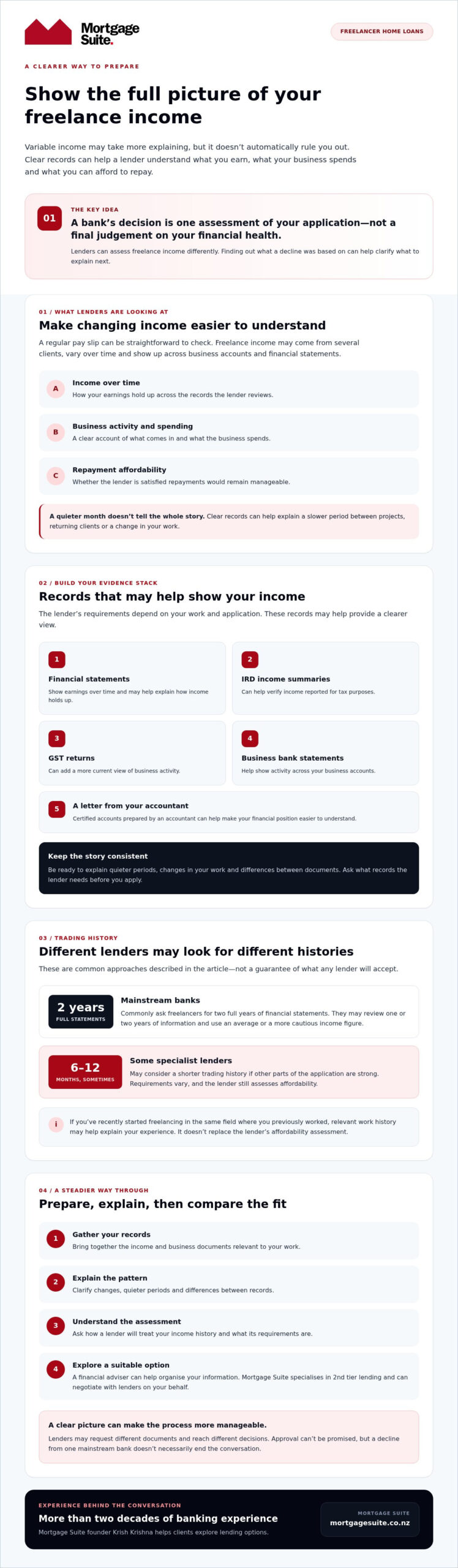
Start by gathering records that support a consistent account of your income and business activity. Depending on your work and the lender’s requirements, these could include financial statements, IRD income summaries, GST returns, business bank statements and a letter from your accountant. Be ready to explain quieter periods, changes in your work and differences between documents. Clear explanations can help prevent confusion later.
In the freelancer mortgage nz process, a financial adviser can help organise your information and present it in a way a lender can assess. Lenders may request different documents and reach different decisions. Being prepared means you can explain your income and circumstances more clearly.
The Role of IRD Records and GST Returns
IRD income summaries can help verify income reported for tax purposes. They aren’t pay slips, but they may form part of the official record a lender considers alongside your other documents. GST returns can add a more current view of business activity, while certified accounts prepared by an accountant can help make your financial position easier to understand. Ask what records the lender needs before you apply.
What if You Have Only Been Trading for One Year?
Mainstream banks commonly ask freelancers for two full years of financial statements. Some specialist lenders may consider a shorter trading history, sometimes around six to 12 months, if other parts of the application are strong. Requirements vary, so one year in business doesn’t automatically rule you out.
If you’ve recently started freelancing in the same field where you previously worked, include evidence of that experience and any relevant work history. It may help explain how your skills and client base support the business, but it won’t replace a lender’s assessment of affordability. Mortgage Suite specialises in 2nd tier lending for people who don’t fit mainstream criteria and can negotiate with lenders on your behalf. A suitable option depends on your full application, and approval isn’t guaranteed.
To understand how Mortgage Suite supports borrowers, see its team and approach.
Mainstream Banks vs 2nd Tier Lenders: Finding Your Best Fit
A “no” from a mainstream bank can feel personal, especially after you’ve gathered paperwork and explained how you earn. But it’s one lender’s decision using its own criteria, not a final judgement on you or your finances. Another lender may assess your income, work history and property equity differently. First, ask what drove the decline. Then consider whether clearer evidence or a different lending approach could suit your situation.
2nd tier lenders are an alternative for borrowers who don’t fit mainstream criteria. They’re not a shortcut around affordability checks, and approval is never guaranteed. They may, however, take a different view of a freelancer’s overall application. Mortgage Suite specialises in 2nd tier lending and can negotiate with lenders on your behalf. For more detail, read this guide to 2nd tier lender New Zealand options.
When the Local Branch Says No
A lender’s assessment process may not capture every detail of your work, income pattern or experience, particularly if your situation doesn’t fit standard categories. A decline can sting, but it doesn’t mean you’ve run out of options. Ask which parts of the application raised concern. That information can help you decide whether to provide clearer evidence, approach a different lender or review the loan structure.
The Flexibility of Non-Bank Home Loans
Some non-bank lenders may consider an equity safety net: the value you hold in a property after accounting for the borrowing secured against it. They may also assess applications differently, but lending criteria and available terms vary. Ask how repayments would fit your freelance cash flow, what conditions apply and whether the arrangement supports your longer-term plans.
It’s tempting to compare loans by the headline interest rate alone. For a freelancer, the fit also depends on how income is assessed, how repayments are structured and whether the arrangement leaves room for quieter periods. A loan that looks appealing at first glance may not suit your cash flow or future goals. Compare the full structure and ask questions before deciding.
For some borrowers, a 2nd tier loan may be a step towards buying sooner, with a possible plan to refinance to a mainstream lender later. That depends on your circumstances at the time, your repayment record and the criteria of the lender you approach. Treat refinancing as a goal to review, not a promise. In a freelancer mortgage nz application, the best-fit lender is one whose assessment and loan structure make sense for your situation and plans.
Your Step-by-Step Guide to a Successful Freelancer Application
A home loan application is easier to manage when you know what to do first. Get your records in order, check how repayments could fit your budget, then present your income and plans clearly to a lender. Preparation can reduce last-minute stress, and a well-organised application helps a lender understand the story behind the figures.
Here’s a practical place to start:
- Separate business and personal spending. Make it easy to see which costs relate to your work and which are household expenses. If accounts have been mixed, add clear notes rather than leaving transactions unexplained.
- Gather your financial statements. Have your latest statements ready, and aim to include the last two years if available. Lenders’ requirements vary, so ask what they need for your circumstances.
- Review smaller debts. List balances and regular repayments. Paying down a debt may help your overall picture, but consider your cash reserves and speak with an adviser before making changes to your finances.
For a freelancer mortgage nz application, don’t just send documents without context. Explain changes in income, gaps between projects and unusual business expenses. That context can help a lender make sense of the figures.
Run a Serviceability Stress Test
A serviceability stress test is a lender’s way of checking whether you could still manage repayments if they assessed your borrowing using a higher interest rate than the one offered. It tests future affordability, not what rates will do.
You can try a similar check on your own budget. Use the mortgage calculator to explore repayment scenarios, then consider what would happen if your income dipped or household costs rose. Leave room for quieter trading periods, regular bills and business expenses. The calculator can help you explore possibilities, but it won’t confirm what a lender will approve.
Once you’ve prepared your records and tested your budget, you’ll be in a better position to discuss your options and identify any gaps before applying. Mortgage Suite can help present your circumstances to lenders and negotiate on your behalf. Talk with Mortgage Suite about your home loan options.
How Mortgage Suite Advocates for NZ Freelancers
Applying for a home loan as a freelancer can feel like you’re expected to fit your finances into a box designed for salaried workers. Mortgage Suite founder Krish Krishna brings more than two decades of banking experience to understanding clients’ circumstances and negotiating with lenders on their behalf.
That experience can help make sense of what a lender needs to see, where your application may need more explanation and which lending options could be worth exploring. It isn’t a promise of approval. Mortgage Suite can help you present your case clearly and explore possible options. Lenders make their own decisions, but a clear application gives them a better account of your circumstances.
You can learn more about Krish and the team on the About Us page.
Why a Negotiator Beats a Computer Algorithm
Your figures matter, but so does the context behind them. A negotiator can explain how your work history, client income and business records fit together, rather than leaving a lender to interpret unfamiliar details on their own. They can also discuss the loan structure, repayment fit and safety margin, not just the headline rate. Lenders still make their own decisions, but clear communication can help them understand your circumstances.
Getting Your Application Across the Line
Freelance work keeps you busy. Support with organising documents and responding to lender questions can make the application feel more manageable while you stay focused on your work. The steps and time involved depend on your circumstances and the lender, so ask what support you can expect throughout the process.
If you’re ready to explore a freelancer mortgage nz application, start by talking through your income, goals and any previous lender feedback. Mortgage Suite specialises in 2nd tier lending for people who don’t fit mainstream criteria and can negotiate with lenders to explore possible options. Approval isn’t guaranteed, but a bank decline doesn’t have to be the end of the conversation.
Talk with Mortgage Suite about getting your home loan sorted.
Take the Next Step Towards Your Home
Your freelance income doesn’t have to follow a standard pay-slip pattern for you to explore a home loan. Clear financial records can help lenders understand your earning history, and a decline from one bank doesn’t automatically close the door to other options. The right lender and loan structure depend on your circumstances, so focus on getting an assessment that accounts for your plans.
For a freelancer mortgage nz application, help explaining the story behind your figures can make the process more manageable. Mortgage Suite founder Krish Krishna brings more than two decades of banking experience, and the company specialises in 2nd tier lending for people who don’t fit mainstream criteria. No one can promise approval, but you can get a clearer view of your options with help negotiating with lenders.
Ready to take the next step? Talk with Mortgage Suite about your freelancer home loan options.
Frequently Asked Questions
Can I get a mortgage if I have only been freelancing for a year?
Possibly. Some specialist lenders may consider a shorter trading history when other parts of your application are strong. Mainstream banks commonly ask for two full years of financial statements, while some non-bank lenders may consider around six to 12 months of records. Previous experience in the same industry, a clear income trail and your overall ability to manage repayments may help explain your position. Each lender assesses applications differently, and approval isn’t guaranteed.
Do I need a bigger deposit as a freelancer in New Zealand?
Not automatically. The deposit a lender requires depends on its criteria, the property and your overall application, including how it assesses your freelance income. Reserve Bank Loan-to-Value restrictions also affect how much some banks can lend against a property, but they don’t guarantee that a particular borrower will be approved with a smaller deposit. Ask lenders what deposit they require and whether your income evidence and property choice affect their decision.
What is a serviceability stress test and how does it affect me?
A serviceability stress test checks whether you could manage repayments if a lender assessed your application using a higher interest rate than the one offered. It helps the lender consider whether repayments could remain affordable if conditions change. As a freelancer, you can also test your budget by allowing for quieter work periods and household expenses. A mortgage calculator can help you explore repayment scenarios, but it doesn’t confirm how much a lender will approve.
Why did my mainstream bank decline my home loan application?
A decline can happen for several reasons, and it isn’t necessarily a final judgement on your financial health. The bank may have wanted a longer record of freelance income, assessed your earnings cautiously, or found that your expenses, debts, deposit or chosen property didn’t fit its criteria. Ask for the reason behind the decision. That can help you identify what to clarify or whether another lender may assess your circumstances differently.
What documents do I need to prove my income to a lender?
Lenders may ask for financial statements, IRD income summaries, GST returns, business bank statements and information from your accountant. The exact list depends on the lender and your work setup. These records help show your reported income and how your business is trading. Keep business and personal transactions clear, and explain gaps or unusual changes so the lender can understand the figures rather than guess what they mean.
Is a 2nd tier lender safe for a freelancer mortgage?
A 2nd tier lender can be an alternative for borrowers who don’t fit mainstream bank criteria, but check the full loan terms before deciding. Ask about repayments, fees, conditions, the loan structure and whether it suits your plans. Mortgage Suite specialises in 2nd tier lending. A lender’s suitability depends on your circumstances, and no lender can promise approval.
Can I still get a mortgage if my income fluctuates significantly?
Possibly. Lenders may review income over time and use an average or a more cautious figure to allow for changes in earnings. Clear records can help show whether quieter months are a normal gap between projects or part of a longer-term change. Include your business expenses and existing repayments in your budget, too. The freelancer mortgage nz options available to you depend on the lender’s assessment of your income and ability to repay.
What is the “Small Apartment Rule” and does it apply to me?
The Small Apartment Rule describes lender criteria that may treat apartments below a specified floor area as higher-risk security. There isn’t one standard size requirement across all lenders, so criteria may differ depending on the lender and the property. If you’re considering an apartment, ask how its size and features affect the deposit and lending criteria before making an offer. A lender’s assessment of the property is separate from its assessment of your income.