
How to Calculate Interest on a Home Loan in New Zealand
What if the interest on your home loan depends on more than the rate you see advertised? If your statement makes it hard to tell how much of each repayment goes towards interest, you’re not alone. To calculate interest on a home loan, you need to consider the amount still owing as well as the interest rate.
Interest is generally charged on your outstanding loan balance. As that balance changes, the interest charged can change too. Your loan terms, payment timing and whether you have a fixed rate, floating rate or offset account can also affect the figures. The exact calculation method depends on your loan agreement, so check the details rather than relying on a general formula.
This guide explains the basic calculation, what to look for in your loan documents and how to check your statement. You’ll also learn when to ask your lender or adviser to explain a figure. If you’d like help understanding your loan structure, Mortgage Suite can talk through your circumstances, drawing on founder Krish Krishna’s more than two decades of banking experience.
Key Takeaways
- To calculate interest on a home loan, check the outstanding balance, interest rate, time period and method set out in your loan agreement.
- Your repayment includes more than interest. Check your statement to see how the interest amount compares with the total repayment.
- The rate isn’t the only factor. Changes to your balance, rate or calculation period can affect the interest charged.
- Compare statements covering similar periods. Before checking the interest entry, look for changes to your balance or rate.
- If a figure still doesn’t make sense, ask your lender to explain how it was calculated and what your loan terms say.
What does it mean to calculate interest on a home loan?
Interest is the amount a lender charges for letting you borrow money. For a home loan, it’s generally worked out against the outstanding balance, meaning the amount you still owe, rather than the original amount borrowed. That balance can change as you make repayments or other activity affects the loan, so the interest charged can change as well.
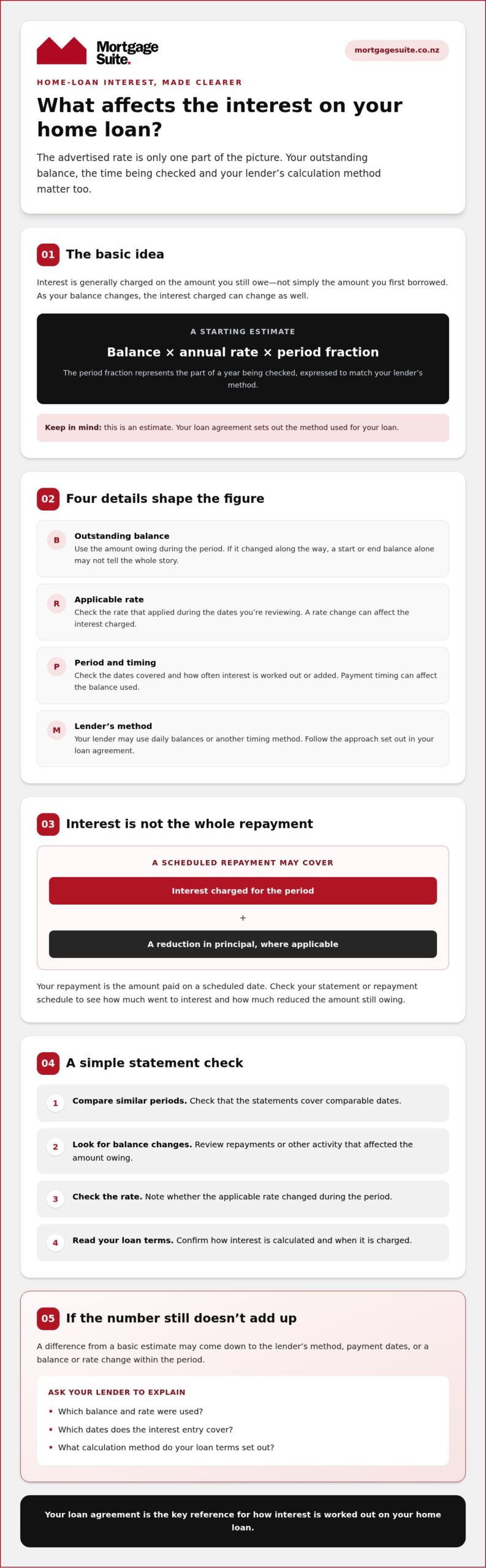
A useful starting estimate is: outstanding balance × applicable annual interest rate × the share of the year being checked. This shows the basic relationship between the balance, rate and time. It won’t necessarily match your statement: lenders can use different calculation methods and charging schedules, as set out in your loan agreement.
What information do you need for a basic interest estimate?
Before you calculate interest on a home loan, find the balance that applied during the period you’re checking, not just the amount you first borrowed. Then check the applicable annual rate and the dates covered. If the balance or rate changed during that time, one simple calculation may not represent the whole period.
Check your loan agreement or statement for details of how your lender calculates and charges interest. For example, the agreement may explain how often interest is worked out and when it’s added to the loan. Use those terms when checking your figures rather than assuming every lender follows the same approach.
How is interest different from a home-loan repayment?
Your repayment is the amount you pay towards the loan on a scheduled payment date. It may cover the interest charged for that period and reduce the principal, which is the amount you still need to repay. The split can vary over the life of the loan, so the full repayment figure won’t tell you by itself how much went to interest.
Interest is the charge for borrowing during a period. Your repayment is the amount paid towards that charge and, where applicable, the principal.
A repayment schedule, sometimes called an amortisation schedule, can show how payments are divided between interest and principal over time. Check your lender’s schedule and loan terms for your own figures. If a statement entry doesn’t match your estimate, ask the lender to explain the balance, rate, dates and calculation method used.
How is home-loan interest calculated as your balance changes?
Interest is based on the amount you owe over the period being checked. As repayments reduce your outstanding balance, later interest may also reduce, depending on your loan terms and how your lender calculates the charge. The rate on its own won’t tell the whole story.
For a useful estimate, work through these steps:
- Check the balance: Find the amount owing during the period, not just the balance at the start or end if it changed in between.
- Identify the rate: Use the interest rate that applied during the period you’re checking.
- Confirm the period: Check the dates covered and how often your lender calculates or charges interest.
- Apply the lender’s method: Follow the approach described in your loan agreement or confirmed by your lender.
These details also help explain how mortgage repayments are calculated. Your agreement remains the key reference for the method used on your loan.
A simple formula for estimating interest
As a starting point, use interest estimate = balance × annual rate × period fraction. The balance is the amount owing, the annual rate is the rate that applies, and the period fraction represents the part of a year being checked, expressed in a way that matches your lender’s method.
For example, if the balance is B, the annual rate is R, and the period fraction is P, the estimate is B × R × P. Convert an annual rate into a rate for a shorter period only if your loan terms allow that approach and explain how to do it. Treat the result as an estimate, not a promise that your statement will show the same figure.
Why the lender’s figure may differ from your estimate
Your lender may calculate interest using daily balances or another timing method. Payment dates can affect the balance used, while a rate or balance change during the period may mean the calculation needs to account for more than one set of figures. Check your agreement rather than assuming the same method applies to every home loan.
If you’re unsure which figures to use, ask your lender to explain the method and dates behind the interest entry. You can also discuss your home-loan structure with Mortgage Suite if you’d like support understanding your options.
What changes the interest charged on a home loan?
The headline interest rate matters, but it isn’t the only factor that determines the interest charged. The amount still owing, any rate changes, the dates being checked and the lender’s calculation method can all affect the result. Two statements with the same rate may show different interest charges if their balances or periods differ.
| Factor | What changes | What to check |
|---|---|---|
| Loan balance | Interest is calculated against the amount owing under your loan terms. A lower balance may mean less interest is charged later. | Check the balance used for the period and whether repayments or other activity changed it. |
| Interest rate | A change in the rate can change the interest charged, even if the balance stays the same. | Confirm which rate applied and the date any new rate took effect. |
| Calculation period and method | The dates covered and the lender’s method affect the figures used in the calculation. | Check your statement and loan agreement for the period and calculation details. |
How do fixed and floating rates affect interest calculations?
A fixed interest rate stays unchanged for an agreed period, subject to your loan terms. That doesn’t necessarily mean your whole loan is fixed. Different parts may have different rates or arrangements. A floating rate can change, so check when a new rate takes effect before comparing interest across statements. For more background, you can also read about mortgage rates in New Zealand.
Can an offset account reduce the balance used for interest?
An offset account is an account whose balance reduces the loan balance used to calculate interest. Whether your account qualifies, how the offset is applied and which loan portions it relates to depend on the specific arrangement. Check the account rules with your lender before relying on an estimate.
To calculate interest on a home loan more confidently, compare the balance, rate and dates for the period, then confirm how your loan terms treat rate changes or an offset balance. If any of those details are unclear, ask your lender how they affect the interest shown on your statement.
How can you check your home-loan interest step by step?
A statement can be hard to read when balances, rates and interest entries appear alongside each other. Check one detail at a time. Matching the right balance and rate to the dates shown is a practical first step, but your lender can explain how its method applies to your loan.
- Choose the period: Note the statement’s start and end dates.
- Check the balances: Record the opening and closing balances, and note any repayments or other changes during the period.
- Find the rate: Confirm the rate that applied and check whether the statement shows a change date.
- Locate the interest entry: Identify the interest charged for the same period.
Which details should you compare on your loan statement?
Make sure you’re comparing like with like. Match the interest entry to the dates it covers, then check the opening and closing balances and the applicable rate for those dates. If the rate changed part-way through, note when the new rate started. A comparison using a different statement period, balance or rate may not explain the figure you’re checking.
Note any details that don’t match your records. This gives you a clear starting point if you need to ask your lender about the entry.
When should you ask for help checking the figures?
Contact your lender if the rate, dates or balance on the statement don’t match what you expected, or if the interest entry remains unclear after your checks. Ask which balance and rate were used, what dates the calculation covers and how the lender’s method applies under your loan agreement. A difference doesn’t automatically mean there’s an error, so get an explanation before drawing that conclusion.
Mortgage Suite’s Mortgage School offers related home-loan learning resources. If you’d like to explore repayment estimates, try the Mortgage Suite mortgage calculator. A repayment estimate can help with planning, but a repayment and the interest charged are related figures, not the same thing. To calculate interest on a home loan against your statement, check the lender’s figures and terms for the period in question.
What to do next if your home loan interest is unclear
If a statement figure doesn’t make sense, pause before assuming there’s been a mistake. Gather the details you’ve checked: the balance, the rate that applied, the statement period, the lender’s calculation method and the interest entry. Having these to hand can make it easier to understand the explanation and identify what needs clarifying.
Knowing how interest is worked out can also help you ask clearer questions about your loan structure. For example, ask whether a rate change or the timing of a repayment affected the interest for the period. You can then consider whether the current arrangement still suits your goals and circumstances.
What questions can you ask your lender or adviser?
Start with the figure you want explained and ask direct questions. You might ask:
- How was interest calculated for this statement period, and which balance and dates were used?
- Did a rate change or the timing of a repayment affect the amount shown?
- Does my current loan structure still fit my goals and circumstances?
If the balance, rate or dates don’t match your records, point that out and ask the lender to check them. A clear explanation can help you understand whether the difference comes from the method, timing or another detail in your loan terms.
How can Mortgage Suite help you understand your options?
You don’t have to work through every part of your loan structure alone. Mortgage Suite supports home-loan borrowers across New Zealand by helping review their lending needs and understand suitable lender options. Founder Krish Krishna brings more than two decades of banking experience to those conversations. That experience can inform a discussion, but it doesn’t guarantee a particular lending outcome.
If you’re unsure how your loan works or want to talk through whether its structure fits your circumstances, explore Mortgage School home-loan resources or discuss your situation with the team. Bring the statement entry and any questions you’ve noted. Getting the details explained is a sensible next step.
Talk through your home-loan options with Mortgage Suite when you’re ready. A conversation can help clarify what to check next and which lending options may be worth exploring, without assuming approval is guaranteed.
Take the next step with confidence
To calculate interest on a home loan, look beyond the headline rate. The balance you owe, the rate that applies, the period being checked and your lender’s calculation method all matter. Comparing the same dates and checking for changes can help you make sense of a statement, but your loan agreement and lender can clarify the exact figure.
Once you understand how interest is worked out, you can ask more useful questions about your loan structure and whether it still suits your circumstances. You don’t have to figure it all out on your own. Mortgage Suite supports borrowers through mainstream and alternative lending channels, and founder Krish Krishna brings over two decades of banking experience to conversations about home-loan options.
If you’d like help making sense of your figures or discussing what may suit your needs, talk through your home-loan questions with Mortgage Suite. A clear conversation can help you decide what to check next and move forward with greater confidence.
Frequently Asked Questions
How do you calculate interest on a home loan?
To calculate interest on a home loan, start with the balance owing, the rate that applied and the period you’re checking. A basic estimate is the balance multiplied by the annual rate and the share of the year being considered. This is a guide, not necessarily the amount on your statement. Your lender’s agreement sets out the calculation method and timing, so check those terms before comparing your estimate.
Is home-loan interest calculated on the original amount borrowed?
Usually, the relevant amount is the outstanding balance, not the original amount borrowed. As repayments reduce the amount still owing, the balance used to work out later interest may also fall, subject to your loan terms. Check the balance for the statement period you’re reviewing, as it may differ from the opening balance or the amount shown when your loan began.
Does home-loan interest get calculated daily or monthly?
It depends on the calculation method in your loan agreement. Your lender may use daily balances or another method, and the timing of interest charges shown on a statement may differ from how often interest is calculated. Check your agreement or ask your lender to explain which dates and balances it uses. This will help you compare the statement with an estimate for the same period.
Does making extra repayments reduce home-loan interest?
Extra repayments can reduce the balance owing, which may lower the interest charged later, depending on your loan terms and how the lender applies payments. Timing matters: a repayment made during a statement period may change the balance used for part of that period. Check your agreement to understand how extra payments are handled, then compare balances and interest over matching periods.
Can an offset account reduce home-loan interest?
An offset account is an account whose balance reduces the loan balance used to calculate interest. Whether an account can be linked to your loan and how its balance affects the calculation depend on the specific loan arrangement. Check the account rules with your lender before using a simple estimate, and ask which loan balance or portion the offset applies to.
Why does my home-loan interest figure differ from my estimate?
Your estimate may use different balances, dates or timing from your lender’s calculation. A rate change, a repayment during the period or the lender’s method can all affect the figure. First compare the statement period, opening and closing balances, and applicable rate with your records. If the difference remains unclear, ask your lender to explain the calculation method and statement entry in plain English.