
Home Loan with Defaults in NZ: Get a Mortgage in 2026
What if a single “no” from a major bank wasn’t the final word on your dream of owning a home? It’s incredibly frustrating to feel like a past financial slip-up is standing between you and your own front door. We understand the sting of being turned away by the big banks, especially when you have worked hard to get your finances back in order. You aren’t alone in feeling a bit embarrassed by old mistakes, but those hurdles don’t have to define your future.
The reality is that securing a home loan with defaults nz is still a very achievable goal in 2026. You don’t need to get lost in confusing industry jargon or settle for a “no” just because your history isn’t perfect. We are here to help you find a lender who looks at the big picture of your life today, rather than just a number on a screen. This guide will walk you through the non-bank lending options available under the latest FMA regulations and provide clear, simple steps to help you prepare an application that finally gets you the keys to your own place.
Key Takeaways
- Realise that a past credit issue doesn’t have to end your dream, as there are many paths to a mortgage outside the big banks.
- Learn how to secure a home loan with defaults nz by understanding why you might need a larger deposit and how to plan for it.
- Find out why 2nd tier lenders are often the best fit for Kiwis who don’t meet standard bank criteria but are ready to buy.
- Discover five clear steps to tidy up your financial profile so you can present a strong, reliable case to potential lenders.
- Understand how expert guidance can help you move past rejection and finally get the keys to your own home.
Can you get a home loan with defaults in NZ? The honest truth
You might have heard that a credit default is the end of the road for your home-buying dreams. That simply isn’t true. While the big banks might make you feel like you’ve failed a test you didn’t know you were taking, the reality in 2026 is much more flexible. Securing a home loan with defaults nz is entirely possible if you know where to look and how to tell your story. Alternative lenders are now a massive part of the market, growing at a nearly 14% compound annual rate over the last five years because they offer solutions where banks offer roadblocks.
What exactly counts as a default in New Zealand?
In the New Zealand credit landscape, a default is usually recorded when a payment of at least $125 is more than 30 days overdue. This could be anything from an old power bill you forgot during a house move to a missed credit card payment or even a court judgement. These marks stay on your credit record for five years, even after you’ve paid them off. Lenders look at these records when understanding your credit score to gauge how you handle financial commitments. However, lenders view a ‘paid’ default much more favourably than an ‘unpaid’ one. It shows you’ve taken responsibility and cleared the air, which counts for a lot when we negotiate on your behalf.
Why banks say no (and why that’s okay)
The ‘Big Four’ banks in New Zealand have very little appetite for risk. They use rigid computer systems that often automatically decline applications the moment a default appears. This is partly due to their own internal policies and partly because of the Credit Contracts and Consumer Finance Act (CCCFA). As of July 1, 2026, the Financial Markets Authority (FMA) has taken over as the conduct regulator for the CCCFA, ensuring all lenders are incredibly thorough with their affordability checks. Banks prefer the “easy” cases, but a rejection from them isn’t a final verdict on your character or your future. It just means you don’t fit their narrow criteria, and it’s time to look at lenders who value your current financial health over a five-year-old mistake.
Alternative lenders specialise in looking at the “big picture”. They want to know why the default happened and what has changed since then. If you can show a stable income and a clear pattern of regular savings now, many non-bank lenders are happy to partner with you. This shift in the lending landscape means that a past slip-up is now just a speed bump, not a dead end.
How defaults and credit marks influence your borrowing power
When you apply for a home loan with defaults nz, lenders aren’t just looking at your past; they’re trying to predict your future. Think of your credit report as a financial CV. If there’s a default on there, a lender sees it as a sign of potential risk. To balance this out, they might change the terms of the deal. For example, while a borrower with a perfect history might get away with a 10% deposit, you might be asked to provide 20%. This extra equity gives the lender a safety net, making them more comfortable to say yes.
Risk also influences the interest rate you’ll pay. Because non-bank lenders take on cases that the “Big Four” won’t touch, they often charge a slightly higher rate to offset that risk. However, this doesn’t have to be permanent. Many of our clients use these loans as a stepping stone, staying with an alternative lender for a few years until their credit is clear, then moving back to a mainstream bank. If you’re a first-home buyer, you might also look into the Kāinga Ora First Home Loan scheme, though having a default can make eligibility more complex without the right guidance.
The ‘Big Three’ credit bureaus in NZ
In New Zealand, your financial history is tracked by three main agencies: Centrix, Equifax, and Illion. It’s quite common for your score to vary between them because they each use their own unique formula to calculate risk. One might have a record of an old debt that the others don’t. We always recommend getting a free copy of your report from all three bureaus before you start your journey. Knowing exactly what’s on your file allows us to address any issues head-on rather than being surprised halfway through an application.
The ‘Big Picture’ approach to lending
The good news is that modern lending is moving away from simple “pass or fail” scores. Specialists now take a “big picture” approach. They look at the size of the default; a $200 forgotten phone bill from three years ago is treated very differently to a $5,000 credit card default from last month. They also want to understand the “why” behind the mark. If you can show that a default happened during a period of genuine hardship, like a medical emergency, and that you’ve had a stable income ever since, it carries a lot of weight. Lenders primarily care about your “servicing capacity” – your ability to comfortably handle the repayments today. You can use our mortgage calculator to see how different loan sizes might fit into your current budget.
If you’re feeling unsure about where you stand, it’s often helpful to chat with a specialist who can look at your specific situation and find the right path forward.
Bank vs. 2nd tier lenders: Finding the right fit for your situation
When you’re searching for a home loan with defaults nz, you’ll quickly find that the world of lending is much wider than just the household bank names you see on every street corner. Second tier lenders are fully regulated financial institutions that operate outside the traditional banking model. They don’t have the same rigid “tick-box” systems as the big banks, which allows them to be much more flexible. These lenders are often the perfect fit for Kiwis who are self-employed or those who have had a few credit dings in the past.
The core philosophy here is to use these lenders as a stepping stone. You aren’t necessarily signing up to stay with them for the next thirty years. Instead, we help you secure a loan that gets you into your home now, rather than waiting five years for your credit record to clear. Once you’ve proven yourself with a period of consistent, on-time repayments, we can then look at moving you back to a mainstream bank with a lower interest rate. It’s a proactive strategy that prioritises your long-term goal of home ownership over a temporary hurdle.
The benefits of going non-bank
One of the biggest advantages of working with an alternative lender is the speed and the human touch. While a big bank might take weeks to process a complex application, non-bank lenders often provide much faster approval times because they have less red tape. They are also far more willing to consider “low-doc” applications. This is a lifesaver for self-employed people who might have a complicated income structure that traditional banks simply don’t understand. They take a much more empathetic approach to how defaults are viewed, looking for the context behind the numbers rather than just issuing an automated decline.
What to watch out for with alternative loans
While these loans offer a vital lifeline, you need to go into the process with your eyes wide open. Because these lenders take on more risk, their fee structures are different. You should expect to see establishment or application fees, which can range from $2,000 to $5,000 depending on the complexity of your situation. Some loans might also have shorter fixed-term periods. It is also vital to ensure your lender is a reputable member of an independent dispute resolution scheme like Financial Services Complaints Ltd (FSCL). We take pride in our long-standing reputation for connecting clients with trustworthy, ethical lenders who provide a clear path forward. Our job is to ensure you understand every cost upfront so there are no surprises down the track.
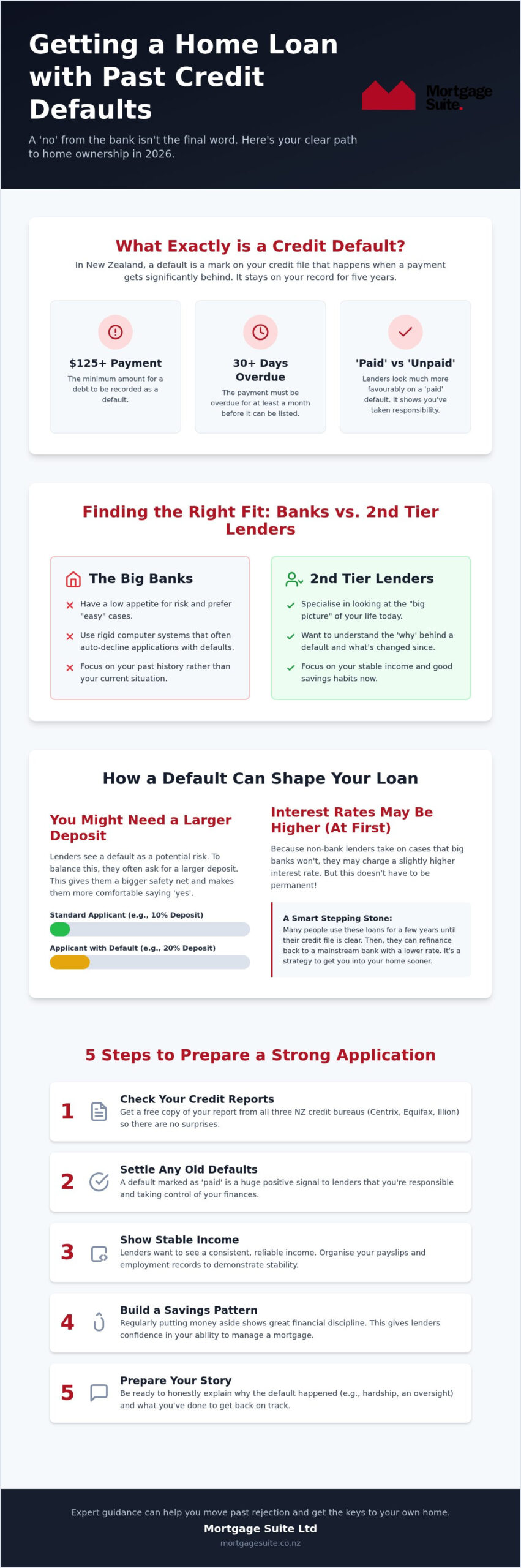
Five steps to take before applying for a home loan with a default
Preparation isn’t just about ticking boxes; it’s about building a story that makes a lender feel safe. When you’re aiming for a home loan with defaults nz, showing that you’ve learnt from the past is your greatest asset. It’s about proving that the person who missed that payment years ago isn’t the same person applying for a mortgage today. Organising your documents and cleaning up your recent history early saves a massive amount of stress once the application process begins.
Step 1: Get your credit file in order
You can’t fix what you haven’t seen. Start by requesting your free report from the main bureaus. Errors are surprisingly common; perhaps a debt you paid off is still showing as outstanding. If you have the spare cash, clearing any remaining defaults is a massive win. A “paid” status looks much better to a specialist lender than one that’s still hanging over your head. Most importantly, stop applying for new credit. Every “hard enquiry” for a store card or car loan can lower your score further and raise red flags for a mortgage lender.
Step 2: Build a ‘clean’ six-month history
Lenders love recent stability. For the next six months, treat every bill like a high-stakes test. Your rent and utilities must be paid on the exact day they are due. We also suggest cooling it with “buy now, pay later” services like Afterpay or Laybuy. While they’re convenient, some lenders view a high volume of these transactions as a sign of tight cash flow. Even a small, regular savings contribution shows you have the discipline to manage a mortgage. This period of “clean” banking proves you’ve moved past previous financial hurdles.
Step 3: Work with a specialist mortgage broker
This is where the magic happens. A specialist broker doesn’t just pass on your documents; they package your application to highlight your strengths. We know which 2nd tier lenders will be most sympathetic to your specific situation. Part of our process involves helping you write a clear, honest explanation for your past credit issues. One well-constructed sentence explaining a period of illness or redundancy can be the difference between a decline and an approval. You can learn about our approach at Mortgage Suite and see how we’ve helped hundreds of Kiwis move past their credit history.
Getting your finances ready before you approach a lender is the best way to turn a “no” into a “yes”. If you’re ready to start the process, you can book a consultation with our team to review your current position and find the best path forward.
How Mortgage Suite helps you navigate alternative lending in 2026
Securing a home loan with defaults nz requires more than just a standard application; it requires a strategy. We’ve spent over two decades working inside the New Zealand banking and brokerage world, so we know exactly how the systems work from the other side. This experience allows us to act as your advocate, translating your financial history into a language that non-bank lenders understand. We specialise in those “non-standard” loans that don’t fit the rigid criteria of the big banks, ensuring your application gets the human attention it deserves.
Our role is to be your negotiator. We don’t just pass your papers along; we fight for your approval by highlighting your current strengths and your ability to manage debt responsibly now. We also look beyond the immediate “yes”. For many of our clients, a 2nd tier loan is a strategic first step. We help you map out a clear plan to improve your credit standing over the next few years, with the ultimate goal of refinancing you back to a mainstream bank once your record is clear.
A personalised partnership, not just a transaction
We believe that every Kiwi deserves a fair go at home ownership, regardless of a less-than-perfect credit file. Our team takes the time to listen to the story behind your numbers because we know that life happens. Whether you are part of the many first-home buyers trying to enter a tough market or an investor looking to grow your portfolio, we provide a steady hand. You won’t find any confusing corporate jargon here. We prefer honest, jargon-free conversations that keep you informed and empowered throughout the entire process.
Ready to see what’s possible?
If you’re tired of being processed by a computer and want a professional who values personal connection, let’s talk. You can start by using our mortgage calculator to see how your budget might look with different lending options. It’s also worth reading through our client reviews to see how we have helped other New Zealanders move past their defaults and into their own homes. When you’re ready, book a chat with Krish and the team. We are here to show you that your dream of home ownership is still very much alive, and we have the expertise to help you reach it.
Take the first step toward your new home
Your financial history doesn’t have to be a permanent barrier to your future. As we’ve explored, securing a home loan with defaults nz is a realistic goal when you have the right strategy and the right partners. By focusing on a clean six-month banking history and looking beyond the big banks, you can find a lender who values your current stability over past mistakes. Specialist non-bank lenders offer a vital bridge, allowing you to move into your own home while you rebuild your credit score.
At Mortgage Suite, we bring over 20 years of industry experience to every conversation. We are passionate advocates for first-home buyers and specialists in navigating the complex world of 2nd tier lending. We don’t just see a credit file; we see a person ready for a fresh start. If you’re ready to stop letting a past default hold you back, we are here to find a way forward together.
Book a no-obligation chat with the Mortgage Suite team today and let’s discover what’s possible for your situation. You’ve done the hard work to get your finances back on track; now let us handle the negotiations to get you home.
Frequently Asked Questions
Will a default stop me from getting a mortgage in NZ forever?
No, a credit default is only a temporary hurdle rather than a permanent block. While mainstream banks might decline your application today, specialist lenders focus on your current ability to pay rather than past mistakes. Most credit marks disappear from your record after five years, but we can often help you secure a home loan with defaults nz much sooner by using alternative lending paths.
How much extra deposit do I need if I have bad credit?
You will likely need a 20% deposit to secure a loan with a default. While some buyers with perfect credit can sometimes access 10% deposit options, lenders usually require a larger safety net when credit issues are present. This extra equity reduces the lender’s risk and makes it much easier for them to feel comfortable approving your home loan application.
How long does a default stay on my NZ credit report?
A default stays on your New Zealand credit file for five years from the date it was first listed. This timeframe applies whether the debt is paid or unpaid. Once you clear the debt, the status on your report changes to “paid,” which lenders view much more favourably, but the record itself remains visible until the five-year period ends.
Can I get a home loan if my default is still unpaid?
Yes, it is possible to get a home loan with an unpaid default, but your options will be more limited. Some specialist lenders will consider these cases if you have a very strong explanation and a significant deposit. However, we always recommend clearing the debt before applying, as it significantly improves your chances of approval and helps you secure a better interest rate.
Are interest rates much higher for non-bank home loans?
Interest rates for non-bank loans are generally higher than those offered by the “Big Four” banks. Because these lenders take on more risk by helping Kiwis with defaults, they charge a premium, often ranging from 1% to 3% above standard bank rates. Most clients view this as a short-term solution to get into a home while they work on clearing their credit history.
Can I use KiwiSaver for a deposit if I have a default?
Absolutely. Having a credit default does not stop you from withdrawing your KiwiSaver funds for a first home purchase. As long as you meet the standard KiwiSaver withdrawal criteria, you can use that money toward your deposit. The default only affects your ability to borrow the remaining balance from a lender, not your right to access your own savings.
What is the difference between a 2nd tier lender and a loan shark?
Second tier lenders are professional, regulated financial institutions that must follow New Zealand’s strict responsible lending laws. They are reputable alternatives to traditional banks. Loan sharks are often unregulated, charge extreme interest rates, and don’t provide the same consumer protections. We only partner with established, ethical 2nd tier providers who are committed to your long-term financial success.
How do I clear a default from my credit record early?
You cannot usually remove a legitimate default before the five-year mark. If the default is a genuine error, you can dispute it with the credit bureau to have it removed immediately. Otherwise, the best path is to pay the debt so the record is marked as “paid.” This shows lenders you have taken responsibility for the mistake and cleared your obligations.