
Rental Property Loan Requirements NZ: Your 2026 Guide to Getting Sorted
What if the biggest barrier to growing your portfolio isn’t the size of your bank balance, but simply knowing which door to knock on? It is a common hurdle in 2026, where lending rules seem to change just as you are getting comfortable. Many Kiwis feel stuck between confusing LVR limits and those strict debt-to-income ratios that can make mainstream banks feel out of reach. It is exhausting trying to keep up with interest deductibility changes while worrying if your cash flow can handle a 9% stress test. We understand that behind every application is a goal for your family’s future, not just a set of numbers on a spreadsheet.
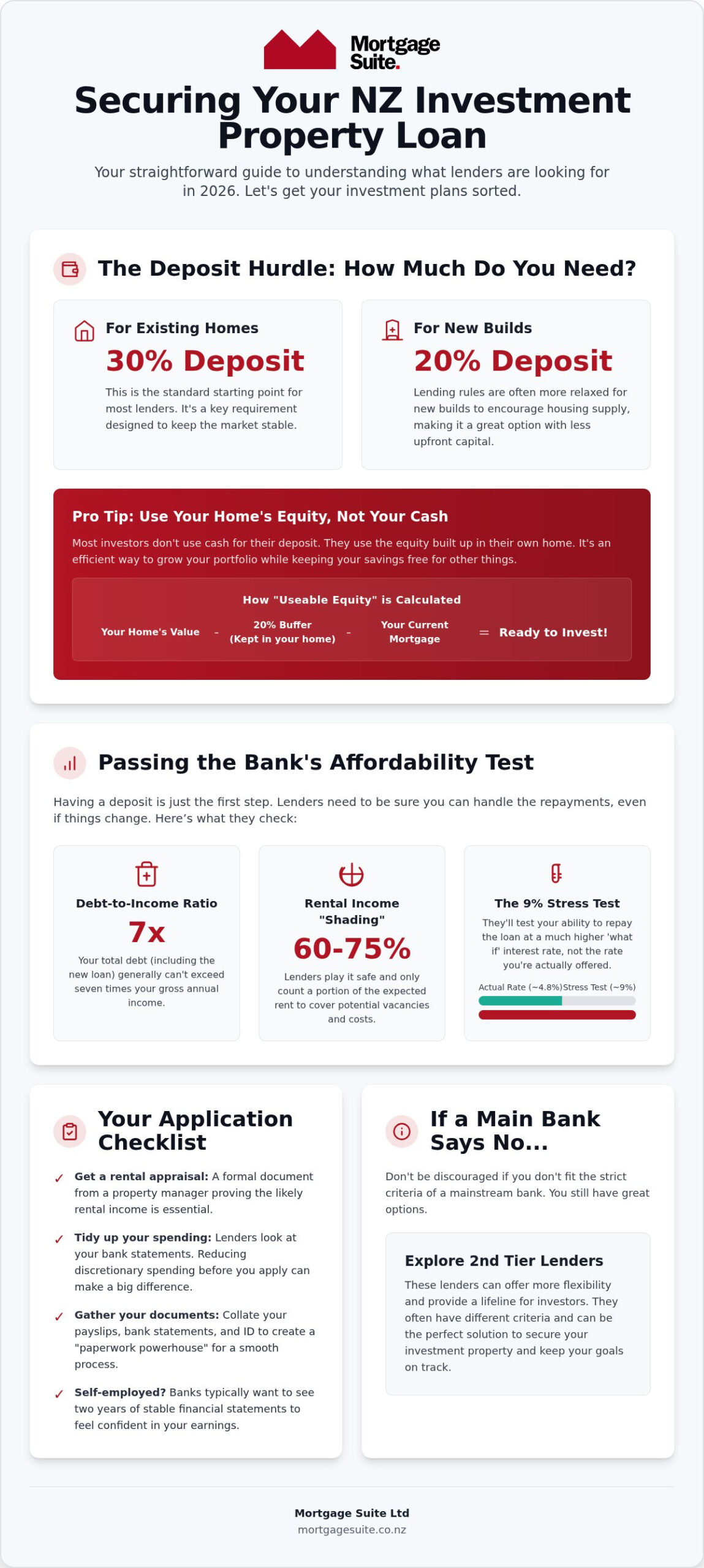
This guide clears the air by detailing the specific rental property loan requirements nz lenders expect right now. You will discover how to use existing equity instead of cash, the difference between buying new versus existing properties, and the checklist you need to apply with total confidence. Whether you are looking at a 30% deposit for an existing home or a 20% deposit for a new build, we provide the professional roadmap to help you get your investment plans sorted.
Key Takeaways
- Understand why a 30% deposit is the standard starting point for existing homes and how new builds might offer a path with just 20% down.
- Learn how lenders “shade” your rental income and what you need to meet the rental property loan requirements nz banks use to test your serviceability.
- Identify which property types are on the bank’s “black list” to ensure the home you choose is actually one they are willing to fund.
- Discover how 2nd tier lenders can provide a lifeline if a mainstream bank says no, giving you a second chance at securing your investment.
- Use our practical checklist to tidy up your personal spending and gather the “paperwork powerhouse” needed for a stress-free application.
The 2026 Deposit and Equity Rules for NZ Landlords
Standard bank policy for an existing investment property usually starts with a 30% deposit. While this might feel like a high bar to clear, it is designed to ensure the market remains stable. If you are looking at a brand-new build, the rules are often more relaxed; many lenders only require a 20% deposit. This exemption is a strategic way to encourage more supply in the market, making it a popular choice for those looking to meet the rental property loan requirements nz lenders set with less upfront capital.
We are also seeing a rise in “rentvesting” across the country. This is where first-home buyers choose to rent where they want to live while buying a rental property in a more affordable area. Because the Housing in New Zealand market has become so varied, this strategy allows people to get a foot on the ladder without sacrificing their lifestyle. It is a clever way to build wealth while the 2026 market continues to evolve.
Calculating Your Useable Equity
Most of our clients do not actually use cash for their deposit. Instead, they use the equity built up in their own home. Banks generally want you to leave a 20% buffer in your primary residence. Anything above that 20% mark is what we call “lendable equity.” For example, if your home is worth NZ$1,000,000 and your mortgage is NZ$500,000, your lendable equity isn’t the full NZ$500,000. It is the amount above the NZ$200,000 buffer, which is 20% of the value. To find your specific “magic number” and see how much you could potentially borrow, our mortgage calculator is an excellent place to start your planning.
Cash vs. Equity: Which is Better?
Choosing between using cash or equity often comes down to your long-term goals and tax structure. Since 1 April 2025, property investors can claim 100% of their mortgage interest as a tax-deductible expense. This makes borrowing for an investment property quite efficient. Many seasoned investors prefer to keep their cash in an offset account or a high-interest savings fund for emergencies, while using home equity to fund the rental purchase. This approach keeps your personal and investment debt separate and easy to manage. With property values shifting, 2026 is the perfect time to get a fresh valuation. You might find you have more “house power” than you realised a year ago.
Income and Serviceability: Proving You Can Handle the Repayments
Serviceability is essentially the bank’s way of asking, “Can you still afford this loan if life gets expensive?” While having a deposit is a great start, proving you can handle the ongoing repayments is often the biggest hurdle for investors. In 2026, meeting the rental property loan requirements nz lenders demand involves more than just showing a decent salary. Banks are now looking closely at your Debt-to-Income (DTI) ratio. For most investors, your total debt cannot exceed seven times your gross annual income. It is a firm boundary that has changed how many Kiwis approach their next purchase.
Lenders are also very cautious about how they calculate your potential earnings. They don’t just take your expected rent at face value. Instead, they “shade” the income, usually only counting between 60% and 75% of the total rent. This buffer accounts for times when the property might be empty, or when you have to pay for unexpected repairs and rates. On top of that, even if you secure a fixed rate around 4.8%, the bank will stress-test your application at a much higher rate, currently around 9%. They want to be absolutely certain you are protected if interest rates climb in the future.
Rental Yield and Appraisals
Before a bank gives you the green light, they will require a formal rental appraisal from a registered property manager. This document proves what the property is likely to earn in the current market. Choosing a property with a high rental yield is vital because it directly supports your serviceability calculation. You need to look beyond the purchase price and consider the net income after insurance, maintenance, and council rates are paid. If the numbers are tight, the bank may see the property as a risk rather than an asset. If you are unsure how your specific income will be viewed, you can learn more about our approach at Mortgage Suite Ltd.
Self-Employed and Unique Income
If you work for yourself, the paperwork trail is a bit more involved. Banks typically want to see two years of stable financial statements to feel confident in your earning power. We often help clients present their “business story” to lenders, highlighting growth and consistency that a simple tax return might miss. For those whose situations don’t fit the rigid boxes of mainstream banks, 2nd tier lenders can be a fantastic alternative. They often offer more flexibility for self-employed individuals or those with unique income streams, ensuring your investment goals don’t stall just because of a complex payslip.
Property Requirements: What Kind of House Will the Bank Fund?
When you apply for a loan, the bank isn’t just looking at your bank statements; they are looking at the house itself. If a property is hard to sell, it is hard to finance. This is why the physical state and legal title of the house are central to rental property loan requirements nz. Some properties are on a “black list” for major lenders. This includes tiny homes under 40 square metres, properties with monolithic cladding and no cavity system, or the notorious “leaky buildings.” If a house has structural issues or significant unconsented work, most banks will simply walk away. They want security that holds its value, not a project that might become a liability.
Title types also play a huge role in your success. A fee simple title is the gold standard because you own the land and the building outright. Cross-lease and unit titles are common in our major centres, but they require extra homework. For unit titles, the bank will want to see the last few years of body corporate minutes and proof of full replacement insurance. If the body corporate has a poor maintenance history or a low sinking fund, the bank might see it as a risk. It is about ensuring there are no hidden costs that could sink your ability to pay the mortgage.
The New Build Advantage
Buying brand new has become a popular strategy for meeting the rental property loan requirements nz because of the LVR exemptions. As we mentioned earlier, you can often get in with a 20% deposit instead of the usual 30%. The government and banks prefer these because they increase the housing stock for all Kiwis. However, 2026 has taught us to be cautious with sunset clauses. If a project is delayed or a builder runs into financial trouble, you need to ensure your contract protects your deposit and gives you an out if things go south.
Healthy Homes and Compliance
Since 1 July 2025, every private rental in New Zealand must comply with the Healthy Homes Standards. If a property doesn’t meet these rules for heating, insulation, or ventilation, it is a massive red flag for a lender. They may even withhold part of the loan until you prove the work is finished. We always recommend checking the council’s Land Information Memorandum (LIM) for unconsented works before you sign a sale and purchase agreement. If you are planning a “fixer-upper,” talk to us early. We can often help you structure the loan to include those renovation costs from day one, making the process much smoother.
When the Big Banks Say No: Exploring 2nd Tier Lending
Getting a decline from a mainstream bank can feel like a dead end. But in the 2026 property market, it is often just a sign that you don’t fit a very narrow, rigid set of rules. The “Big Four” banks are heavily restricted by debt-to-income (DTI) ratios and aggressive stress testing. If your situation is even slightly outside the norm, you might struggle to meet the standard rental property loan requirements nz banks demand. This is exactly why 2nd tier lenders exist. They offer a lifeline to investors who have a strong strategy but don’t quite match the high-street profile. For a deeper look at these options, check out our guide on 2nd tier lenders in New Zealand.
Non-bank lenders are particularly helpful if you have a “credit blip” from the past, a complex income structure as a contractor, or if you are slightly short on the standard 30% deposit for an existing home. They don’t just look at a computer-generated score; they look at the person behind the application. They understand that a temporary dip in income or a missed bill three years ago doesn’t necessarily make you a high-risk borrower today.
The Pros and Cons of Non-Bank Loans
The main trade-off with a non-bank lender is cost versus flexibility. You will likely pay a higher interest rate than the 4.79% or 4.99% fixed rates currently offered by major banks. However, the benefits often outweigh the extra interest. Non-bank lenders can move much faster, sometimes providing an answer in days rather than weeks. They are also more willing to look at the “big picture” of your finances. We often use these loans as a bridge; you secure the property now, and once you have a year of clean accounts or the property value increases, we help you refinance back to a mainstream bank at a lower rate.
How Mortgage Suite Negotiates for You
We specialise in loans that do not fit standard bank criteria. With over 20 years of banking experience, we know exactly how to package your application to show a lender why you are a good bet. We act as your advocate, negotiating with both banks and private lenders to find the best possible fit for your goals. We have helped many investors get “sorted” after being turned away elsewhere. If you have been told “no” by your bank, reach out to us today to explore your alternative options and get your investment plans back on track.
How to Get Your Loan Approved: A Practical Checklist
Once you understand the deposit rules and property types, it’s time to get your own house in order. Meeting the rental property loan requirements nz lenders set is much easier when you present a clean, organised financial profile. Banks don’t just look at what you earn; they look at how you spend. Preparation is the difference between a quick “yes” and a frustrating “we need more information” email. By taking a few intentional steps before you submit your application, you can significantly increase your chances of success.
Getting a pre-approval is your most powerful tool. It allows you to hunt for properties with confidence, knowing exactly what your budget is. In a competitive market, being able to make an unconditional offer because your finance is already sorted gives you a massive edge over other buyers. It turns you from a “maybe” into a serious contender in the eyes of real estate agents and sellers.
Your 30-Day Pre-Application Plan
In the month leading up to your application, you should enter a “clean up” phase. Banks typically look at your last three to six months of bank statements to gauge your spending habits. Small changes can make a big impact on your serviceability. We recommend focusing on these key areas:
- Reduce credit limits: Even if you don’t use your credit cards, the bank counts the full limit as a potential debt. Lowering a NZ$10,000 limit to NZ$2,000 can boost your borrowing power.
- Close BNPL accounts: Accounts like Afterpay or Zip are viewed as debt. It is best to close these and show you can manage your lifestyle without them.
- Show consistent savings: Ensure your statements show that you are living within your means and, ideally, still adding to your equity or savings.
Booking a chat with Krish early in this process is a smart move. We can help you map out your long-term goals and identify any potential red flags before the bank sees them. You can see how we have helped other Kiwis navigate this journey by reading our reviews.
The Power of a Mortgage Broker
Going directly to your local bank branch limits you to just one set of rules. If you don’t fit their specific criteria, they will simply say no. As your broker, we compare dozens of different lenders, from the big high-street names to specialised 2nd tier providers. We know which lenders are currently “hungry” for investment business and which ones have the most flexible rental property loan requirements nz investors can benefit from. We take the stress out of the back-and-forth negotiations, using 20 years of banking experience to advocate for your best interests. We don’t just find you a loan; we find you the right strategy for your future.
Ready to Grow Your Property Portfolio?
Getting your investment property sorted in 2026 doesn’t have to be a source of stress. While the rental property loan requirements nz banks use are strict, they are much easier to manage when you have a clear plan. Remember that a 30% deposit is standard for existing homes, but new builds offer a faster path with only 20% down. Most importantly, don’t let a “no” from a mainstream bank stop you. There are flexible 2nd tier options available that can bridge the gap while you build equity and clean up your accounts.
With over 20 years of banking experience, we have seen every scenario and know how to negotiate on your behalf. We provide national coverage to help Kiwis secure residential investment loans that actually fit their unique situation. Our team specialise in complex approvals and 2nd tier lending, acting as your mentor through the entire process. Talk to Krish and the team at Mortgage Suite about your investment goals today and let’s get your next property purchase across the line. Your future portfolio is waiting.
Frequently Asked Questions
Do I really need a 30% deposit for a rental property in NZ?
A 30% deposit is the standard requirement for existing properties, but you can often secure a new build with just 20% down. This difference exists because the government wants to encourage more housing supply. If you don’t have the cash, we can look at using the equity in your current home to meet these rental property loan requirements nz lenders have in place. It’s a common strategy that lets you grow your portfolio without touching your savings.
Can I use my KiwiSaver to buy an investment property?
No, you cannot use your KiwiSaver funds to purchase an investment property. KiwiSaver is strictly designed for your first home, which you must live in, or your retirement. While it is a great tool for getting on the ladder initially, once you move into the world of residential investment, you will need to rely on your own cash savings or the equity built up in your current home instead.
What is the Bright-line test and does it affect my loan?
The Bright-line test is a tax on any profit you make if you sell a residential property within a specific timeframe. While it doesn’t directly change your mortgage approval, lenders consider it part of your overall financial strategy. If you plan to sell quickly, you need to account for the tax hit on your capital gains. Always talk to an accountant to see how this fits with your long-term investment goals.
How does interest deductibility work for landlords in 2026?
From 1 April 2025, property investors can claim 100% of their mortgage interest as a tax-deductible expense. This is a significant change that has improved cash flow for many Kiwi landlords in 2026. When we assess your rental property loan requirements nz, this deductibility makes the property’s income look much stronger on paper. It essentially reduces your taxable income, making the investment more sustainable over the long term.
Will the bank consider the potential rent as part of my income?
Yes, banks will certainly count your potential rental income, but they won’t use the full amount. Most lenders “shade” the rent, typically only counting 60% to 75% of what the property manager’s appraisal suggests. This buffer covers costs like insurance, rates, and maintenance. They want to ensure you can still meet your repayments even if the property is empty for a few weeks or costs more to run than expected.
What happens if my rental property sits vacant for a few weeks?
Lenders expect your property to be vacant occasionally, which is why they only count a portion of the rental income during your application. Having a small “rainy day” fund is essential for covering the mortgage during these gaps. If a property sits empty for longer than expected, it can impact your cash flow, but a well-structured loan with a bit of a buffer will keep your investment safe while you find new tenants.
Is it harder to get a loan for an apartment than a house?
It can be slightly more complex to finance an apartment than a standalone house. Lenders have strict rules about size, often requiring the apartment to be at least 40 square metres excluding balconies. They also look closely at the body corporate minutes and the building’s maintenance history. If the apartment is too small or the building has structural issues, mainstream banks might decline the loan, though 2nd tier lenders can sometimes help.
Can I get an interest-only loan for my rental property?
Yes, interest-only loans are a popular choice for many New Zealand investors. They allow you to keep your monthly repayments lower, which can help with your initial cash flow. Most banks will offer an interest-only period of one to five years before requiring you to switch to principal and interest. It’s a strategic way to manage your finances, especially if you are focusing on capital growth rather than paying down debt immediately.