
How to Build a Property Portfolio in NZ: 2026 Guide
What if the next property in your portfolio should be decided by your financial breathing room, not the maximum a lender might offer? If you’re working out how to build a property portfolio nz, it’s understandable to feel unsure about how existing loans, available equity and changing repayments could affect your next move.
A sustainable plan starts with your goals and what your household can comfortably manage, not a target number of properties. This guide will help you map out practical next steps, understand how lenders may assess your income and existing debt, and review the risks before taking on another commitment.
You’ll also learn how available equity may support a purchase, why lenders test whether you could manage higher repayments, and how to plan for vacancies or changes in your circumstances. Mortgage Suite helps borrowers compare suitable lending options and structure finance as their plans develop. If a mainstream bank has declined your application, that doesn’t necessarily mean your options have run out.
Key Takeaways
- Start with clear property and personal goals, then set a pace your household budget can support.
- See how to build a property portfolio nz by understanding how lenders may weigh your income, expenses, existing debt and proposed repayments.
- Compare buying one property at a time with a faster purchase plan, and weigh using available equity against building savings.
- Check whether your budget could handle vacancies, income changes, repayments and property upkeep before taking on another loan.
- Organise your finances and compare lending paths so your plan can adapt as your circumstances change.
How to build a property portfolio in NZ: start with a clear plan
Buying a second property can feel like a major financial step. You’re not only deciding whether a particular home suits your plans; you’re taking on another loan and the responsibilities that come with it. A useful starting point for how to build a property portfolio nz is to decide what you want property ownership to do for you, and what level of debt your household can manage comfortably.
A property portfolio is a group of properties held for investment, rather than a single purchase considered on its own. It might grow through separate purchases over time. But owning several properties isn’t a plan by itself: each purchase needs to fit your borrowing, income and ability to manage the ongoing commitments. For a broad introduction, you can explore these real estate investing principles.
What does building a property portfolio involve?
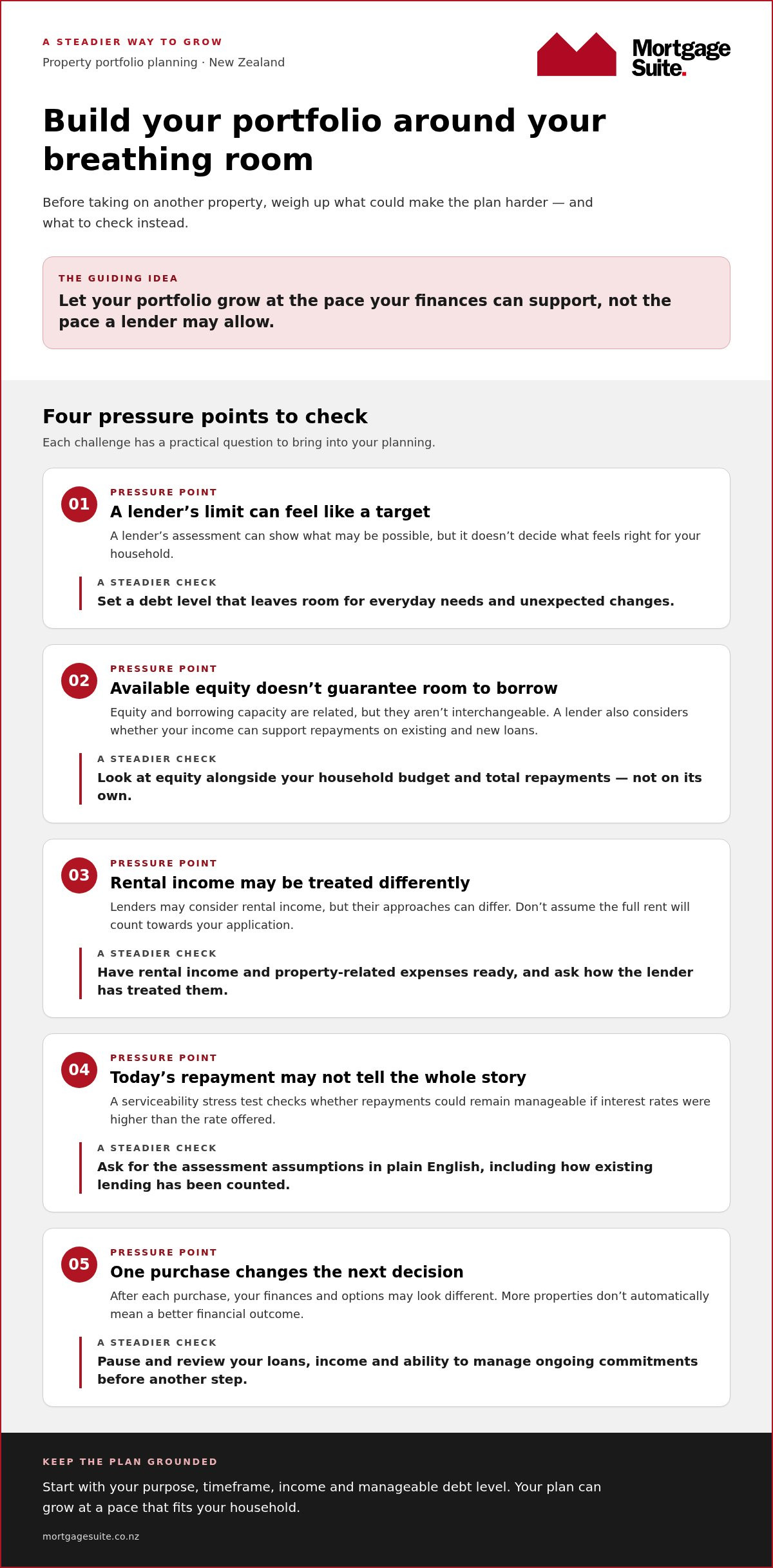
Portfolio growth is usually a sequence of decisions, not one large transaction. After each purchase, your finances and options may look different, so pause and review before taking another step. More properties don’t automatically mean a better financial outcome. Your plan needs to account for the loans and responsibilities attached to each property, not just the number you own.
Set goals before you look at another property
Start by asking what you want property ownership to support. Then consider your timeframe, how steady your income is and what commitments your household already has. Set a debt level that leaves room in your budget for everyday needs and unexpected changes. These answers can help you decide whether another purchase fits your priorities now, later or not at all.
Write down your starting point before browsing listings. It can help to consider:
- Your purpose: What do you want property ownership to contribute to your longer-term plans?
- Your timeframe: Are you comfortable holding a property for the period your plan requires?
- Your income: Could you manage the commitments if your income changed or became less predictable?
- Your debt limit: What level of repayments would still feel manageable alongside your other obligations?
Be realistic about the difference between a goal and a borrowing limit. A lender’s assessment can show what may be possible, but it doesn’t decide what feels right for your household. Leave room for property ownership and maintenance, as well as changes that could affect your income or budget. That breathing space matters more than reaching a particular portfolio size.
Growing a property portfolio won’t suit every household or financial situation, and there’s no need to rush. Let your portfolio grow at the pace your finances can support, not the pace a lender may allow. If the numbers or your circumstances don’t feel settled, taking time to strengthen your plan is a sensible next step.
How lenders assess finance as your NZ property portfolio grows
As your property plans develop, a lender will look at your overall borrowing, not just the value of the next property. Existing home and property loans, income, household expenses and proposed repayments all help shape whether a new loan may be affordable. Assessments vary between lenders, so an earlier approval or decline won’t necessarily determine the outcome of a later application.
How equity and borrowing capacity fit together
Equity is the difference between a property’s current value and the lending secured against it. If the property’s value rises or the loan balance falls, your equity may increase. But that doesn’t automatically mean you can borrow more. A lender also needs to consider whether your income can support repayments on both existing and new loans. Available equity and borrowing capacity are related, but they aren’t interchangeable.
For example, you may have equity available while your household budget has little room for another repayment. In that case, the equity alone won’t show whether another purchase is manageable. The property type and lender requirements may also affect how the property is viewed as security for lending. If you’re weighing up finance for a rental purchase, this guide to mortgage lending concepts can help you get familiar with the basics.
What lenders may consider across multiple properties
A lender may review your existing repayments alongside your regular income, household commitments and the proposed repayments for the new loan. It may also consider rental income, but lenders can treat that income differently. Don’t assume the full rent will count towards your application. The same applies to property-related expenses. Current lender criteria matter.
The assessment may also include a serviceability stress test, which checks whether repayments could remain manageable if interest rates were higher than the rate offered. This helps explain why a loan that looks affordable at today’s repayment level may be assessed differently. Ask your mortgage adviser to explain the assessment assumptions in plain English, including how existing lending and rental income have been treated.
To prepare, organise an up-to-date view of your finances before discussing another purchase. Include:
- All current lending: balances, repayments and any changes you already expect.
- Household income and commitments: regular income alongside everyday expenses and other debt.
- Rental details: income received and property-related expenses, while allowing for the lender’s own approach.
- The proposed loan: expected repayments and how they fit with your existing commitments.
A clear picture makes it easier to compare possible lending paths and spot gaps before you commit to a purchase. A mortgage adviser can help present your circumstances to suitable lenders and negotiate a structure that fits your plans. If one mainstream bank says no, that isn’t automatically the end of the conversation. As you consider how to build a property portfolio nz, focus on understanding the reasons behind an assessment and which options may suit your situation.
Compare property portfolio strategies before choosing your next step
There’s no single route that suits every borrower. The right approach depends on how steady your income is, how much room your budget has for repayments and how much time you have to review each decision. A mortgage assessment can help you understand possible lending paths, but it doesn’t tell you whether a property is suitable or what return it might deliver. Consider the property choice and the finance separately.
One purchase at a time or a faster sequence?
Buying one property at a time gives you a chance to see how each new commitment affects your finances before deciding what comes next. A faster sequence may add properties sooner, but it also means taking on commitments closer together. Neither approach is automatically better. Consider how much time you want between decisions and whether your income and budget could manage the pace if circumstances change.
| Approach | What to weigh up |
|---|---|
| One purchase at a time | More time to review repayments, income and commitments before another application, though progress may be slower. |
| Faster purchase sequence | May add commitments sooner, so consider whether your budget and income can carry them without relying on everything going to plan. |
| Use available equity | Could provide funds towards a purchase, but any extra borrowing adds repayments and still needs to fit lender criteria. |
| Build savings for a deposit | Can reduce the need to borrow for the deposit, but waiting may affect your timing and requires consistent saving. |
Using equity or building a deposit
Using equity means seeking further lending against value held in a property. Building savings means setting money aside towards a deposit instead. Equity may make a purchase possible sooner, but it can increase total debt and repayments. Saving first may mean waiting longer, while giving you time to build your deposit. Neither route guarantees approval or makes a property a sound choice. Compare both against your likely repayment capacity and timeframe.
Before settling on either path, consider what would happen if your income fell, expected rental income changed or a property needed attention. A plan that only works under ideal conditions may leave little room to adjust. Think about how much flexibility you want to keep and whether taking on another commitment now fits your broader financial priorities.
Use plain-English mortgage learning resources to get clearer on the lending concepts behind your options. Then compare possible finance structures against your goals, rather than choosing a purchase pace first and trying to make the borrowing fit afterwards. That’s a practical starting point for how to build a property portfolio nz while keeping the focus on a pace your finances can support.
Check portfolio resilience before taking on another property
Before adding another loan, look beyond whether the repayments fit your budget today. A portfolio can feel manageable while income is steady and properties are occupied, but vacancies, repairs or changing household circumstances can alter the picture. A practical resilience check helps you spot pressure points before you commit.
Stress-test the household budget
A lender’s assessment and your own comfort level are two different checks. A lender decides whether an application fits its criteria; you need to decide whether repayments leave enough room for everyday needs and unexpected changes. Try the mortgage repayment calculator to explore how repayments may change under different assumptions. Treat it as a planning aid, not an approval estimate or a promise of what a lender will offer.
Work through this check before each purchase. Be honest about less favourable circumstances, not just the version where every payment arrives on time and nothing needs fixing.
- 1. Repayments: Map the repayments for all your loans together. Would they remain manageable if rates or other household expenses rose?
- 2. Income changes: Consider how a drop in household income, fewer work hours or a change in employment could affect your ability to meet commitments.
- 3. Rental vacancies: Allow for a period when a property has no tenant and rental income pauses. Could you still cover its loan and other regular commitments?
- 4. Repairs and upkeep: Think about routine maintenance as well as an unexpected repair. Does your budget have room to respond without disrupting essential household spending?
- 5. Loan fit: Check how each loan’s repayments and structure fit with your other commitments and the plans you have for the coming years.
Plan for vacancies, repairs and changing circumstances
A suitable financial buffer can help you manage a gap in rent or property work that can’t be put off, but the right amount depends on your circumstances. Set a level that reflects your household commitments, property needs and capacity to save. Don’t rely on rent being received without interruption. Revisit the plan when your income, expenses or borrowing changes, and before taking on another property.
Keep the scope clear, too. A mortgage review can help you understand how lending fits your plans, but it doesn’t replace separate tax, legal or property-investment advice. Those matters may need input from the relevant professional. The Mortgage Suite website has information about lending options. A clear view of your commitments can help you decide whether the next step feels manageable, not simply possible.
Build your property portfolio with a finance plan that can adapt
A useful finance plan isn’t a timetable that says you must buy again by a certain date. It’s a way to keep your borrowing choices connected to your goals, income and changing commitments. If you’re considering how to build a property portfolio nz, focus on making the next decision with a clear view of what you owe, what you can manage and which finance paths may suit.
When a mortgage adviser can help
Before pursuing another purchase, an adviser can help you review your borrowing as a whole, including current loans, income and the new commitment you’re considering. They can compare lending options across suitable lenders and negotiate on your behalf, explaining how loan structure may affect your plans. The aim is to help you understand your choices, not to promise a particular rate, approval or outcome.
A mainstream-bank decline can be disappointing, but it doesn’t automatically close off every finance option. Another lender may assess your circumstances differently, depending on its current criteria and the details of your application. Mortgage Suite acts as a personal advocate through that process, helping you understand the options available and what each may mean for your wider borrowing picture.
Turn the plan into practical next steps
Get your information organised before a finance discussion. A clear picture makes it easier to identify questions, compare possible paths and work out what needs attention before you proceed. You can start with these steps:
- Organise your finances: Gather details of your income, regular expenses, savings and existing lending.
- Map your commitments: Include repayments and the ongoing responsibilities attached to each property.
- Compare lending paths: Discuss how different lender criteria and loan structures may fit your plans.
- Review your readiness: Consider whether the proposed commitment still feels manageable if circumstances change.
Then review the plan after a major change, such as a shift in income, new household commitments or a change to your existing lending. Revisit it before each purchase, too. A plan that fitted last year may need adjusting now, and there’s no need to follow someone else’s buying schedule.
Mortgage Suite’s team can support you as you consider your next finance decision. The Mortgage Suite website explains how to start a conversation about a property finance plan and explore a suitable way forward.
Make your next property decision with confidence
Your plan doesn’t have to map out every purchase from the start. Treat it as a working guide: revisit it as your income, commitments and goals change, and let those changes shape your next move. That gives you room to pause, adjust or proceed when the finances make sense for your household.
If you’re still considering how to build a property portfolio nz, a conversation about the lending side can help you understand the paths available. Mortgage Suite supports residential investment property borrowing and can discuss mainstream and alternative lending options. Founder Krish Krishna brings over two decades of banking experience to helping borrowers work through their finance choices. No lender can promise an outcome, but you can make your next decision with a clearer view of your options.
Talk through your property finance plans with Mortgage Suite when you’re ready to take that next step. A steady, considered pace can help you move towards your goals while keeping your household’s financial wellbeing in view.
Frequently Asked Questions
Can I build a property portfolio with only one investment property to start?
Yes, a property portfolio can begin with one investment property. Owning it doesn’t mean another purchase will suit your household, though. First, decide what you want the property to support and how long you expect to hold it. Then list your existing loan repayments and other commitments, and review your borrowing capacity before planning a next step. There’s no required property count or guaranteed route to growth.
Does having equity mean I can buy another investment property?
No, equity alone doesn’t mean you can buy another property or that a lender will approve a new loan. A lender may also consider your income, existing debt, expenses and the property offered as security. For example, having value available in one property won’t necessarily resolve a tight household budget. Look at whether repayments would be affordable as well as how much equity may be available.
How many properties should I have in a portfolio?
There’s no single number that suits everyone. If you’re considering how to build a property portfolio nz, start with what fits your goals, income, borrowing capacity and comfort with risk, rather than aiming for a particular count. For one household, keeping a single rental property may be the right fit; another may have room to grow over time. Judge progress by whether each commitment remains manageable, not by comparing portfolio sizes.
Can rental income help me qualify for another property loan?
It may help, but lenders can assess rental income in different ways. Don’t assume every dollar of rent will count in full or that rent will cover all your existing commitments in a lender’s assessment. For instance, a lender may take a cautious view of expected rent while still considering your other income and expenses. Review rental income alongside your full financial position and the lender’s current criteria.
Should I use equity or save a deposit for my next property?
Either approach may suit, depending on your circumstances. Using equity may mean taking on additional borrowing and repayments; saving towards a deposit may take longer but change how much you need to borrow. Compare the options against your timeframe, existing commitments and ability to manage repayments if circumstances shift. Before deciding, review the full lending position rather than treating available equity or savings as the only factor.
What happens if a bank declines my next property loan?
A decline isn’t a personal judgement, and it doesn’t automatically end every finance option. Start by understanding the reasons for the decision, such as how the lender viewed your income, commitments or property details. Another lender may assess your circumstances differently, but approval isn’t guaranteed. A mortgage adviser can review your position and discuss suitable mainstream or alternative lending pathways where appropriate.
Is it risky to build a property portfolio using borrowed money?
Borrowing adds repayments, so changes to income, property expenses or lending conditions can affect your household budget. The level of risk depends on your circumstances and how the lending is structured. Before taking on more debt, test your budget against less favourable conditions, consider a financial buffer that suits your situation and review your loans regularly. Property ownership isn’t risk-free, so avoid relying on everything going to plan.