
How to Get a Mortgage on a Low Income in NZ in 2026
What if a lower income doesn’t automatically rule out a home loan? Working out how to get a mortgage with low income nz can feel daunting, especially if you’re worried that regular bills, existing debt or a small deposit will affect your application.
Lenders look at your full financial picture: your income, regular spending, debts and whether repayments appear affordable if interest rates rise. Their lending policies can differ, so a decline from one mainstream bank doesn’t necessarily mean you’re out of options. For eligible first-home buyers, the Kāinga Ora First Home Loan may allow a deposit as low as 5%, but meeting the deposit requirement doesn’t guarantee approval.
This guide explains how lenders assess affordability, which financial records to prepare and what pathways may be worth exploring. You’ll also learn how a mortgage adviser can organise your application and negotiate with lenders, including discussing alternative options where suitable. The aim is to help you understand your next steps and get sorted with a clearer picture, without assuming any lender will approve your application.
Key Takeaways
- See how to get a mortgage with low income nz by looking at your full financial picture, not income alone.
- Map your regular income, essential spending and debt to see what room your household budget may have for repayments.
- Prepare clear, consistent financial records to help lenders assess your application.
- Compare lending pathways by affordability, repayment structure and flexibility, and consider how each fits your longer-term plans.
- A mortgage adviser can help organise your application and negotiate with lenders, but no pathway guarantees approval.
Can you get a mortgage on a low income in NZ? Start with affordability
Borrowing can feel stressful when income is tight. You might be wondering whether there’s room for a mortgage after rent, food, transport and other regular bills. A lower income can affect how much you may be able to borrow, but it doesn’t decide the outcome on its own.
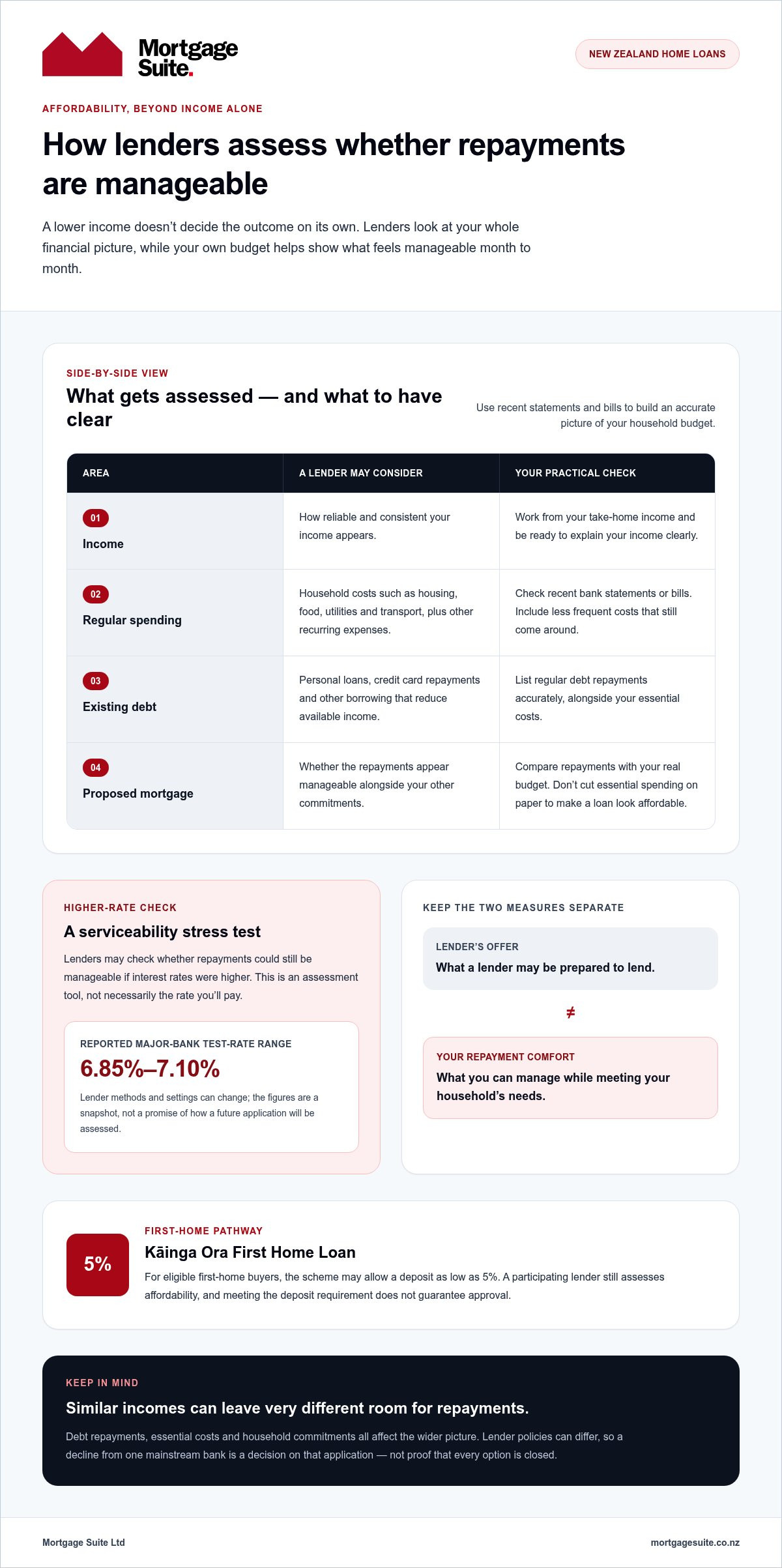
Affordability is about whether the proposed repayments appear manageable alongside your household’s other commitments. A lender considers the overall picture, including how reliable your income is, what you spend, any existing debt and the repayments for the home loan you’re seeking. The aim is to assess your application as a whole, rather than judge you by one number.
A rough income rule can offer a starting point, but only an individual lender assessment can consider how your income, spending and commitments fit together. That’s why an online estimate or a simple percentage of income shouldn’t be treated as a borrowing limit or a sign of approval.
What does a lender look at beyond your income?
Income matters, but so does the amount left after regular household costs and debt repayments. A lender may consider whether your income is consistent, what you pay towards existing borrowing, and how a proposed mortgage repayment would sit alongside essentials such as food, utilities and transport.
Two people with similar incomes can have very different budgets. One might have few debts and modest regular commitments; the other might have personal loan repayments or be supporting dependants. Those differences can affect how much room each household appears to have for a mortgage. Be ready to explain your regular costs accurately, rather than relying on a calculator result or a general rule.
Why a lower income does not tell the whole story
Lenders assess the proposed loan against your wider repayment picture, and their policies can differ. That doesn’t mean one lender will necessarily approve an application another declines. It means lender fit may be worth exploring, with affordability and the loan’s terms kept firmly in view. If a mainstream bank says no, treat that as a decision on that application, not a judgement on you or proof that every option is closed.
If you’re exploring how to get a mortgage with low income nz, focus on presenting a clear, accurate account of your finances and understanding what may affect your application. General explanations of a mortgage loan can help clarify common terms, but they don’t describe how a New Zealand lender will assess your application. If you’re buying your first home, Home Loans for First Home Buyers in New Zealand is also a useful next read about the first-home buyer pathway. A careful look at your circumstances can help you work out what to prepare next, without assuming approval is guaranteed.
How NZ lenders assess whether your mortgage repayments are manageable
A salary can look sufficient on paper but leave little breathing room once household costs are included. Lenders look beyond gross income to estimate what could realistically remain for mortgage repayments after regular expenses and existing commitments. Your own budget matters too: a lender’s maximum offer isn’t automatically an amount that will feel comfortable month to month.
A lender’s offer shows what it may be prepared to lend; repayment comfort is about what you can manage while still meeting your household’s needs. Keep that difference in mind when weighing a possible loan amount against your real-life budget.
How income, expenses and existing debt fit together
Start with your take-home income, then list regular costs using recent bank statements or bills to keep your estimates grounded. Include essentials such as housing, food, utilities and transport, along with less frequent expenses that still recur. Don’t trim essential spending on paper just to make a mortgage look affordable. Give an accurate account of your financial commitments.
Existing personal loans, credit card repayments and other borrowing can reduce the income available for a home loan. For example, two households with similar take-home pay may have different repayment room if one has regular debt repayments or higher essential costs. The point isn’t to judge those choices. It’s to give the lender an accurate picture of what your budget can carry.
Why a lender may test repayments at a higher rate
A serviceability stress test checks whether repayments might still be manageable if interest rates were higher. It’s an assessment tool, not necessarily the interest rate you’ll pay. As reported by interest.co.nz and NZ Adviser in October 2026, major banks were using test rates ranging from 6.85% to 7.10%. Lender methods and settings can change, so those figures are a snapshot, not a promise of how a future application will be assessed.
This higher-rate check can affect how much a lender considers affordable, even if the actual rate offered is lower. If you’re looking at a low-deposit first-home option, the Kāinga Ora First Home Loan scheme still involves an affordability assessment by a participating lender. A small deposit doesn’t remove the need to show that repayments fit your circumstances.
To explore how a fixed interest rate or a different loan structure could affect repayments over time, see the Mortgage Rates NZ guide. Compare more than the headline rate: consider the repayment pattern, flexibility and how each option fits your plans. If you’re unsure how a lender may assess your budget, talk through your home-loan options with an adviser who can help organise your financial picture and discuss lender fit.
Which mortgage pathways may suit a lower-income borrower?
There isn’t one lending route that suits every household. Mainstream banks and alternative lenders may assess applications differently, while a first-home loan option has its own eligibility requirements and still depends on a participating lender’s assessment. The useful question isn’t simply which pathway may lend more. It’s which one could fit your budget and plans without leaving repayments uncomfortably tight.
For eligible first-home buyers, the Kāinga Ora First Home Loan may allow a deposit as low as 5%. That deposit level isn’t a promise of approval. You still need to meet current scheme criteria, and the participating lender assesses whether the loan is affordable for you. Check the current requirements before relying on scheme details, as criteria can change.
| Pathway | What to consider |
|---|---|
| Mainstream lender | How its assessment fits your income, commitments, deposit and property plans. |
| Alternative lender | Whether its different assessment approach suits your circumstances, and whether the repayments and terms remain manageable. |
| Kāinga Ora First Home Loan | Whether you meet the current scheme criteria, and whether a participating lender considers the loan affordable. |
When a mainstream lender may not be the only route
A decline from one bank is a decision on that application, not necessarily a final answer from every lender. Policies and assessment approaches differ, so another lending channel may view your circumstances differently. That doesn’t mean it will approve the application or that it will be the right fit.
An adviser can help organise your information, understand your goals and present your circumstances to suitable lending channels. If you’re weighing up a second-tier option, the 2nd Tier Lender New Zealand guide can give you more context about this type of lending. Treat alternative lending as a pathway to assess carefully, not a shortcut around affordability.
How to weigh flexibility against repayment comfort
Compare the whole loan, not just the headline interest rate. Consider how repayments are structured, what flexibility is available if your circumstances change, and whether the loan supports your longer-term plans. A feature that looks helpful may matter less than repayments that reliably fit your household budget.
To make the comparison practical, write down what matters most: predictable repayments, room in your budget for changing expenses, or flexibility to adjust the loan later. Then consider each pathway against those priorities. The right fit is personal, and an option that works for one borrower may not suit another.
If you’re weighing up how to get a mortgage with low income nz, focus on matching the lender and loan structure to your circumstances, rather than chasing the largest possible offer. A careful comparison can help you explore a fair go while keeping repayment comfort front and centre.
How to prepare a stronger mortgage application on a lower income
A well-organised application helps show a lender how your finances work in practice. You don’t need to make your budget look perfect. Give a clear, consistent account of your income, spending and commitments, then explore lending options that fit your circumstances.
Build a clear picture of your household budget
Start with a simple household budget. List your take-home income, essential spending, regular commitments and what remains for possible mortgage repayments. Include costs that don’t happen every week or month, so your estimate reflects normal life rather than an unusually quiet period.
Next, consider whether a possible repayment would leave enough room for everyday needs and unexpected changes. If the budget only works when nothing goes wrong, that’s useful to know before applying. A realistic figure gives you a better starting point for discussing a loan size and structure that may suit you.
You can use the Mortgage Suite mortgage calculator to explore how changing the loan amount, repayment frequency or term affects estimated repayments. Treat the result as an initial guide, not an approval or a substitute for a lender’s assessment. Try a few scenarios and compare them with the budget you’ve written down.
Get your application details organised before applying
Gather clear records of your income, employment and existing financial commitments. Lenders may ask for different information, so check the current requirements for the pathway being considered before you apply. Keeping your details together can make it easier to answer questions accurately and avoid gaps in your application.
If your income has changed or varies over time, explain that plainly. Note what changed and how your current income is earned, then make sure the information you provide is consistent across your application. Don’t leave an unusual item unexplained or omit a commitment to make the figures look better. Clear context helps a lender understand the financial picture you’re presenting.
Use your preparation to discuss suitable lending pathways
Once your budget and financial details are organised, you can have a more focused discussion about which lending channels may fit. Share what matters to you, such as keeping repayments manageable or having room in your budget if circumstances change. A mortgage adviser can organise the information and present your circumstances to lenders, while explaining that an application still needs to meet the lender’s criteria.
Preparing this way can make the next steps in how to get a mortgage with low income nz feel more manageable. It also helps you compare a possible offer with your own budget, rather than relying on the largest amount a lender might consider. Talk through your home loan options with Mortgage Suite and use your figures to guide a conversation about suitable pathways.
How Mortgage Suite can help you explore a mortgage on a low income
A home loan decision involves more than working out a possible borrowing amount. An adviser can first understand what you want to achieve, how your income is earned and which commitments shape your household budget. From there, Mortgage Suite can help you consider mainstream or alternative lending channels, including second-tier lending for borrowers who don’t fit mainstream bank criteria, and identify questions to resolve before taking the next step.
Mortgage Suite helps organise your application and represent your circumstances clearly when discussing options with lenders. The focus is on finding a suitable fit for your goals and budget, not pushing you towards a particular loan. Each lender makes its own assessment, so no outcome can be promised.
What to expect from an initial conversation
You can talk through your income, regular commitments, plans for a home and what you hope a mortgage will make possible. If you’ve already spoken with a lender, share what you learned and what remains unclear. This gives the adviser a practical starting point for identifying questions, organising relevant details and considering possible pathways, without treating the conversation as a promise of approval.
Mortgage Suite founder Krish Krishna brings more than two decades of banking experience to this work. That background informs the firm’s approach to understanding borrowers’ circumstances and discussing lender fit.
Take the next step without feeling pressured
You don’t need to arrive with a perfect application or a definite borrowing target. Bring the information you have and use the discussion to clarify what you can prepare next. It’s also a chance to talk about what feels manageable for your household and which questions matter most before making a decision.
If you’re considering how to get a mortgage with low income nz, a calm, informed conversation can help turn uncertainty into a practical next step. Talk with Mortgage Suite about your home-loan options when you’re ready to explore what may fit.
Take your next step with a clear plan
A home-buying plan doesn’t have to start with a final borrowing figure. Start by deciding what repayment would leave your household feeling steady, then use that as a guide when considering properties and loan options. If your income or commitments change, revisit the plan before making a major decision.
Working out how to get a mortgage with low income nz is less about finding a one-size-fits-all rule and more about understanding the options for your circumstances. A conversation can help you identify what to clarify, which questions to ask and what a sensible next step might look like. You don’t need to have everything perfectly sorted before you begin.
Mortgage Suite can help you consider your goals and discuss possible lending pathways without treating approval as a given. Talk through your home loan options with Mortgage Suite and take the next step at a pace that feels right for you. With a clearer plan, you can move forward with more confidence and give your home-buying goals a fair go.
Frequently Asked Questions
Can I get a mortgage in NZ if I earn close to the minimum wage?
Possibly, but your pay alone can’t show whether a mortgage will fit your circumstances. Before approaching a lender, work out what your household regularly spends and what remains after essentials and existing commitments. There isn’t a set income threshold that guarantees an outcome. This practical budget can help you discuss how to get a mortgage with low income nz without assuming a particular borrowing amount is within reach.
Can I apply for a mortgage if my income changes from week to week?
You can discuss an application, but be ready to explain how your income varies and how you earn it. Keep a clear record over time so the pattern is easy to understand, including quieter and busier periods if that reflects your work. Lenders may assess changing income in different ways, and no single history or rule applies to every case. Share accurate details before settling on a lending pathway.
Can a partner or family member apply for a mortgage with me?
Yes, you can explore applying together. A lender will consider each applicant’s income, commitments and circumstances, so discuss everyone’s finances openly before starting. Shared borrowing also brings shared responsibility: joint and several liability means each borrower may be responsible for the whole shared debt, not only an agreed personal share. Make sure you understand how repayments will be handled and what you’d do if one person’s circumstances changed.
Does a low income mean I will have to pay a higher interest rate?
Not automatically. Income alone doesn’t determine the interest rate a lender may offer. Its decision can reflect your overall application and the loan structure being considered. As you compare options, look at the repayment pattern and any flexibility alongside the rate, then consider whether the arrangement supports your longer-term plans. A rate that looks appealing on its own may not be the best fit if the wider loan terms don’t suit your needs.
Will a mortgage calculator tell me whether a lender will approve me?
No. A calculator can’t weigh lender-specific criteria, the property being considered or all the details of your application. Use the Mortgage Suite Mortgage Calculator to explore possible repayments, then check that the figures you enter reflect the loan scenario you’re considering. The result can help you prepare questions for a lender or adviser, but it can’t confirm that a particular loan will be approved.
Does a declined mortgage application mean I cannot borrow from another lender?
Not necessarily. Before taking another step, ask the lender to explain the main reasons for its decision and whether any information was unclear or missing. Check that you understand what would need to change before another application is considered. This can help you decide whether to update your information, wait or discuss your circumstances with an adviser. Avoid applying again until you have a clearer plan, as another lender will make its own assessment.